

Is it possible that the very product meant to protect your new tattoo is actually preventing it from breathing? Many collectors searching for aquaphor australia encounter this fear, worried that heavy ointments will trap heat and suffocate their fresh ink. We understand the frustration of navigating conflicting aftercare advice, especially when you've invested significant time and physical endurance into a piece of art that you want to last a lifetime. It's common to feel overwhelmed by the transition from the sterile environment of a professional studio to the daily variables of home care.
This guide provides a professional perspective on why Aquaphor remains a global clinical standard for managing dermal trauma. We'll demystify the science of how this ointment creates a semi-occlusive environment that promotes barrier repair without clogging pores. You'll learn exactly how it stacks up against common Australian pharmacy alternatives and receive a precise protocol for safe application. By the end, you'll have a clear, evidence-based roadmap to ensure your skin heals with the clarity and integrity your artist intended, replacing uncertainty with a sense of controlled, predictable progress.
Key Takeaways
- Understand the clinical mechanism of semi-occlusive ointments and how they manage transepidermal water loss during the critical first 48 hours of dermal trauma.
- Navigate the local market by comparing aquaphor australia availability with traditional alternatives to determine the most breathable option for your specific skin type.
- Master the professional "less is more" application protocol to prevent suffocating your new ink while maintaining the ideal moisture balance for cellular regeneration.
- Learn why sourcing professional-grade tattoo aftercare from specialist supply houses ensures product authenticity and protects the long-term physical integrity of your work.
Understanding Aquaphor Healing Ointment for Tattoo Aftercare in Australia
Aquaphor isn't a simple moisturizer; it's a sophisticated semi-occlusive barrier designed specifically for compromised skin. While it gained legendary status in the North American tattoo community, the demand for aquaphor australia has surged as local collectors seek more refined options than traditional pharmacy staples. It functions as a protective shield that supports the body's natural regenerative processes rather than just sitting on the surface. This clinical pedigree is why artists worldwide trust it to manage the delicate transition from an open wound to a settled piece of art.
The transition from a cult favorite to a clinical standard happened because Aquaphor addresses the specific biological needs of a fresh tattoo. Unlike many products found in big-box retailers that focus on surface-level dryness, this ointment is formulated for dermal trauma. This makes it a reliable partner for the tattoo aftercare phase, where the skin is essentially an open wound requiring both protection and air. At Tatt Lab, we prioritize skin integrity by vetting aftercare solutions that align with the high-performance needles and inks we provide to the industry.
What Makes Aquaphor Different from Standard Petroleum Jelly?
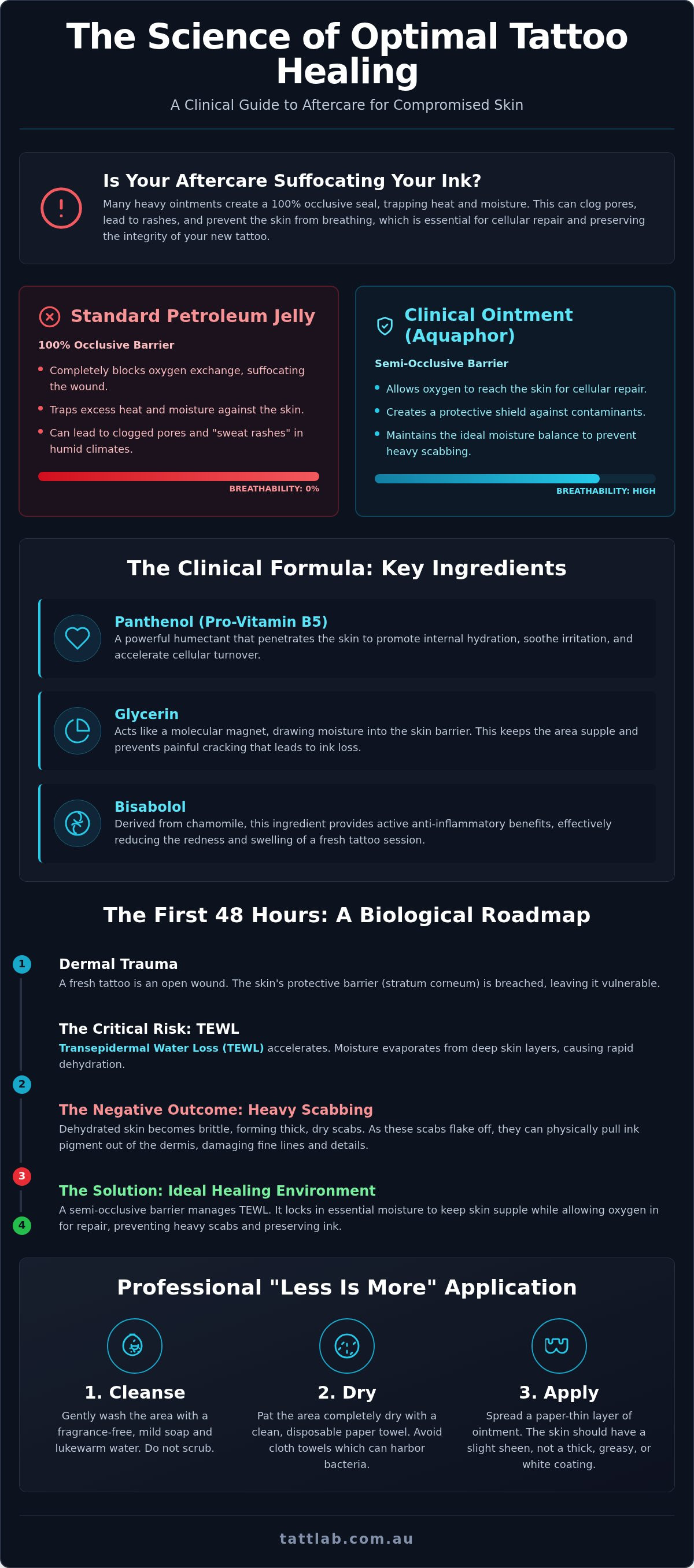
The primary distinction lies in the formulation's ability to facilitate gas exchange. While pure petroleum jelly is 100% occlusive and can effectively "suffocate" a wound by trapping heat and moisture, Aquaphor is semi-occlusive. This means it allows oxygen to reach the skin, which is vital for cellular repair, while still providing a water-resistant barrier against external contaminants. Its composition includes several key components:
- Panthenol (Pro-Vitamin B5): A powerful humectant that penetrates the skin to promote internal hydration and soothe irritation.
- Bisabolol: Derived from chamomile, this ingredient provides active anti-inflammatory benefits to reduce the redness and swelling typical of a fresh session.
- Glycerin: This draws moisture into the skin barrier, ensuring the area remains supple and preventing the painful cracking that leads to ink loss.
Why Australian Artists are Shifting Toward Clinical Ointments
Australian artists are increasingly moving away from heavy, fully occlusive dressings. The local climate plays a significant role in this shift. In our often hot and humid environment, thick creams can trap excessive body heat against the skin, leading to "sweat rashes" or clogged pores around the tattoo site. Clinical ointments provide a more predictable, breathable outcome that works with the skin's natural cooling mechanisms.
This movement toward professional-grade aftercare mirrors the evolution of the industry itself. Modern studios operate with the precision of medical facilities, using specialized tools like long taper needles and high-pigment inks. It's only logical that the recovery phase follows the same rigorous standards. By choosing a vetted solution, you're ensuring that the physical integrity of your skin is maintained throughout the entire healing narrative.
The Biological Mechanism: How Aquaphor Facilitates Skin Regeneration
Within the first 48 hours of receiving a tattoo, your skin enters a state of acute dermal trauma. Every pass of the needle is a calculated disruption of the physical barrier, leaving the dermis exposed and vulnerable. During this window, the body initiates an inflammatory cascade to seal the site. In the context of aquaphor australia, the clinical value lies in how it manages Transepidermal Water Loss (TEWL). When the stratum corneum is breached, moisture evaporates from the deeper layers at an accelerated rate. If this dehydration occurs too quickly, the skin becomes brittle, leading to heavy scabbing that can compromise the placement of the ink.
Aquaphor utilizes Glycerin as a high-performance humectant to counteract this evaporation. Glycerin acts like a molecular magnet, pulling moisture from the environment and the deeper dermis into the healing site. This is paired with Panthenol (Provitamin B5), which serves as a catalyst for cellular turnover. By accelerating the rate at which new skin cells reach the surface, Panthenol shortens the duration of the "open wound" phase. Following professional tattoo aftercare instructions ensures these biological processes happen in a stable, protected environment rather than a chaotic one.
Creating the 'Ideal Healing Environment'
The goal of tattoo recovery isn't just to heal, but to heal with precision. A dry, thick scab is the primary enemy of fine-line and high-detail work because it acts as a physical anchor that can pull pigment out of the skin as it sheds. By maintaining a consistent moisture profile, you ensure the skin remains supple, allowing the wound to close without forming a heavy crust. Semi-occlusion is a state of controlled permeability where a barrier protects against pathogens while allowing the exchange of water vapor and oxygen necessary for cellular repair. This balance is critical for preserving the crispness of your tattoo's edges.
Ingredient Deep Dive: The Tatt Lab Clinical Perspective
We look at ingredients through the lens of physical integrity. Aquaphor includes Lanolin Alcohol, a specialized emulsifier that mimics the skin's natural lipids to soften the tissue. While highly effective for most, it's a point of consideration for those with known wool sensitivities. This is balanced by the inclusion of Bisabolol, a concentrated derivative of chamomile. Bisabolol provides a necessary anti-inflammatory effect that specifically targets the "tattoo itch" phase, reducing the urge to scratch and potentially damage the healing ink. When you choose vetted tattoo aftercare, you are supporting your body’s natural healing narrative with scientific rigor.
Aquaphor vs. Bepanthen and Local Australian Aftercare Solutions
Choosing the right recovery medium often feels like a choice between tradition and clinical evolution. For decades, the Australian market relied heavily on Bepanthen, a nappy rash cream found in every local chemist. However, as tattoo techniques have advanced toward hyper-realism and delicate fine-line work, the demand for aquaphor australia has grown. The primary difference lies in the formulation's interaction with the skin's surface. While many local staples are designed to create a thick, moisture-proof barrier for infant skin, a healing tattoo requires a more nuanced approach that balances protection with oxygen exchange.
The "grease factor" is a common concern for many collectors. Over-application of heavy, fully occlusive products can lead to localized folliculitis, commonly known as "tattoo pimples." These small white bumps occur when the hair follicles become blocked by excess ointment, trapping sweat and bacteria. Aquaphor's semi-occlusive nature reduces this risk by allowing the skin to breathe more effectively than traditional paraffin-heavy creams. From an economic perspective, while a tube of specialized ointment may seem like a higher initial investment, the cost-per-use is often lower. Because the formula is highly concentrated, a single 50g tube can support the entire healing cycle of a large-scale piece, whereas thinner creams often require more frequent reapplication.
Bepanthen: The Antiseptic Approach vs. The Occlusive Approach
Bepanthen remains a staple, but it's important to recognize that its formulation has shifted over the years. Some versions contain antiseptic properties that, while helpful for minor abrasions, can be too aggressive for a fresh tattoo. Over-applying heavy antiseptic creams creates a risk of "leaching," where the cream draws excess moisture and potentially pigment out of the dermis before it has a chance to settle. Choosing a dedicated tattoo aftercare solution over a generic nappy rash cream ensures the ingredients are optimized for pigment retention and skin suppleness rather than just infection prevention.
Natural Balms vs. Synthetic Ointments
The Australian market has seen a significant rise in vegan, essential-oil-based balms like Dr. Pickles. These products appeal to those seeking botanical ingredients, but they can sometimes be reactive for individuals with sensitive skin or allergies to specific plant extracts. Clinical ointments like Aquaphor provide a more neutral, predictable environment for recovery. As the American Academy of Dermatology on wound care notes, petrolatum-based products are highly effective at preventing scabbing by keeping the wound moist. This is a critical factor for ensuring the long-term clarity of the ink.
- Aquaphor: Synthetic base, semi-occlusive, high breathability, hypoallergenic.
- Natural Balms: Botanical base, variable occlusion, moderate breathability, potential for plant-based sensitivity.
- Bepanthen: Lanolin/Paraffin base, high occlusion, low breathability, contains antiseptic agents.
Professional Application: The Artist’s Protocol for Healing with Aquaphor
The moment you leave the studio, the responsibility for maintaining the physical integrity of your new art shifts from the artist to you. While many general retail descriptions suggest applying aquaphor australia "as needed," professional standards require a much more disciplined approach. The "less is more" rule is the foundation of a successful recovery. A thin, transparent layer is all that's required to facilitate the semi-occlusive barrier your skin needs. Applying too much doesn't speed up the process; instead, it creates a stagnant environment where bacteria can thrive and heat becomes trapped against the dermis.
Maintaining a sterile environment at home is just as critical as the sanitization protocols followed during your session. Using professional medical supplies, such as sterile applicators or even just ensuring your hands are thoroughly scrubbed with antimicrobial soap, prevents the introduction of pathogens into the open wound. This methodical approach ensures that your body's natural healing narrative remains uninterrupted by preventable complications.
Step-by-Step: The First 72 Hours
- Step 1: Gentle Cleansing. After removing the initial studio wrap, wash the area with lukewarm water and a fragrance-free, pH-balanced soap. Use your fingertips in a circular motion to remove any excess plasma or ink.
- Step 2: Controlled Drying. Air-drying for 10 to 15 minutes is the gold standard to avoid friction. If you're pressed for time, pat the area very gently with a single-use, sterile paper towel. Never use a bathroom towel, which can harbor bacteria and shed fibers into the wound.
- Step 3: The 'Rice Grain' Method. For a medium-sized tattoo, use an amount of ointment no larger than a grain of rice. Warm it between clean fingertips and dab it across the tattoo before gently spreading. The skin should look slightly hydrated, not wet or glossy.
Common Mistakes to Avoid with Aquaphor
The most frequent error is "smothering" the skin. When a thick layer of ointment is applied, it can lead to miliaria, or heat rash, which appears as small, itchy red bumps. This over-saturation can also cause the skin to soften excessively, potentially leading to ink loss as the scabs become too heavy. Another critical mistake is cross-contamination. You should never double-dip your fingers into a tub of ointment. If you aren't using a tube, use a clean, disposable spatula to remove the product you need for each application.
Around day four or five, you'll notice the tattoo entering the peeling stage. As the initial dermal trauma subsides, the skin's requirements shift. This is the signal to transition from the heavy protection of an ointment to a lighter, fragrance-free lotion. This progression ensures the emerging skin remains supple without the intensive occlusion required during the first 72 hours. Explore our range of vetted tattoo aftercare solutions to support every phase of your skin's recovery.
Sourcing Professional Grade Aftercare and Supplies in Australia
Sourcing authentic aquaphor australia involves more than a simple search for the lowest price point. When you're managing an open wound, the physical integrity of the product is just as important as the technique used to apply it. While finding aquaphor australia through general marketplaces is possible, these platforms often lack the rigorous quality control found in a specialized facility. Dedicated tattoo supply houses ensure that every batch is authentic, stored at the correct temperature, and within its clinical shelf life. This level of meticulousness is what separates a predictable recovery from one marred by unexpected reactions.
At Tatt Lab, our commitment to safety is rooted in our identity as an artist-owned specialist. We don't just move inventory; we curate a selection of supplies that we trust on our own skin and in our own studios. Beyond the ointment itself, a complete aftercare kit should include clinical-grade soaps and sterile wipes to maintain the sterile environment required for recovery. By centralizing your supplies through a trusted specialist, you ensure that every component of your healing kit meets a professional standard of excellence.
The Tatt Lab Advantage for Australian Studios
We understand that in the world of tattooing, timing is everything. Whether you're a studio owner stocking up on cartridges or a collector preparing for a multi-day session, our national express shipping ensures you have your essentials exactly when the healing narrative begins. Our expertise extends beyond aftercare into the very tools of the trade. We support the Australian industry with a deep understanding of the chemistry behind high-performance tattoo ink and the mechanical precision of modern needles. This holistic approach ensures that every variable, from the first pass of the liner to the final day of peeling, is optimized for success. In other sectors of professional maintenance, such as estate management, Taiamai Group provides a similar level of dedicated care for large-scale grounds and acreage upkeep.
This commitment to professional excellence is also reflected in specialized beauty education, where nail technician courses Cape Town provide students with the technical skills needed for high-quality nail artistry.
Final Verdict: Is Aquaphor Right for Your Next Tattoo?
Aquaphor remains a global benchmark for a reason. Its ability to manage moisture levels while allowing the skin to breathe makes it particularly effective for high-detail fine-line work and vibrant color saturation. If you have sensitive skin or are prone to heavy scabbing, this semi-occlusive barrier provides the most predictable path to a clear, well-settled result. While natural balms have their place, the clinical reliability of this ointment is hard to match for the critical first 72 hours of recovery. We invite you to prioritize your skin's long-term health and the aesthetic clarity of your art. Explore the Tatt Lab aftercare collection to find the professional tools your skin deserves.
Invest in Your Skin's Healing Narrative
Successful tattoo recovery is a narrative of patience and scientific precision. By understanding the semi-occlusive benefits of aquaphor australia, you've moved beyond the guesswork of supermarket alternatives and toward a clinically supported healing environment. You now have the professional protocol to manage the critical first 72 hours of dermal trauma, ensuring that your skin's physical integrity remains intact while the pigment settles. This methodical approach replaces the anxiety of the unknown with a sense of controlled, predictable progress.
Healing is a long-term commitment to skin health that extends far beyond the initial session. Tatt Lab is here as your dedicated partner in this progression. As an artist-owned and operated specialist, we provide a curated selection of medical-grade tattoo supplies that prioritize safety above all else. With our nationwide express shipping across Australia, you can access professional-grade aftercare exactly when your recovery demands it. We focus on the science of healing so you can focus on the transformation your art represents.
Shop Professional Tattoo Aftercare and Medical Supplies at Tatt Lab to ensure your next session heals with the clarity and vibrancy it deserves. We're proud to support your journey toward lasting self-assurance through meticulous care and specialist expertise.
Frequently Asked Questions
Is Aquaphor available in Australia at local chemists?
Aquaphor is generally not stocked in physical retail pharmacies or supermarkets across Australia. While it is a household staple in North America, collectors looking for aquaphor australia typically need to source it through specialized tattoo supply houses or online clinical retailers. Purchasing from a dedicated provider ensures you receive an authentic, professional-grade formulation rather than a generic or expired substitute.
How many times a day should I apply Aquaphor to a new tattoo?
The standard professional protocol is to apply a very thin layer two to three times per day. You should only apply the ointment after the skin has been gently cleansed and completely air-dried. If the tattoo feels tight or looks excessively dry between these windows, you may add a fractional amount, but the goal is to maintain a supple texture without creating a visible, greasy film.
Can Aquaphor cause my tattoo to fade or lose ink?
Aquaphor will not cause fading when used according to the "less is more" rule. In fact, it protects the physical integrity of the ink by preventing the formation of thick, heavy scabs that can pull pigment from the dermis. Ink loss usually occurs only if the product is applied so heavily that it "suffocates" the skin or if the collector picks at the softening tissue during the peeling phase.
Is Aquaphor better than Bepanthen for large-scale tattoo work?
Many artists prefer Aquaphor for large-scale pieces because its semi-occlusive nature allows for better gas exchange over extensive surface areas. Bepanthen is a traditional choice, but its high paraffin content can feel quite heavy and greasy on large limbs, which sometimes leads to blocked pores. The breathable barrier of aquaphor australia provides a more predictable recovery for complex backpieces or full sleeves.
What should I do if I notice small bumps or a rash after using Aquaphor?
If you notice small red bumps or a localized rash, you should stop using the ointment immediately and cleanse the area with a mild, fragrance-free soap. This reaction is often miliaria, a heat rash caused by applying the product too thickly and trapping sweat. In rare cases, it may be a sensitivity to lanolin alcohol. Once the irritation subsides, consult your artist about transitioning to a lighter, non-occlusive lotion.
Can I use Aquaphor on an old tattoo to make it look brighter?
Applying the ointment to an existing tattoo provides an immediate boost in saturation by hydrating the top layer of the skin, which makes the underlying ink appear more vivid. However, this effect is temporary and purely aesthetic. To maintain the long-term clarity of an old tattoo, focus on consistent daily moisturizing and high-SPF sun protection rather than relying on heavy ointments.
Is there a vegan alternative to Aquaphor available in Australia?
Yes, there are several vegan-friendly balms available in the Australian market, such as those formulated with shea butter or synthetic lipids. Aquaphor contains lanolin alcohol, which is derived from sheep's wool, meaning it doesn't meet strict vegan criteria. If you require a vegan solution, look for botanical balms specifically designed for tattoo recovery that offer similar semi-occlusive properties without animal-derived emulsifiers.
How long should I wait after getting tattooed before applying Aquaphor?
You should wait until you have removed the initial studio wrap and performed the first gentle wash, which typically occurs between two and twenty-four hours after your session. Never apply ointment over a "weeping" tattoo that hasn't been cleaned of excess plasma and ink. Once the skin is clean and dry, you can begin the application protocol to support the first stage of dermal regeneration.


Comments (0)
There are no comments for this article. Be the first one to leave a message!