

Why do some hand-poked tattoos age into blurry, faded shadows while others maintain the crisp integrity of a gallery-grade print? You likely understand that the difference isn't just in the artist's hand, but in the physics of the tools they select. Choosing the right needle for stick and poke is a decision that dictates both the aesthetic outcome and the health of the skin. It's frustrating to watch your hard work result in inconsistent line quality or ink that simply won't stay saturated. With approximately 22% of tattoos resulting in some form of complication, the margin for error is smaller than most realize. Safety isn't just a checkbox; it's the foundation of your creative progress.
Mastering these technical nuances is the most direct path to ensuring safety, precision, and professional-grade results. This guide helps you move beyond the confusion of codes like 1207RL and understand the biological interaction between steel and skin. We'll demystify how specific configurations, such as round liners and magnums, influence ink retention and faster healing. You'll gain the clinical confidence to select tools that minimize trauma while delivering the saturated, intentional lines that define modern craftsmanship.
Key Takeaways
- Understand why sterile, professional-grade needles are the only safe option to prevent micro-tearing and ensure long-term ink retention.
- Decode technical needle configurations like 1207RL to gain precise control over line weight, diameter, and taper depth.
- Master the selection framework for choosing the right needle for stick and poke by matching round liners and shaders to your specific design requirements.
- Establish a clinical-grade sterile environment using essential PPE and medical barriers to safeguard against cross-contamination.
- Learn how artist-vetted supplies bridge the gap between amateur attempts and sophisticated, professional-grade hand-poked results.
Why Professional Needles are Non-Negotiable for Stick and Poke
The foundation of a safe, aesthetic tattoo begins with the biological compatibility of your tools. A professional tattoo needle isn't just a piece of sharp metal; it's a precision instrument engineered for the specific task of depositing ink into the dermal layer while minimizing tissue damage. When you're choosing the right needle for stick and poke, you're selecting the primary interface between your artistic vision and the body's physical integrity. Professional tools are designed to work with the skin's natural elasticity rather than fighting against it.
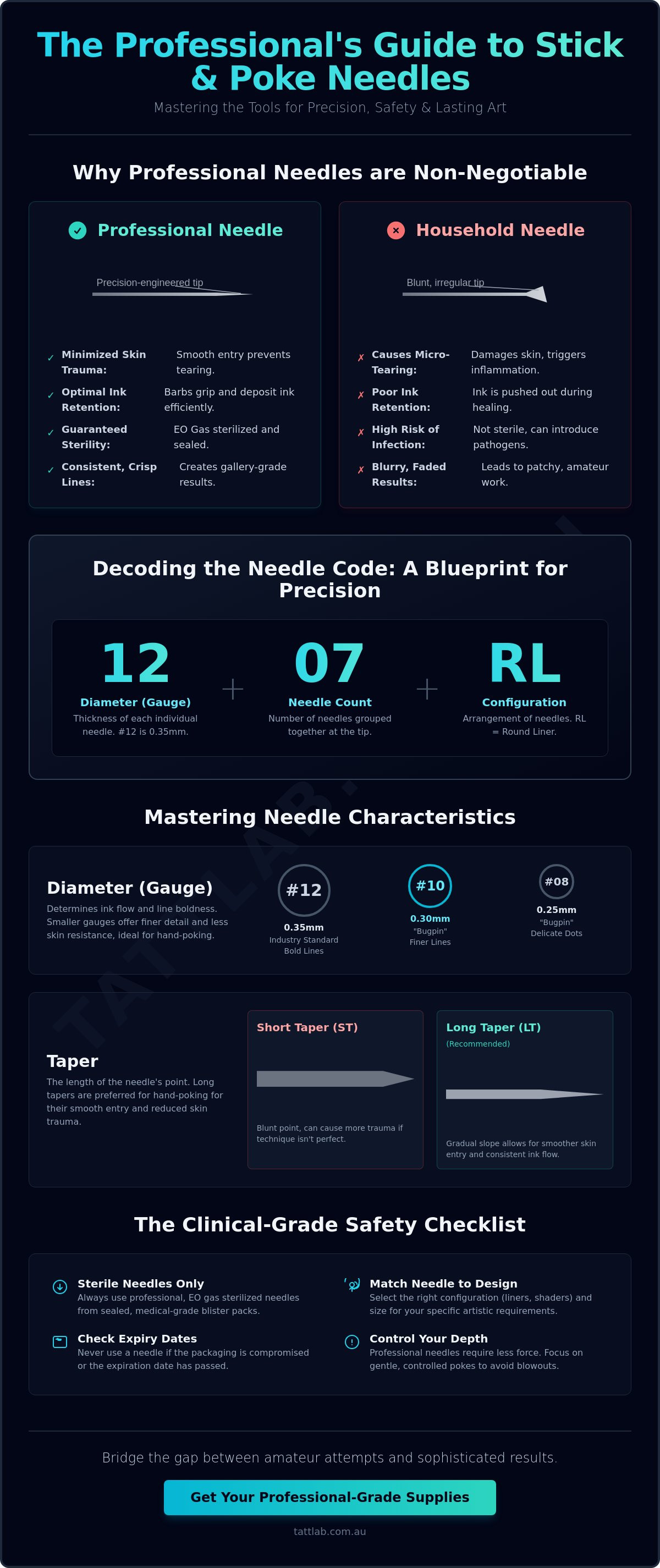
Many beginners fall for the "sewing needle" myth, assuming any sharp object can deliver a permanent mark. This is a dangerous misconception. Household needles are designed to slide through fabric, not human skin. Microscopically, they're blunt and irregular compared to professional-grade steel. Using them causes excessive trauma and micro-tearing, which triggers a significant inflammatory response. This trauma doesn't just hurt; it pushes ink back out during the healing process, leading to the patchy, faded results common in amateur work. Professional needle barbs are engineered to "grip" ink and carry it into the dermis efficiently, ensuring every puncture is productive.
The Stick and poke tattooing method relies on clinical integrity to achieve lasting results. At Tatt Lab, we provide needles sterilized with Ethylene Oxide (EO) gas, a medical-grade process that eliminates pathogens that simple surface cleaning cannot reach. This commitment to safety protects against cross-contamination and ensures that your creative process begins in a controlled, sterile environment. Professionalism isn't just about the visual outcome; it's about respecting the biological reality of the procedure.
Anatomy of a Professional Needle
A professional tool consists of a rigid needle bar with a specific grouping of needles soldered at the tip. These needles are crafted from high-quality stainless steel, the gold standard for skin-contact tools due to its hypoallergenic properties and structural stability. Each unit is individually sealed in medical-grade blister packaging. It's essential to check the expiry date and the sterilization indicator on every pack. If the seal is compromised, the tool is no longer suitable for use. This meticulous packaging is what separates professional supplies from bulk, unverified hardware.
Manual vs. Machine Mechanics
Hand-poking operates on a different mechanical logic than machine-driven work. Without the high-frequency oscillation of a motor, you lack the consistent "stop" that a machine provides. This means your hand is solely responsible for controlling depth and pressure. Because you're working at a slower pace, the sharpness and taper of your needle become even more critical. A dull needle requires more force to penetrate, increasing the risk of "blowouts" where ink is deposited too deeply. By selecting professional Traditional Needles, you ensure the point enters the skin with minimal resistance, allowing for the gentle, controlled progression required for a clean, sophisticated result.
Decoding Needle Codes: Configuration, Diameter, and Taper
Understanding the alphanumeric sequences on medical packaging is essential for precision. A code like "1207RL" isn't a random serial number. It's a blueprint for the needle's physical characteristics. The first two digits (12) represent the diameter or gauge. The next two (07) indicate the number of individual needles soldered together in a cluster. The letters at the end (RL) define the configuration, which in this case refers to a Round Liner. Mastery of these codes allows you to predict exactly how the skin will respond to every puncture.
Choosing the right needle for stick and poke requires you to look beyond the grouping size. While the needle count determines the width of your line, the diameter and taper dictate how that line heals and how much trauma the skin sustains. Using professional tools ensures you're working within established safety parameters, much like following FDA tattoo ink safety regulations ensures the substances you use are appropriate for the body. This technical knowledge transforms a simple procedure into a controlled, scientific method.
The Role of Needle Diameter
Diameter, often called gauge, refers to the thickness of each individual needle in the grouping. #12 (0.35mm) is the industry standard. It provides a robust puncture that holds ink well, making it ideal for bold, traditional-style work. If you're looking for something more delicate, "Bugpins" like #10 (0.30mm) or #08 (0.25mm) offer a smaller surface area. These create finer dots and offer less resistance when entering the skin. This reduced resistance is a significant benefit for hand-poking, as it allows you to maintain consistent depth with less physical effort and fatigue.
Understanding Taper and Point Length
The taper is the length of the point at the end of the needle. A Short Taper (ST) has a blunt, aggressive point that enters the skin quickly but can cause more trauma if your technique isn't perfect. Most hand-poke specialists prefer a Long Taper (LT). The gradual slope of a long taper allows for a smoother entry into the dermis. This precision is vital because it provides more consistent ink flow and reduces the risk of "blowouts" caused by excessive force. It's a subtle adjustment that makes a profound difference in the patient's healing experience.
These technical specifications directly influence the final aesthetic. A #12 07RL will produce a saturated, heavy line that ages with a classic look. Conversely, a #10 03RL results in a whisper-thin trail of dots perfect for minimalist designs. By mastering these codes, you replace guesswork with clinical accuracy, ensuring your tattoos heal with the same clarity you intended during the session. It's about moving from a "DIY" mindset to a professional standard of care.
The Selection Framework: Matching Needles to Your Design
Selection is the bridge between technical knowledge and artistic execution. While your understanding of diameter and taper provides the "how," your configuration choice dictates the "how much." Every design requires a specific needle grouping to maintain structural integrity over time. For instance, a delicate script piece demands a different mechanical approach than a heavy, geometric block of color. When choosing the right needle for stick and poke, you must align the tool's mechanical properties with your desired visual outcome to avoid wasted ink and poor retention.
Round Liners (RL) are the essential starting point for almost every practitioner. These needles are soldered in a tight, circular grouping to focus the ink into a single, cohesive point. This concentration is why they're the primary tool for defining shapes. In contrast, Round Shaders (RS) feature a looser arrangement. This extra space between the individual needles allows for a softer, more dispersed ink delivery, making them ideal for filling small areas without the harshness of a liner. For specialized geometric precision, Flat (F) needles are arranged in a straight line, allowing you to create sharp, clean edges that are difficult to execute with circular clusters.
Choosing for Fine Detail and Outlining
The 3RL has become the most popular choice for delicate, minimalist designs. Its tiny footprint allows for incredible precision, but it carries a higher risk for beginners. Because the surface area is so small, it's easy to exert too much pressure and cause a blowout, where ink spreads into the subcutaneous layer. If you're aiming for a "bold-will-hold" traditional aesthetic, stepping up to a 7RL or 9RL provides a more forgiving experience. These larger groupings create a thicker line that remains saturated and legible for decades. They offer a physical "stop" that helps you gauge depth more intuitively than ultra-fine needles.
Techniques for Shading and Filling
When moving beyond simple lines, shading requires a shift in needle physics. Choosing the right needle for stick and poke shading often involves Round Shaders to create a classic "stipple" effect. This technique uses the needle's grouping to create a gradient of dots, mimicking the look of a vintage lithograph. For larger projects, some advanced artists utilize Traditional Needles in Magnum (M1 or RM) configurations. These feature two rows of needles that cover more surface area in a single pass. While using Magnums for hand-poking requires more physical effort to ensure each needle penetrates the skin, the result is a smooth, professional-grade transition that's difficult to achieve with liners alone. This methodical approach ensures faster healing by reducing the total number of punctures needed for full saturation.
Clinical Standards: Safe Handling and Sterile Setup
The technical process of choosing the right needle for stick and poke is only the first phase of a successful procedure. Once you've selected your tools, the focus shifts to the clinical environment where they'll be applied. Safety isn't an afterthought; it's the framework that allows your artistic precision to thrive. A professional approach treats every session as a minor medical intervention, prioritizing the biological integrity of the skin to ensure predictable, healthy results. This methodical focus replaces the anxiety of the unknown with a sense of controlled, professional progress.
Establishing a sterile field is the primary defense against cross-contamination. This involves more than just a clean table; it requires the use of dental bibs to create a moisture-proof barrier and medical-grade sanitizers to decontaminate all contact surfaces. Personal Protective Equipment (PPE) is equally essential. Nitrile gloves are the industry standard for a reason. They provide a superior chemical barrier and puncture resistance compared to latex, ensuring your hands remain a sterile interface throughout the session. If your gloves touch any non-sterile surface, they must be replaced immediately to maintain the integrity of the work zone.
Safe handling extends to the moment the session ends. Needle-stick injuries are a significant risk that can be mitigated through clinical discipline. The "One-Handed" rule is a standard safety protocol where you never use a second hand to recap or manipulate a used needle. In Australia, the legal requirement for disposal is a dedicated, yellow sharps container. These puncture-resistant vessels are the only safe way to manage biohazardous waste. Proper disposal ensures that the journey of personal transformation remains safe for both the artist and the community.
Setting Up Your Workstation
A professional workstation follows a logical, step-by-step preparation. Begin by disinfecting the entire area with a hospital-grade solution before laying down your barrier film and dental bibs. This creates a dedicated "clean zone" for your needles and pigments. For a comprehensive breakdown of these protocols, you can consult our specialized guide on Medical Supplies for Tattoo Artists. Finally, prepare the skin with professional-grade cleansers. This step removes surface bacteria and natural oils, ensuring the stencil adheres perfectly and the skin is ready for the first puncture.
Needle Hygiene During the Session
Maintaining tool integrity requires constant vigilance while you work. When dipping your needle into the ink cap, be careful not to strike the bottom of the plastic, as this can blunt the delicate taper you've selected. Use sterile gauze and gentle wiping techniques to clear excess ink; aggressive wiping can irritate the skin and lift your stencil prematurely. Most importantly, never "double-dip" into a primary ink bottle. Any ink used must be dispensed into single-use caps to prevent contaminating your entire supply. To maintain these high standards in your own space, you can find a curated selection of professional tattoo supplies at Tatt Lab, where we prioritize medical-grade safety for every artist.
Elevating Your Craft with Tatt Lab Professional Supplies
Precision is a journey of refinement. Once you've mastered the logic of choosing the right needle for stick and poke, the final variable in your success is the consistency of your equipment. Inconsistent manufacturing can lead to microscopic burrs on needle tips, causing unnecessary trauma and uneven saturation. This is why Australian artists trust Tatt Lab for their Traditional Needles. We operate not just as a supplier, but as a dedicated partner in your creative progression, ensuring every tool meets the rigorous standards of a professional studio environment.
The benefit of artist-vetted supplies lies in our transparency. We don't believe in the high-pressure sales tactics of conventional industry marketing; instead, we offer a curated selection of tools that we use ourselves. This results-oriented approach builds immediate trust, allowing you to focus on the liberating narrative of your work rather than questioning the integrity of your materials. Whether you're a beginner establishing your first sterile field or a professional seeking predictable results, our resources are designed to demystify the science behind the craft without oversimplifying the expertise required.
The Tatt Lab Quality Guarantee
Every batch of needles undergoes rigorous quality control to ensure consistent sharpness and structural stability. This meticulousness extends to our commitment to providing medical-grade PPE alongside essential consumables. We understand that professional gear is the primary driver of client satisfaction and superior healed outcomes. By maintaining physical integrity through high-quality steel and sterile packaging, you reduce the risk of complications and ensure your art stands the test of time. It's a methodical approach that mirrors the precision of the work itself, replacing uncertainty with a sense of controlled progress.
Next Steps for the Aspiring Artist
Your evolution as an artist depends on experimentation within safe, established parameters. Explore our specialized range of Round Liners for crisp definition or Round Shaders for soft, stippled textures. To further refine your knowledge, read our Guide to Tattoo Ink to pair your needle selection with the most stable pigments. We support your progress with nationwide express shipping, delivering professional-grade gear to your studio anywhere in Australia.
Our delivery rhythm is designed to be as reliable as our products, reflecting the patience and commitment to long-term results that define our brand. Join the Tatt Lab community to access ongoing industry insights and professional support as you transform your craft into a sophisticated, modern practice. We view the body not just as a canvas, but as a vessel for holistic wellness, where every intentional mark contributes to a liberating narrative of self-assurance and personal transformation.
Mastering the Science of Hand-Poked Precision
Transitioning from amateur curiosity to professional craftsmanship requires a commitment to technical rigor and biological safety. You now understand that the architecture of your tools, from the taper length to the specific configuration of a round liner, directly dictates the longevity and clarity of your art. By prioritizing medical-grade safety standards and sterile protocols, you protect both your creative vision and the physical integrity of the skin. Mastering the nuances of choosing the right needle for stick and poke is the definitive step toward achieving the crisp, saturated results that define modern hand-poked tattoos.
As an artist-owned and operated facility, Tatt Lab is dedicated to supporting your progression with professional-grade equipment that we trust in our own studios. We simplify the path to excellence. By offering artist-vetted supplies and express nationwide shipping across Australia, we ensure you have the tools needed for predictable, high-end outcomes. Shop Professional Traditional Needles at Tatt Lab and begin your next project with clinical confidence. We're here to partner with you from the first puncture to the final healed result.
Frequently Asked Questions
Can I use a regular sewing needle for a stick and poke tattoo?
No, you should never use a sewing needle for tattooing. These household items are not designed for dermal penetration; they are blunt and irregular at a microscopic level. Using them results in micro-tearing and poor ink saturation, which leads to patchy healing. Additionally, sewing needles cannot be properly sterilized at home, increasing the risk of infection significantly.
What is the best needle size for a first-time stick and poke?
A 7RL or 9RL is generally the most effective starting point for beginners. While smaller needles like a 3RL are popular for fine details, they are more likely to cause blowouts if your depth control isn't perfect. Larger groupings offer a physical stop against the skin, making the process of choosing the right needle for stick and poke easier for those still developing their technique.
How many times can I reuse a professional tattoo needle?
Professional tattoo needles are strictly single-use and must never be reused. Even if you are tattooing yourself, the needle tip becomes dull and microscopic hooks form after just one session. Reusing a needle introduces a high risk of cross-contamination and causes unnecessary skin trauma. Always dispose of your tools in a sharps container immediately after the session concludes.
What is the difference between a Round Liner and a Round Shader for hand-poking?
The primary difference lies in the spacing of the needle points. Round Liners are soldered in a tight cluster to create a solid, focused point for defining sharp outlines. Round Shaders have a looser arrangement, allowing ink to disperse more softly. This makes shaders ideal for stippled shading or filling in small geometric shapes without the harshness of a liner.
How do I know if a tattoo needle is sterile?
You can verify sterility by inspecting the individual blister packaging. Professional needles are sterilized using Ethylene Oxide (EO) gas; look for a color-changing indicator on the back of the pack that confirms the process is complete. Always check the expiry date before opening the seal. If the packaging is torn, damp, or compromised in any way, the needle is no longer sterile.
Where can I safely dispose of used tattoo needles in Australia?
In Australia, used needles must be placed in a yellow, puncture-resistant sharps container. You can typically dispose of these containers at local pharmacies, community health centers, or designated public hospital disposal points. Never place used needles in your regular household recycling or waste bins, as this poses a significant risk to waste management workers.
Does the length of the needle taper matter for hand-poking?
Taper length is a critical factor in how the needle interacts with the skin. A long taper is preferred for hand-poking because it provides a more gradual entry into the dermis. This reduced resistance allows for greater precision and less physical fatigue during a session. It also minimizes the trauma footprint, which encourages faster healing and better ink retention.
Can I use tattoo cartridges for stick and poke without a machine?
You can use tattoo cartridges for hand-poking, provided you use a compatible hand-poke tool or grip designed for that purpose. Cartridges are convenient because they protect the needle tip when not in use and allow for quick configuration changes. However, when choosing the right needle for stick and poke, many traditionalists still prefer the direct tactile feedback and control offered by a standard needle on a bar.


Comments (0)
There are no comments for this article. Be the first one to leave a message!