

The lowest sticker price isn’t always the best value: for discount tattoo supplies in Australia, compare like-for-like products and confirm stock before choosing. Needles, cartridges and inks serve different purposes, so a lower price alone doesn’t show whether an item suits your studio’s needs.
It’s sensible to watch costs while keeping your setup consistent and ready for work. This guide explains how to compare prices and availability across needles, cartridges, grips, tubes, tips, disposables and other studio supplies, and what to consider when assessing value. You’ll also see how to weigh product type, pack details and stock status so you can make a measured purchasing decision without relying on the sticker price alone.
Key Takeaways
- Compare needle and cartridge options by type and intended use, rather than treating different configurations as interchangeable.
- Assess listed prices alongside stock status and pack details to make a more useful comparison for your studio.
- Match grips, tubes and tips to your setup before buying, so each component works within your chosen configuration.
- Plan disposables and other studio supplies around your regular workflow, and explore Tatt Lab’s needles, inks and aftercare when sourcing those essentials.
Needles and cartridges
Match needles and cartridges to your technique and preferred configuration. Requirements for tattoo inks and equipment can vary by product and jurisdiction in Australia, so follow the applicable local requirements and the product’s instructions.
Needle and Cartridge Brands
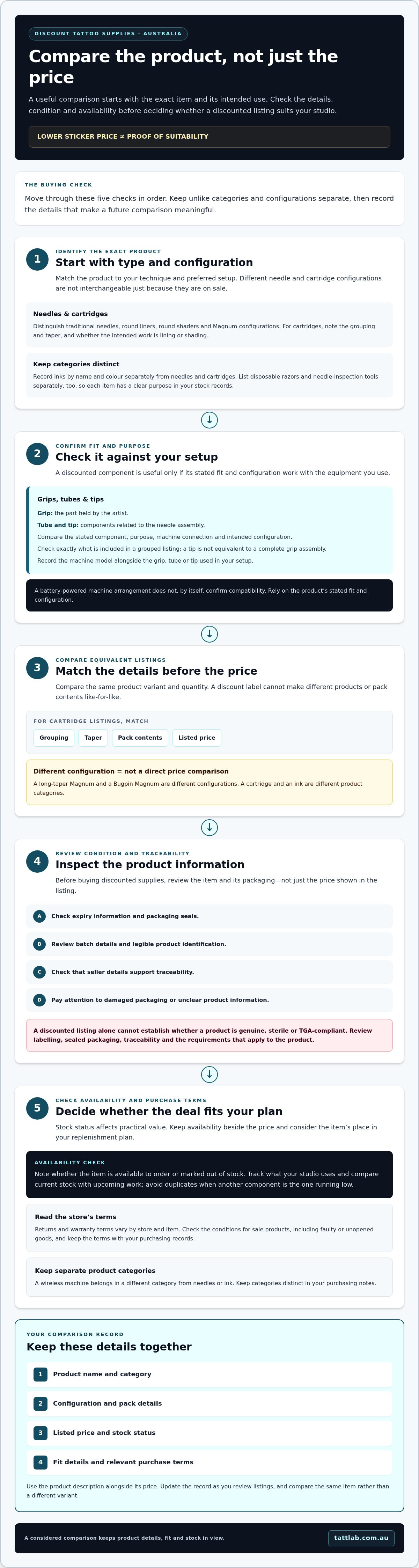
Compare products by their stated details, not brand name alone. Traditional needles, round liners, round shaders and Magnum configurations suit different setups. For cartridges, check grouping and taper, then match them to your lining or shading work. Keeping clear product records makes it easier to reorder the same configuration and maintain a consistent workflow.
Cartridge Needle Sale Prices
Sale prices depend on the specific cartridge and pack. Compare like for like by matching the grouping, taper and pack contents. A long-taper Magnum and a Bugpin Magnum are different configurations, so their listed prices aren’t directly comparable. Record the product description alongside its price to make future comparisons useful.
Tattoo inks are a separate purchase from needles and cartridges. Keep ink names and colours in their own stock records, rather than grouping them under needle supplies. That separation helps artists reorder the correct product and maintain an organised studio inventory.
Before buying discounted supplies, review expiry information, packaging seals and batch details. Check that product identification is legible and the seller’s details support traceability. Damaged packaging or unclear product information deserves attention, whatever the price.
Disposable razors and needle-inspection tools also belong in your purchasing review. Examine razor packaging and product identification, and use an inspection magnifier to assess needle condition. List these tools separately from needles and cartridges so each item has a clear purpose in your stock records.
Product prices and stock availability
Compare listings by product identity, pack contents and stock status, not discount labels alone. A sale price only helps if the item matches your studio’s requirements. For discount tattoo supplies in Australia, start by comparing equivalent items rather than different categories.
A discounted listing alone can’t establish whether a product is genuine, sterile or TGA-compliant. Review the labelling, sealed packaging and traceability, alongside the requirements that apply to the product. A low price doesn’t replace careful attention to the item and its packaging.
Returns and warranty terms vary by store and item. Before ordering, read the terms for sale products, including the conditions for faulty or unopened goods. Keep those terms with the product details in your purchasing records.
For special offers, compare the same variants and quantities. A cartridge and an ink aren’t directly comparable, even if both are discounted. Check the product name, configuration and pack contents, then compare prices for the same item. Record the listed price and stock status together, so a lower figure doesn’t distract from a different specification.
Stock status also affects a deal’s practical value. Note whether an item is available to order or marked out of stock, and consider how it fits your replenishment plan. A wireless machine, for example, belongs in a different category from needles or ink. Keep those categories distinct in your purchasing notes.
Review new products as carefully as sale stock. Compare their stated specifications with the products already in your workflow, and note any differences in configuration or intended use. A review saying “highly recommend” or “amazing” is an opinion, not evidence of compatibility or current stock. Base your decision on listing details and studio needs.
For a practical comparison of discount tattoo supplies in Australia, record each product name, pack details, listed price and availability. Update the record as you review listings, and compare the same item rather than a different variant. This makes changes easier to identify without assuming a promotion will remain active.
Browse current sale listings as one way to compare discounted stock, then assess each item against your buying criteria.
Grips, tubes and tips
Match each grip, tube and tip to the machine and setup you already use. A component that doesn’t fit your machine won’t become useful just because it’s discounted. Before ordering, compare the product description with your equipment, including connection type and intended configuration. Record those details to keep future orders consistent.
Keep the three categories distinct when comparing listings. A grip is held by the artist; tubes and tips relate to the needle assembly. Since product descriptions may use different terms, compare the stated component and purpose rather than relying on a short title. A tip listing, for example, isn’t equivalent to a complete grip assembly.
Use the same checks for every listing: identify the component, confirm its intended machine or needle arrangement, then compare pack contents. If a listing groups items together, note exactly what’s included. This is more useful than judging a sale badge alone and helps keep separate parts organised in your stock records.
Your working setup also affects what to choose. An artist using a battery-powered machine may organise components differently from someone using another machine arrangement. That alone doesn’t confirm compatibility, so rely on the product’s stated fit and configuration. Record the machine model alongside the grip, tube or tip you use to make replenishment more precise.
Stock planning matters, too. Track the grip, tube and tip types used in your studio, then compare current stock with upcoming work. If one component is running low while others are available, prioritise the missing part instead of buying duplicates just for a discount. Clear product names and configuration details help staff identify the right replacement.
Tattoo studio supplies and disposables
A studio’s day-to-day supplies go beyond tattoo equipment. Keep consumables, surface-protection items and reusable tools in separate stock records. For example, list barrier film separately from machine components. This helps you see which items need routine replenishment and which support a longer-term equipment setup.
Build your inventory around your actual workflow. Record each item’s name, purpose and current stock, and note when it’s opened or replenished. Group disposable razors, gloves and barrier coverings by use. Clear records make a busy studio easier to organise, especially when several artists share supplies.
Compare disposable products by pack contents and intended task, not just the sale label. Gloves and barrier film serve different purposes, so their listed prices aren’t directly comparable. Check the description, quantity and packaging before adding an item to your purchasing list, and use consistent product names in your stock records.
Plan replenishment around what you use. Review the disposables needed for a typical session, then compare that pattern with what remains in storage. If gloves are running low but surface coverings are well stocked, prioritise the gap instead of buying duplicates. This ties purchasing decisions to studio activity rather than impulse.
Keep tattoo equipment and single-use supplies in separate inventory groups. A machine component belongs in the equipment record, while a disposable item belongs in the consumables list. Staff can then find supplies quickly and distinguish routine replenishment from equipment purchasing. Clear labels also help prevent confusion between similar-looking products with different uses.
Before placing an order, review your list against upcoming studio work. Identify the items that support planned sessions, remove duplicates and compare matching products. This short review keeps purchasing focused on practical needs. For sale options that fit your buying plan, browse tattoo supply sale listings.
Tatt Lab: Tattoo Aftercare
Tatt Lab is a practical option when your studio needs tattoo aftercare alongside core consumables. Its range includes Tattoo Aftercare, Traditional Needles, tattoo cartridges and Tattoo Inks, so you can source several essentials from one Australian supplier.
Use the criteria in this guide to compare each product with your workflow. Match needle types to your established setup, then assess ink and aftercare as separate categories. This keeps purchasing decisions clear and supports a consistent studio routine.
If you’re replenishing tattoo essentials or refining your stock list, explore Tatt Lab’s offerings and choose what fits your needs. Contact Tatt Lab to discuss your studio supplies.
Make your next stock order more deliberate
A dependable purchasing routine gives your studio room to adapt without letting urgent gaps dictate every order. Keep a working list of the products your artists use and review it before replenishing stock. This helps distinguish essentials from items that can wait, while making it easier to compare suitable discount tattoo supplies in Australia.
Choose a supplier whose range aligns with what you need. Tatt Lab offers Tattoo Aftercare, Traditional Needles and tattoo cartridges, covering aftercare and core consumables. Use your stock list to identify which category needs attention instead of ordering on promotion alone.
When you’re ready to review available sale items, browse Tatt Lab’s tattoo supply sale. A considered next order can help your studio stay organised and ready for its work.
Frequently Asked Questions
Where can I buy discounted tattoo ink from reputable Australian suppliers?
Tatt Lab is an Australian supplier of tattoo inks, including Dynamic Color. Browse its sale listings, then compare the ink name, colour and container size with your studio’s requirements. For repeat orders, record the exact product you use. Matching the same ink makes replenishment clearer and reduces the risk of choosing a different colour or formulation by mistake.
What are the prices of discounted needles, cartridges, and grips in Australia?
Prices depend on the product, configuration, brand and pack contents. A cartridge price isn’t directly comparable with a traditional needle pack, and grips are a separate category. For a useful comparison, match product type and configuration first, then compare pack contents and sale status. This gives you a more practical baseline than comparing headline prices for different items.
Which Australian tattoo supply stores offer free shipping, bulk discounts, or loyalty rewards?
Registered wholesale accounts receive 10% off the catalogue. For a studio order, consider whether the supplies you need fit the relevant eligibility conditions before factoring savings into your purchasing plan. Treat loyalty rewards as a separate benefit, and include them only when their published terms explain how they apply to your order.
How do prices and ranges compare between Australian tattoo supply retailers?
Compare retailers using a shortlist of identical products, not broad category labels. Record each item’s configuration, pack contents, availability and shipping conditions, then assess whether the range covers your planned needs. A supplier carrying both traditional needles and cartridges, for example, may suit a different purchasing pattern from one focused on inks. This structured approach clarifies fit without relying on promotion language alone.
Are discounted tattoo supplies sold in Australia genuine, sterile, and TGA-compliant?
A discounted listing alone can’t establish whether a product is genuine, sterile or TGA-compliant. Review its labelling, sealed packaging and traceability, and check the requirements that apply to the product.


Comments (0)
There are no comments for this article. Be the first one to leave a message!