
A tattoo’s visual language is shaped by technique as much as subject. Learning new tattoo styles means understanding how line, shading, colour and composition create distinct effects, from American traditional’s bold outlines and solid colour to fine-line work’s delicate marks. Each approach has its own imagery and demands, so recognising the differences helps you make sense of what you’re seeing.
It’s natural to be drawn to a design before considering how it’s made. But a tattoo’s construction affects its contrast, detail and overall feel, while scale and placement influence how those qualities read on skin. The right style for an idea depends on its visual character and the technique used to express it.
This guide explores American traditional, fine-line, dotwork, blackwork, realism, portraits and Chicano tattoo styles. Compare their imagery and methods, and learn about the cultural roots of Chicano work to better understand the choices behind each design.
Key Takeaways
- Recognise how bold outlines, fine marks, dot patterns and solid black areas create different visual effects.
- Consider how scale, placement and detail affect realism and portrait designs as they heal and age.
- Understand the cultural influences behind Chicano tattooing and how its imagery is shaped by fine-line and black-and-grey techniques.
- Connect style choices with the practical essentials of tattooing, including needles, cartridges, inks and aftercare.
American traditional tattoo imagery and techniques
American traditional tattooing uses bold outlines, bright colours and simplified forms. For artists learning new tattoo styles, its clear visual structure offers a focused way to study shape and contrast.
Books, courses and tutorials are most useful when they demonstrate drawing, line control, colour packing and healed results. Study examples, sketch original designs, then seek feedback from an experienced mentor. A portfolio can present these studies clearly by distinguishing drawings from completed tattoos.
Roses, anchors and lady heads are familiar traditional motifs. American traditional designs are two-dimensional and use one line weight; strong outlines and solid colour keep each image legible. For this style, an 11 or 14 round liner is recommended with a standard taper identified as 1211RL.
Tribal tattooing encompasses diverse Indigenous body art traditions dating back thousands of years. Their forms and meanings vary across cultures, so study specific contexts rather than treating them as one generic style. Learning new tattoo styles respectfully means understanding the origins of imagery, not simply copying its appearance.
Neo-Traditional Lines, Gradients, and Colour
Neo-traditional tattooing builds on prominent linework and vibrant colour, adding decorative details and natural imagery. Designs remain two-dimensional, but more intricate details and subtle gradients create an illustrative quality. Using 2-3 line weights helps separate major contours from smaller features. This variation matters because it establishes visual hierarchy: the silhouette reads first, followed by colour transitions and ornament.
Practice, Skills, and Equipment
Artists develop a style by studying examples, drawing original designs and practising individual techniques. Line control, shape, contrast and composition support different approaches. Trying unfamiliar techniques on clients can lead to inconsistent work and skin trauma. Apprentices can practise on synthetic skin under mentor supervision before tattooing people. Choose needles to suit the design; traditional outlines use the round-liner grouping.
There’s no fixed timeline for proficiency. Progress depends on deliberate practice, feedback and consistent results. In Australia, mentors and tattoo conventions can support learning new tattoo styles. Document studies and healed work to build a portfolio that shows your development.
Other styles including fine-line, dotwork and blackwork
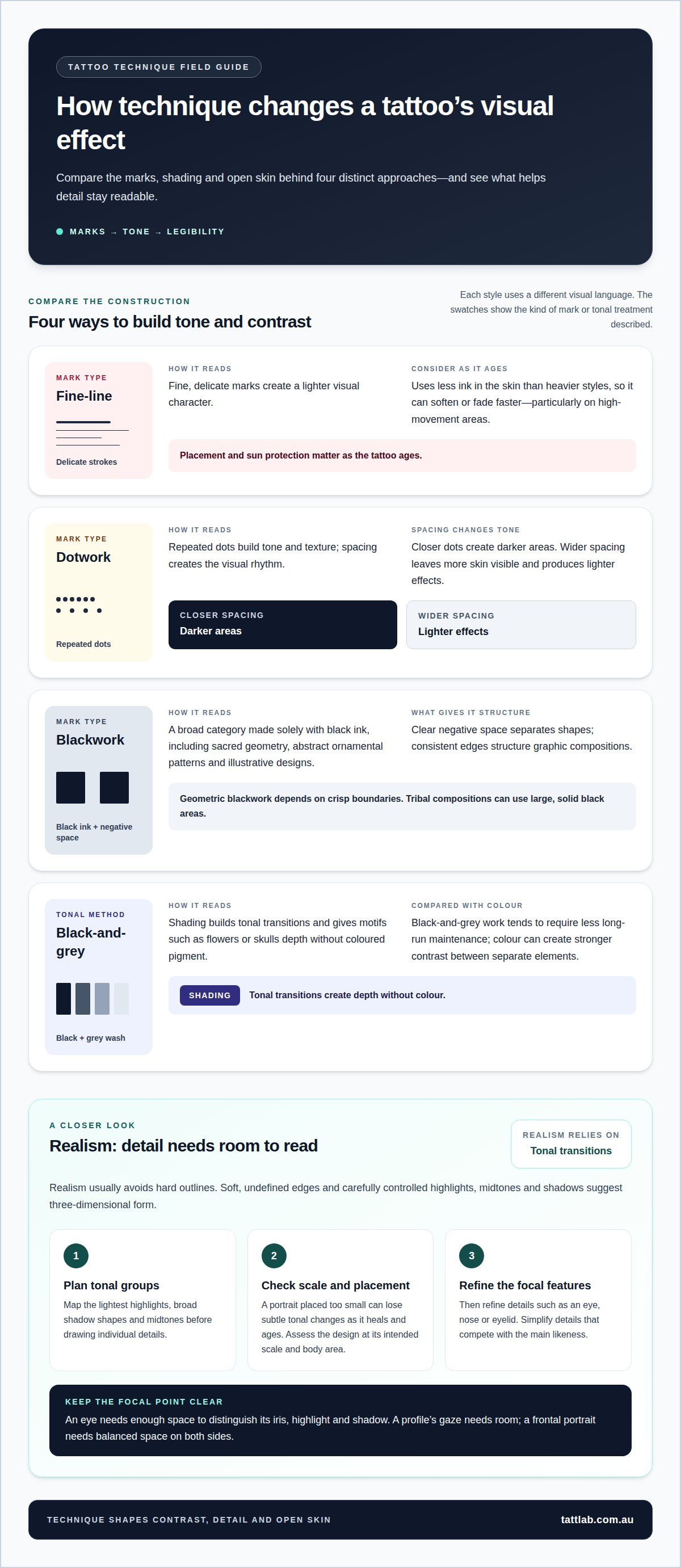
Fine-line, dotwork and blackwork differ in their use of marks, shading and colour. Realism creates soft, dimensional images; blackwork uses black ink alone, while fine-line relies on delicate strokes. Dotwork builds tone and texture with repeated dots, making spacing and consistency central to the design.
Fine-line designs use less ink in the skin than heavier styles, so they can soften or fade faster, particularly on high-movement areas. Placement and sun protection matter as a tattoo ages. Dotwork has a different visual rhythm: closely spaced dots create darker areas, while wider spacing leaves more skin visible and produces lighter effects.
Blackwork is a broad category for body art made solely with black ink. It includes sacred geometry, abstract ornamental patterns and illustrative designs. Clear negative space helps separate shapes, while consistent edges give graphic compositions their structure. Tribal designs can use large, solid black areas, and the approach to packing ink can vary with the design.
Black-and-grey tattoos use black and grey wash without colour. Artists build tonal transitions through shading, giving motifs such as flowers or skulls depth without coloured pigment. Black-and-grey work tends to require less maintenance over the long run than colour tattoos, while colour can create stronger contrast between separate elements.
Compare how each approach handles contrast, detail and open skin. A geometric blackwork pattern, for example, depends on crisp boundaries, while dotwork relies on controlled spacing. Fine-line designs need thoughtful placement because movement can affect how delicate marks age. These distinctions help artists match technique to the intended visual effect.
For tribal compositions, black ink packing supports the intended solid areas; tattoo inks and related supplies are available through black-ink tattoo supplies.
Blackwork includes body art made only with black ink, from sacred geometry to abstract, ornamental and illustrative styles. Black-and-grey tattoos tend to require less maintenance over the long run than colour tattoos. Very fine tattoo work depends more on skin and aftercare as it ages than bold, simple work, so consider these factors when comparing approaches.
Realism, portraits, scale and detail
Realistic tattooing emerged around the latter half of the 20th century. Unlike American traditional work, realism usually avoids hard outlines, using soft, undefined edges to suggest three-dimensional form on skin. A portrait of a person, a dog or a flower depends on carefully controlled tonal transitions. The image feels dimensional because highlights, midtones and shadows describe form without relying on a strong contour.
Scale determines whether tonal transitions have enough room to remain distinct. A detailed portrait placed too small can lose subtle changes in tone as it heals and ages, making facial features or fur less legible. An eye, for instance, needs enough space to distinguish its iris, highlight and shadow. When planning a portrait, consider both the reference image and the available body area.
Placement also affects how a composition reads across the body. A face in strong profile may suit an area that gives its gaze room, while a frontal portrait needs balanced space on both sides. Assess the design at its intended scale, then simplify details that compete with the main likeness. This keeps focal features clear instead of crowding them with tiny transitions.
When developing realism, study a reference in tonal groups before drawing individual details. Map the lightest highlights, broad shadow shapes and midtones first, then refine features such as a nose, eyelid or petal edge. This sequence helps build form instead of outlining every object. Compare the finished drawing with the reference at the planned tattoo size, where overly fine detail is easier to spot.
Evaluate healed examples, not just fresh tattoos, when assessing realistic work. Fresh ink can show crisp contrast that changes as the tattoo settles, so healed portraits reveal how transitions and details read over time. Review examples at similar scales and placements, such as a small pet portrait beside a larger shoulder portrait. This comparison helps set realistic expectations for detail, composition and likeness.
Detailed realism needs sufficient space: when a portrait is too small, fine transitions can blur as it heals and ages. Before choosing a realistic tattoo, consider its scale and placement, and review the artist’s healed examples alongside fresh tattoos.
Chicano tattoo style
Chicano tattooing is usually fine-line and black-and-grey, shaped by the history of the Mexican Revolution, Los Angeles low-rider culture and Pachuco culture. Those roots matter: the style is more than a monochrome look. Its visual language reflects specific communities and histories, so artists learning it should study the context alongside the linework and shading.
Fine lines give Chicano designs delicate definition, while black-and-grey values build depth without colour. This balance calls for controlled line placement and graduated shading: subtle tonal changes can make a portrait expressive without heavy outlines. Grey wash can heal lighter than it looks when fresh, so plan tonal contrast with the settled result in mind.
Chicano imagery is often recognised through expressive portraits, lettering and religious or cultural symbols. Treat each element as part of a considered composition, not a decorative shortcut. Script, for example, needs enough space between letters to remain legible; tightly packed forms can lose definition over time. Facial features also need clear tonal separation to preserve their expression.
Artists developing this approach can begin with drawing studies that isolate its core techniques. Practise smooth transitions between light, mid-grey and shadow, then test how fine contours define a face or lettering. Compare the drawing at its intended size to spot crowded details and areas where more open space could strengthen the focal image.
Respectful study means understanding how Mexican-American identity and Los Angeles subcultures inform the style. Avoid reducing Chicano work to generic black-and-grey imagery or copying culturally significant designs without context. Learn the visual grammar and history together: technique alone cannot communicate the style’s full meaning.
To support black-and-grey work, explore tattoo inks suited to developing tonal designs.
Tatt Lab
Tatt Lab supports artists as they translate style studies into considered practice, with tattoo equipment and aftercare essentials. As you explore a new approach, suitable supplies help you work consistently with its linework, shading or colour needs. Tatt Lab offers traditional needles, tattoo cartridges, tattoo inks and tattoo aftercare, giving artists practical essentials as their technique develops.
Match needle choices to the linework you’re practising and select inks for your planned designs. Aftercare is also part of responsible tattoo practice, supporting clients as their tattoos heal. These supplies complement study and mentorship; they don’t replace technique development or careful practice.
Shop Tatt Lab for tattoo supplies to support your next stage of practice.
Keep developing your visual practice
Start your next study with a specific creative question: which visual decisions make a design distinctive, and how can you adapt them without losing its character? Let the question guide your sketches, feedback and practice. A focused process makes learning new tattoo styles more purposeful, because each study has an intention beyond copying a finished image.
Build gradually. Record what you’re testing, notice which choices work together, and revisit your drawings with fresh eyes. Over time, reflection can help you take a more deliberate approach to new designs and communicate your ideas clearly. Keep curiosity and care at the centre of your practice.
For a conversation about your tattoo, contact Tatt Lab to discuss your tattoo. Let each new study become a considered step towards work that feels distinctly yours.
Frequently Asked Questions
What are the best books, courses, and tutorials for learning tattoo styles?
Choose books, courses and tutorials that demonstrate drawing, line control, colour packing and healed results.
How can artists find mentors or conventions to learn tattoo styles in Australia?
In Australia, mentors and tattoo conventions can support learning. Seek feedback from an experienced mentor and practise on synthetic skin under their supervision.


Comments (0)
There are no comments for this article. Be the first one to leave a message!