

The tactile intimacy of a six-hour session shouldn't be compromised by the very barrier designed to protect it. You understand that every needle stroke requires absolute precision, yet hand fatigue and slippery grips from petroleum-based ointments often turn a creative flow into a physical struggle. It's frustrating when a glove tears mid-procedure, forcing a break in concentration and increasing exposure risks. When evaluating nitrile vs latex gloves for tattooing, the decision impacts more than just your comfort; it defines your studio's safety profile and your client's biological response.
We agree that your hands are your most vital tools, deserving of a barrier that offers both clinical rigor and ergonomic support. This guide provides a technical analysis of how modern materials ensure maximum chemical resistance against inks and petroleum while maintaining the sensitivity needed for fine linework. You'll discover why nitrile is 3 to 5 times more puncture-resistant than latex and how adhering to ASTM D6319-19 standards protects you from costly OSHA violations. We'll examine the shift toward medical-grade nitrile to help you reduce skin irritation and eliminate the risk of client allergic reactions for a more professional, predictable result.
Key Takeaways
- Understand the molecular differences that make nitrile the scientifically superior barrier against the solvation effects of petroleum-based ointments.
- Compare the puncture resistance and tactile feedback of nitrile vs latex gloves for tattooing to ensure your hands remain protected during long sessions.
- Learn how textured fingertips and proper sizing mitigate the risk of carpal tunnel syndrome while maintaining a precise grip on your machines.
- Discover why the industry-wide shift to synthetic materials is essential for eliminating client allergic reactions and fostering a safe healing environment.
- Gain insights into sourcing medical-grade PPE that meets rigorous Australian standards to maintain a sterile and professional studio atmosphere.
The Evolution of Studio Safety: Why Glove Choice Matters
The disposable glove is the most critical piece of equipment in your station. It serves as the primary barrier against bloodborne pathogens (BBPs), protecting both the artist and the client from cross-contamination. While the industry relied heavily on natural rubber for decades, the 2020s have seen a definitive shift toward advanced synthetics. This transition isn't just a trend; it's a response to the need for higher physical integrity in high-friction environments. Tattooing involves constant contact, stretching of the skin, and the use of vibrating machinery, all of which test the limits of a glove's molecular structure.
In the Australian regulatory landscape, studio hygiene and PPE are governed by strict public health standards. Compliance requires more than just wearing a glove; it demands the use of barriers that maintain their protective properties throughout the entire procedure. Choosing between nitrile vs latex gloves for tattooing is a decision that balances legal responsibility with the physical demands of the craft. It's about ensuring that the barrier you choose doesn't fail when the skin is under tension or when exposed to the various liquids used during a session.
The Clinical Role of Disposable Gloves
Contamination is a silent risk. Every time you touch your machine, the client's skin, or your workspace, you risk transferring pathogens. Non-sterile gloves are the industry standard, but they must carry a medical-grade certification to ensure they meet specific barrier performance levels. Using inferior products can lead to micro-tears that are invisible to the eye but large enough for viruses to penetrate. For a deeper look at how to outfit your workspace with compliant gear, consult our Medical Supplies for Tattoo Artists guide, which explores the full spectrum of professional studio safety.
Beyond the Allergy: A Modern Perspective
Type I latex allergies are often the catalyst for a studio's switch to synthetic alternatives. These reactions can range from mild dermatitis to severe respiratory distress, creating a liability for the artist and a traumatic experience for the client. However, modern safety standards focus on more than just allergy avoidance. The evolution of Medical glove materials has introduced polymers that offer superior puncture resistance. When comparing nitrile vs latex gloves for tattooing, the goal is to find a material that resists the repetitive motion of the needle and the chemical degradation caused by inks and ointments. This ensures that your protective layer remains intact from the first line to the final wipe, providing a consistent sense of security for everyone involved.
Nitrile vs. Latex: A Technical Comparison for the Modern Artist
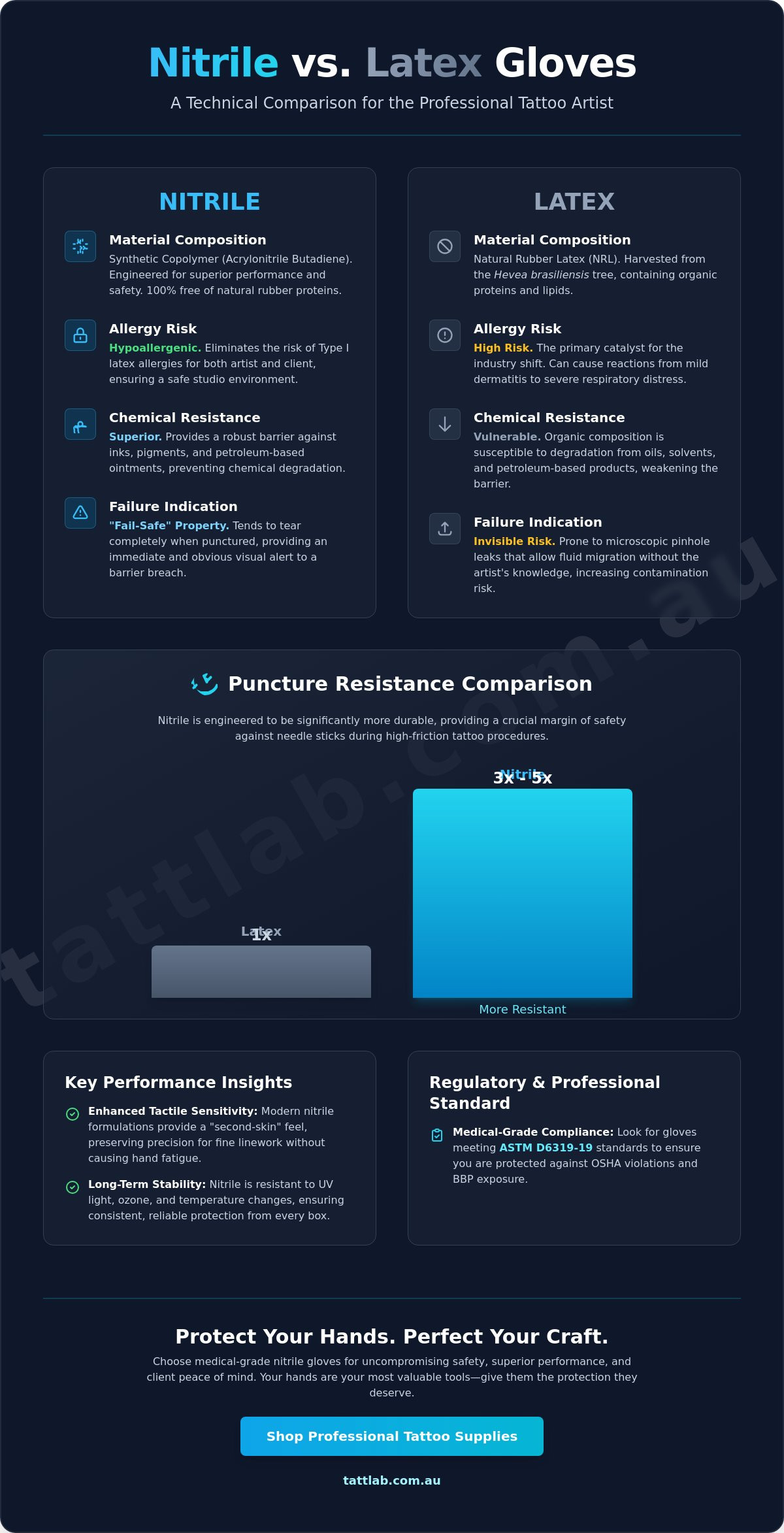
When comparing nitrile vs latex gloves for tattooing, the primary technical distinction lies in the molecular architecture of the materials. Natural Rubber Latex (NRL) is composed of organic proteins and lipids harvested from the Hevea brasiliensis tree. While this provides exceptional natural elasticity, the material's organic nature makes it susceptible to rapid degradation. In contrast, nitrile is a synthetic copolymer known as Acrylonitrile Butadiene. This synthetic composition provides a superior baseline for the chemical resistance of gloves, specifically against the pigments and carriers found in modern inks. The result is a more stable, predictable barrier that doesn't react with the body’s chemistry or the products on your workstation tray.
The physical performance of nitrile vs latex gloves for tattooing also extends to how the material behaves under stress. Nitrile is engineered to be 3 to 5 times more puncture-resistant than latex. In a high-stakes environment where needles move at thousands of cycles per minute, this margin of safety is not just a preference; it's a necessity. Storage conditions also play a role in this technical evaluation. Latex is highly sensitive to UV light, ozone, and temperature fluctuations, which can cause the material to become brittle or "tacky" over time. Nitrile remains stable for significantly longer periods, ensuring that the box you open six months from now provides the same protection as the one you opened today.
Durability and Puncture Resistance
Nitrile possesses a unique "fail-safe" property that is invaluable during a procedure. When the material is compromised by a sharp object, it tends to tear completely and immediately. This visible failure alerts you to the breach instantly, allowing you to pause and replace the glove. Latex, however, is prone to microscopic pinhole leaks that can remain unnoticed for hours. These tiny breaches allow fluids to migrate through the barrier without your knowledge. By maintaining a stable nitrile barrier, you preserve your tactile awareness of needle depth and skin tension without the looming risk of invisible contamination.
Tactile Sensitivity and Hand Fatigue
A common misconception is that nitrile is inherently stiff or "numb" compared to the second-skin feel of latex. Modern "soft-nitrile" technology has largely closed this gap, offering a modulus of elasticity that mimics natural rubber while maintaining synthetic strength. This allows for the nuanced tactile feedback required for complex shading and color packing. Hand fatigue is the physiological result of improper glove tensioning that forces muscles to work against the material's resistance. Selecting the right size and material ensures your hands remain steady throughout an all-day session. Investing in medical-grade gear, such as premium tattoo cartridges, ensures that every component of your setup meets these high technical standards.
Chemical Integrity: How Tattoo Inks and Ointments Affect Your Barrier
A tattoo artist's workstation is a complex chemical environment where multiple substances interact simultaneously. Beyond the biological risks, your gloves must withstand constant exposure to pigments, carriers, and lubricants. When evaluating nitrile vs latex gloves for tattooing, the most significant risk often isn't a needle stick, but the silent degradation of the material's molecular structure. This invisible breakdown compromises the barrier, potentially exposing your skin to concentrated chemicals and pathogens without any immediate physical sign of failure.
The stability of your protective layer depends on its resistance to the specific solvents used in the studio. While natural rubber provides excellent elasticity, its organic composition makes it vulnerable to many common tattooing supplies. Synthetic polymers are engineered to provide a more robust defense. According to OSHA's guide to glove selection, choosing the correct material requires matching the glove's chemical resistance to the specific substances handled in the workspace. In a high-end studio, this means selecting a barrier that remains inert when it touches petroleum, alcohol, and complex pigment suspensions.
The Petroleum Problem: Why Latex Fails
Petroleum-based products, such as Vaseline and various tattoo glides, are ubiquitous for their ability to soothe skin and facilitate smooth needle movement. However, natural rubber latex is highly susceptible to a process called solvation. This occurs when the oils in petroleum products penetrate the latex matrix, weakening the molecular bonds and causing the material to swell. Within minutes, the physical integrity of a latex glove can diminish significantly, turning a secure barrier into a porous, compromised layer. This degradation creates a phenomenon known as "wicking," where microscopic contaminants are drawn through the softened material. Nitrile offers a vastly superior resistance to these oils, making it the only scientifically sound choice when working with heavy ointments.
Ink Permeability and Solvent Resistance
Ink permeability is another critical factor in maintaining a professional environment. Tattoo pigments are suspended in carriers that often contain glycerin and isopropyl alcohol. While alcohol is essential for skin preparation, it is also a powerful solvent that can dry out and crack natural rubber. Nitrile maintains its stability against these carriers, protecting your skin from long-term exposure to concentrated pigments. For a deeper understanding of what is inside your bottles, you can explore our Professional Guide to Tattoo Ink. Using nitrile vs latex gloves for tattooing ensures that your barrier remains a dedicated partner throughout the entire procedure, preventing ink from staining your hands or causing cumulative skin irritation from pigment exposure.
Tactile Precision and Ergonomics: Finding Your Perfect Fit
Tattooing requires a marathon of fine motor control, making the ergonomic profile of your gear just as important as its safety rating. When comparing nitrile vs latex gloves for tattooing, the physical toll on your hands is a primary consideration. A glove that fits poorly creates unnecessary resistance, forcing your muscles to work harder against the material with every movement. Over time, this repetitive strain is a leading contributor to Carpal Tunnel Syndrome and chronic hand cramps. Achieving a balanced fit ensures that your hand remains relaxed, allowing for the fluid movement necessary for long, intricate sessions.
While standard medical environments often utilize blue or purple barriers, the "Black Glove" has become the definitive standard for professional artists. This preference serves a functional purpose beyond the minimalist urban aesthetic. Black nitrile reduces visual distractions by masking ink splatters and blood, which allows you to maintain absolute focus on the detail of your work. This visual clarity is a subtle but powerful component of technical precision. When evaluating nitrile vs latex gloves for tattooing, the synthetic stability of black nitrile provides a consistent visual field that natural rubber often lacks.
Measuring for Success
Determining your ideal size is a methodical process that begins with measuring the circumference of your palm at its widest point. A professional fit should feel snug like a second skin, yet it must never be constricting. If the material pulls tightly across your knuckles, it will restrict circulation and lead to premature fatigue. Conversely, you must avoid "finger-tip overhang." Excess material at the tips of your fingers is a significant hazard when handling delicate needle cartridges, as it can obscure your view of the needle depth or get caught in the machine's moving parts. A precise fit eliminates these variables, ensuring your tools respond exactly as intended.
Texture, Grip, and Machine Control
The interaction between the glove surface and your machine grip determines your level of control. Most high-end nitrile gloves feature textured fingertips, which provide essential traction on vibrating machines, especially when internal perspiration begins to affect the glove's internal grip. Some artists prefer fully textured surfaces for heavy color packing, while others choose fingertip-only textures for the nuanced feedback required in dotwork. The thickness of the material, or its mil rating, also plays a role; thinner 3-5 mil gloves offer maximum sensitivity, while thicker 6-8 mil options provide a robust barrier for longer procedures. To ensure your setup matches your commitment to precision, explore our selection of professional tattoo cartridges designed for consistent performance.
Sourcing Medical-Grade Protection: The Tatt Lab Advantage
Selecting the right barrier is a technical decision, but sourcing it requires a partner who understands the high-stakes nature of a professional studio. At Tatt Lab, we function as a dedicated extension of your workspace, curating a selection of medical-grade PPE that meets the rigorous demands of modern body art. When choosing between nitrile vs latex gloves for tattooing, the reliability of your supplier is just as important as the mil rating of the material itself. We provide a steady, low-pressure procurement process that ensures your station is always equipped with barriers that prioritize physical integrity and biological safety.
Our role as a Trusted Specialist in the Australian market is built on a foundation of clinical rigor and aesthetic awareness. We recognize that high-volume professional environments require a consistent supply of gear that doesn't fail under pressure. By offering bulk purchasing options, we help studios maintain their safety protocols without the anxiety of inventory gaps. This methodical approach to supply chain management allows you to focus on the creative transformation of your clients while we handle the science of your safety barrier.
The Tatt Lab Selection Criteria
Every product in our inventory undergoes a vetting process that mirrors the precision of the tattooing process. We evaluate our range for puncture resistance, tactile feedback, and chemical stability to ensure they exceed standard medical requirements. Our specialized black nitrile gloves are selected specifically for their ability to provide a neutral visual field and a superior grip on vibrating machines. For a comprehensive look at how we curate our inventory, you can consult our Specialist’s Selection Guide. This resource demystifies the science behind our curation, helping you understand why specific materials are chosen for the professional Australian studio.
Supporting the Australian Tattoo Community
We are deeply invested in the long-term progress of the local industry. From our Victoria-based headquarters, our local support team provides personalized assistance to ensure you find the exact fit for your specific style. We offer wholesale account options for registered professional studios, streamlining the acquisition of essential supplies like tattoo inks and disposable barriers. With nationwide express shipping, we ensure that studios from Melbourne to Perth have immediate access to the highest tier of protection. This commitment to the community reflects our belief that safety is not just a technical task, but a holistic approach to the health of the artist and the client alike.
Explore our professional glove range at Tatt Lab to secure a barrier that matches your commitment to excellence.
Elevating Your Studio's Safety Standards
The technical evaluation of nitrile vs latex gloves for tattooing is no longer a matter of simple preference, but a commitment to the long-term health of your hands and the safety of your clients. By prioritizing the superior puncture resistance of nitrile and its inherent immunity to petroleum-based solvation, you ensure that your protective barrier remains as precise as your linework from the first drop of ink to the final aftercare application. Selecting artist-vetted, medical-grade equipment reflects a meticulous approach to the craft, where clinical rigor meets artistic excellence in every session.
We are dedicated to supporting your professional progress with specialized black nitrile gloves that maximize ink visibility while maintaining the sensitive tactile feedback required for complex shading. Our team provides the reliability your studio demands through express nationwide Australian shipping and a curated selection of supplies that prioritize physical integrity. Transitioning to a synthetic-first environment reduces the risk of unpredictable allergic reactions and provides the steady, controlled safety profile your reputation deserves.
Shop Professional Medical-Grade Gloves at Tatt Lab
Maintain the integrity of your practice and continue your journey of artistic transformation with absolute confidence.
Frequently Asked Questions
Is nitrile better than latex for preventing cross-contamination in tattooing?
Nitrile is superior for cross-contamination prevention because its synthetic structure is more resistant to the micro-tears and pinhole leaks common in natural rubber. While latex can develop invisible breaches during a session, nitrile’s "fail-safe" property causes it to tear visibly when compromised. This immediate feedback allows you to maintain a truly sterile field by alerting you to the need for a glove change before a breach leads to exposure.
Can I use latex gloves if I apply Vaseline during the tattoo process?
You should avoid using latex if your workflow involves petroleum-based products like Vaseline. The oils in these ointments trigger a chemical reaction called solvation, which rapidly weakens the molecular bonds of natural rubber. This process turns the glove into a porous, unstable barrier within minutes. Choosing nitrile vs latex gloves for tattooing is essential here, as nitrile remains chemically inert when exposed to oils, ensuring your protection remains intact.
Why do most tattoo artists prefer black nitrile gloves over blue medical ones?
The preference for black nitrile is rooted in both visual ergonomics and studio aesthetics. The dark surface masks ink splatters and blood, which minimizes visual distractions and helps you maintain focus on the intricate details of your work. Unlike blue or purple medical gloves, black nitrile provides a high-contrast background that makes it easier to see the needle tip and ink flow, supporting the precision required for professional results.
How do I know if I have a latex allergy or just contact dermatitis?
Distinguishing between a Type I latex allergy and contact dermatitis requires observing the speed and severity of the reaction. A true latex allergy often presents as immediate hives, swelling, or respiratory distress. Contact dermatitis is typically a delayed, localized rash caused by moisture trapped against the skin or chemical additives. Because these reactions impact your long-term health, we recommend consulting a medical professional for formal allergy testing to ensure your safety.
What thickness (mil) should I look for in a professional tattoo glove?
Most professional artists find that a thickness between 4 and 6 mil provides the ideal balance of protection and tactile sensitivity. When comparing nitrile vs latex gloves for tattooing, the mil rating significantly impacts your needle-depth awareness. Thinner 3 mil options are excellent for fine linework, while 7 or 8 mil heavy-duty gloves are better suited for color packing or station teardown. Selecting the right thickness depends on your specific style.
Are vinyl gloves a safe alternative for tattooing if I am on a budget?
Vinyl gloves are not a safe or recommended alternative for tattooing due to their poor barrier integrity and lack of elasticity. They have a high failure rate under stress and don't provide the snug, ergonomic fit needed to control a vibrating machine. In a professional setting where exposure to bloodborne pathogens is a daily reality, the cost savings of vinyl don't justify the significantly increased risk of barrier breach and contamination.
How often should I change my gloves during a long tattoo session?
You should change your gloves every 60 to 90 minutes during an extended session, or immediately if you touch a non-sterile surface. Over time, the material can experience barrier fatigue from constant movement and exposure to fluids. Changing them regularly prevents the buildup of internal perspiration and ensures the material’s physical integrity remains uncompromised. This habit is a foundational component of a rigorous cross-contamination protocol.
Do nitrile gloves expire or lose their effectiveness over time?
Nitrile gloves do have a shelf life, typically ranging from three to five years depending on the manufacturer and storage conditions. While they are more stable than natural rubber, they can still degrade if exposed to extreme heat or UV light for prolonged periods. Always check the expiration date on the box and store your supply in a cool, dark environment to ensure the synthetic bonds remain strong and reliable for every procedure.


Comments (0)
There are no comments for this article. Be the first one to leave a message!