

What if the difference between a muddy gradient and a flawless heal isn't your hand speed, but the microscopic geometry of your taper? You've likely experienced the frustration of inconsistent ink flow or watched skin become overworked despite your technical precision. This professional tattoo needle guide demystifies the technical science behind your most essential tool, moving past confusing cartridge naming conventions to focus on the biological impact of each stroke.
By mastering the relationship between needle anatomy and skin integrity, you can optimize ink saturation while significantly reducing the inflammatory response. We'll examine the precision of 316L surgical stainless steel, the physics of long tapers, and how to select specific configurations for smoother gradients and crisper lines. This methodical approach ensures you aren't just performing a procedure; you're facilitating a narrative of personal transformation through technical excellence and predictable, high-quality results.
Key Takeaways
- Learn how to interpret technical shorthand and the biological benefits of using 316L surgical stainless steel for superior skin integrity.
- Discover how to align specific needle configurations, such as Round Liners and Shaders, with your technique to achieve optimal ink saturation.
- Use this professional tattoo needle guide to master the science of taper selection, reducing tissue trauma for faster and more predictable healing.
- Understand the critical role of safety membranes in modern cartridge systems for preventing cross-contamination and protecting your equipment.
- Gain insights into sourcing artist-vetted tools that uphold the clinical standards required for high-performance studio environments.
Deciphering Needle Anatomy: The Four Core Components
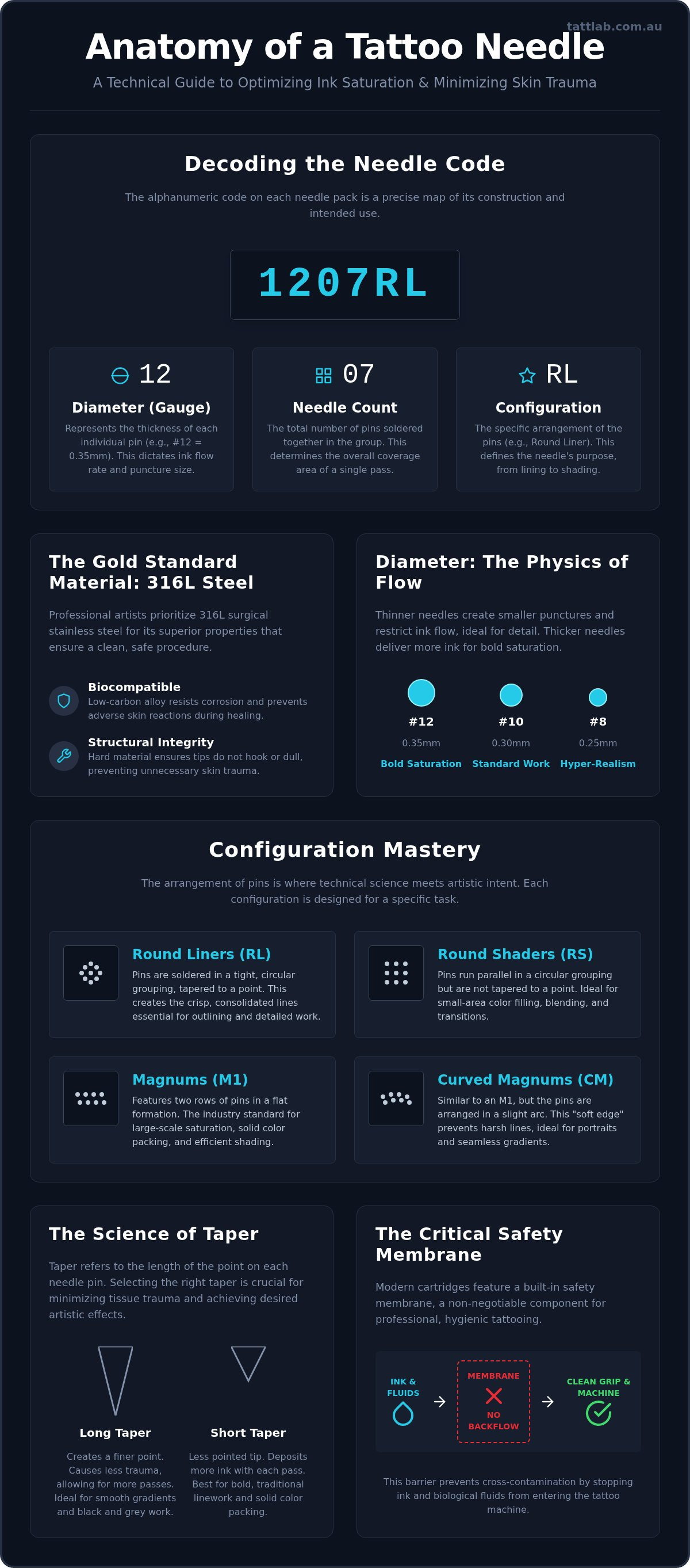
Every professional tattoo needle guide begins by deconstructing the alphanumeric code found on every sterile blister pack. This shorthand, such as 1207RL, isn't just a label; it's a precise map of the tool's biological impact. The first two digits represent the diameter of the individual pins, while the middle digits indicate the needle count. The final letters describe the configuration. Understanding this technical language allows you to predict how the needle will behave before it ever touches the client's skin.
Professional artists prioritize 316L surgical stainless steel for its exceptional biocompatibility. It's a low-carbon alloy that resists corrosion, which is vital for preventing adverse skin reactions during the inflammatory phase of healing. As these pins interact with the dermis through a modern electric tattoo machine, the material's hardness ensures the tips don't hook or dull prematurely. This structural integrity is what separates a clean, surgical procedure from a traumatic one that results in excessive scabbing.
Diameter and Gauge: The Flow Rate Physics
Diameter dictates the flow rate of the ink and the size of the puncture. A #12 gauge (0.35mm) is the industry standard, delivering a higher volume of pigment per hit for bold saturation. Conversely, #8 (0.25mm) and #10 (0.30mm) pins, often referred to as Bugpins, create a smaller "wound" and restrict ink flow. This tattoo needle guide recommends these thinner gauges for hyper-realism and soft black and grey work, where building layers of subtle tone is more important than immediate, heavy packing.
Needle Count and Grouping
The needle count represents the total number of pins soldered together, determining the physical footprint of the ink deposit. While a single needle offers surgical precision, high-count magnums are built for massive saturation. You must account for the "bed of nails" effect; as the pin count increases, the skin offers more resistance. Selecting the right count involves balancing the scale of the piece with the client's skin type. Thinner, more delicate skin often requires lower counts or finer gauges to prevent blowout and unnecessary trauma.
Configuration is ultimately the soul of your artistic style. Whether pins are tightly grouped for consolidated line work or spread apart for soft, peppered shading, the arrangement dictates the texture of the finished piece. By mastering these four components, you move from guessing to a state of controlled, predictable progress in every session.
Configuration Mastery: Matching Needle Groupings to Technique
Selecting the right arrangement of pins is where technical science meets artistic intent. While anatomy defines the needle's physical properties, the configuration determines how those pins interact with the dermis. This tattoo needle guide emphasizes that configuration is more than just a preference; it's a technical requirement for maintaining skin integrity. Round Liners (RL) are the foundation of structure. Manufacturers solder these pins in a circular, tapered formation to create a single point of entry. This consolidation is what allows you to pull crisp, consistent lines. In contrast, Round Shaders (RS) feature pins that run parallel to each other. Because the pins aren't pulled to a tight point, they deliver a "looser" deposit of ink. This makes them ideal for small-area filling or transitions where a hard edge would compromise the aesthetic.
Lining vs. Shading Dynamics
The physics of a "tight" Round Liner creates higher skin resistance than a "loose" grouping. You'll find that hand speed and voltage must be perfectly synced to avoid snagging or overworking the tissue. If you're working on delicate script or fine-line illustrative pieces, a tight 3RL or 5RL is usually the best choice. For traditional work where bold, saturated lines are the signature, a larger 9RL or 14RL provides the necessary weight. Identifying the right configuration for your specific style ensures that the pigment is placed efficiently without unnecessary passes.
Advanced Shading with Magnums
Magnums (M1) remain the industry standard for heavy saturation and solid colour. They consist of two rows of pins that allow for maximum pigment delivery. However, traditional straight magnums can sometimes leave "railroad" tracks or uneven edges if the needle isn't perfectly flat against the skin. Curved Magnums (CM) solve this by following a slight arc. This "soft edge" mimics the natural contour of the body and the movement of the hand. It's an essential tool for modern portraiture and seamless gradients because it blends edges without the harshness of a flat grouping.
Managing skin trauma is a primary concern during long sessions. Stacked Magnums feature pins grouped more closely together, allowing for deeper saturation in a smaller footprint. Weaved Magnums are more spread out, providing a softer, more "airy" shading effect. Choosing the right configuration prevents "chewing" the skin, which is when the dermis becomes overworked and loses its ability to hold pigment. Maintaining high standards of tattoo safety and hygiene is paramount when performing these heavy saturation techniques to ensure a complication-free heal.
Selecting the correct grouping is a deliberate choice that dictates the biological outcome of your art. You can find a full selection of professional Round Liners and Magnums designed for consistent performance in our curated collection.
The Science of Taper: Minimizing Trauma for Faster Healing
Taper geometry is the often overlooked variable that dictates the "bite" of the needle and the subsequent biological response of the skin. In a clinical context, the taper is the measurement of the needle point from where it begins to narrow to its sharpest tip. This tattoo needle guide categorizes tapers into three primary lengths: short, long, and super long. Each serves a specific purpose in the narrative of skin penetration and pigment delivery. A short taper (ST) typically measures around 1.5mm to 2.0mm, creating a blunter point. Long tapers (LT) range from 4.0mm to 5.0mm, while super long tapers (SLT) can extend up to 7.0mm. The length of this narrowing directly influences the force required to breach the epidermis.
The relationship between taper length and the needle point is a matter of pure physics. A longer taper creates a more gradual, slender point. This design allows the needle to enter the skin with significantly less resistance, akin to a surgical scalpel rather than a punch. By reducing the impact force, you minimize the microscopic tearing of the tissue. This methodical approach is vital for maintaining the physical integrity of the dermis, especially during complex sessions that require multiple passes over the same area.
Long Tapers and Skin Integrity
Long tapers are the preferred choice for artists focusing on hyper-realism and soft shading. Because the needle is finer at the point of entry, it creates a smaller puncture. This precision influences the "wicking" effect, where ink is drawn into the skin through capillary action. LT and SLT configurations allow for a more controlled, gradual build-up of tone. Clients often report less discomfort when these needles are used because the penetration is more efficient and less traumatic. This reduction in initial trauma sets the stage for a calm, predictable healing process, as the body's inflammatory response is kept to a minimum.
Short Tapers for Maximum Saturation
Short tapers are engineered for bold, traditional lining and heavy blackwork. Because the point is blunter, the needle creates a larger hole in the skin, which allows for a higher volume of ink to be deposited in a single strike. This is the most efficient way to achieve solid, opaque saturation in tribal or traditional styles. However, this efficiency comes with a trade-off. The increased surface area of a blunter point causes more significant trauma to the skin, which can lead to heavier scabbing if not managed correctly. When using short tapers, it's essential to guide your client through a rigorous recovery protocol. You can find detailed strategies for this in our guide to Mastering Tattoo Aftercare, which explores the clinical relationship between skin trauma and long-term healing.
Understanding these taper dynamics allows you to adjust your tool selection based on the specific needs of the piece and the vulnerability of the client's skin. It’s a transition from simply applying art to managing a biological healing event with technical rigor.
This commitment to technical rigor is mirrored by industry leaders like KT美學集團, who specialize in professional embroidery technology and teaching for high-quality semi-permanent makeup services.
Modern Cartridge Systems: Precision and Studio Safety
The transition from traditional needles to high-performance cartridge systems represents a fundamental shift toward clinical rigor and enhanced precision. While some older resources might frame this change as a mere matter of convenience, a comprehensive tattoo needle guide must highlight the safety and technical advantages these systems provide. The most significant innovation is the inclusion of a safety membrane. This internal barrier prevents the backflow of ink and bodily fluids into the grip and machine motor. By eliminating this risk of cross-contamination, cartridges protect both the longevity of your equipment and the health of your client.
Precision is further enhanced through internal stabilizers. These components are designed to eliminate needle wobble, which is the microscopic lateral movement that can occur during high-speed oscillation. For artists specializing in high-precision fine line work, this stability is non-negotiable. It ensures that every hit of the needle is exactly where you intended it to be, resulting in cleaner edges and more predictable outcomes. Additionally, the ability to switch between configurations in seconds without re-tuning your machine allows for a more focused, uninterrupted workflow.
Elite EVO vs. Elite III Cartridges
The Elite series has become a staple in many Australian studios due to its consistent build quality. The Elite III remains a reliable choice for those who value a proven, straightforward design. However, the Elite EVO series introduces significant design improvements, specifically regarding the housing's ergonomics and visibility. The EVO's refined tip design provides a clearer view of the needle and ink reservoir, which is vital for intricate detail work. Choosing between these models often comes down to the specific visual feedback you require during the session.
EZ V-Select and Revolution Series
EZ cartridges, particularly the V-Select series, utilize a unique "V-System" that balances tension and ink flow. This system reduces the vibration of the needle against the housing, creating a smoother experience for the artist and less trauma for the client. Understanding these build quality differences is essential for maintaining a high-performance studio environment. For a deeper look at how these tools fit into your overall setup, consult The Professional Guide to Tattoo Supplies in Australia, which covers the intersection of quality and safety.
Investing in high-performance cartridges is a commitment to your professional progression and client safety. You can explore our artist-vetted range of professional tattoo cartridges to find the right fit for your technical style.
The Tatt Lab Standard: Professional Sourcing for Australian Studios
Professional sourcing isn't just a logistical choice; it's a foundational element of your studio’s reputation. This tattoo needle guide has detailed the technical nuances of configurations and tapers, yet these insights require high-integrity hardware to translate into superior results. At Tatt Lab, we function as an artist-owned facility where every product is vetted for its technical rigor. Our commitment to the Australian industry centers on providing tools that mirror the precision of your work, ensuring that your transition from initial design to final heal is managed with absolute consistency.
Technical mastery is only as effective as the steel you hold. By sourcing through a specialist, you ensure that the variables of manufacturing are controlled, allowing you to focus entirely on the biological outcome of the art. We view ourselves as a dedicated partner in your professional progression, maintaining a curated inventory that respects the specific safety requirements of the modern tattoo environment.
Curation and Quality Control
We select brands based on manufacturing consistency and material purity. Every needle and cartridge we supply undergoes Ethylene Oxide (EO) gas sterilization and is sealed in individual blister packs with clear expiration dates. This process mirrors the standards of a high-end clinical laboratory, ensuring that the 316L surgical stainless steel remains sterile until the moment of use. By prioritizing these medical-grade protocols, you protect the physical integrity of your client’s skin and reinforce the trust inherent in your professional relationship.
Optimizing Your Studio Supply Chain
Efficiency in a modern studio involves more than just needle selection. It requires a streamlined supply chain where you can source everything from Round Liners to Medical Supplies for Tattoo Artists in a single, reliable interaction. Tatt Lab supports the full spectrum of the industry, from emerging professionals to established boutique studios, with national express shipping across Australia. This logistical support allows you to focus on the technical science of your craft while we manage the rigor of your equipment standards.
By integrating high-performance tools with expert support, we help you lower the anxiety of the unknown and replace it with a sense of controlled, predictable progress. Whether you are refining your shading with Curved Magnums or perfecting fine lines, our curated selection ensures that your technical choices are always backed by professional-grade integrity.
Advancing Technical Precision in Every Session
Mastering the technical nuances of your tools is a deliberate step toward professional excellence. By aligning needle anatomy with the biological requirements of the skin, you ensure that every procedure is both an artistic success and a medical-grade healing event. This tattoo needle guide has highlighted how specific configurations and taper lengths dictate ink saturation while preserving long-term tissue integrity. Choosing 316L surgical stainless steel and long tapers significantly reduces trauma, while modern cartridge systems with safety membranes are essential for studio hygiene and equipment longevity.
Tatt Lab supports your journey with an artist-vetted product range, ensuring every needle meets high-integrity standards. As an artist-owned and operated facility, we provide expert technical advice alongside medical-grade sterilization on all needle products. Benefit from fast express shipping Australia-wide to maintain your studio's steady, predictable progress. Explore our artist-vetted range of Professional Tattoo Needles and Cartridges to elevate your practice. Your commitment to these technical standards honors the physical vulnerability of your clients and the enduring quality of your art.
Frequently Asked Questions
What is the difference between a bugpin and a regular tattoo needle?
Bugpins are characterized by a narrower diameter, typically #08 (0.25mm) or #10 (0.30mm), whereas regular needles are standard #12 (0.35mm) pins. This tattoo needle guide recommends bugpins for artists who require a more "pixelated" shading effect or ultra-fine details. Because the pins are thinner, the punctures are smaller, allowing for smoother transitions in black and grey realism without overworking the tissue.
How do I know if a tattoo needle is pre-sterilized and safe to use?
To verify safety, look for the Ethylene Oxide (EO) gas sterilization indicator on the individual blister pack, which typically changes color when processed. Never use a needle if the paper backing is torn, damp, or if the expiry date has passed. Professional sourcing ensures every needle is individually inspected and sealed to maintain clinical standards and protect the physical integrity of your client's skin.
When should I use a curved magnum instead of a standard magnum?
You should select a curved magnum when your goal is seamless blending or soft-edge shading on contoured body parts. The slight arc of the pins prevents the ends from digging too deep, which eliminates the "railroad tracks" often seen with straight magnums. Standard straight magnums remain the superior choice for packing solid, heavy saturation into large, flat areas where a crisp edge is desired.
Why are long taper needles better for smooth shading and gradients?
Long taper needles are superior for shading because their slender geometry reduces skin resistance during penetration. This gradual entry allows you to build layers of pigment through multiple passes without causing the same level of inflammation as a blunter point. It’s a methodical way to achieve soft gradients while respecting the physical integrity of the client’s dermis throughout the duration of the session.
Do all tattoo cartridges have a safety membrane to prevent backflow?
No, not all cartridges on the market include a safety membrane, as some lower-tier manufacturers use simple rubber bands or no tension system at all. This tattoo needle guide emphasizes using only membrane-equipped cartridges to prevent ink and bodily fluids from entering your machine. Professional brands like Elite and EZ provide this barrier as a standard feature to ensure both equipment longevity and client safety.
What needle gauge is best for fine line tattooing?
For high-precision fine line work, #10 (0.30mm) or #08 (0.25mm) gauges are the industry standard. These finer pins create a narrower footprint in the skin, allowing for the consolidated, sharp lines required for minimalist or geometric styles. Using a thinner gauge reduces the risk of blowouts, provided your hand speed and voltage are correctly synchronized with the needle's specific flow rate.
How often should I change my needle during a long tattoo session?
You should change your needle immediately if you notice any "drag" or if the ink flow becomes inconsistent, which often signals that the tip has dulled or developed a microscopic hook. In long sessions, the structural integrity of the steel can degrade, leading to increased skin trauma. Swapping to a fresh cartridge ensures you maintain a clean, surgical approach from the first line to the final highlight.
Can I use cartridge needles with a traditional coil tattoo machine?
Yes, you can use modern cartridges with a traditional coil machine by attaching a dedicated cartridge grip and a plunger bar. This hybrid setup allows you to benefit from the efficiency of quick configuration changes while retaining the specific hit and feel of your favorite coil machine. It’s an excellent way to modernize your workflow without abandoning the traditional equipment you've already mastered.


Comments (0)
There are no comments for this article. Be the first one to leave a message!