

If you view your tattoo needles as just another consumable, you're overlooking the most critical biological interface in your studio. Every puncture is a calculated interaction with living tissue, where the margin for error is measured in microns. You understand the frustration of a needle that vibrates mid-stroke or a taper that causes more trauma than saturation. These technical inconsistencies don't just affect the final aesthetic; they compromise the healing process and extend your time behind the machine.
We're here to help you master the nuances of needle gauges, tapers, and groupings to elevate your artistry and ensure optimal skin integrity. By understanding the physics of ink delivery, you can achieve those buttery gradients and crisp lines that define professional work. This guide explores everything from the stabilization of ELITE cartridges to the specific applications of long tapers. You'll gain a specialist's perspective on selecting configurations that reduce skin resistance and deliver predictable, high-performance results every time you're in the chair.
Key Takeaways
- Identify why medical-grade stainless steel and precise needle geometry are essential for ensuring skin integrity and superior healing outcomes.
- Master the technical relationship between needle gauges and taper lengths to gain absolute control over how the point interacts with the dermis.
- Learn to select the specific configuration of tattoo needles required to eliminate line blowouts and achieve perfectly smooth saturation in every session.
- Evaluate the mechanical differences between modern cartridge systems and traditional bar needles to optimize your workflow and machine performance.
- Discover how artist-vetted features like vibration-minimizing stabilization can enhance your precision and reduce tattooing time through more efficient ink delivery.
Understanding the Anatomy of Professional Tattoo Needles
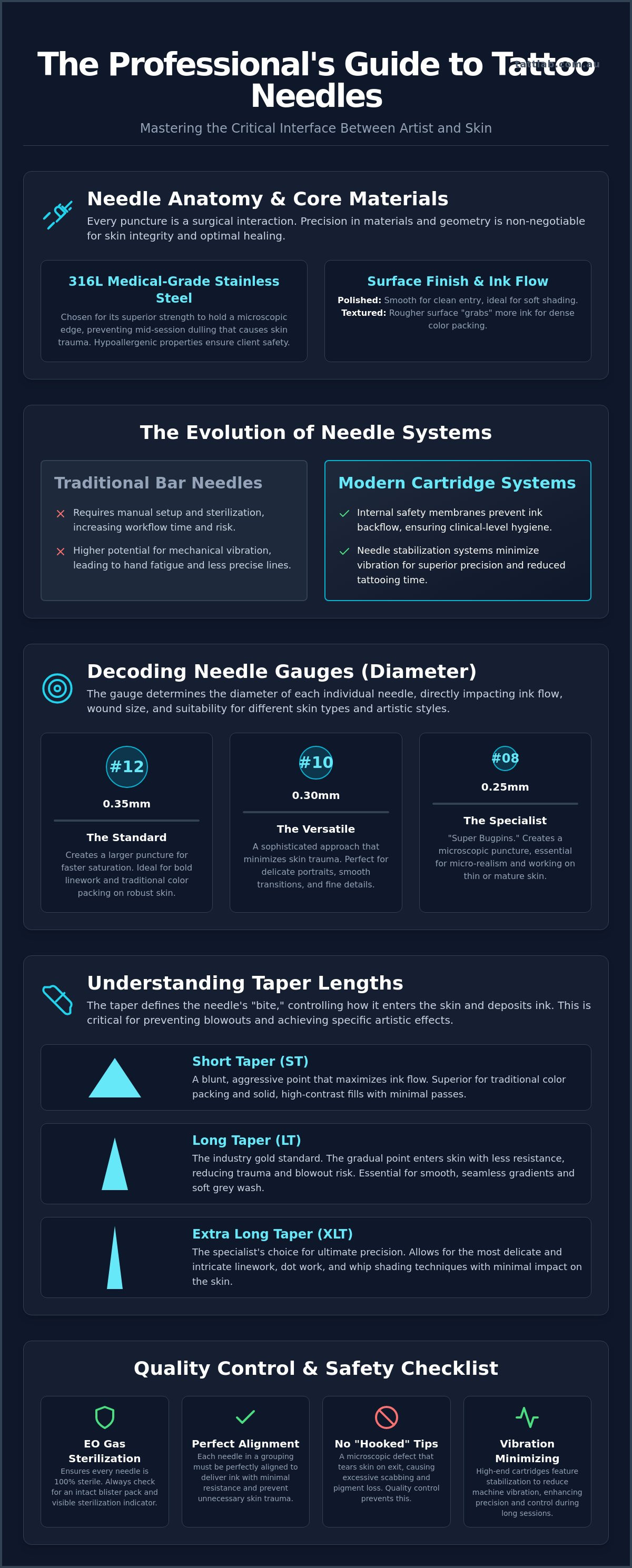
The needle is the primary interface between your vision and the client's anatomy. It isn't merely a tool; it's a surgical instrument that must perform with absolute predictability. Most professional tattoo needles are constructed from 316L medical-grade stainless steel, a material chosen for its hypoallergenic properties and its ability to hold a microscopic edge. This structural integrity is vital because a needle that loses its sharpness mid-session forces you to increase your hand pressure, which inevitably leads to skin trauma and inconsistent saturation. Every puncture is a moment of trust between you and the living canvas.
Looking back at the history of the tattoo machine, we see a steady progression toward precision. The industry has largely moved from traditional bar needles, which require manual setup and sterilization, to specialized cartridge systems. These modern cartridges feature internal membranes that prevent backflow and stabilize the needle grouping, reducing the mechanical vibration that can cause hand fatigue and shaky lines. This evolution has transformed the tattooing process into a more controlled, clinical procedure that prioritizes the physical integrity of the skin.
Quality control is where the specialist separates from the hobbyist. We have all seen the results of low-quality manufacturing. When needles aren't vetted by artists, you often find "hooked" tips or misaligned groupings. A hooked tip is a microscopic defect where the point curls back on itself. It might look fine to the naked eye, but under a loupe, it is a disaster. It tears the skin upon exit, leading to excessive scabbing that pulls pigment out during the healing phase. High-quality manufacturing ensures that every needle in a grouping is perfectly aligned to deliver ink with minimal resistance.
The Science of Ink Displacement
The way tattoo needles carry and release pigment is governed by fluid dynamics and surface tension. Polished needles have a smooth finish that allows for a clean, fast entry, making them ideal for soft shading and fine lines. Conversely, textured needles have a slightly roughened surface that "grabs" more ink, allowing for denser color packing in fewer passes. The precision of the grouping determines the capillary action that draws ink into the skin, ensuring that your gradients remain smooth and your saturation stays solid.
Sterilisation and Safety Standards
Safety is a non-negotiable pillar of professional artistry. Every needle should undergo Ethylene Oxide (EO) gas sterilization and arrive in an individual blister pack with a visible sterilization indicator. Before you begin any procedure, inspect the packaging for any breaches in integrity. For a deeper look at maintaining a sterile environment, refer to our guide on Medical Supplies for Tattoo Artists. This clinical rigor protects both the client's health and the longevity of your work, turning a technical task into a safe, transformative experience.
Decoding Needle Gauges and Taper Lengths
Mastering the technicality of tattoo needles requires a deep understanding of how physical dimensions translate into biological outcomes. The gauge represents the diameter of the individual needle wire. While #12 (0.35mm) remains the standard for traditional work and bold saturation, it creates a larger wound profile. For artists focusing on micro-realism or delicate portraits, #10 (0.30mm) and #08 (0.25mm) configurations offer a more sophisticated approach. These smaller gauges minimize the "cratering" effect in the skin, allowing for tighter groupings and smoother transitions that heal with remarkable clarity.
The taper is equally critical, as it defines the needle's "bite." A long taper (LT) is the industry gold standard for smooth, seamless gradients. Because the point is more gradual, the needle enters the skin with less resistance, reducing the risk of blowouts. This clinical precision is essential when you're building layers of soft grey wash or subtle color blends. It's about finding the balance between effective ink delivery and minimal tissue trauma. If you're looking to refine your setup, exploring our collection of professional-grade tattoo needles can provide the consistency your artistry demands.
Gauge Selection Guide
Choosing between a #10 and a #12 gauge isn't just about the size of the line. It's about the volume of ink displaced. A #12 needle allows for faster saturation because it carries a larger droplet of pigment. However, it requires a more robust skin type. For clients with thinner or more mature skin, #08 Super Bugpins are essential. These needles create a microscopic puncture that significantly reduces the inflammatory response, leading to a calmer healing process and better pigment retention in high-detail areas.
Taper Length and Application
Taper length dictates how much ink is deposited with each stroke. Short Tapers (ST) have a blunt, aggressive point that maximizes ink flow, making them superior for traditional color packing where you want high-contrast, solid fills. On the other end of the spectrum, Extra Long Tapers (XLT) are the specialist's choice for intricate linework and whip shading. Some artists also favor "Textured Tapers." These unpolished needles have microscopic ridges that hold more pigment than a standard polished needle, allowing for heavy saturation without the need for multiple passes. Following FDA safety guidelines regarding equipment sterility remains the foundation of this technical work, ensuring that your choice of taper leads to a successful, safe outcome.
Selecting the Right Configuration for Your Style
Selecting the ideal configuration of tattoo needles is a decision that balances artistic intent with biological reality. The physical arrangement of the points determines how the skin reacts to the mechanical trauma of the procedure. For instance, a 3RL (Round Liner) exerts significantly more pressure per square micron than a 15CM (Curved Magnum). This requires a more delicate touch to avoid blowouts, especially in areas where the dermis is thin. By aligning your needle choice with the specific demands of the artwork, you ensure a smoother narrative of healing and a more predictable aesthetic result.
Adhering to professional safety protocols is the foundation of this selection process. Utilizing configurations that meet OSHA's Bloodborne Pathogens Standard ensures that your studio operates with the clinical rigor necessary for high-end artistry. This commitment to safety, combined with technical knowledge of needle groupings, transforms the tattooing process from a simple procedure into a sophisticated biological interaction.
Liners and Shaders: The Precision Duo
Round Liners (RL) are engineered with tips soldered into a tight, circular formation. Tight liners are essential for intricate detail and fine-line work, while loose liners provide a slightly thicker, more traditional line weight. When your project shifts from crisp outlines to small-area saturation or bold lettering, transitioning to a Round Shader (RS) increases your efficiency. Unlike liners, the needles in a 7RS or 9RS grouping run parallel to each other. This allows for better ink flow and softer edges, making them superior for filling tight corners without overworking the tissue. To optimize your results, refer to our Guide to Tattoo Ink to ensure your pigment viscosity matches your needle choice.
The Magnum Masterclass
For large-scale color packing and smooth black and grey gradients, Magnums are the industry gold standard. These tattoo needles are arranged in two rows, allowing you to cover more surface area with fewer passes. Weaved Magnums (M1) offer a slightly more spaced grouping, which is ideal for blending and soft shading. Stacked Magnums, conversely, provide a denser grouping for heavy, solid saturation.
Curved Magnums (CM) represent a significant advancement in skin-friendly technology. By arching the needles to follow the natural curvature of the skin, these configurations prevent the edges from "digging in" and causing unnecessary trauma. This is particularly beneficial in realism, where buttery-smooth transitions are required. Using a 23CM for a large backpiece or a 9CM for a smaller portrait allows you to maintain consistent depth and saturation while respecting the physical integrity of your client's skin.
Cartridges vs. Traditional Bar Needles: A Technical Evaluation
The transition from traditional bar needles to modern cartridge systems represents one of the most significant shifts in the history of tattooing. While traditional bar needles remain the preferred choice for purists using coil machines, the cartridge system has become the industry standard for rotary and pen-style machines. This shift isn't just about convenience; it's a move toward a more modular, efficient workflow. Cartridges allow you to switch between a 3RL and a 15CM in seconds, eliminating the need for multiple machine setups and reducing the physical footprint of your workstation.
Machine safety is another area where cartridges offer a distinct technical advantage. High-quality cartridges feature a safety membrane that acts as a physical barrier, preventing ink and biological fluids from flowing back into the machine's grip or motor. This backflow prevention is essential for maintaining the clinical hygiene of your equipment. Non-membrane cartridges, while often cheaper, pose a significant risk of cross-contamination and can lead to internal machine damage over time. Choosing professional tattoo needles with a robust membrane system is a calculated decision that protects both your equipment and your client's health.
A critical factor often overlooked in technical comparisons is the stabilization of the needle grouping within the housing. In many generic cartridges, the needle has lateral play; it moves slightly from side to side as it reciprocates. This microscopic instability translates to "chatter" at the skin surface, which can compromise the sharpness of your linework. The ELITE range addresses this through an internal stabilization system that keeps the needle perfectly centered, ensuring your tattoo needles track exactly where you intend them to go. If you're ready to experience this level of mechanical precision, you can browse the full Tatt Lab Tattoo Needles collection to find the right configuration for your machine setup.
Performance Features of the ELITE Range
The ELITE range is designed with the artist's ergonomics in mind. These cartridges feature shorter tips, which brings your hand closer to the skin. This lowers your center of gravity and provides a level of grip and control that mimics the feel of a traditional pencil. By reducing the distance between your fingers and the needle point, you gain better tactile feedback from the skin. Additionally, the internal stabilization system significantly reduces mechanical vibration. This is a vital benefit during long, complex sessions, as it minimizes hand fatigue and allows you to maintain consistent pressure from the first hour to the last.
Making the Switch to Cartridges
Transitioning to a cartridge system requires ensuring compatibility with your current rotary pen or cartridge-specific grip. While the initial cost per needle is higher than traditional bars, the reduction in setup time and the elimination of complex sterilization processes often result in a more profitable workflow. You save time on tube cleaning and autoclave cycles, allowing you to focus entirely on the artistry. It's a progression toward a more streamlined, professional studio environment where technical reliability is a given, not a variable.
The Tatt Lab Standard: Premium Needles for Australian Studios
Tatt Lab is built on the principle that the equipment you use should be as refined as your technique. Being an artist-owned supplier changes the procurement process from a simple transaction into a professional endorsement. We don't just stock tattoo needles; we stress-test them in our own studios to ensure they meet the clinical and aesthetic standards our industry demands. From the dependable geometry of our Traditional Round Shaders to the advanced engineering of the Elite III range, every configuration is selected to provide predictable, high-performance results. This methodical vetting process ensures that when a needle touches the skin, it performs exactly as intended.
Efficiency in a modern studio requires a streamlined supply chain. We understand the pressure of a fully booked week and the necessity of having reliable equipment on hand. Our one-stop-shop approach allows Australian artists to source everything from stencils to specialized cartridges in a single order. By maintaining a deep inventory and offering express nationwide shipping, we ensure that your creative flow is never interrupted by logistics. It's about providing a sense of controlled progress, where your focus remains on the client rather than the supply cabinet. This reliability builds immediate trust, allowing you to focus on the liberating narrative of personal transformation you provide for your clients.
Standalone Products for Your Kit
Precision requires different tools for different philosophies. For those utilizing high-end rotary machines, the Elite EVO Cartridges represent a pinnacle of current needle technology. They offer unparalleled stability and ink flow for the most demanding realism and fine-line projects. If you operate a classic coil setup, our Traditional Round Shader 10-packs provide the consistent "bite" and durability required for bold, traditional work. We also carry AVA Tattoo Supply, which offers exceptional value for daily studio operations without compromising on the clinical standards necessary for safe skin interaction. Every product in our catalog is a reflection of our commitment to physical integrity and aesthetic excellence.
Join the Tatt Lab Professional Community
We view our relationship with Australian studios as a dedicated partnership. By setting up a wholesale account, you can access bulk needle orders and studio-specific discounts that help manage your overheads without sacrificing quality. For artists in the local area, our click-and-collect service provides immediate access to essential gear, while our fast express shipping covers the rest of the country. This accessibility ensures that every artist, regardless of their location, can maintain the Tatt Lab standard of excellence. When you choose your tattoo needles from a source that understands the biological and technical nuances of the craft, you are investing in the long-term success of your artistry and the safety of your clients.
Shop the Full Range of Professional Tattoo Needles at Tatt Lab
Refining Your Technical Precision
Mastering the physics of ink delivery is a career-long progression that separates the technician from the specialist. By aligning your choice of tattoo needles with a deep understanding of taper lengths and gauge diameters, you ensure that every procedure respects the physical integrity of the skin. This methodical approach doesn't just improve the immediate saturation of your work; it fosters a predictable healing process that preserves the clarity of your vision for years to come.
As an artist-owned and operated supplier, we understand that technical consistency is the backbone of a successful studio. Whether you're transitioning to the stabilized ELITE range or maintaining a traditional setup, your equipment should never be a variable in your performance. We support your growth with express nationwide shipping across Australia and offer free shipping on orders over $100 to keep your workflow uninterrupted. Your commitment to these technical nuances reflects a deep respect for the craft and the physical safety of your clients.
Browse the Professional Tattoo Needle Collection
Your journey toward absolute precision is a narrative of constant improvement. We're honoured to provide the tools that help you translate your creative vision into a lasting legacy of self-assurance and artistry.
Frequently Asked Questions
What is the difference between a #10 and a #12 tattoo needle gauge?
The primary difference lies in the diameter of the individual needle wires, with #10 measuring 0.30mm and #12 measuring 0.35mm. A #12 gauge is the industry standard for traditional work because it carries more pigment and allows for faster saturation. In contrast, #10 needles offer a more refined puncture, making them the preferred choice for artists who prioritize soft gradients and intricate detail over speed.
Can I use needle cartridges with a traditional coil tattoo machine?
You can use tattoo needles in cartridge form with a coil machine by attaching a specialized cartridge-compatible grip. This setup allows you to maintain the classic power and hit of a coil machine while benefiting from the rapid configuration changes that cartridges provide. It’s an effective way to modernize your workflow without abandoning the mechanical feedback that many purists still value for their daily craft.
What are the best tattoo needles for fine-line work?
The best needles for fine-line work are typically Round Liners in smaller gauges, specifically #10 (0.30mm) or #08 (0.25mm) Bugpins. These tight groupings minimize skin resistance and allow for high-precision linework that stays crisp over time. Using a long taper with these smaller gauges further reduces the risk of blowouts, ensuring that delicate geometric or micro-realism designs maintain their physical integrity during the healing process.
How do I know if a tattoo needle is properly sterilised?
You can verify sterilization by inspecting the Ethylene Oxide (EO) gas indicator strip on the individual blister pack. This indicator changes color once the sterilization process is complete. Always examine the packaging for any punctures or breaches before use. At Tatt Lab, we ensure every needle in our collection meets these clinical standards, providing you with the peace of mind necessary to focus on your artistry.
What is the benefit of using a Curved Magnum (CM) needle?
Curved Magnums feature a slightly arched grouping that mimics the natural curvature of the skin, preventing the outer needles from digging in too deep. This design is superior for achieving buttery-smooth gradients and soft shading in realism. By distributing pressure more evenly across the grouping, these tattoo needles reduce tissue trauma and eliminate the harsh "edge" lines often associated with traditional flat or straight magnums.
Why are some tattoo needles described as "Bugpins"?
"Bugpin" is a specialized term for needles made from much thinner wire, typically #08 (0.25mm) or #06 (0.20mm). Because the individual needles are smaller, they can be grouped more tightly together. This allows for incredibly smooth, photo-realistic shading and micro-detail that isn't possible with standard gauges. They are essential for artists who want to create soft, charcoal-like textures on a living canvas.
How often should I change my tattoo needle during a long session?
You should change your needle immediately if you notice a decrease in ink flow or any microscopic "hooking" at the tip. For sessions lasting longer than four hours, many specialists prefer to swap to a fresh cartridge to maintain absolute sharpness. This proactive approach ensures that the skin is treated with the utmost care, preventing unnecessary inflammation and ensuring the final result remains vibrant and clear.
Do Tatt Lab needles fit all standard tattoo machine grips?
Our needle cartridges are engineered with a universal fit that is compatible with all standard rotary pens and cartridge-compatible grips. Similarly, our traditional bar needles adhere to industry-standard dimensions for use with standard tubes and coil machine setups. This compatibility ensures that you can integrate Tatt Lab's artist-vetted configurations into your existing kit without any technical friction or the need for proprietary equipment.


Comments (0)
There are no comments for this article. Be the first one to leave a message!