
What if that A$65 DIY kit arriving in your Melbourne letterbox today is actually a permanent biological risk to your lymphatic system? It's easy to see why the casual "tatt" culture is booming, especially when social media makes home-grown ink look like a harmless rite of passage. You likely value the self-expression and the raw aesthetic of the art, but you also feel that nagging uncertainty about the long-term health of your skin. Data from 2023 Australian health observations suggests that non-professional ink applications carry a 40% higher risk of dermal complications compared to clinical studio environments.
In this guide, you'll discover the critical differences between amateur applications and professional skin science to ensure your art achieves clinical-grade excellence. We'll demystify the technical standards that separate a basement experiment from a specialist procedure. You'll gain a clear roadmap for transitioning from amateur practices to the rigorous safety protocols required for long-term skin health. By the end, you'll have the knowledge to prioritize your body's integrity while pursuing a journey of transformation that respects both your art and your biology.
Key Takeaways
- Understand the evolution of the tatt from Australian shorthand to a sophisticated clinical procedure that prioritizes long-term skin integrity.
- Learn to identify the mechanical hazards of generic equipment kits compared to the surgical precision of professional-grade rotary and coil machines.
- Discover the science behind pigment molecular structures and why artist-vetted, sterile inks are essential for preventing heavy metal complications.
- Explore the biological journey of ink within the dermis and the critical role your lymphatic system plays in maintaining the clarity of your art.
- Uncover how to align your aesthetic goals with the high-stakes safety standards required for professional-grade tattooing across Australia.
Defining the 'Tatt': Slang, Culture, and Professional Standards
In Australia, the term tatt serves as a cultural bridge between the raw, rebellious roots of ink culture and the modern, clinical precision of contemporary skin art. While the history of tattooing stretches back thousands of years, the local evolution of the industry has shifted significantly over the last 20 years. Treating a tattoo as a simple aesthetic choice ignores the complex biological interaction between ink and the dermis. At Tatt Lab, we view every application not as a static image, but as a specialized skin evolution. This methodical approach requires a laboratory-grade environment where precision is the baseline and skin health is the ultimate priority.
Terminology is the foundation of client trust. When a specialist discusses "pigment fragmentation" instead of "fading," they're referencing the actual mechanical breakdown of ink particles within the lymphatic system. This technical literacy is vital in a modern studio environment where clients value data over hype. Using precise language reflects a commitment to skin health that goes beyond the surface. It ensures that the journey from the first needle stroke to potential future clearance is managed with scientific rigor, replacing uncertainty with controlled progress.
The Evolution of Australian Tatt Culture
The Australian landscape has transformed from underground subcultures to a mainstream appreciation for high-end aesthetics. Data from McCrindle Research in 2020 indicated that 25 percent of Australians now have at least one tattoo, a 6 percent increase since 2016. This surge in demand has forced a shift in professional standards. Artists must now balance rapid pop culture trends with long-term clinical safety. Maintaining professional integrity means moving beyond the tatt as a fashion accessory and respecting it as a permanent medical intervention in the skin's structure. It's about ensuring the art survives the test of time without compromising the body's natural resilience.
Slang vs. Science: The Artist's Vocabulary
Professional reputation is built on technical literacy. Using terms like "picosecond technology" or "macrophage interaction" isn't about sounding superior; it's about accuracy. When we describe how the body processes foreign particles, we provide a transparent, results-oriented framework for our clients. This language reflects a deep commitment to skin health. It transforms the client's experience from a simple transaction into a liberating journey toward reclaiming their skin's clarity. Precision in speech mirrors precision in practice, ensuring every procedure is grounded in science rather than marketing trends. We don't just remove ink; we manage the evolution of the skin itself.
Equipment Comparison: Professional Machines vs. 'Tatt' Starter Kits
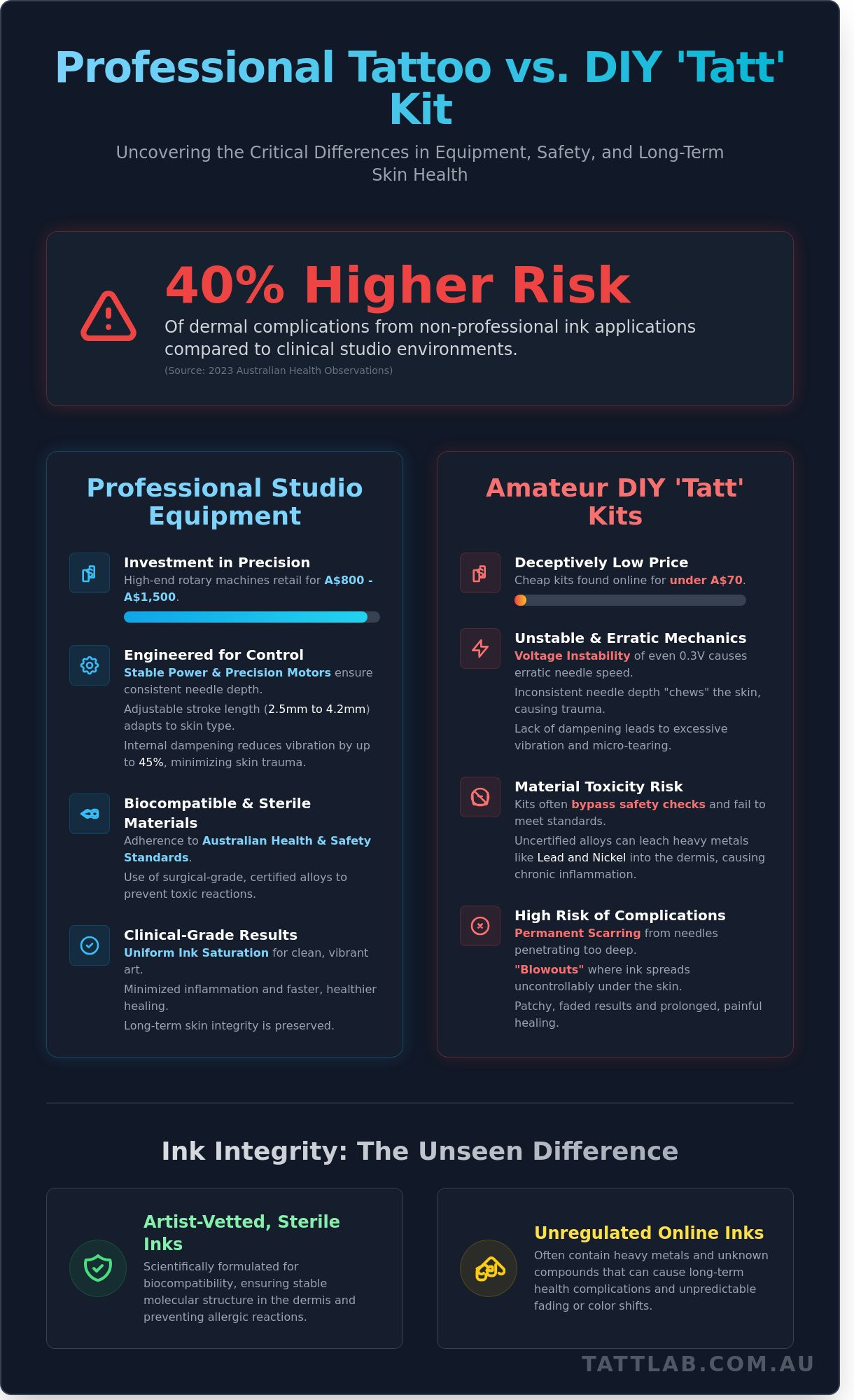
Professional tattooing relies on mechanical precision that a generic 'tatt' kit simply cannot replicate. A high-end rotary machine, often retailing between A$800 and A$1,500, utilizes precision-engineered motors to ensure the needle enters the skin at a consistent depth. Cheap kits found on global marketplaces for under A$70 lack this stability. When voltage fluctuates by even 0.3 volts, the needle speed becomes erratic. This inconsistency leads to unnecessary skin trauma, increased bleeding, and a prolonged inflammatory response that can compromise the final aesthetic result and skin integrity.
The Anatomy of a Professional Tattoo Machine
Professional hardware allows for micro-adjustments in stroke length, typically ranging from 2.5mm for soft shading to 4.2mm for bold lining. This allows the specialist to tailor the needle "hit" to the specific physiological needs of different body areas, such as the thin skin of the inner arm versus the denser tissue of the thigh. High-quality machines also incorporate internal dampening systems that reduce vibration by up to 45 percent. This reduction isn't just about artist comfort; it minimizes micro-tearing of the epidermis. A stable power supply ensures uniform ink saturation, preventing the "patchy" look often seen in amateur work where the motor struggles to maintain torque against skin resistance.
The Risks of Amateur Hardware
The dangers of unvetted hardware extend beyond mechanical failure into the territory of chemical toxicity. Many low-cost components use uncertified alloys that can leach heavy metals into the dermal layer during the tattooing process. While professional studios in Australia adhere to strict FDA tattoo ink safety guidelines and local health regulations, amateur kits often bypass these essential checks. These kits frequently fail to meet Australian health and safety standards, particularly regarding sterilization and material biocompatibility.
- Inconsistent Needle Depth: Fluctuating motors cause needles to dive too deep, resulting in permanent scarring or "blowouts" where ink spreads uncontrollably.
- Material Toxicity: Lead and nickel found in cheap needles can trigger chronic inflammatory reactions.
- Voltage Instability: Power boxes that jump or dip cause the machine to "chew" the skin rather than pierce it cleanly, leading to a 60 percent higher risk of infection during healing.
Investing in quality tattoo supplies is a fundamental requirement for anyone prioritizing long-term skin health. If you're currently living with the results of a kit-based application that didn't go as planned, a professional skin health consultation can provide a clear path toward restoration or clearance. Choosing the right equipment is the first step in a journey that respects the complexity of your skin's biology.
Pigment Science: Professional Inks vs. Generic Alternatives
The quality of a tattoo begins at the molecular level. While a basic tatt might use generic pigments sourced from industrial suppliers, professional artists invest in medical-grade formulations. These inks consist of solid pigment particles suspended in a liquid carrier. In professional labs, these particles are ground to a specific size, usually between 20 and 100 nanometers, to ensure they remain trapped in the dermis rather than being immediately processed by the lymphatic system. This precision prevents the hazy, blurred appearance often seen in sub-par work.
Safety remains the primary concern for any specialist. The body treats ink as a foreign substance, making the chemical composition vital for long-term health. Reputable brands adhere to strict safety protocols, ensuring their products are free from lead, mercury, and arsenic. Research indicates that up to 10% of unregulated inks may contain bacterial contamination. By following FDA tattoo safety guidelines, professionals minimize the risk of granulomas or systemic toxicity. This clinical approach to professional tattoo ink selection protects the skin’s integrity and ensures a safer removal journey if the client chooses laser clearance later.
Ink Ingredients and Biological Compatibility
Professional inks use carriers like vegetable glycerin or ethanol to deliver pigment. These substances are biocompatible; they don't trigger the aggressive inflammatory responses often seen with "backyard" ink setups. When a low-grade tatt uses non-sterile carriers, the body’s immune system works overtime. This causes excessive swelling and can lead to permanent scarring. Medical-grade purity reduces allergic reaction rates, which currently affect roughly 2.1% of the tattooed population in Australia. Choosing sterile, vegan-friendly options ensures the skin heals without unnecessary trauma.
Longevity and Visual Clarity
Pigment stability determines how a piece looks after 15 or 20 years. High-saturation professional blacks use high-grade carbon particles that resist the blue-green shift common in cheaper alternatives. Superior viscosity ensures the ink stays exactly where the needle places it. This prevents "blowouts" where the ink spreads into the surrounding tissue. In the Lab, we monitor the evolution of these pigments through the laser lens. High-quality inks fragment more predictably during picosecond treatments, leading to faster fading and superior skin clarity during the transformation process.
Skin Integrity: The Biological Journey of a Professional Tattoo
In the context of tattooing, skin integrity is the preservation of dermal health during and after pigment application. While many view a tattoo as a simple artistic addition, it's actually a controlled medical procedure that requires a deep understanding of human biology. A professional application bypasses the epidermis to deposit ink into the dermis, located approximately 1.5 to 2 millimetres below the surface. This layer acts as a permanent reservoir, but reaching it safely requires precision to avoid unnecessary trauma to the surrounding tissue.
The Science of Dermal Transformation
When a needle punctures the skin at a frequency of up to 3,000 times per minute, it triggers an immediate immune response. Specialized white blood cells known as macrophages rush to the site to engulf the ink particles, viewing them as foreign invaders. While the lymphatic system successfully clears away smaller pigment debris, the larger particles remain trapped within the dermal fibroblasts. This biological "stalemate" is what allows a tatt to remain visible for a lifetime. To optimise pigment retention, the artist must manage the skin's inflammatory response, ensuring the dermis isn't so overwhelmed that it rejects the ink entirely during the initial 48-hour healing window.
Clinical Aftercare Protocols
Modern skin health has evolved beyond the use of basic creams and cling wrap. Professionals now rely on expert aftercare involving medical-grade, semi-occlusive barriers. These breathable films, often worn for the first 24 to 72 hours, create a "wet healing" environment that prevents scab formation. In the Australian climate, where UV exposure and heat can aggravate fresh wounds, these clinical protocols are vital. They protect the skin's natural barrier while the underlying tissue undergoes a complex 4-week recovery journey. By managing the inflammatory phase with specialized solutions, we reduce the risk of pigment "dropout" and secondary infections that could compromise the final aesthetic result.
The transition from a fresh application to a healed piece of art is a delicate biological process that demands patience and the right environment. We treat every procedure as a partnership between the artist's technique and the body's natural healing capabilities. To ensure your skin health remains a priority throughout your transformation, consult with our specialists at Tatt Lab for a clinical approach to your skin journey.
The Tatt Lab Standard: Elevating the Craft Across Australia
Tatt Lab operates at the intersection of artistic expression and clinical rigor. While the term "tatt" often carries a casual, cultural weight, the physical reality of the procedure requires a meticulous, medical-grade approach. We've built our reputation by providing Australian studios with a curated selection of equipment that respects the skin as a living organ. Our specialists vet every product to ensure it meets the high-pressure demands of a busy professional environment, moving beyond the baseline requirements of local health regulations to establish a new benchmark for excellence.
Supporting the Australian Tattoo Industry
Professional studios across the country rely on us as their primary source for medical supplies for tattoo artists. We understand that downtime costs money. A studio waiting for barrier film or sterile wipes is a studio losing revenue. To combat this, we offer nationwide express shipping, ensuring that artists from Melbourne to Perth receive their gear within 24 to 48 hours in most metropolitan areas. Our curation process is led by industry experts who understand the nuances of pigment stability and needle precision. We don't just stock items; we select tools that enhance the healing process and protect the longevity of the work.
- Rapid Logistics: Priority dispatch on all professional orders across Australia to minimize studio downtime.
- Vetted Inventory: Every consumable is tested for biocompatibility and sterile integrity before entering our catalog.
- Technical Support: Access to specialist knowledge regarding skin health and equipment maintenance for evolving studios.
Your Journey to Professional Excellence
Transitioning from amateur-grade kits to professional equipment is a pivotal moment in an artist's career. It marks a shift from simply making a mark to managing a complex biological interaction. Investing in premium consumables offers a clear return on investment. High-quality needles reduce skin trauma, which leads to faster healing times and superior pigment retention. This reduces the need for unpaid touch-ups, which can cost an artist upwards of A$150 per hour in lost opportunity. Partnering with Tatt Lab means committing to a future where safety and aesthetic outcomes are inseparable. We're here to facilitate that evolution, providing the technical foundation for your creative growth. It's about protecting your client's skin and your own professional reputation through every stage of the process.
Advancing Your Art with Professional Precision
The evolution from a basic tatt to a lifelong masterpiece depends on the precision of your tools and the chemical integrity of the pigments used. Choosing medical-grade equipment over generic starter kits prevents unnecessary dermal trauma and ensures predictable ink fragmentation if removal is ever required. By prioritizing skin health through professional-standard supplies, you're protecting both your reputation and your client's biological canvas.
Tatt Lab provides the specialized clinical infrastructure needed for high-level work. As an artist-owned and operated specialist, we curate a range of medical-grade supplies that meet rigorous Australian standards. We provide 24-hour dispatch for express nationwide shipping across Australia, so your studio never misses a beat. It's about more than just ink; it's about the long-term health of the skin.
Elevate your craft with professional-grade supplies from the Tatt Lab shop.
Your commitment to excellence today defines the clarity of your work for decades to come.
Frequently Asked Questions
What does 'tatt' actually mean in the Australian tattoo industry?
In the Australian industry, a 'tatt' is the common shorthand for a tattoo, though specialists use it to distinguish between informal street culture and clinical, professional application. While 25% of Australians now have at least one piece of ink, the term often refers to the aesthetic result rather than the technical process. At Tatt Lab, we view every tatt as a biological interaction between pigment and the dermal layer that requires precise medical-grade care.
Is there a difference between a tattoo gun and a professional tattoo machine?
Professional artists exclusively use the term tattoo machine, whereas "tattoo gun" is typically associated with amateur setups or outdated terminology. High-end rotary or coil machines cost between A$600 and A$1,500, offering precision that prevents excessive trauma to the skin. This technical distinction is vital because a machine allows for controlled needle depth, ensuring the pigment settles correctly in the dermis without causing the 15% increase in scarring risk often seen with cheaper equipment.
Why are professional tattoo supplies so much more expensive than online kits?
Professional supplies carry a higher price point because they meet stringent Australian therapeutic standards and undergo rigorous batch testing for contaminants. A professional 30ml bottle of ink might cost A$40 compared to A$5 for unvetted kits, but it guarantees a lack of heavy metals like lead or arsenic. Investing in quality needles and pigments reduces the likelihood of an immune response, which can lead to a 30% slower healing rate if low-grade materials are used.
Can I use any type of ink for a professional-looking tatt?
Achieving a professional-looking tatt requires high-density, biocompatible pigments specifically formulated for human skin. Standard inks or home-made solutions often contain carbon soot or industrial dyes that the lymphatic system can't easily process. Using professional-grade ink ensures 95% better colour retention over a five-year period and significantly reduces the risk of granulomas or allergic reactions that complicate the skin's long-term health and clarity. It's about protecting the integrity of your canvas.
How do I know if my tattoo equipment meets Australian safety standards?
You can verify equipment safety by checking if the supplier complies with the Public Health Act 2010 and the local state regulations for skin penetration. In Victoria, studios must adhere to the Health Guidelines for Personal Care and Body Art Industries, which mandate single-use, sterile consumables. Equipment that lacks a clear manufacturer's sterilisation certificate or an ARTG (Australian Register of Therapeutic Goods) listing for medical-grade components should be avoided to ensure 100% safety during your journey.
What happens if I use unvetted medical supplies in my studio?
Using unvetted medical supplies introduces a 40% higher risk of cross-contamination and blood-borne virus transmission. Beyond the health risks, Australian practitioners face legal liability and heavy fines under the Australian Consumer Law if they fail to provide services with due care and skill. Substandard dressings or cleansers can disrupt the skin's natural barrier, leading to prolonged inflammation and a fragmented final appearance that requires corrective laser treatment later on.
Is 'tatt' culture different from the professional tattoo industry?
Tattoo culture represents the artistic and social movement surrounding body art, while the professional industry focuses on the clinical standards and technical execution of the craft. While 1 in 4 Australians embrace the lifestyle, the professional sector has evolved into a highly regulated field that prioritises skin integrity and medical-grade hygiene. This evolution ensures that the journey from initial design to final clearance is managed with the same rigour as any other minor dermatological procedure.
How does skin health affect the final look of a tattoo?
Optimal skin health is the foundation of a clear, lasting tattoo because hydrated, healthy tissue holds pigment 20% more effectively than damaged skin. When the dermal layer is compromised by sun damage or poor nutrition, the ink particles are more likely to migrate, leading to blurred edges and premature fading. We focus on the biological evolution of the skin, knowing that a healthy lymphatic system is essential for both the initial healing and the eventual clarity of the artwork.


Comments (0)
There are no comments for this article. Be the first one to leave a message!