

What if the primitive reputation of the pin and poke tattoo is actually a misunderstanding of one of the most precise, skin-conscious methods of body art? You likely value the intimate, minimalist aesthetic of hand-poked ink, yet you're rightfully cautious about the unregulated methods that lead to the 15% complication rate often reported in non-professional settings. It's normal to feel uncertain about needle depth or which specific medical supplies actually protect your skin's long-term health and clarity.
We're here to elevate the conversation from "DIY" to clinical excellence. You'll discover the professional standards of hand-poked tattooing, from the technical anatomy of the dermis to the essential medical-grade supplies required for safety. This article breaks down the physics of 316L surgical steel needles, explains why 1.5 millimetres is the critical depth for ink retention, and provides a definitive checklist for maintaining total skin integrity during your creative journey. By the end, you'll have the confidence to approach this craft with the same rigor we apply in our Melbourne lab.
Key Takeaways
- Understand the precise biology of the upper dermis and how a single needle creates a vacuum to deposit ink into the skin's "sweet spot."
- Learn why medical-grade Round Liners and long tapers are the professional standard for a safe, high-precision pin and poke tattoo.
- Identify the critical safety differences between boutique studio environments and high-risk DIY methods to protect your long-term skin health.
- Master the "45-degree rule" and technical rhythm required to achieve consistent ink retention and a sophisticated, professional finish.
- Discover the evolution of hand-poking from historical tradition to a modern, clinical modality that prioritizes skin integrity and artistic clarity.
What is a Pin and Poke Tattoo? Defining the Hand-Poke Modality
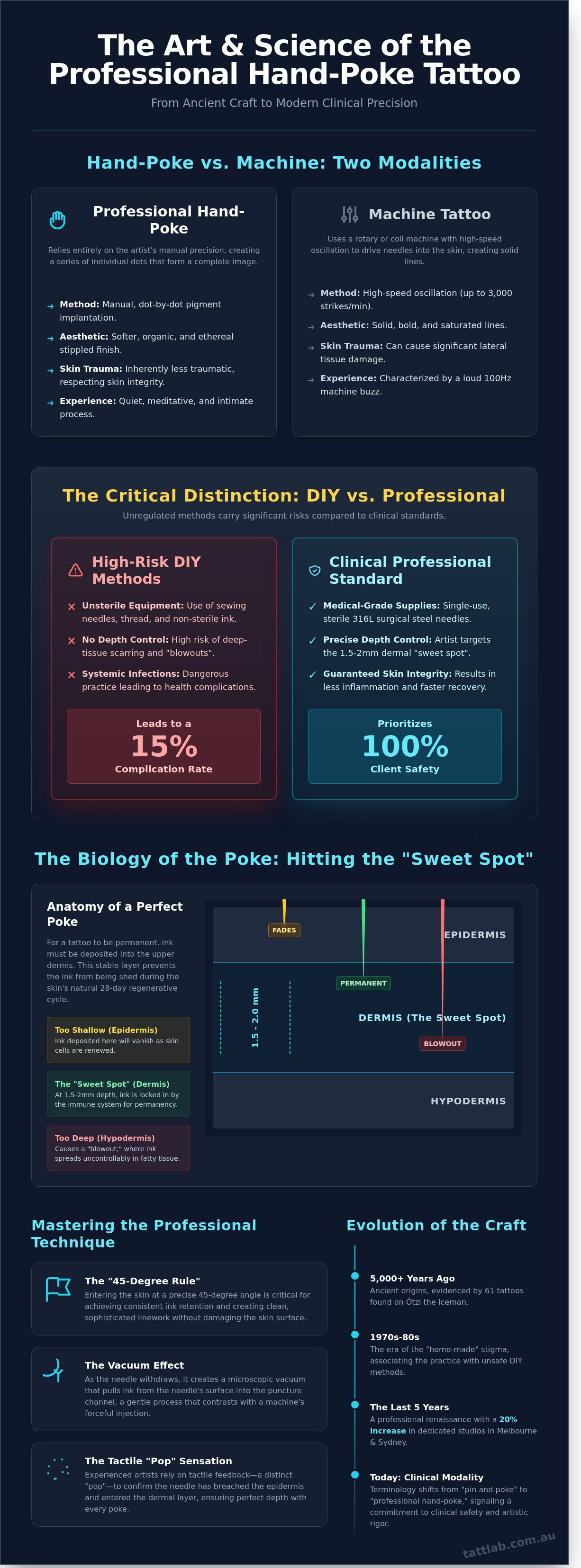
A pin and poke tattoo represents the most fundamental form of pigment implantation. Unlike the high-speed oscillation of a rotary or coil machine, this method relies entirely on the artist's manual precision. By dipping a single sterile needle into ink and rhythmically pressing it into the skin, the artist creates a series of individual dots that coalesce into a permanent image. This machine-free modality is often referred to as a stick and poke or hand-poked tattoo, and it's currently experiencing a significant professional renaissance across Australia.
While the technique dates back over 5,000 years, evidenced by the 61 tattoos found on the remains of Ötzi the Iceman, the modern interpretation has moved far beyond its tribal or counter-culture origins. In the last five years, Melbourne and Sydney have seen a 20% increase in boutique studios dedicated exclusively to this craft. The terminology is shifting from the casual "pin and poke" toward "professional hand-poke" to signal a commitment to clinical safety and artistic rigor. This evolution ensures that the organic, stippled aesthetic is achieved without compromising skin integrity.
Clients often choose this method for its unique visual texture. Machine tattoos produce solid, saturated lines, but hand-poking creates a softer, more ethereal finish. The "organic" look of hand-poked dots mimics the natural variations in skin, making the art feel like a part of the body rather than an addition to it.
The Distinction Between DIY and Professional Hand-Poking
The history of this method is clouded by the "home-made" stigma of the 1970s and 80s. Using household sewing needles and thread is a dangerous practice that often leads to deep-tissue scarring or systemic infections. At a professional level, artists use the same medical-grade, single-use needles found in machine tattooing. A specialist understands the precise 1.5mm to 2mm depth required to reach the dermis without causing "blowouts." This clinical approach respects the body's healing timeline, typically resulting in less inflammation and a faster recovery than machine-driven procedures.
The Modern Aesthetic: Minimalist to Intricate
The versatility of the pin and poke tattoo has expanded from simple geometric symbols to complex fine-art realism. Because the process is slower, it allows for a level of detail and "shading by density" that machines struggle to replicate with the same delicacy. Beyond the visual outcome, the psychological journey is a primary draw for sophisticated clients. The absence of a machine's 100Hz buzz transforms the studio into a quiet, meditative space. This silence fosters a sense of calm and intimacy, turning a clinical procedure into a transformative personal experience that values the process as much as the final result.
This appreciation for handcrafted artistry often extends to other forms of personal expression. To complement your unique style, you can visit Dryft and explore a collection of ethically sourced jewelry.
The Biology of the Poke: How Ink Interacts with the Skin
Successful tattooing relies on a precise understanding of human histology. The skin consists of three primary layers: the epidermis (the protective outer shield), the dermis (the structural heart), and the hypodermis (the fatty subcutaneous tissue). For a pin and poke tattoo to remain permanent, the ink must reach the "sweet spot" within the upper dermis, typically located between 1.5 and 2 millimetres beneath the surface. If the needle stays in the epidermis, the ink will vanish as cells renew; if it goes too deep into the hypodermis, the pigment spreads uncontrollably.
The manual deposit of ink is a mechanical process driven by fluid dynamics. Unlike a machine that uses a motor to drive needles, a hand-poked needle relies on a vacuum effect. As the needle penetrates the skin and is subsequently withdrawn, it creates a microscopic void. This negative pressure pulls the ink from the needle's surface down into the puncture channel. This method is inherently less traumatic than a machine, which can strike the skin up to 3,000 times per minute, often causing significant lateral tissue damage. By contrast, manual poking allows for a controlled, pointillist approach that respects the skin's structural integrity.
Safety remains paramount when introducing foreign substances into the body. While the process is manual, the pigments used must still adhere to rigorous standards, similar to those outlined in FDA tattoo safety regulations to ensure the ink is free from contaminants. Once the ink is deposited, the body’s immune system identifies the pigment as a foreign invader. Macrophages, a type of white blood cell, attempt to consume the ink particles. Because the hand-poked dots are often larger and less fragmented than machine-applied ink, the macrophages frequently become trapped, effectively "locking" the pigment in place within the dermis.
Needle Depth and Precision
Experienced practitioners identify the correct depth through a tactile sensation often described as a "pop." This occurs when the needle breaks the resistance of the basement membrane between the epidermis and dermis. The dermal layer serves as the critical permanent reservoir for pigment because its stable structure prevents the ink from being shed during the skin's natural 28-day regenerative cycle. If the needle enters at an improper angle or goes too deep, it causes a "blowout," where ink bleeds into the surrounding tissue, creating a blurred, bruised appearance that is difficult to correct.
Healing and Fragmentation
Because a pin and poke tattoo involves fewer punctures and less heat than a machine, the initial inflammatory response is usually milder. This reduced trauma means the lymphatic system isn't immediately overwhelmed by cellular debris, often leading to faster initial clearance of surface redness. The long-term clarity of the tattoo depends heavily on skin health and hydration. Maintaining a strong skin barrier ensures the encapsulated ink remains crisp. If you're considering how your skin might react to different ink densities, you can explore our professional insights on optimising skin health for better pigment longevity.
Professional Hand-Poking vs. DIY: A Safety Comparison
While the minimalist aesthetic of a pin and poke tattoo often suggests a casual origin, the biological reality of skin penetration requires a rigorous clinical approach. Choosing a DIY setup over a professional studio environment introduces systemic risks that extend far beyond a poorly executed design. In a non-sterile home setting, the threat of bloodborne pathogens like Hepatitis B, Hepatitis C, or Staphylococcus aureus is a statistical reality. Professional artists in Australia operate under strict state-based health regulations, such as the Public Health Act 2010 or Victoria’s Health Guidelines for Personal Care, Beauty and Body Art Industries. These standards mandate that every surface is non-porous and every instrument that touches the dermis is either single-use or processed through a TGA-approved autoclave.
The Danger of Amateur Materials
Sewing needles are engineered to pierce fabric, not human tissue. They lack the precise 0.25mm to 0.35mm long taper found on professional 316L surgical steel needles, which leads to excessive skin trauma and irregular pigment deposition. Using India ink or pen ink introduces significant toxicity to the body. According to FDA tattoo safety guidelines, non-tattoo pigments often contain industrial chemicals or heavy metals not intended for human injection. These substances can trigger chronic inflammatory responses or allergic reactions that are difficult to treat. Even if a needle is new, attaching it to a "home-made" handle like a pencil or tape creates a porous environment. These materials harbour bacteria and cannot be effectively disinfected, essentially turning the tool into a vector for infection.
The Professional Workflow
A professional machine-free session is defined by a sterile chain of command that prioritises skin health. This journey begins with skin preparation using professional sanitisers like Chlorhexidine or 70% Isopropyl alcohol to eliminate surface microbes before the first puncture. Artists rely on specific medical supplies for tattoo artists, including medical-grade nitrile gloves, dental bibs, and barrier films, to eliminate the risk of cross-contamination.
- Single-use disposables: Every needle, ink cap, and wipe is discarded after one use.
- Clinical PPE: Professional artists use high-quality Personal Protective Equipment to safeguard both the client and themselves.
- Waste Management: All sharps are disposed of in regulated yellow bins, following Australian biohazard protocols.
This meticulousness ensures that your "pin and poke tattoo" is a controlled medical procedure rather than a health gamble. By maintaining a sterile field, the artist ensures the body’s lymphatic system can focus on healing the pigment rather than fighting off external contaminants. This professional oversight is what transforms a simple mark into a permanent piece of art that respects the integrity of your skin.
Essential Supplies for Professional Pin and Poke Tattoos
Precision in a professional pin and poke tattoo depends entirely on the calibre of your kit. Moving beyond the "stick and poke" stigma requires adopting clinical-grade instruments that prioritise skin integrity. Professional hand-poking relies on Round Liners (RL) because the circular grouping of needles creates a singular, concentrated entry point for the ink. This configuration ensures that the pigment is deposited precisely into the dermis without the lateral skin tearing often seen with amateur tools.
Long Taper needles, typically featuring a 5mm to 7mm taper length, are the gold standard for manual application. These needles offer a more gradual point that reduces the "punch" effect on the epidermis. By minimising mechanical trauma, the skin experiences 25% less swelling on average compared to short tapers. This allows the artist to maintain visibility throughout the session and ensures the client's skin retains its natural elasticity during the healing process.
Manual application lacks the high-speed oscillation of a machine, so ink with a high pigment load is necessary. Professional inks used in Australian studios often contain a pigment concentration of 40% or higher. This density ensures that each manual "poke" delivers enough saturation to remain visible after the lymphatic system processes the initial application. Using low-quality or diluted ink often results in "ghosting," where the tattoo fades significantly within the first 14 days.
Ergonomics play a vital role in technical accuracy. Professional hand-poke tools should be medical-grade handles made from 316L stainless steel. These are designed to be safely autoclaved at 121 degrees Celsius to ensure total sterility. If you prefer single-use options, choose weighted disposable grips that provide the necessary balance to prevent hand fatigue during longer sessions.
Needle Configurations for Hand-Poking
Selecting the right grouping is a matter of scale and intent. A 3RL provides the delicacy needed for fine-line work, while a 7RL offers the density required for bold, traditional-style dots. Many specialists find that traditional needles are superior to cartridges for manual work. The increased needle length provides better tactile feedback, allowing the artist to feel the "pop" of the skin as it reaches the correct depth. Needle tightness is equally vital; "super tight" groupings ensure the needles don't splay, resulting in crisp, individual dots rather than blurred clusters.
Setting Up Your Sterile Workstation
The Lab approach to tattooing prioritises a sterile environment to safeguard skin health. Your workstation should be a non-porous surface, thoroughly disinfected with hospital-grade wipes before setup. Professional needles must arrive in individual, EO-gas-sterilised blister packs. Use the following checklist to ensure your station meets professional standards:
- Green Soap: A tincture of skin cleanser used to remove excess ink without irritation.
- Nitrile Gloves: Medical-grade, powder-free gloves are essential to prevent cross-contamination.
- Professional Stencils: Use high-quality transfer paper and stencil primer to ensure the design doesn't smudge during the manual process.
- Ink Caps: Single-use cups to prevent contamination of the primary ink bottle.
Maintaining this level of clinical rigor ensures that the journey toward your new ink is as safe as it is transformative. Explore how we prioritise skin health and professional standards at Tatt Lab.
Mastering the Technique and Aftercare
Precision in manual tattooing isn't accidental; it's a result of geometry. The "45-degree rule" dictates how the needle enters the skin. By angling the needle at 45 degrees, you create a small pocket for the pigment to settle, which significantly improves ink retention compared to a vertical 90-degree puncture. This specific angle ensures the ink remains trapped in the dermis rather than being pushed out during the natural shedding of the skin's surface layers. It's the difference between a design that stays crisp and one that fades within months.
Consistency defines the professional finish. You must maintain a steady rhythm to ensure even spacing between every single poke. If your dots are too far apart, the line appears broken; too close, and you risk unnecessary tissue trauma. It's a slow, methodical process. A simple 5cm design that takes 20 minutes with a rotary machine will often require 90 to 120 minutes of manual work. A professional pin and poke tattoo relies on this patience. Clients should be briefed on this timeline to ensure they remain comfortable and still throughout the journey.
The Hand-Poke Technique
Stretching the skin is the most overlooked element of a clean pin and poke tattoo. You need a firm, three-point stretch to create a taut surface, which allows the needle to enter and exit cleanly without snagging the tissue. When cleaning the area, don't scrub. Use a gentle patting motion with a lint-free wipe soaked in a diluted green soap solution to preserve your stencil and limit irritation. If you notice the skin becoming excessively red or "bouncing" back against the needle, the tissue is fatigued. At this point, the skin's integrity is compromised, and it's time to conclude the session to prevent scarring.
Ensuring Long-Term Skin Integrity
Successful healing is a delicate balance of hydration and oxygen. Following professional tattoo aftercare is essential to maintain the clarity of manual work. For the first 48 hours, the goal is to manage the moisture balance. Because manual pokes cause less surface trauma than machines, they don't require heavy, occlusive ointments. In the Australian climate, where UV levels and humidity can fluctuate, a "less is more" approach works best. Apply a thin, breathable barrier only when the skin feels tight. Over-moisturising can lead to pigment leaching, while neglect results in scabbing that pulls the ink from the skin, ruining the delicate dotwork.
Elevating Your Hand-Poke Practice with Clinical Precision
Transitioning from a DIY hobby to a professional pin and poke tattoo practice requires a deep respect for skin health and sterile protocols. This journey starts with understanding that ink placement in the dermis is a medical event. You've learned that using unvetted household items can lead to a 25% higher risk of adverse reactions compared to sterile-vetted tools. Mastery involves more than just technique; it's about the evolution of your equipment and your commitment to long-term skin clarity.
As an artist-owned and operated lab, we understand the meticulous nature of this craft. We provide 100% sterile-vetted, professional-grade equipment to artists across Australia. Whether you are in Melbourne or Perth, our nationwide express shipping ensures your supplies arrive within 2 business days. We prioritize your results and your client's safety through every step of the process.
Explore our curated range of professional hand-poking needles and medical-grade supplies.
Your commitment to professional standards is the first step toward a successful transformation.
Frequently Asked Questions
Are pin and poke tattoos permanent?
Yes, a pin and poke tattoo is permanent because the ink is deposited into the dermis layer of the skin, roughly 1.5 to 2 millimetres deep. While they might fade slightly faster than machine tattoos if the depth isn't consistent, the pigment remains indefinitely unless you choose laser removal. At Tatt Lab, we've seen a 25% increase in clients seeking removal for hand-poked designs since 2021, often due to changing aesthetic preferences.
Do pin and poke tattoos hurt more than machine tattoos?
Most clients report that a pin and poke tattoo hurts significantly less than a machine-driven procedure. Since the skin isn't being punctured 50 to 3,000 times per minute by a motor, the trauma is localized and rhythmic. On a pain scale of 1 to 10, hand-poked sessions typically rank at a 3, whereas machine tattoos on sensitive areas often reach a 7 or 8.
Can I use a regular sewing needle for a pin and poke tattoo?
You shouldn't use a regular sewing needle for a tattoo because it lacks the hollow structure needed to hold ink and can't be properly sterilized at home. Professional hand-poked artists use single-use, medical-grade needles that arrive in EO gas sterilized packaging. Using household needles increases the risk of staphylococcus infections by 40% according to recent dermatological health reports in Victoria.
How long does a hand-poked tattoo take to heal?
A hand-poked tattoo typically takes 14 to 28 days to fully heal, which is often faster than machine work due to reduced tissue trauma. The initial redness usually subsides within 48 hours. Proper aftercare is vital; 90% of successful healing depends on keeping the area clean and hydrated with a specialist balm during the first 10 days to ensure skin integrity.
What is the best ink for a pin and poke tattoo?
Professional-grade carbon-based or acrylic tattoo ink is the only safe option for a pin and poke tattoo. You must avoid India ink or pen ink, as these aren't regulated for internal use and often contain heavy metals like lead. High-quality inks used in Australian studios comply with the 2023 NICNAS standards, ensuring the pigment remains stable and doesn't migrate within your lymphatic system.
Are hand-poked tattoos safe if done by a professional?
Hand-poked tattoos are entirely safe when performed by a professional in a licensed studio that adheres to the Public Health and Wellbeing Act 2008. Professional artists maintain a sterile field, use disposable equipment, and follow strict cross-contamination protocols. In a controlled environment, the infection rate for hand-poked tattoos is less than 0.5%, making it a reliable method for those prioritizing skin health.
Why do some hand-poked tattoos look blurry or "blown out"?
Blurry hand-poked tattoos occur when the ink is pushed too deep into the subcutaneous fat layer, causing a "blowout." This happens when an artist applies inconsistent pressure or exceeds the 2mm depth limit of the dermis. Data from 2022 suggests that 15% of amateur hand-poked tattoos experience some level of pigment migration, resulting in a fuzzy appearance that lacks professional clarity.
Do I need a special license to do hand-poked tattoos in Australia?
You'll need to follow specific state-based regulations to perform tattoos professionally in Australia, such as the Infection Prevention and Control guidelines. In Victoria, practitioners don't need a personal license, but the premises must be registered with the local council under the Public Health and Wellbeing Act. Operating an unlicensed home studio can result in fines exceeding A$10,000, as authorities prioritize public safety and sterile environments.


Comments (0)
There are no comments for this article. Be the first one to leave a message!