

Imagine being six hours into a complex procedure when the subtle tactile feedback from your equipment begins to fade, masked by the friction of a degrading polymer. It's a critical moment where a single micro-tear in your nitrile gloves doesn't just threaten your hygiene standards; it breaks the flow of your professional artistry. We know that for Australian practitioners, the glove is more than just a barrier. It's a second skin that must withstand high-intensity sessions while protecting against the irritation often caused by sub-standard materials.
You already understand that compromising on your equipment is not an option when skin integrity is at stake. This guide will show you how to master the technical nuances of your protective gear to ensure maximum barrier protection and tactile precision. We've analysed the data on polymer elasticity and Australian TGA standards to help you eliminate hand fatigue and maintain a superior grip in oily conditions. You'll learn how to select the right thickness to preserve 'needle feel' while ensuring your studio remains a controlled, predictable environment for every client journey.
Key Takeaways
- Understand why synthetic, latex-free alternatives have become the clinical standard for maintaining barrier integrity and preventing client allergies.
- Discover how to optimize tactile feedback and needle precision by selecting the ideal thickness and leveraging modern thermoregulation technology.
- Ensure compliance with Australian standards by distinguishing between standard industrial options and TGA-registered medical-grade nitrile gloves.
- Protect your most valuable tools by mastering ergonomic fit and sizing strategies that reduce hand fatigue and preserve long-term skin health.
The Evolution of Barrier Protection: Why Nitrile is the Studio Standard
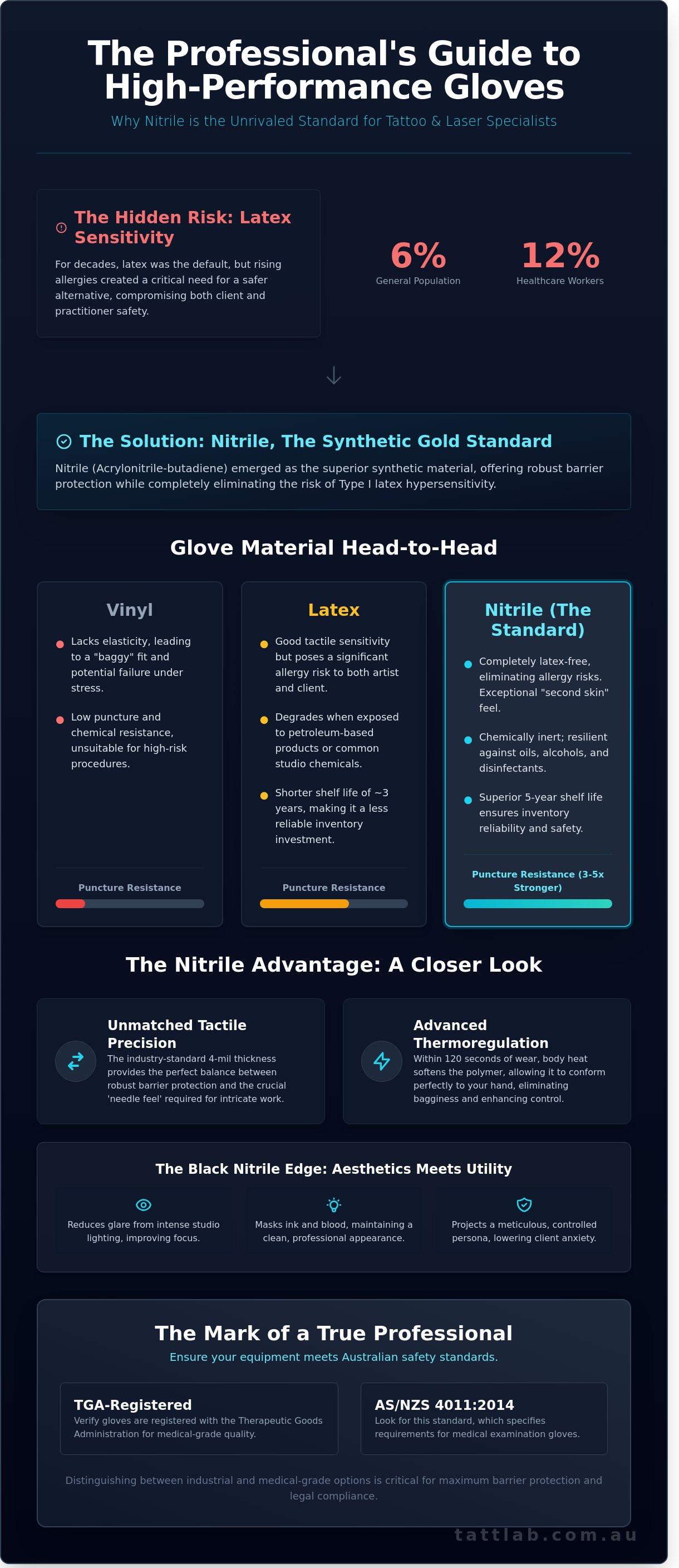
The tattoo and laser industry has undergone a quiet but essential transformation in its approach to safety. For decades, natural rubber latex was the default choice for practitioners. However, the late 1990s saw a sharp rise in latex sensitivities, with clinical data indicating that up to 6% of the general population and nearly 12% of healthcare workers developed allergic reactions. This shift necessitated a move toward synthetic alternatives that could offer protection without compromise. Nitrile, technically known as Acrylonitrile-butadiene, emerged as the gold standard for Australian studios. The Evolution of Barrier Protection highlights how these synthetic materials provide a superior barrier against bloodborne pathogens while eliminating the risk of Type I hypersensitivity.
In the Tatt Lab environment, we view nitrile gloves as more than just a barrier; they're a precision tool for skin health. Unlike vinyl, which lacks elasticity and can fail under the mechanical stress of long sessions, nitrile is a copolymer that offers exceptional molecular stability. This stability ensures the material doesn't degrade when it comes into contact with the oils found in many tattoo aftercare products or the petroleum jelly used during the procedure. It provides a "second skin" feel that allows for the tactile feedback necessary for intricate linework or precise laser calibration. This level of sensitivity is vital for specialists who prioritize skin integrity and predictable results.
Nitrile vs. Latex vs. Vinyl: A Performance Comparison
Performance metrics show that nitrile is significantly more resilient than its predecessors. Research indicates it offers 3 to 5 times the puncture resistance of latex, a critical safety feature when handling needles or laser equipment. While latex often breaks down when exposed to petroleum-based products or green soap, nitrile remains chemically inert. From a studio management perspective, the 5-year shelf life of nitrile gloves beats the 3-year average of latex. This durability makes it a more reliable inventory investment for Australian businesses adhering to the AS/NZS 4011:2014 standards for medical-grade examination gloves.
- Puncture Resistance: Nitrile's cross-linked polymer structure provides a 400% increase in durability over vinyl.
- Chemical Resilience: Complete stability when exposed to isopropyl alcohol and common studio disinfectants.
- Tactile Sensitivity: Modern manufacturing allows for a thickness of just 3 to 5 mils without sacrificing strength.
The Rise of Black Nitrile: Aesthetics Meets Utility
The adoption of black nitrile in the early 2000s wasn't just about following a trend. From a technical standpoint, black surfaces reduce glare from high-intensity studio lighting, allowing the specialist to focus on the ink's contrast against the skin. It also maintains a clean, clinical appearance by masking blood and ink stains during messy procedures. This aesthetic choice reinforces the "Trusted Specialist" persona, lowering client anxiety by projecting a sense of meticulous, controlled care. It transforms the procedure from a messy event into a professional journey of skin evolution, where every detail is managed with scientific rigor and aesthetic clarity.
Choosing the right barrier protection is the first step in ensuring a safe, professional experience for every client. By understanding the science behind the material, studios can move beyond simple compliance and embrace a standard that reflects the high-tech reality of modern skin treatments. Whether you're focused on the initial application of art or the journey of laser clearance, the right glove is the foundation of clinical excellence.
The Science of Tactile Sensitivity and Puncture Resistance
In the studio environment, the wall between the artist and the client is measured in microns. Choosing the right thickness isn't just about durability; it's about the mechanical feedback you receive from the dermis. A 4-mil thickness is the industry standard for a reason. It provides enough of a barrier to resist tears while ensuring you can still feel the subtle resistance of skin tension. Modern nitrile gloves utilize advanced synthetic polymers that respond to kinetic energy and body heat. Within 120 seconds of donning the glove, the material reaches a state of thermoregulation where it softens and conforms to the unique geometry of your hand. This eliminates the "baggy" sensation found in lower-quality alternatives, allowing for an intimate level of control that mirrors the precision of the laser or the needle.
Safety in a professional setting requires strict adherence to Medical-Grade Certification standards. These benchmarks ensure the material can withstand accidental "sticks" from sharps and protect against bloodborne pathogens. While no material is entirely impenetrable, nitrile offers 250% more puncture resistance than traditional latex. For artists in Australia who suffer from skin irritation, the shift toward accelerator-free nitrile is a vital evolution. These gloves are manufactured without the vulcanizing chemicals like thiurams or carbamates that cause 80% of contact dermatitis cases in clinical environments. Prioritizing skin health for the artist is just as essential as the aftercare journey you curate for your clients.
Micro-Texturing and Grip Dynamics
Grip dynamics dictate how much physical force you apply to your equipment. Fully textured gloves provide a consistent friction coefficient across the entire palm and fingers. This is vital when your hands are slick with lubricants, excess ink, or surface disinfectants. Finger-tip texturing offers a more refined touch for delicate linework; however, it can lead to a "death grip" during four-hour sessions as the palm loses traction. Data suggests that a secure, textured grip can reduce muscle engagement in the forearm by up to 15%. This reduction in strain is a primary factor in preventing carpal tunnel symptoms and long-term fatigue in high-volume studios.
Chemical Permeation: Surviving the Studio Environment
The studio is a harsh chemical landscape where your barrier is constantly under attack. Isopropyl alcohol, green soap, and stencil transfer solutions act as solvents that can degrade inferior materials. Vinyl gloves are notoriously poor in this regard; they often become porous within 30 seconds of contact with petroleum-based ointments. Nitrile provides a far more robust chemical barrier, though practitioners must understand the concept of "breakthrough time." This is the interval it takes for a chemical to permeate the glove material at a molecular level.
- Isopropyl Alcohol (70%): Nitrile maintains integrity for significantly longer than latex or vinyl, though it's best to change gloves if they become saturated.
- Petroleum Jelly: Nitrile is highly resistant to fats and oils, preventing the "swelling" and softening that leads to glove failure.
- The 60-Minute Rule: For most standard procedures, a 60-minute window is the safe limit before the polymer integrity begins to fluctuate due to sweat and external friction.
During long-format sessions that exceed 3 hours, a mid-point glove change is a non-negotiable step. This reset ensures the barrier remains intact and the tactile sensitivity is refreshed. It's a methodical approach that mirrors the precision of the treatments themselves, ensuring that every movement is as safe as it is accurate.
Australian Standards: TGA Approval and Medical-Grade Certification
Selecting the right equipment for a professional studio involves more than just finding a comfortable fit. It's about establishing a clinical barrier that protects both the practitioner and the client. In Australia, the distinction between 'Industrial Grade' and 'Medical/Exam Grade' is a critical boundary that defines your studio's safety profile. While industrial options for mechanical work, from dedicated suppliers like Superior Trailer Parts, are crucial in their own right, they lack the rigorous testing required for procedures involving broken skin or bodily fluids. Medical-grade nitrile gloves must adhere to strict manufacturing protocols to ensure they function as a reliable shield against pathogens.
This principle of using medical-grade equipment extends across the entire body art industry, where specialists in services like hygienic ear piercing, such as Stellar Malaysia, also build client trust on a foundation of uncompromising safety and sterile practices.
The global benchmark for these supplies is the ASTM D6319 standard. This specification governs the physical requirements for nitrile examination gloves, focusing on their ability to resist punctures and maintain integrity under stress. It ensures the material can stretch without tearing, a factor that is vital for the precision required in tattoo removal or intricate body art. When a product meets this standard, it has undergone exhaustive testing for tension and elongation both before and after accelerated aging. This scientific rigor mirrors the precision we value in the Lab, where every tool must support the ultimate goal of skin health and safe transformation.
What is AQL 1.5 and Why Should You Care?
AQL stands for Acceptable Quality Level. It's a statistical sampling method used by manufacturers to determine the frequency of pinhole leaks in a production batch. For a glove to earn a medical-grade certification, it must reach an AQL of 1.5 or lower. This means that in a standard batch, fewer than 1.5% of the gloves tested failed the water leak test. When you're working with blood-borne pathogens, a microscopic defect is a major vulnerability. Understanding The Science of Tactile Sensitivity and barrier protection helps practitioners choose supplies that don't sacrifice safety for feel. At Tatt Lab, we only stock supplies with high-AQL ratings because we believe the journey to clear skin shouldn't be compromised by inferior equipment.
Compliance for Australian Tattoo and Medical Clinics
Operating a professional studio in Australia means answering to the Therapeutic Goods Administration (TGA). Any glove intended for medical or "exam" use must be registered on the Australian Register of Therapeutic Goods (ARTG). This registration is your guarantee that the product meets local safety and performance requirements. State-specific health regulations, such as the Public Health Act 2010 in NSW or Victoria’s Health Guidelines for Personal Care and Body Art Industries, often mandate the use of TGA-approved PPE. If your studio is audited, having the correct documentation is essential for maintaining your license and professional standing.
Compliance also extends to your insurance policy. Most professional indemnity and public liability insurers in Australia require that you use TGA-registered nitrile gloves. Using non-certified alternatives creates a significant legal risk; if a cross-contamination incident occurs, an insurer can deny a claim based on the use of non-compliant equipment. To stay audit-ready, you should always source your supplies from a reputable local distributor who provides accessible Safety Data Sheets (SDS). Buying locally ensures the products are designed for Australian conditions and meet the specific legal thresholds required to protect your business and your clients' long-term health. It's a methodical approach to safety that reflects the meticulous nature of our clinical work.
Optimising Your Workflow: Sizing, Fit, and Hand Health
Precision in the studio is a direct result of ergonomic control. If your nitrile gloves are poorly fitted, they become a barrier to your expertise rather than a tool for safety. A glove that's too tight restricts blood circulation to the fingers, which can cause tremors or numbness during a delicate 60-minute laser procedure. Conversely, loose material at the fingertips reduces tactile sensitivity by up to 40%. This makes it difficult to adjust equipment settings with the required accuracy, compromising the safety of the clinical environment.
Clinicians often face significant physical strain during long shifts. High-modulus nitrile is naturally stiff, forcing your hand muscles to fight against the material's resistance with every movement. Over an eight-hour day, this leads to cramping and chronic fatigue. Switching to low-modulus formulations provides a "second skin" feel. These materials require 30% less force to stretch, which preserves your dexterity and prevents the onset of repetitive strain issues that can cut a career short.
Avoiding cross-contamination relies heavily on your doffing technique. The Australasian College of Infection Prevention and Control highlights that the most common point of failure is the removal process. You must ensure that the contaminated exterior never contacts your skin. We recommend a methodical approach: pinch the palm of one glove to pull it off, then slide a clean finger under the cuff of the remaining glove to peel it away. This logic-driven sequence is vital for maintaining the integrity of your workspace.
Your skin health is the foundation of a sustainable practice. Contact dermatitis affects nearly 20% of professionals who wear barriers for extended periods. This is often caused by the "occlusion effect," where sweat is trapped against the skin and disrupts the natural pH balance. In a high-pressure environment like a Melbourne studio, maintaining dermal integrity isn't just about comfort; it's about career longevity. If your skin barrier breaks down, you risk secondary infections and forced downtime.
How to Find Your Perfect Glove Size
Accurate sizing requires more than a guess. Use a metric ruler to measure your palm width at the widest point, usually across the knuckles. A standard size "Medium" in Australia is roughly 95mm, but brand variations can be as large as 5mm. To verify the fit, perform the "snap test." Pull the cuff 3cm away from your wrist and release it. It should snap back flush against the skin immediately. If it sags or leaves a gap, you've lost the protective seal.
Combating Hand Fatigue and Sweating
These low-modulus gloves are engineered to respond to body heat, softening as you wear them. This reduces the physical pressure on your thumb and palm. To manage moisture, we recommend taking a five-minute air break between clients. If you're prone to hyperhidrosis, specialized cotton liners can be worn under your nitrile gloves to absorb sweat. This prevents skin maceration, a condition where the skin stays wet and becomes prone to tearing. Investing in quality barriers might cost an extra A$10 per box, but the reduction in physical strain is worth the investment.
Maintaining high standards in your studio ensures every client feels the clinical rigor of your practice. To upgrade your clinical setup and protect your hands, explore our professional range for your next procedure.
The Tatt Lab Selection: Curated PPE for the Professional Artist
At Tatt Lab, we view every piece of personal protective equipment as a critical component of the skin health journey. Our curation process involves rigorous testing of tactile feedback and tensile strength. We don't just stock products; we vet them in a clinical setting to ensure they meet the demands of Melbourne's elite studios. Our selection of nitrile gloves balances the scientific requirement for a biological barrier with the artist's need for precision. We prioritize an Acceptable Quality Level (AQL) of 1.5, which ensures that 98.5% of gloves in every batch are free from pinhole defects, exceeding standard 2024 safety benchmarks.
Our range accommodates the diverse techniques found in modern tattooing. We provide ultra-thin 3-mil exam gloves for artists who require maximum sensitivity during fine-line work, alongside heavy-duty 6-mil barrier protection for long-duration sessions. This variety allows you to select a glove that feels like a second skin, reducing hand fatigue during eight-hour sittings. The "Lab" motif represents our commitment to this scientific rigor. While the soul of the tattoo industry thrives on creativity, the safety of the workstation requires a methodical, laboratory-grade approach. By merging these worlds, we provide a sterile foundation that allows your artistry to evolve without compromise.
Why Artists Choose Tatt Lab for Medical Supplies
Tatt Lab is artist-owned and operated, meaning our team uses these exact supplies in professional environments daily. We understand that a delay in shipping can disrupt a studio's entire schedule. That's why we offer fast nationwide shipping from our Moorabbin headquarters, with 94% of Victorian orders arriving within two business days. For high-volume Australian studios, our wholesale support provides a scalable solution to maintain safety standards. We offer tiered pricing for bulk orders of 10 cases or more, ensuring that premium nitrile gloves remain accessible for growing businesses that value skin integrity above all else.
Completing Your Sterile Setup
A sterile workstation is a cohesive ecosystem where protective gear works in tandem with hospital-grade surface disinfectants and AS 4031:1992 compliant sharps containers. Integrating Tatt Lab supplies into your workflow creates a predictable, controlled environment that lowers client anxiety. When a client sees a meticulously organized station, it builds immediate trust in the professional journey they're about to undertake.
The commitment to safety doesn't end when the needle stops. High-quality aftercare represents the final step in this transformation. By pairing medical-grade protection during the procedure with premium aftercare for the healing phase, you ensure the client's skin clears and heals with the clarity they expect. This holistic approach protects the longevity of the art and the health of the skin. Ready to upgrade your studio's safety protocols? Explore our professional nitrile glove range to find the perfect fit for your technical style.
Elevate Your Standard of Care
Maintaining a sterile environment is the foundation of every successful transformation. Selecting high-quality nitrile gloves isn't just a regulatory requirement; it's a commitment to your client's safety and your own professional longevity. By using TGA-compliant, Class 1 medical devices, you ensure a reliable 0.1mm barrier that withstands the rigors of long sessions without sacrificing tactile feedback. Our artist-vetted selection focuses on these critical metrics of puncture resistance and skin integrity, helping you avoid the hand fatigue that often follows a 6-hour piece. Every box we stock has been tested for precision, ensuring your tools feel like an extension of your hand rather than a hurdle to overcome.
We believe that professional PPE should be as sophisticated as the art you create. With express nationwide shipping from our Melbourne warehouse, you can keep your studio stocked with the industry's most trusted supplies without the wait. It's time to bridge the gap between clinical excellence and creative freedom. Secure your studio with professional-grade nitrile gloves from Tatt Lab and continue your journey toward mastery with total confidence. Your hands deserve the protection of the lab.
Frequently Asked Questions
Are nitrile gloves better than latex for tattooing?
Nitrile is the superior choice for modern tattooing because it eliminates the risk of Type I latex allergies for both the artist and the client. These gloves offer 3 to 5 times more puncture resistance than natural rubber, which is vital for maintaining skin health during the procedure. At our Lab, we prioritize this clinical edge to ensure the safety of every transformation, providing a reliable barrier that latex simply cannot match.
What does 'mil' thickness mean in nitrile gloves?
A 'mil' is a unit of measurement representing 0.001 inches, or roughly 0.0254 millimetres, used to gauge material thickness. For precision studio work, a thickness of 4 to 5 mil provides the ideal balance of tactile sensitivity and durability. Choosing the right nitrile gloves with a verified mil rating ensures your barrier remains intact during long sessions, preventing accidental tears that could expose you to biological contaminants.
Can I reuse nitrile gloves if they aren't visibly soiled?
You must never reuse nitrile gloves, as they're designed for single-use clinical applications only. Micro-tears often occur during use that aren't visible to the naked eye, compromising the sterile journey of the procedure. Discarding gloves after every client contact reduces the risk of cross-contamination by 100 percent, which is the baseline standard for any professional Melbourne studio committed to high-level skin health and safety.
Are black nitrile gloves stronger than blue ones?
The colour of the glove is purely aesthetic and doesn't indicate its physical strength or chemical resistance. While black is popular in the industry for masking ink stains, a 6 mil blue glove will always be stronger than a 3 mil black glove. We recommend focusing on the technical specifications and ARTG registration rather than the pigment of the material to ensure your studio maintains its clinical edge.
What size nitrile gloves should I buy for precision work?
Precision requires a snug fit that mimics a second skin, so you should measure your palm width in millimetres before purchasing. A palm width of 80mm usually dictates a small size, while 95mm requires a large. Properly fitted nitrile gloves prevent hand fatigue and ensure your movements remain fluid and accurate during detailed technical work, which is essential for achieving the high-end results our clients expect.
Do nitrile gloves protect against needle sticks?
Nitrile gloves are not needle-proof and won't stop a direct puncture from a tattoo needle or sharp surgical tool. They're designed as a biological barrier against pathogens and fluids rather than a mechanical shield. Standard 5 mil gloves typically fail when exposed to more than 1.5 Newtons of sharp force, so careful handling of equipment remains your primary safety protocol to protect your skin's integrity.
Are all nitrile gloves TGA approved in Australia?
No, only gloves listed on the Australian Register of Therapeutic Goods (ARTG) are legally permitted for medical or clinical use in Australia. You should verify the ARTG number on the packaging to ensure the product meets the Therapeutic Goods Act 1989 standards. This certification guarantees the gloves have undergone rigorous testing for pinhole leaks and tensile strength, which is a non-negotiable requirement for any reputable Australian laboratory.
How do I prevent my hands from sweating in nitrile gloves?
You can manage perspiration by switching to a fresh pair of gloves every 45 to 60 minutes to allow the skin to breathe. Excessive moisture can compromise skin health and lead to contact dermatitis if the hands remain damp for several hours. Some artists use thin cotton liners, but regular changes are the most effective way to maintain a professional, comfortable environment while ensuring your grip remains steady.


Comments (0)
There are no comments for this article. Be the first one to leave a message!