
With 40% of individuals aged 18 to 34 now carrying at least one piece of permanent art, the biological responsibility resting on your studio has never been more significant. Maintaining a rigorous tattoo studio cleaning checklist isn't just about passing a health department audit; it's about honoring the deep trust your clients place in your clinical precision and professional integrity. You likely feel the weight of this responsibility every day, especially with the increased enforcement of health standards seen throughout 2026. It's common to feel anxious about whether your disinfectants are truly effective against evolving bloodborne pathogens while the clock ticks down between sessions.
We understand that you're balancing the role of an artist with the duties of a health professional. This article will help you master the rigorous hygiene protocols and essential medical-grade supplies required to maintain a sterile, compliant, and professional Australian tattoo studio. We'll provide a clear, repeatable workflow that incorporates the March 24, 2026, OSHA Bloodborne Pathogens Standard updates. You'll gain a comprehensive preview of the daily, weekly, and session-based tasks that transform your workspace into a controlled environment where science meets art, ensuring every client leaves with a result that's as safe as it is beautiful.
Key Takeaways
- Understand the updated 2026 clinical standards for Australian studios to effectively mitigate the biological risks of bloodborne pathogens.
- Implement a structured tattoo studio cleaning checklist that establishes a precise "dirty-to-clean" workflow between every client session.
- Learn the critical importance of "contact time" for hospital-grade sanitisers to ensure surfaces are truly decontaminated rather than just wiped.
- Differentiate between standard commercial products and TGA-listed disinfectants to maintain full compliance with rigorous state health regulations.
- Establish a terminal cleaning schedule for the end-of-day reset to protect the physical integrity of both clinical and communal studio spaces.
Why Infection Control is the Foundation of Professional Tattooing
In the modern Australian studio, the boundary between a creative space and a clinical facility has dissolved. Every session is a delicate biological interaction, where the skin's natural barrier is breached to create lasting art. This process demands a level of precision that mirrors surgical environments. Integrating a rigorous tattoo studio cleaning checklist into your daily rhythm is no longer just a recommendation; it's the baseline for professional integrity in 2026. When you prioritize infection control, you aren't just following rules. You're safeguarding the physical transformation of your clients and the longevity of your career.
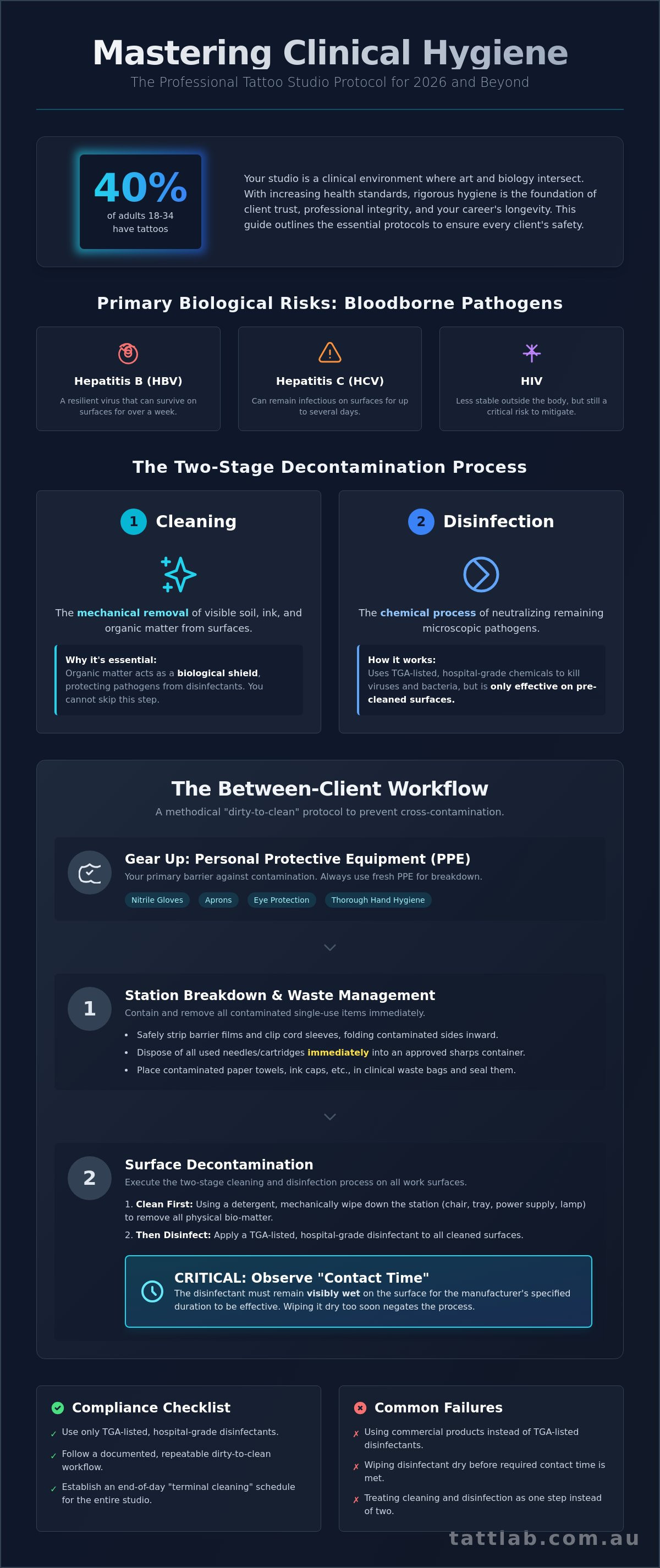
The biological risks inherent in tattooing are significant and require a deep understanding of bloodborne pathogens. Hepatitis B (HBV), Hepatitis C (HCV), and HIV represent the primary concerns in a studio setting. These pathogens can survive on surfaces for days if not neutralized correctly. Understanding the health effects of tattoos and the potential for cross-contamination allows you to approach your workspace with the necessary clinical caution. It's about moving from a mindset of "tidying up" to one of "decontaminating."
Compliance with Australian State and Territory health guidelines for skin penetration is your legal safeguard. Whether you operate in New South Wales, Victoria, or Queensland, the regulations are tightening. Health departments now demand evidence of consistent, repeatable hygiene workflows. Beyond the legalities, your commitment to safety builds an invisible layer of trust. Clients in 2026 are more educated than ever. They notice the meticulousness of your setup and the calm, controlled way you break down a station. This transparency becomes a powerful part of your brand reputation, signaling that you value their wellness as much as the aesthetic outcome.
Cleaning vs. Disinfection: Know the Difference
Effective hygiene follows a logical progression. Physical cleaning is the essential first step; it involves the mechanical removal of visible soil, ink, and organic matter from surfaces. You can't skip this. If organic matter remains, it acts as a biological shield that protects microorganisms from chemicals. Disinfection is the second phase, using hospital-grade chemicals to neutralize remaining pathogens. A professional tattoo studio cleaning checklist ensures these two distinct processes happen in the correct order, ensuring your workstation is truly sterile rather than just visually clean.
The Role of Personal Protective Equipment (PPE)
Your PPE is your primary barrier in the clinical environment. Selecting high-quality nitrile gloves is vital, as they offer the chemical resistance needed for handling disinfectants while maintaining tactile sensitivity for intricate work. During the breakdown of a station, the risk of splashes is at its highest, making aprons and eye protection non-negotiable. Remember that PPE only works when paired with strict hand hygiene. Washing your hands thoroughly before donning and after removing gloves prevents the transfer of pathogens to your skin and communal surfaces, maintaining the sterile chain of your studio.
The Between-Client Workflow: A Step-by-Step Decontamination Protocol
The period between clients is the most critical window for maintaining the sterile chain of your studio. It's not a race; it's a methodical transition. By adopting a "dirty-to-clean" workflow, you ensure that pathogens from the previous session aren't inadvertently transferred to your tools or the next client. This linear progression is the core of a functional tattoo studio cleaning checklist. It transforms a chaotic cleanup into a predictable, clinical procedure that protects both you and your community.
Adhering to CDC tattoo safety guidelines means treating every surface as potentially infectious until it has been professionally decontaminated. This mindset prevents the cross-contamination that often occurs when artists touch clean equipment with contaminated gloves or fail to recognize the biological reach of aerosolized fluids. In 2026, the standard of care requires a disciplined approach to every high-touch zone, from the adjustment knobs on your lamp to the buttons on your power supply.
Station Breakdown and Waste Management
The breakdown starts with the removal of all single-use items while wearing fresh gloves. Safely strip barrier films and clip cord sleeves by folding them inward, ensuring the contaminated side doesn't touch the underlying equipment. All used tattoo cartridges and needles must go immediately into an approved sharps container. Don't let them sit on the tray. Clinical waste bags should be used for contaminated paper towels and ink caps, then sealed before being moved to the designated waste area to prevent the spread of organic matter.
Surface Decontamination Steps
Decontamination is a two-stage process that relies on patience and the correct chemical application. Most professionals fail here by wiping surfaces dry too quickly.
- Step 1: Spray hard surfaces with a clinical-grade detergent. Wipe away any visible residue. This removes the "bio-load" that can shield germs from the disinfectant.
- Step 2: Apply a hospital-grade disinfectant to all hard surfaces, focusing on armrests and equipment stands.
- Step 3: Allow the surface to remain damp for the manufacturer-specified "contact time." Most hospital-grade solutions require several minutes to effectively neutralize bloodborne pathogens.
Resetting the Sterile Field
Once the contact time has passed and surfaces are dry, you can begin the reset. Apply fresh barrier films to every surface you'll touch during the procedure. This is the time to organize your tattoo stencils and fresh supplies for the upcoming session. Before the next client enters, perform a final hand sanitization. This ritual marks the completion of the decontamination cycle. For those seeking to upgrade their clinical environment, exploring the professional range at Tatt Lab can provide the medical-grade tools necessary for this level of precision.
Beyond the Station: Daily, Weekly, and Monthly Maintenance Schedules
Terminal cleaning is the process of resetting the studio to a clinical baseline at the end of each day. It's a methodical transition that ensures the environment is safe for the first client of the following morning. This isn't just about aesthetics. It's a critical component of managing tattoo risks and precautions by eliminating environmental contaminants that could otherwise compromise a fresh procedure. In the eyes of Australian health regulators, a clean reception area and bathroom are just as indicative of your professional standards as your sharps disposal protocol.
Maintaining a digital or physical cleaning log is essential for navigating state health audits. These records provide tangible proof of your commitment to safety, documenting exactly when and how each area was sanitized. Don't overlook hidden hazards like air conditioning vents, ceiling fans, and storage shelves. Dust accumulation in these areas can harbor bacteria and fungi, which are easily disturbed and circulated throughout the studio during the day, potentially settling on sterile equipment.
The Daily Terminal Clean
The end-of-day reset starts with the floors. Use a hospital-grade disinfectant solution, such as a pH-neutral detergent or a TGA-listed surface sanitizer, to mop all hard flooring. Focus on the high-traffic zones where clients and artists move most frequently. Sanitizing every door handle, light switch, and payment terminal is non-negotiable, as these are primary vectors for cross-contamination. Finally, empty all waste bins, including those in the waiting room and bathrooms, and disinfect the interior of the bins before relining them for the next day.
Weekly and Monthly Deep Cleaning
Consistency is the key to clinical excellence. Each week, set aside time to inspect the seals on your autoclave and the fluid levels in your ultrasonic cleaners. These machines are the workhorses of your sterilization process and require meticulous care to function at peak performance. On a monthly basis, perform a deep clean of all inventory shelves and storage areas to prevent dust buildup and ensure your stock remains in a pristine environment.
Every quarter, it's wise to perform a thorough audit of your medical supplies for tattoo artists. Check expiration dates on disinfectants and ensure your PPE stock is sufficient for the coming months. This proactive management prevents the pressure of running out of essential supplies, allowing you to maintain your hygiene standards without interruption or the need for shortcuts.
Essential Inventory for Sterile Environments: From PPE to Surface Sanitisers
Your clinical workflow is only as effective as the tools you use to execute it. In a high-volume Australian studio, maintaining an exhaustive inventory is the physical manifestation of your hygiene standards. A comprehensive tattoo studio cleaning checklist serves as your supply manifest, ensuring that every barrier and chemical agent meets the rigorous requirements of 2026 health audits. Without the correct hardware, even the most disciplined artist cannot maintain a truly sterile chain.
Choosing between TGA-listed disinfectants and standard commercial cleaners is a decision of biological consequence. Standard supermarket cleaners are often designed for common household bacteria, which fail to neutralize the specific bloodborne risks present in skin penetration procedures. TGA-listed products have been laboratory-tested to ensure efficacy against pathogens like HBV and HCV. Using these medical-grade solutions isn't just about compliance; it's about the physical integrity of your space and the long-term safety of your clients.
Barrier products represent your first line of defense against cross-contamination. These disposables create a physical wall between your equipment and the biological matter generated during a session. Selecting the correct size for clip cord sleeves and machine bags ensures that your equipment is fully encased without gaps. Managing these inventory levels is a task of precision. Running out of critical PPE like nitrile gloves or barrier film can halt your operations or, worse, lead to dangerous hygiene shortcuts that compromise your professional reputation.
Medical-Grade Disinfectants and Sanitisers
Surface sprays and pre-saturated wipes each play a specific role in your facility. Sprays are efficient for large, non-porous surfaces like flooring or counters, while wipes offer precision for delicate equipment where overspray could cause damage. High-quality skin sanitisers and tattoo aftercare protocols work in tandem to manage the microbial load on the client's skin before and after the procedure. Always use lint-free paper towels for clinical cleaning to prevent the distribution of fibers that can harbor bacteria and interfere with the sterile field.
Barrier Protection and Disposables
The utility of dental bibs and lap cloths in creating a sterile field cannot be overstated. These moisture-resistant barriers prevent ink and fluids from reaching your work surfaces, making the post-session breakdown significantly safer. Barrier film should be applied meticulously to power supplies, lamps, and furniture adjustment points. These are the areas most frequently touched during a session, and they require a fresh, intact layer of protection for every client. To secure your facility with artist-vetted tools, you can buy medical-grade tattoo supplies that meet the highest professional standards.
Elevating Studio Safety with Tatt Lab Professional Supplies
Securing the biological integrity of your studio requires more than just knowledge; it requires access to a specialized inventory that mirrors your dedication to the craft. Tatt Lab operates as a dedicated partner in your professional journey, providing artist-vetted supplies that transform your workspace into a clinical facility. By integrating our curated range into your tattoo studio cleaning checklist, you move beyond simple compliance. You establish a higher standard of clinical excellence that protects your clients and elevates your brand's reputation in the competitive Australian market.
Professional studios across the country trust our medical range because it's selected by specialists who understand the unique demands of the tattoo environment. We recognize that high-volume studios face intense time pressure between sessions. Our wholesale accounts are designed to alleviate this stress, ensuring you have consistent access to the TGA-listed disinfectants and medical-grade PPE discussed in previous sections. Streamlining your logistics with our express national shipping means you're never left vulnerable to supply chain gaps, allowing you to maintain your hygiene protocols with absolute precision and calm.
A One-Stop Shop for Tattoo and Medical Supplies
We've removed the friction of sourcing from multiple vendors by creating a comprehensive facility for all your professional needs. You can access world-renowned tattoo ink alongside hospital-grade PPE in a single, efficient order. This holistic approach ensures that every element of your procedure, from the first stencil to the final aftercare application, meets the same rigorous safety standards. For those in metropolitan areas, our local click-and-collect service provides immediate access to critical stock, while our nationwide express delivery keeps regional studios fully equipped. Our team understands the nuances of the Australian health regulations and provides expert support to help you navigate the specific requirements of your state or territory.
Ready to Standardise Your Studio Hygiene?
The transition to a more clinical studio environment begins with a thorough review of your current practices. Use the insights provided in this guide to audit your existing tattoo studio cleaning checklist against the 2026 standards. Identifying gaps in your workflow or inventory is the first step toward a more secure and professional operation. We invite you to build a custom supply bundle tailored to your studio's specific volume and service offerings, ensuring you have the exact barriers and sanitisers needed for every procedure. Take the next step in your professional progression and Shop the Tatt Lab Medical & Cleaning Range today to secure the future of your studio's safety and success.
Securing the Future of Your Clinical Practice
Adopting a meticulous approach to hygiene is a profound statement of respect for the art form and the individuals who carry it. By transforming your daily routines into a disciplined clinical workflow, you ensure that every session is defined by safety and precision. We've explored how a rigorous tattoo studio cleaning checklist serves as the backbone of your operations, moving beyond simple aesthetics to protect the biological integrity of every client. Remember that the efficacy of your protocol relies on the deliberate order of operations and the patience required for hospital-grade disinfectants to reach their full potential.
As an artist-owned and operated specialist, Tatt Lab is dedicated to supporting your professional evolution with a curated, medical-grade inventory. We provide the tools necessary to maintain a sterile environment, backed by the convenience of express Australia-wide shipping to keep your facility running without interruption. We invite you to Browse Professional Studio Cleaning & Medical Supplies to find the high-performance barriers and sanitisers your practice deserves. Your commitment to these standards doesn't just meet regulations; it builds a legacy of trust and excellence that will define your career for years to come.
Frequently Asked Questions
What is the most effective disinfectant for a tattoo studio?
The most effective disinfectants are TGA-listed, hospital-grade solutions specifically formulated to neutralize bloodborne pathogens like HBV and HIV. You should prioritize products that are verified as virucidal, bactericidal, and fungicidal to ensure a comprehensive reduction of the microbial load. These clinical-grade agents are far superior to standard domestic cleaners, which lack the chemical strength required for skin penetration environments.
How often should I clean the floors in my tattoo studio?
You must clean your floors at least once daily as part of your terminal cleaning routine at the end of each business day. However, any spills involving ink, blood, or clinical fluids require an immediate, localized decontamination. Using a hospital-grade mop solution ensures that pathogens aren't tracked through the studio by staff or clients, maintaining the physical integrity of your communal spaces.
Are alcohol-based cleaners safe for all tattoo equipment?
Alcohol-based cleaners aren't universally safe for all equipment and can actually damage certain materials over time. High concentrations of alcohol can cause vinyl chairs to crack and plastics on power supplies or lamps to become brittle. It's better to use pH-neutral, TGA-listed sanitisers that are specifically designed for medical equipment to ensure your tools remain in peak condition without compromising their surfaces.
Do I need a specific license for clinical waste disposal in Australia?
While individual artists don't typically need a license, your studio must have a formal agreement with a licensed clinical waste collection service. Australian state and territory health regulations require that sharps and contaminated waste are disposed of through certified medical waste channels rather than general council bins. Keeping records of these pickups is a vital part of your tattoo studio cleaning checklist and audit preparedness.
Can I use reusable cloths for cleaning my tattoo station?
You should never use reusable cloths for cleaning a workstation due to the high risk of cross-contamination. Reusable fabrics can harbor bacteria even after washing, potentially spreading pathogens between sessions. Single-use, lint-free paper towels are the clinical standard because they're disposed of immediately after contact with a contaminated surface, ensuring a completely fresh start for every client.
What should be included in a tattoo studio daily cleaning log?
A daily cleaning log should record the date, the specific area cleaned, the time of completion, and the signature of the responsible artist. It's also helpful to note the specific batch or type of disinfectant used during the process. This documentation provides a transparent audit trail for health inspectors, proving that your studio maintains a consistent, predictable rhythm of hygiene throughout the working week.
How long should a disinfectant stay on a surface to be effective?
A disinfectant must remain damp on the surface for the full "contact time" specified by the manufacturer, which is typically between 2 and 10 minutes. If you wipe the surface dry prematurely, you risk leaving viable pathogens behind. Patience is a critical part of the tattoo studio cleaning checklist; it allows the chemical agents to fully break down the cellular walls of microorganisms before the surface is handled again.
What PPE is required when cleaning a contaminated workstation?
You're required to wear nitrile gloves, a fluid-resistant apron, and protective eyewear when cleaning a contaminated workstation. The breakdown process is the moment when you're most at risk of accidental needle sticks or fluid splashes. This combination of PPE creates a reliable barrier between your skin and the biological matter generated during the previous session, ensuring your personal safety remains uncompromised.


Comments (0)
There are no comments for this article. Be the first one to leave a message!