

What if the secret to a flawless transition isn't actually in the fluidity of your wrist, but in the mathematical alignment of your hardware? Many dedicated artists have experienced the quiet frustration of a gradient that looks "peppered" or patchy, despite their best efforts to maintain a steady rhythm. It's a common struggle to balance consistent saturation with the delicate need to avoid overworking the dermis, especially during those long, demanding shading sessions where skin trauma becomes a primary concern.
Mastering the technical synergy required for achieving smooth gradients in tattoos is what separates standard work from clinical-grade realism. By understanding the relationship between needle taper, ink dilution, and hand speed, you can transform your approach from a series of hopeful passes into a predictable, scientific process. This guide provides a methodical breakdown of how to choose the right curved magnums and long tapers to ensure your transitions are seamless. We'll explore the biological mechanics of ink absorption and the precise equipment combinations needed to protect the skin's integrity while delivering professional, high-end results.
Key Takeaways
- Understand the mechanical difference between "pepper shading" and true seamless transitions to set a higher standard for your realism work.
- Identify why curved magnums and long tapers are essential for achieving smooth gradients in tattoos by reducing trauma and pigment "snagging."
- Learn the science of ink dilution and why professional mixing solutions are critical for maintaining pigment density and long-term stability.
- Master the "pendulum" motion to balance machine voltage with hand speed, creating a controlled, layered effect without overworking the skin.
- Gain insights into selecting artist-vetted cartridges that provide the predictable performance necessary for clinical-grade results.
Defining the Technical Gradient in Professional Tattooing
A gradient in professional tattooing is much more than a simple visual fade; it's a controlled transition of pigment density within the dermis. While many artists view shading as a singular aesthetic task, veterans recognize it as a precise manipulation of light and shadow. The objective of achieving smooth gradients in tattoos is to create a seamless flow where the human eye cannot detect where one shade ends and the next begins. This process requires a profound respect for skin integrity. If the tissue is traumatized through excessive passes or improper technique, the resulting inflammation prevents the pigment from settling correctly. This often leads to "muddy" results or permanent scarring that disrupts the visual flow of the artwork.
There's a clear technical distinction between "pepper shading" and "smooth shading." Pepper shading intentionally leaves visible needle marks to create a granular, stippled texture, often used in illustrative or "whip-shaded" styles. In contrast, smooth shading relies on the mechanical basis of the modern tattooing process to distribute ink with clinical evenness. This distribution is heavily influenced by capillary action. As the needle enters the skin, it creates a temporary vacuum that draws the ink into the interstitial spaces between cells. If the hand speed or needle depth is inconsistent, this capillary flow becomes erratic, resulting in the patchy or "peppered" look that many artists struggle to eliminate.
Grey Wash vs. Opaque Grey Systems
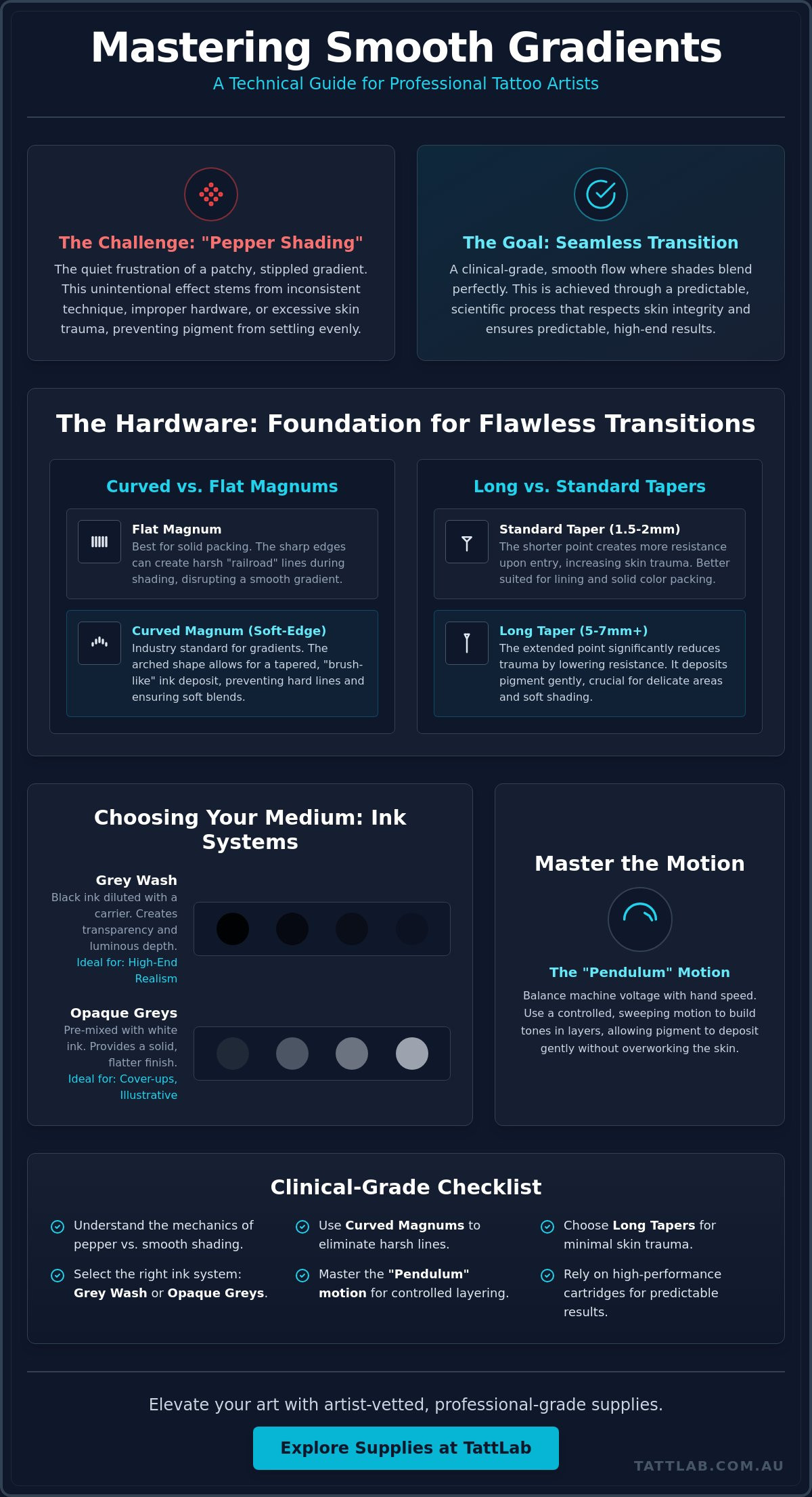
Choosing your medium is the first technical decision in the shading process. Grey wash systems rely on black ink diluted with a carrier liquid to create varying levels of transparency. This allows the natural skin tone to reflect through the pigment, creating a luminous depth ideal for high-end black and grey realism. Opaque greys are pre-mixed pigments that use white ink to achieve different values. These are less transparent and provide a flatter, more solid finish. Artists typically choose grey wash for soft portraits and opaque greys for illustrative work or cover-ups where transparency would reveal underlying skin imperfections.
The Physics of Ink Saturation
The pigment load in your ink significantly affects how the needle interacts with the skin. High-viscosity inks can be difficult to disperse smoothly, while overly thin inks may run or cause blowouts. Using high-quality tattoo ink is essential for maintaining a consistent "hit" throughout the session. When the ink viscosity is balanced, the needle carries a predictable amount of pigment into the skin with every stroke. This predictability is the foundation of achieving smooth gradients in tattoos, as it allows the artist to focus on the mechanics of their motion rather than constantly compensating for ink flow issues.
The Hardware: Selecting Needles for Seamless Transitions
The technical foundation of achieving smooth gradients in tattoos begins long before the machine is powered on. It starts with the selection of the needle. In a professional setting, the needle is not merely a tool for delivery; it is a precision instrument that dictates how the skin receives and retains pigment. While standard magnums are excellent for solid packing, curved magnums, often called "soft edge" magnums, are the industry standard for gradients. The slight curvature of the needle grouping allows for a tapered distribution of ink. This prevents the harsh "railroad" lines that occur when the outer needles of a flat magnum dig too deeply into the dermis during a lateral stroke.
Hardware performance also relies heavily on cartridge engineering. Membrane tension is a frequently overlooked variable that can compromise a transition. If a cartridge membrane is too stiff, it creates inconsistent needle depth and increases hand fatigue. Conversely, a membrane with the correct tension ensures a predictable "snap back," allowing the artist to maintain a delicate touch. Professionals seeking these specific configurations often rely on high-performance tattoo supplies to ensure every session meets these clinical standards. While hardware is the focus here, the safety of the substances being delivered is equally vital; consulting FDA information on tattoo ink safety helps clarify the biological standards required for professional work.
Long Taper Needles: The Secret to Softness
The taper refers to the length of the needle point before it reaches its full diameter. Standard tapers are typically 1.5mm to 2mm, while long tapers extend to 5mm or even 7mm. This extended point reduces the surface area of the needle as it enters the skin, which significantly lowers resistance. This allows for "brush-like" strokes that deposit pigment with minimal trauma. Long tapers are essential for achieving smooth gradients in tattoos on delicate areas like the inner arm or ribs, where the skin is thinner and more prone to inflammation.
Curved Magnums vs. Traditional Magnums
The "umbrella" effect of a curved magnum is its defining characteristic. Because the needles are arranged in a slight arc, the center needles penetrate slightly deeper than the edges. This mimics the natural, pivoting movement of the human wrist. When selecting your gauge, consider the skin's texture. A 0.30mm (10 gauge) needle offers a tighter grouping for smoother, finer blends, while a 0.35mm (12 gauge) provides a more aggressive "hit" for faster saturation in larger areas. Smaller needle counts, such as a 7CM, provide surgical precision in tight transitions, whereas a 15CM is superior for softening large-scale backgrounds.
The Medium: Mastering Ink Dilution and Pigment Control
The medium you deliver is as critical as the instrument used to deliver it. When achieving smooth gradients in tattoos, the chemistry of your pigment determines both the immediate visual result and the long term dermal retention. A common technical error is over-dilution. While it's tempting to use distilled water to create a wash, this often breaks the chemical bonds of the ink's binder. This instability results in pigment "falling out" during the healing process, where the softest parts of the gradient simply disappear. Using professional mixing solutions ensures the pigment remains suspended and stable, allowing for predictable, clinical-grade results that stand the test of time.
A standard professional setup typically involves a 4-cup or 5-cup wash station. This progression moves from a 100% black "outliner" or "solid black" cup down to a 10% or 20% "ghost wash." Maintaining this scale is vital for batch consistency, especially during large-scale work. If you're working on a full sleeve over multiple months, your "medium" wash in the first session must match your "medium" wash in the final session. Without this clinical control, the healed piece will appear disjointed. Using high-quality tattoo ink as your base ensures that the viscosity remains uniform, preventing the choppy transitions often seen with inferior pigments.
Creating a Professional Grey Wash Scale
The "Drop Method" is a staple in many studios, where artists count specific drops of black ink into caps filled with mixing solution. This offers a high degree of customization, but pre-made grey wash sets provide superior clinical consistency. These sets are manufactured in controlled environments to ensure the pigment load is identical in every bottle. When testing these values, remember that paper is a non-porous surface. Ink will always look darker on paper than it does once it has settled into the living tissue of the dermis, where biological factors like skin undertone will influence the final shade.
Pigment Stability and Skin Interaction
Pigment stability relies on a delicate balance of glycerine and alcohol. Glycerine acts as a humectant, keeping the ink wet on the needle for longer periods. If the ink dries too quickly, it leads to "choppy" gradients because the needle cannot release the pigment smoothly. Alcohol helps with the flow and serves as a mild antiseptic, but too much can cause the skin to dry out during long sessions. Always maintain a sterile environment when mixing custom shades. Even a small amount of contamination can alter the viscosity and safety of the pigment, compromising the integrity of the work.
The Execution: Hand Speed, Voltage, and Motion
Execution is the final, critical link in the technical chain of achieving smooth gradients in tattoos. Even with the perfect needle and a scientifically balanced grey wash, a lack of mechanical calibration will lead to inconsistent results. Finding the "sweet spot" requires a deep understanding of how machine voltage interacts with your specific hand speed. If your machine cycles too quickly for your hand movement, you'll inevitably overwork the tissue, causing inflammation that obscures the gradient. Conversely, if your hand moves too fast for the voltage, the result is a "peppered" effect where the individual needle strikes are visible rather than a unified field of tone.
The mechanical basis for a seamless transition is the pendulum motion. Unlike the vertical "packing" motion used for solid color, the pendulum stroke involves moving the needle in a shallow arc. The needle enters the skin at the center of the stroke and exits at the ends, creating a natural taper in pigment density. This allows you to build tone through layering rather than forced saturation. Building tone gradually preserves the skin's physical integrity, ensuring the client heals with the same clinical precision you achieved in the studio. To maintain this level of control throughout the session, professional artists prioritize high-quality tattoo stencils and cartridges that don't fail under pressure.
The Pendulum and Whip Shading Techniques
The pendulum stroke is a deliberate, rhythmic movement that requires the artist to maintain a consistent 45-degree angle. This angle is the gold standard for optimal ink entry, as it allows the needle to slide into the dermis with minimal resistance. Whip shading is a variation of this motion, where the needle is "flicked" out of the skin more aggressively. While the pendulum is superior for soft, photographic realism, whip shading is the preferred choice for texture-heavy gradients where a slight granular effect adds to the aesthetic depth of the piece.
Managing Machine Voltage and Give
Machine "give" refers to the amount of resistance the needle provides when hitting the skin. A machine with more give is more forgiving, making it easier to build subtle, light-grey tones without causing immediate trauma. When switching from a small 7CM to a massive 27CM magnum, you must adjust your voltage to compensate for the increased surface area. A larger needle grouping requires more "push" to penetrate the skin effectively. However, lower voltage is generally safer for the initial passes of a gradient, allowing you to map out values with a delicate touch before committing to deeper saturation.
Supplying the Craft: Professional Tools for Australian Artists
The technical mastery required for achieving smooth gradients in tattoos is only as reliable as the hardware used to execute it. In a professional studio, the margin for error is non-existent. This is why Australian artists trust Tatt Lab for high-performance tattoo supplies that prioritize both safety and mechanical precision. Using artist-vetted needles and cartridges isn't merely a preference; it's a strategic choice to eliminate the variables that cause patchy shading. When your equipment performs predictably, you can focus entirely on the artistic nuance of the transition rather than compensating for hardware failure.
Consistency is the hallmark of a specialist. We understand that a studio's reputation is built on the predictable quality of its output. By providing access to clinical-grade PPE and premium tools, we allow artists to maintain a high-end laboratory environment. This methodical approach is supported by our express nationwide shipping, ensuring that your inventory levels never compromise your ability to deliver world-class results. We position ourselves as a dedicated partner in your professional growth, providing the logistical support needed to maintain a sophisticated urban aesthetic.
Premium Cartridges: Elite and EZ V-Select
Premium cartridge systems like Elite III and Elite EVO are specifically designed to meet the demands of realism. These cartridges feature internal stabilizers that prevent needle "wobble," a common cause of skin trauma during achieving smooth gradients in tattoos. When the needle remains perfectly centered, the distribution of pigment is uniform. The V-Select membrane system is another favorite among Australian specialists, offering a unique balance of tension and give. This system ensures that the needle "snaps back" with clinical timing, allowing for the soft, brush-like strokes necessary for seamless grey wash transitions.
Clinical Support and Studio Integrity
A professional procedure requires a sterile, controlled environment. Utilizing specialized medical supplies for tattoo artists prevents cross-contamination and allows you to maintain a focused, clinical workflow. However, the technical journey doesn't end when the machine stops. The longevity of a gradient depends heavily on the healing phase. Recommending high-quality tattoo aftercare is essential for preserving the softest values of your work. Proper healing ensures that the delicate pigment transitions you've mastered remain vibrant and intact, reflecting the science and care invested in the initial procedure.
Refining Your Technical Precision
Mastering the art of achieving smooth gradients in tattoos requires a shift from artistic intuition to technical discipline. By aligning your hardware selection with precise ink dilution and calibrated mechanical motion, you ensure that every transition is seamless and every session respects the biological limits of the skin. Consistency isn't a result of luck. It's the outcome of a methodical approach that prioritizes physical integrity and scientific rigor above all else.
As an artist-owned and operated facility, Tatt Lab is dedicated to supporting your pursuit of excellence. We provide the clinical-grade medical and tattoo supplies necessary to maintain a sophisticated studio environment where science meets health. With our express nationwide shipping across Australia, you can keep your focus where it belongs: on the precision of your craft and the transformation of your clients. Shop Professional Tattoo Supplies at Tatt Lab and elevate the technical standard of your work today. We're here to be your partner in every clinical-grade outcome you achieve.
Frequently Asked Questions
What is the best needle for shading smooth gradients?
Curved magnums are the industry standard for achieving smooth gradients in tattoos because their arched profile prevents harsh edges. When paired with long tapers, these needles minimize skin resistance and trauma. This specific combination allows for a softer pigment deposit that mimics the natural fade of a brush stroke, providing the clinical precision required for high-end black and grey realism work.
Why does my shading look patchy once the tattoo heals?
Patchy results often stem from inconsistent needle depth or the use of unstable ink dilutions during the procedure. If the pigment is deposited at varying levels of the dermis, it'll inevitably heal with a mottled appearance. Additionally, overworking a specific area causes excessive inflammation that "pushes" the ink out, resulting in a fragmented look once the tissue has fully recovered and the skin has settled.
Is it better to use grey wash or opaque greys for realism?
Grey wash is superior for photographic realism because its transparency allows the skin's natural luminosity to reflect through the pigment. Opaque greys, which contain white pigment, are better suited for illustrative styles or covering existing imperfections. You should choose grey wash when you need deep, breathable transitions and reserve opaque sets for a more solid, graphic finish that requires higher opacity.
How do I prevent skin trauma when building up dark gradients?
Building tone through multiple light layers is safer and more effective than attempting full saturation in a single, aggressive pass. Use a pendulum motion to ensure the needle enters and exits the skin at a shallow angle. This approach reduces the physical impact on the dermis, allowing you to achieve deep values without compromising the skin's structural integrity or causing unnecessary scarring.
What machine voltage should I use for soft shading?
There isn't a universal number, but soft shading typically requires a lower voltage relative to your machine's maximum range to maintain a delicate touch. The goal is to find a rhythm where the needle speed matches your hand's travel speed exactly. If the voltage is too high, you risk "chopping" the skin; if it's too low, the ink won't penetrate the dermis effectively.
Can I use distilled water to dilute my tattoo ink?
You shouldn't use distilled water because it lacks the binders and humectants found in professional mixing solutions, which are essential for achieving smooth gradients in tattoos. Water can break down the ink's chemical structure, leading to pigment settlement issues and poor long-term retention. Professional solutions keep the pigment suspended and stable, ensuring the transition remains seamless throughout the entire healing process.
What is the difference between whip shading and pendulum shading?
Whip shading is a fast, flicking motion that creates a granular, "peppered" texture, often used for decorative shading or illustrative pieces. Pendulum shading is a slower, more rhythmic arc where the needle remains in contact with the skin for a longer duration. Use the pendulum technique for seamless, photographic transitions and reserve whip shading for intentional texture where a granular aesthetic is required.
How does needle taper affect the smoothness of a gradient?
A longer taper creates a narrower point, which enters the skin with significantly less force and resistance than a short taper. This reduced impact means less trauma and a smaller "hole" in the tissue, allowing the ink to settle more gently and evenly. Long tapers are the preferred choice for soft shading because they provide a much lighter "hit" on the delicate dermis.


Comments (0)
There are no comments for this article. Be the first one to leave a message!