

The choice between tattoo cartridges vs traditional needles is no longer just a debate over artistic "feel"; it's a critical clinical decision that dictates the long-term health of your client's skin and your own physical longevity. While the traditional needle-on-bar setup offers a nostalgic tactile response, the modern studio environment demands a level of sterile integrity and ergonomic efficiency that manual assembly often struggles to match. You likely value the precision of a custom-soldered grouping, yet you're also familiar with the creeping hand fatigue of a heavy coil machine or the anxiety of managing complex autoclave cycles.
We understand that your equipment is an extension of your hand, and any shift in your toolkit must be justified by superior results. This comparative guide moves beyond the surface level to provide a technical and clinical analysis of both systems. You'll learn how to optimise skin integrity by reducing trauma, master the transition between different needle configurations without losing saturation, and implement setup workflows that meet the rigorous ISO 13485 and MoCRA standards now shaping the global industry. By the end of this analysis, you'll have the technical clarity needed to refine your practice for maximum safety and artistic precision.
Key Takeaways
- Master the mechanical distinction between traditional 5-inch stainless steel bars and modular, self-contained units to better control your machine’s "hit."
- Analyze the clinical relationship between needle "give" and skin trauma to minimize dermatological stress and accelerate the healing process.
- Evaluate the efficiency gains and sterile integrity of tattoo cartridges vs traditional needles when switching between liners and shaders in seconds.
- Learn how to align your needle system with specific machine types and ink viscosities to achieve consistent saturation with fewer passes.
- Explore the strategic advantages of a hybrid studio setup to balance old-school customization with modern, single-use safety protocols.
The Evolution of the Needle: From Traditional Bars to Modular Cartridges
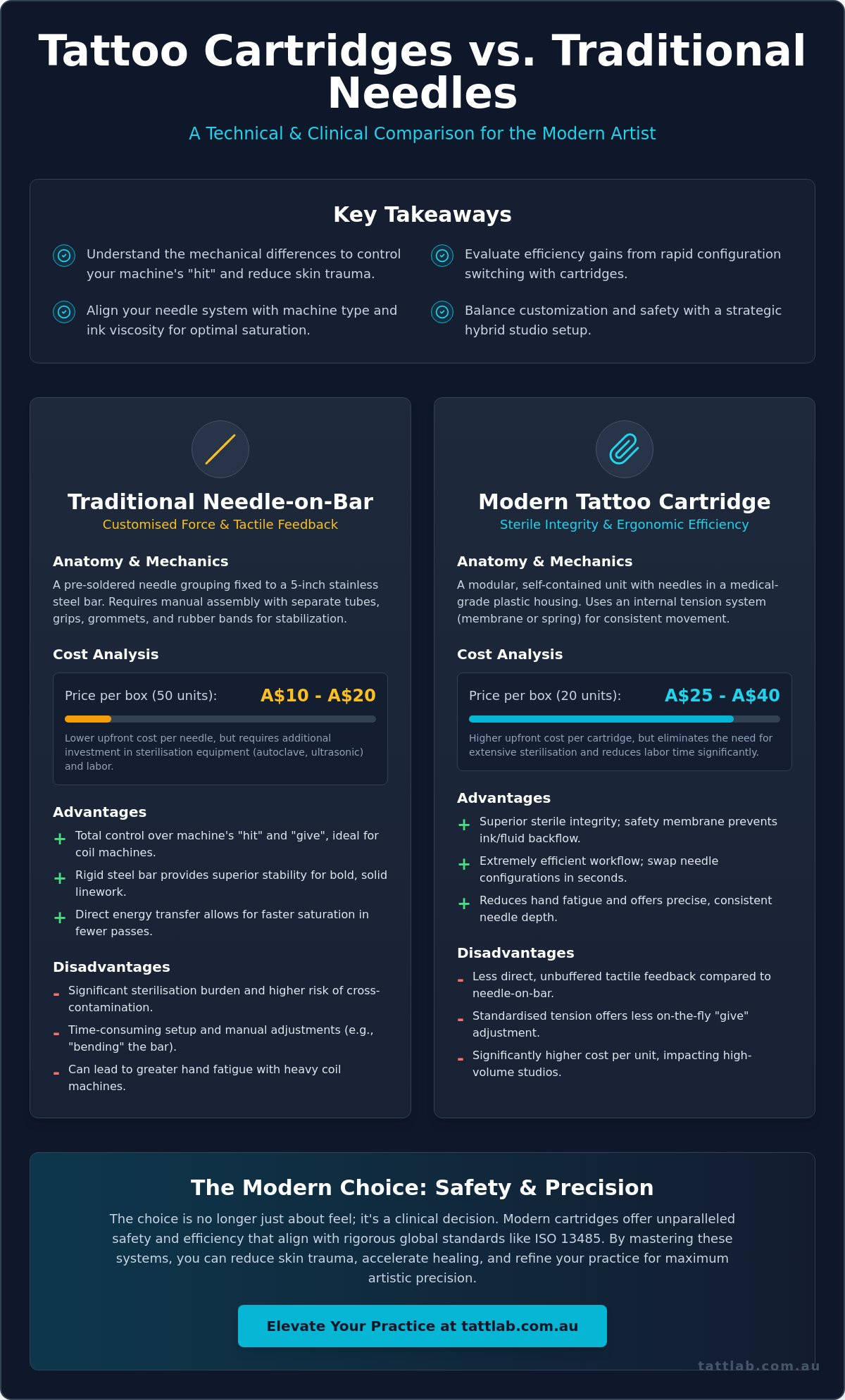
The progression from needle-on-bar setups to modular systems represents a pivotal shift in the history of the modern tattoo machine. For decades, the industry standard was the traditional needle, defined as a pre-soldered grouping of needles fixed to a 5-inch stainless steel bar. These setups operate within an open-tube environment, requiring the artist to manually assemble and sterilise multiple components. In contrast, tattoo cartridges are modular, self-contained units that house the needle within a medical-grade plastic casing, using internal tension systems to regulate movement. Understanding the mechanical differences between tattoo cartridges vs traditional needles is essential for any professional looking to refine their technical mastery and studio efficiency.
This evolution was driven by three primary factors: a heightened focus on safety, the demand for faster setup times, and the technological rise of rotary pen machines. While traditional setups offered a raw, tactile connection to the machine's power, they also presented higher risks of cross-contamination and required extensive cleaning protocols. The shift toward closed-system sterile barriers has modernised the workflow, allowing artists to focus more on the skin and less on the mechanics of the equipment.
The Anatomy of a Traditional Needle-on-Bar
A traditional needle consists of a loop at the top, a rigid stainless steel shaft, and the needle grouping soldered at the tip. To function, this bar must be inserted into a separate tube and grip, which acts as the stabiliser for the needle’s stroke. The tube tip serves as the ink reservoir, and the needle's path is often guided by the artist's manual adjustments. Many experienced professionals consider "bending" the bar a vital skill; it involves creating a slight curve in the steel so the needle hugs the side of the tube tip. This technique provides a steadier line and a specific "give" that many feel is superior for traditional coil machine work, though it adds significant time to the daily preparation routine.
The Engineering of the Modern Tattoo Cartridge
Modern cartridges replace the external rubber bands of coil machines with sophisticated internal tension mechanisms. Most high-quality units use a silicone membrane or a steel spring to manage the needle's retraction. This internal membrane is a critical safety feature because it creates a seal that prevents ink and biological fluids from flowing back into the machine's motor. When comparing tattoo cartridges vs traditional needles, the cartridge’s plunger assembly offers a level of mechanical consistency that is difficult to replicate manually. This assembly regulates depth with precision, ensuring that each stroke is uniform. This engineering allows artists to swap configurations in seconds, reducing hand fatigue and allowing for a more focused, clinical approach to pigment implantation.
Traditional Tattoo Needles: The Standard for Customised Force Delivery
Traditional needles remain the preferred tool for artists who demand total control over the mechanical 'hit' of their equipment. When paired with a coil machine, the needle-on-bar system offers a direct, unbuffered transfer of energy. This synergy allows for a nuanced 'give' that can be adjusted through the tension of the springs and the throw of the armature bar. This tactile feedback is essential for understanding the impact on skin integrity and healing, as it helps the artist feel exactly how the needle interacts with different skin densities. Unlike the standardised tension of a cartridge, the traditional setup lets you tune your machine to the specific resistance of the dermis.
The debate over tattoo cartridges vs traditional needles often centres on this mechanical feedback, but financial viability is equally important for high-volume Australian studios. The price per unit is significantly lower than modular alternatives. While a box of 20 premium cartridges might cost between A$25 and A$40, a box of 50 traditional needles typically ranges from A$10 to A$20. For artists who go through dozens of needles a week, these savings are substantial. However, you must also consider the hidden costs of labour and utilities associated with non-disposable components.
Why Traditional Needles Remain the Choice for Bold Linework
The rigidity of a 5-inch stainless steel bar provides a level of stability that many find superior for packing heavy pigment. When using Round Liners, the traditional setup requires grommets and rubber bands to manage needle flutter. While this manual stabilisation takes practice, it results in a solid, unwavering line that is often difficult to replicate with the lighter, plastic-housed components of a cartridge system. The direct connection ensures that more force is delivered to the needle tip, facilitating faster saturation in fewer passes.
The Maintenance and Sterilisation Burden
Despite their performance benefits, traditional setups carry a significant operational load. Every reusable grip and tube must undergo a rigorous cleaning process, including ultrasonic baths and autoclaving. This requires a dedicated investment in Medical Supplies and hours of staff time each week. As Australian health regulations become more stringent, many studios are weighing the cost of this labour against the convenience of fully disposable systems. If you are looking to maintain this classic approach, sourcing high-quality traditional needles is the first step in ensuring consistent results while managing your overheads.
Tattoo Cartridges: Engineering Safety and Efficiency in the Modern Studio
Efficiency is the hallmark of the modular system. While the previous section highlighted the tactile benefits of manual setups, the reality of a busy Australian studio often demands a faster, more streamlined workflow. By eliminating the need for multiple machine setups, artists can transition from bold outlines to soft shading in a matter of seconds. This speed doesn't just benefit the artist's schedule; it reduces the time the client spends under the needle, which can lead to lower cortisol levels and a more manageable pain experience. When evaluating tattoo cartridges vs traditional needles, the primary advantage is this ability to maintain creative momentum without the mechanical interruptions of traditional gear swaps.
Consistency is the second pillar of cartridge engineering. Each unit comes pre-aligned and tensioned within a medical-grade housing. You don't need to spend time bending bars or adjusting grommets to find the "sweet spot." Every needle is centred and stabilised by the internal plunger assembly, ensuring that the first stroke of the day is identical to the last. All professional-grade cartridges are EO-gas sterilised and individually packaged, providing a level of sterile integrity that is difficult to guarantee with in-house autoclaving. This single-use approach simplifies the teardown process, allowing for a cleaner, safer environment that aligns with modern health standards.
The Critical Role of the Safety Membrane
Not all modular units are created equal. Professional artists must distinguish between budget-friendly "rubber band" versions and high-end membrane systems. A safety membrane acts as a physical barrier that prevents ink, blood, and interstitial fluid from migrating back into the machine's grip or motor. This backflow prevention is a clinical necessity for protecting your rotary machine from internal contamination. Cheap cartridges often use simple springs that lack this seal, creating a significant cross-contamination risk. By choosing a membrane-based system, you maintain a closed sterile field throughout even the longest sessions, ensuring that your equipment remains as pristine as your work.
Versatility and the Rise of Wireless Tattooing
The popularity of wireless rotary pens has made cartridges the essential choice for the modern practitioner. These machines are designed specifically for the low-vibration, high-precision movement of modular units. For artists who frequently travel for guest spots or conventions across Australia, the portability of a cartridge-based kit is unmatched. You can carry a full range of groupings in a single small case rather than hauling multiple heavy coil machines and tubes. This versatility is particularly evident when using Magnum Cartridges. These allow for the execution of soft, buttery gradients and seamless colour blends with a level of precision that traditionally required years of machine tuning to achieve.
Clinical Comparison: Impact on Skin Integrity and Healing
The physiological response of the dermis to pigment implantation is heavily influenced by the mechanical "give" of your chosen equipment. When evaluating tattoo cartridges vs traditional needles, the primary clinical difference lies in how energy is dissipated upon contact with the skin. Traditional needles, when configured on a coil machine, possess a natural rebound effect. This mechanical buffer allows the needle to retract slightly if it hits significant resistance, which can be more forgiving on delicate areas. Modern cartridge systems, particularly when driven by high-torque rotary motors, deliver a more consistent and uncompromising force. This requires the artist to have a more disciplined hand to avoid over-working the tissue.
Saturation efficiency is another critical factor in the inflammatory response. Achieving solid pigment density with fewer passes is the most effective way to preserve skin integrity. Many professionals find that traditional needles allow for a more aggressive "pack" due to the rigidity of the needle bar, whereas cartridges offer a smoother, more controlled delivery that excels in layering and soft gradients. Regardless of the system, the goal is to minimise epidermal trauma to ensure a predictable recovery. Your choice of needle system directly dictates the success of a client's Tattoo Aftercare, as a less traumatised canvas heals with greater clarity and pigment retention.
The "Snag" Factor: Calibrating Hand Speed to Needle Type
Using rotaries with cartridges often requires a faster hand movement compared to traditional setups. Because many rotary machines don't have the same "rebound" as a coil, a slow hand speed can lead to the needle "snagging" or slicing the skin rather than puncturing it cleanly. Skin trauma is the mechanical disruption of the epidermal and dermal layers caused by a needle’s entry and exit frequency exceeding the skin’s elastic threshold. Mastering this balance is essential to prevent scarring and ensure the inflammatory response remains within a healthy, manageable range. If you're transitioning between these systems, you can source professional-grade supplies to test how different tensions affect your specific tattooing rhythm.
Professional Decision Framework: Which System for Which Style?
Your artistic niche often dictates the most effective needle system. For fine line realism, the precision and low vibration of cartridges paired with rotary pens are nearly impossible to beat. The pre-aligned nature of the needles ensures that delicate details remain sharp. Conversely, for Traditional Americana or heavy Blackwork, many Australian artists still swear by the power and tactile feedback of the needle-on-bar. The weight of the traditional setup helps drive larger groupings into the skin with authority. Balancing efficiency with skin integrity means choosing the tool that allows you to achieve your desired aesthetic with the least amount of mechanical stress to the client's body.
Strategic Selection: Matching Needle Systems to Your Artistic Style
Your machine choice dictates your entire approach to pigment delivery. A coil machine's punchy, reciprocating motion is designed to handle the mass of a traditional needle bar. This mechanical synergy allows you to push high-viscosity Tattoo Ink into the skin with a level of authority that lighter setups often struggle to match. Conversely, the constant torque and high frequency of a modern rotary pen are optimised for the low-friction environment of a cartridge. This combination is ideal for building soft, layered textures and delicate gradients where precision is more important than raw force. Mastering the technical nuances of tattoo cartridges vs traditional needles means understanding how these tools interact with your specific motor's power curve.
Many Australian professionals are moving away from a one-system-fits-all mentality in favour of the "hybrid" studio. This strategic approach involves using traditional needles for bold, structural linework where the tactile feedback of a coil machine is irreplaceable. Once the framework is set, the artist switches to a rotary pen and cartridges for the shading and colour packing phases. This hybridity allows you to leverage the raw saturation power of traditional gear while benefiting from the rapid configuration changes and sterile safety of modular units. It is a methodical way to optimise both the artistic outcome and the studio's operational efficiency.
Sourcing quality remains the most significant hurdle in a market flooded with low-cost, unvetted equipment. Using cartridges without proper membrane seals or traditional needles with inconsistent solder points can compromise your machine's motor and, more importantly, the client's skin health. Professionalism in 2026 requires a safety-first mindset that prioritises equipment with proven clinical integrity over budget-driven alternatives.
Optimising Your Workflow with Tatt Lab Supplies
Building a consistent practice requires equipment that has been rigorously tested by those who understand the craft. Selecting artist-vetted needles ensures that you aren't fighting your tools during a session. The quality of your Tattoo Supplies is directly linked to your studio’s reputation and the longevity of your clients' work. Tatt Lab serves as a trusted specialist for the Australian community, providing a curated selection of equipment that meets high-end clinical standards. By choosing supplies that prioritise physical integrity, you ensure a predictable, calm environment for every procedure.
Conclusion: Building a Safe and Efficient Studio in 2026
The debate between tattoo cartridges vs traditional needles isn't about which system is "better," but which is more appropriate for the task at hand. Traditional bars offer the customisation and force needed for classic styles, while cartridges provide the speed, ergonomics, and sterile barriers required for a modern, high-volume workflow. As the industry moves toward more stringent safety regulations, the shift toward clinical, single-use systems is becoming the professional baseline. By matching your needle system to your artistic intent and machine type, you can achieve technical mastery while ensuring the highest level of care for the skin.
Refine your toolkit today. Explore our professional range of needles and cartridges at Tatt Lab.
Advancing Your Practice with Clinical Precision
Choosing between tattoo cartridges vs traditional needles is ultimately a commitment to your client’s dermatological health and your own technical progression. You've seen how traditional bars offer unparalleled tactile feedback for bold saturation, while modular cartridges provide the sterile barriers and speed required in a contemporary, high-volume studio. Balancing these mechanical differences allows you to minimise skin trauma and ensure a predictable, calm healing process for every client. Your equipment should never be a source of uncertainty; it should be a reliable extension of your artistic intent and professional rigour.
As an artist-owned and operated facility, Tatt Lab understands the necessity of specialised medical-grade supplies that respect the body's integrity. We are dedicated to supporting the Australian tattoo community with curated tools that meet rigorous safety standards. Our express nationwide shipping across Australia ensures your studio remains equipped with the highest standard of tools without delay. Shop professional-grade tattoo needles and cartridges at Tatt Lab and continue your journey toward technical mastery with confidence. Your commitment to excellence is the foundation of your success and your clients' lasting assurance.
Frequently Asked Questions
Are tattoo cartridges safer than traditional needles for preventing cross-contamination?
Tattoo cartridges are generally safer because most professional-grade units include an internal safety membrane. This silicone barrier prevents ink and biological fluids from flowing back into the machine's motor or grip. Traditional needles operate in an open-tube system, which increases the risk of fluids entering the machine. To maintain a sterile environment with traditional gear, you must adhere to rigorous ultrasonic cleaning and autoclaving protocols for all reusable components.
Can I use tattoo cartridges with a traditional coil machine?
You can use cartridges with a coil machine, but you'll need a specialised cartridge grip equipped with a plunger bar. This bar connects to the armature bar of your coil machine and pushes the cartridge's internal plunger. While this setup works, many artists find it less efficient than using a rotary machine. The weight and vibration of a coil machine can sometimes interfere with the delicate tension systems found inside modern modular units.
Why are traditional needles-on-bar generally cheaper than cartridges?
Traditional needles are more affordable because their manufacturing process is simpler and doesn't involve complex plastic housings or internal membranes. In Australia, a box of 50 traditional needles typically costs between A$10 and A$20. In contrast, a box of 20 premium cartridges usually ranges from A$25 to A$40. While the initial investment is higher for cartridges, many studios find they save money long-term by reducing the labour hours spent on sterilisation and setup.
Do tattoo cartridges cause more skin trauma than traditional needles?
Neither system inherently causes more trauma, but they require different technical approaches to preserve skin integrity. When comparing tattoo cartridges vs traditional needles, cartridges used with rotary pens deliver a more consistent, rigid strike. This requires a faster hand speed to prevent the needle from snagging the tissue. Traditional needles on a coil machine offer a natural "rebound" that can be more forgiving, though it requires more manual tuning to ensure deep, consistent saturation.
What is the best needle system for fine-line tattooing in Australia?
Cartridge systems paired with rotary pens are currently the preferred choice for fine-line realism in Australian studios. The pre-aligned nature of the needles and the low-vibration output of rotary motors allow for extreme precision. Using Round Liners in a cartridge format ensures that the needle grouping remains perfectly centred, which is essential for executing the delicate, single-pass lines that define this popular style without over-working the dermis.
Do I need a specific type of grip to use tattoo cartridges?
Yes, you need a grip specifically designed to lock cartridge units into place. Traditional grips are hollow tubes designed to hold a needle bar and are tightened with a screw. Cartridge grips feature a internal "twist-lock" or "click" mechanism that secures the modular unit. If you're using a wireless pen-style machine, the cartridge receiver is built directly into the machine's body, eliminating the need for a separate grip assembly.
How do I know if a tattoo cartridge has a high-quality safety membrane?
You can verify the quality by manually pressing the plunger bar before use. A high-quality membrane should offer firm, consistent resistance and snap back into place immediately. If the needle feels loose or uses a metal spring without a silicone seal, it likely lacks a true safety membrane. It's vital to source artist-vetted supplies to ensure the barrier is strong enough to prevent backflow into your expensive rotary equipment.
Can I use the same tattoo ink for both cartridges and traditional needles?
Tattoo ink is compatible with both systems, though the flow rate may differ. Traditional needles-on-bar hold a larger volume of ink within the tube tip, which can be beneficial for long, continuous lines. Cartridges rely on a smaller reservoir and capillary action to draw ink to the tips. You might find that high-pigment, thick inks flow more easily through traditional setups, while cartridges excel with thinner, more fluid inks used for grey wash and layering.


Comments (0)
There are no comments for this article. Be the first one to leave a message!