

With fine line requests surging by over 35% since 2023, the margin for technical error in modern studios has effectively vanished. You likely understand the quiet frustration of a line that looks perfect on the surface but loses its clarity to pigment fallout or a blowout during the healing process. This professional fine line tattoo needle guide moves beyond basic selection to explore the precise biological interaction between surgical steel and dermal resistance. It's a specialized discipline where even the smallest cartridge vibration can compromise a narrative of personal transformation and self-assurance.
Mastering the technical science of needle geometry is the only way to achieve the crisp, long-lasting results your clients expect in 2026. We'll examine how specific tapers and gauges influence ink flow and skin trauma, providing you with a predictable framework for every procedure. By the end of this guide, you'll have the confidence to select configurations that respect the body's integrity while delivering absolute precision. We'll analyze the mechanics of cartridge stability, the impact of current regulatory safety standards, and the exact configurations needed to eliminate inconsistent line weights forever.
Key Takeaways
- Understand why higher manufacturing tolerances are mandatory for the delicate micro-realism and script styles currently defining the professional landscape.
- Demystify technical needle codes to see how diameter and taper length directly dictate dermal hole size and long-term pigment stability.
- Evaluate the performance differences between 1RL and 3RL configurations to determine which grouping provides the most stable ink flow for your specific aesthetic.
- Utilize this fine line tattoo needle guide to develop a selection strategy that matches needle geometry to the unique biological resistance of different skin types.
- Identify the critical anatomical features of premium cartridges, such as internal stabilizers and safety membranes, that protect both the client and the artist.
The Evolution of Fine Line Tattooing: Why Needle Selection is Critical
The Australian tattoo landscape has transitioned toward a minimalist, sophisticated urban aesthetic. We've seen a 35% increase in requests for micro-realism and delicate script between 2023 and 2026. This shift isn't merely a trend; it's a demand for higher technical standards. Traditional tattooing often relies on bold saturated areas that can mask minor technical flaws. In contrast, fine line work provides no such refuge. Every oscillation of the needle is visible. This reality makes a comprehensive fine line tattoo needle guide an essential asset for the modern specialist.
Achieving these results requires manufacturing tolerances that were once reserved for medical instruments. If a needle grouping isn't perfectly centered within the cartridge housing, the resulting line will be blurred rather than crisp. We view the process as a laboratory-grade procedure where the relationship between needle precision and long-term pigment stability is the primary focus. A stable needle ensures that pigment is deposited exactly where the artist intends, preventing the gradual migration of ink that leads to lost detail over time.
The history of the electric tattoo machine shows a steady progression toward this level of control. Today's machines are capable of incredible subtlety, but they require a partner in high-quality needle geometry to respect the client's physical integrity. When the machine and needle are perfectly calibrated, the process becomes a liberating narrative of personal transformation rather than just a technical procedure.
The Technical Challenge of Thin Pigment Deposition
Depositing pigment into the dermis while avoiding the "blowout" phenomenon is a delicate biological balancing act. Fine line needles, particularly those with a higher gauge, penetrate the skin with significantly less resistance than traditional configurations. This ease of entry increases the risk of over-penetration. When ink is deposited too deeply into the subcutaneous fat layer, it spreads uncontrollably. Successful fine line work follows a "less is more" philosophy. By using fewer needles and lower saturation, we reduce skin trauma and ensure the body can heal the site without excessive inflammation or pigment rejection.
Defining the Fine Line Aesthetic in 2026
Modern fine line work has evolved beyond the "single needle" obsession. While a 1RL offers the ultimate in thinness, many professionals now prefer tight groupings, such as a 3RL, for better stability. These configurations allow for a more consistent ink flow, which is vital for achieving a perfect line in a single pass. Re-tracing a line often results in a thickened, uneven appearance that compromises the minimalist aesthetic. High-end studios prioritize specialized medical supplies for tattoo artists to maintain these standards. These professional-grade tools offer the predictable progress required for long-term aesthetic success and client safety.
Decoding Needle Geometry: Diameter, Count, and Taper
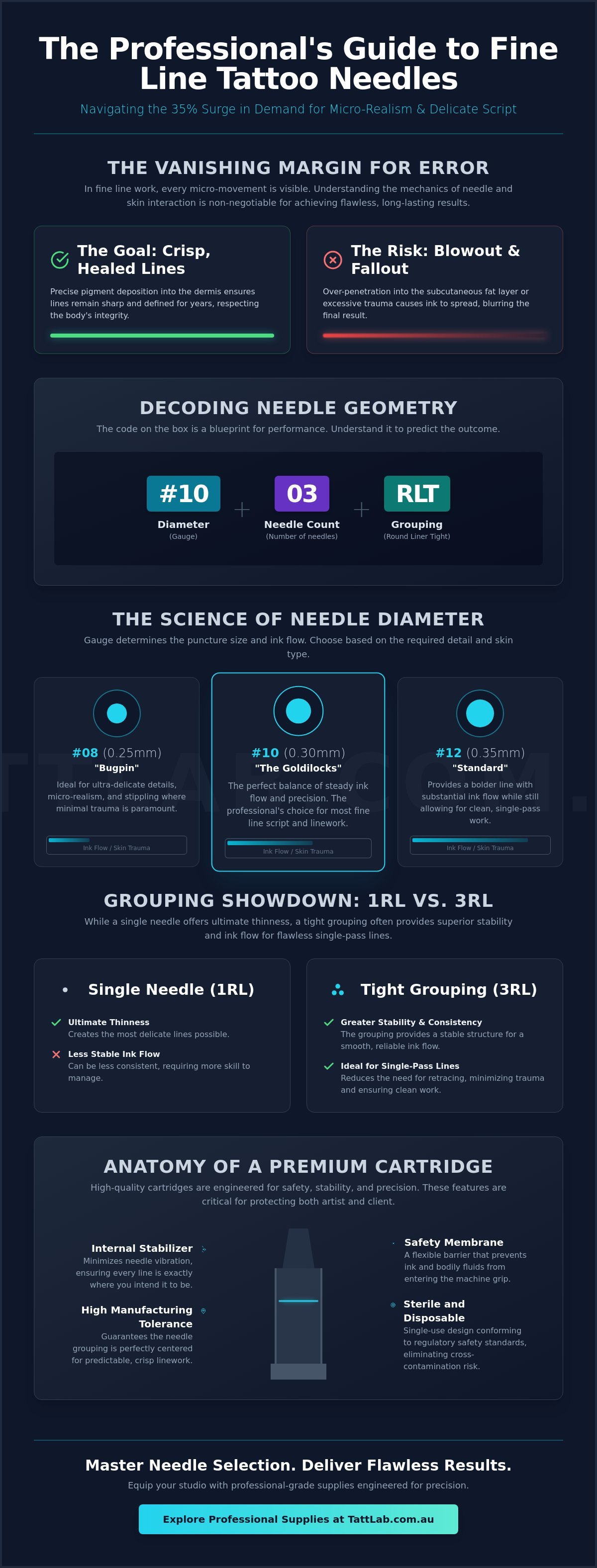
Selecting the right tool for a delicate procedure requires a deep understanding of the needle's DNA. The alphanumeric codes printed on a box of Round Liners aren't just inventory markers; they're a precise description of how that tool will interact with human tissue. For instance, a #1003RL indicates a grouping of three needles, each with a 0.30mm diameter, while a #1201RL describes a single 0.35mm needle. This fine line tattoo needle guide is designed to help you translate these technical specifications into predictable, healed outcomes that respect the body's natural architecture.
The physics of the "tight" grouping (RLT) vs. standard round liners is particularly important for 2026. In a tight round liner, the individual needles are soldered together closer to the tips. This configuration reduces the "footprint" of the grouping, allowing for a sharper, more concentrated ink deposit. While standard liners are excellent for traditional work, the RLT configuration is the specialist's choice for achieving that specific, hair-thin clarity in script and micro-realism. These technical nuances are critical for maintaining the high standards set by FDA safety regulations regarding skin integrity and pigment application.
The Science of Needle Diameter (# Gauge)
Needle gauge is the measurement of the individual needle wire thickness. This dimension determines the size of the puncture and, consequently, the volume of ink deposited per stroke. We categorize these into three primary sizes for fine line work:
- #08 (0.25mm): Often called "bugpins," these are ideal for ultra-delicate details where minimal trauma is paramount.
- #10 (0.30mm): The "goldilocks" gauge. It offers a perfect balance of steady ink flow and technical precision for most fine line script.
- #12 (0.35mm): The standard gauge, providing a bolder presence while still allowing for clean, single-pass linework.
Choosing a #08 bugpin allows for a more gradual build-up of pigment, which is essential for the soft gradients found in micro-realism. If you're looking to upgrade your current setup, you can explore professional-grade Tattoo Cartridges designed for these exact specifications.
Why Taper Length Matters for Fine Lines
The taper is the length of the point at the end of the needle. For fine line tattooing, Long Tapers (LT) or Super Long Tapers (SLT) are the industry standard. A longer taper means the needle is sharper and narrower for a greater portion of its length. This geometry allows the needle to penetrate the skin with significantly less resistance than a Short Taper. Because there's less surface trauma, the skin heals faster and the pigment remains more stable within the dermis. When working on areas with high elasticity, such as the inner arm or ribs, a Long Taper provides the controlled, predictable progress necessary to avoid blowouts and ensure a liberating experience for the client.
The Fine Line Toolkit: 1RL vs. 3RL and Beyond
Transitioning from the abstract science of needle geometry to the physical selection of a toolkit requires a shift in perspective. You aren't just choosing a needle; you're selecting the specific vehicle for pigment delivery. This fine line tattoo needle guide focuses on the toolsets required to bridge the gap between technical theory and the healed reality of the skin. While Round Liners are the primary focus, the modern specialist must also understand how shaders and magnums support the overall narrative of a piece.
Every selection should prioritize the client's physical integrity. Using the wrong grouping can lead to excessive trauma, which complicates the healing process and compromises the final aesthetic. Following established FDA tattoo safety guidelines is about more than just hygiene; it's about choosing high-quality tools that perform predictably every time they touch the skin. This methodical approach ensures that the procedure remains a calm, controlled experience for both artist and client.
Mastering the Single Needle (1RL)
The 1RL is often romanticized as the pinnacle of fine line work. It offers ultimate precision for single-hair details in micro-realism or ultra-fine script that looks as though it was written with a technical pen. However, the 1RL leaves no room for error. Because all the machine's force is concentrated on a single point, it's incredibly easy to "snag" the skin or bury the needle too deep. Mastering this tool requires a perfect synchronization of voltage and hand speed. If the machine runs too fast for your movement, you'll create a "serrated" line; too slow, and the pigment won't saturate enough for a clean, single-pass result.
The Stability of Tight 3RL Groupings
The "Tight" 3RL is frequently the true workhorse for professional fine line artists. By soldering three needles into a singular, sharp point, the configuration creates a larger internal reservoir for ink. This allows you to pull longer, continuous lines without the pigment running dry mid-stroke. The 3RL also provides a subtle "averaging" effect. If your hand makes a microscopic tremor, the three points of contact help mask the movement, resulting in a line that appears smoother than one pulled with a 1RL. This inherent stability makes the 3RL a safer, more reliable choice for artists who value predictable progress over the high-risk nature of a single needle.
Expanding the Palette: Shaders and Magnums
Fine line tattooing isn't limited to outlines. Round Shaders (RS) are essential for "pepper shading," a technique that uses individual dots of pigment to create soft, breathable textures. For more complex micro-realism, Curved Magnums allow for delicate gradients that mimic the natural fall of light. These tools allow for a softer touch, ensuring that even complex designs maintain a sense of lightness and delicacy as they age. By integrating these specialized groupings, you can provide a more comprehensive and sophisticated result that respects the body's natural contours.
Selection Strategy: Matching Needles to Style and Skin
Precision in tattooing is the result of matching needle geometry to the specific biological resistance of the client's skin. This fine line tattoo needle guide provides a clinical framework for selecting tools based on the intended aesthetic and the unique anatomy of the canvas. We view every procedure as a controlled, predictable progression toward a result that respects the body's physical integrity. Choosing the right configuration isn't just about the visual outcome; it's about the liberating narrative of self-assurance that comes with a perfectly healed piece.
The Selection Matrix for Common Styles
Developing a signature style requires a consistent kit that performs reliably across different designs. Micro-realism, for example, demands a layered approach. We recommend combining #08 1RL bugpins for microscopic textures with soft Curved Magnums for the delicate gradients that define the style. These configurations allow for a softer touch, ensuring that even complex portraits maintain a sense of lightness. For fineline script, the #10 3RL Tight serves as the reliable workhorse. It offers the stability needed for long, flowing characters without the fragility of a single needle. Botanical tattoos often benefit from varied line weights to create organic depth, using a 3RL for the primary stems and a 1RL for the delicate leaf veins. Needle selection should be dictated by the thinnest detail in the design.
Transitioning between these line weights requires a methodical approach to avoid overworking the skin. If a design requires both a 3RL and a 1RL, we suggest completing the structural linework first before refining the details. This ensures the skin isn't subjected to unnecessary passes, which can lead to inflammation and compromised pigment stability. To maintain this level of precision, many Australian specialists rely on professional-grade Tattoo Catridges that offer the stability needed for intricate work.
Adapting to Anatomical Variations
Skin is not a uniform surface; it is a complex biological landscape with varying levels of elasticity and thickness. Areas with minimal subcutaneous fat, such as the wrists, ribs, or ankles, are highly sensitive and prone to blowouts. In these zones, a lighter touch and a thinner gauge needle are mandatory to prevent pigment from migrating into the deeper layers of the dermis. Conversely, the skin on the outer arm or thigh is typically thicker and more "thirsty," requiring a steady, saturated ink flow to achieve a solid line in a single pass.
Environmental factors also play a role. Aged or sun-damaged skin often lacks the structural integrity of younger tissue, making it more susceptible to tearing. When working with these skin types, we favor Long Tapers to ensure penetration with minimal surface resistance. The healing process is the final, critical stage of this technical journey. Utilizing professional tattoo aftercare is essential for preserving the clarity of fine lines through the regenerative phase. By matching your needle selection to the specific "thirst" and thickness of the skin, you ensure a result that remains crisp and vibrant for years to come.
The Professional Advantage: Cartridge Quality and Safety
The final pillar of technical precision lies in the mechanical housing of the needle itself. Even the most carefully selected geometry will fail if the delivery system lacks structural integrity. In this concluding part of our fine line tattoo needle guide, we examine the anatomy of premium Tattoo Catridges and why the internal components are just as critical as the needles they hold. High-quality cartridges act as a stabilizer for the artist's hand, transforming a technical procedure into a liberating narrative of precision and self-assurance.
Selecting professional-grade equipment is a commitment to the client's physical integrity. Substandard cartridges often suffer from manufacturing inconsistencies that lead to needle rattle or ink spitting, both of which compromise the delicate nature of fine line work. By choosing tools that meet rigorous laboratory-grade standards, you ensure that every session is a controlled, predictable progression toward a superior aesthetic result.
The Importance of Internal Stabilizers
Needle wobble is a primary cause of inconsistent line weights and unintended skin trauma. When a needle isn't perfectly centered within its housing, it oscillates during penetration; this creates a blurred edge rather than a crisp line. Premium cartridges solve this through integrated internal stabilizers that guide the needle grouping with microscopic accuracy. Before starting any session, we recommend testing your cartridges by running the machine at a low voltage to observe the needle's path. A stable needle should appear as a solid, unmoving point. Beyond precision, the safety membrane is a critical clinical feature. It serves as a hermetic seal that prevents ink and biological fluids from backflowing into the machine, ensuring a sterile environment that aligns with the highest standards for medical supplies for tattoo artists.
Elite III vs. Elite EVO: Mechanical Differences
Understanding the mechanical differences between industry-leading cartridges allows you to tailor your setup to your specific style. The Elite III series is recognized for its robust housing and reliable tension, making it a favorite for structural linework. In contrast, the Elite EVO series features a refined internal design that reduces friction. This lower resistance allows for a smoother ink flow during long sessions, which is vital for complex micro-realism. For those specializing in ultra-fine script, the EZ V-Select cartridges offer a unique V-system. This mechanism maintains consistent tension even with the light pressure required for delicate lettering, ensuring every stroke remains predictable and clean.
Sourcing Professional Supplies in Australia
Physical integrity should never be compromised by substandard equipment. Sourcing your tools from a dedicated tattoo supplies provider in Australia ensures that every needle is EO gas sterilized and individually blister-packed. At Tatt Lab, our commitment to artist-vetted equipment means we only provide supplies that meet our rigorous performance standards. We position ourselves as your dedicated partner, providing the nationwide support and technical rigor necessary for your studio to thrive. By prioritizing quality and safety, you replace uncertainty with a sense of controlled, predictable progress for every client who walks through your door.
Refining Your Technical Approach for 2026
Fine line work demands a meticulous understanding of how needle geometry interacts with the living canvas. By mastering the relationship between taper length and skin resistance, you transform a technical procedure into a predictable, high-end aesthetic result. This fine line tattoo needle guide has outlined the necessity of matching specific gauges and groupings to anatomical variations while prioritizing the mechanical stability found only in premium cartridges. Precision isn't just about a steady hand; it's about the clinical selection of tools that respect the body's physical integrity.
As an artist-owned and operated facility, we understand that your professional reputation rests on the integrity of your tools. We maintain medical-grade safety standards across our entire inventory to ensure your studio operates with absolute rigor and safety. Explore our curated range of professional fine line cartridges at Tatt Lab and take advantage of our nationwide express shipping across Australia. Your commitment to technical excellence is the foundation of every successful transformation you create. We're proud to be your partner in delivering results that empower and reassure your clients.
Frequently Asked Questions
What is the best needle size for fine line script tattoos?
The #10 (0.30mm) 3RL Tight is generally considered the most reliable choice for fine line script. This configuration provides the necessary stability to mask microscopic hand tremors while maintaining a sharp, legible edge. While some specialists prefer the extreme thinness of a 1RL, the 3RL Tight holds a larger reservoir of ink, allowing for the continuous, fluid strokes essential for elegant lettering.
Can I use a regular Round Liner for fine line work?
You can use a standard Round Liner, but a "Tight" Round Liner (RLT) is the professional standard for high-precision work. In a tight configuration, the needles are soldered closer together at the tips to create a smaller footprint. This fine line tattoo needle guide emphasizes that standard liners often produce a slightly thicker line than intended, which can compromise the minimalist aesthetic of micro-realism.
Why do my fine lines look blurry after healing?
Blurry healed lines are typically the result of pigment migrating too deeply into the subcutaneous fat, a phenomenon known as a blowout. This happens when an artist applies too much pressure or selects a needle with a taper that is too short for the specific anatomical area. Excessive skin trauma during the procedure also triggers a heavy inflammatory response, which can cause the ink to spread as the body heals.
Is a 1RL or 3RL better for beginners in fine line tattooing?
A 3RL is significantly better for beginners because it offers more mechanical stability and a more predictable ink flow. The single point of a 1RL is incredibly unforgiving, making it easy to accidentally snag the skin or fluctuate in depth. Starting with a 3RL allows you to focus on your hand speed and voltage synchronization without the high risk of causing immediate skin damage or inconsistent saturation.
What voltage should I use for fine line needles?
Most fine line work is performed at a lower voltage, typically ranging between 5V and 7.5V, depending on your machine's stroke length. Running your machine too fast with thin needles can slice the skin like a scalpel, leading to scarring and poor pigment retention. You should adjust your voltage until the needle moves smoothly without resistance, ensuring a calm and controlled progression throughout the procedure.
How do bugpin needles differ from standard tattoo needles?
Bugpin needles are characterized by their thinner diameter, usually #08 (0.25mm) or #06 (0.20mm), compared to the #12 (0.35mm) standard. These thinner wires allow for much tighter groupings, which is why they are featured in every fine line tattoo needle guide as the primary choice for micro-realism. They create smaller punctures in the skin, resulting in less trauma and a softer, more refined healed appearance.
How often should I change my cartridge during a fine line session?
You should change your cartridge immediately if you notice any "hooking" at the tip or a decrease in the crispness of your lines. During long sessions, the constant friction against the skin can dull the fine point of a long taper needle. Swapping to a fresh cartridge ensures that your technical precision remains consistent from the first stroke to the final detail, protecting the client's physical integrity.
Are all tattoo cartridges compatible with my machine?
Most modern pen-style machines are designed to accept universal backstem cartridges, but you must always verify the specific fitment before a session. Some proprietary systems require brand-specific cartridges that won't lock into standard machines. Using an incompatible or poorly fitted cartridge can lead to excessive vibration and needle wobble, which ruins the precision required for high-end fine line results.


Comments (0)
There are no comments for this article. Be the first one to leave a message!