

The ointment sometimes recommended for a fresh tattoo isn’t automatically the right choice for every healing skin. If you’re considering Aquaphor Healing Ointment, it’s understandable to feel unsure: advice can differ, and a product designed for general skin care isn’t the same as a tattoo-specific aftercare recommendation.
Whether it’s suitable depends on the exact product label, how your skin responds, and the instructions your tattoo artist gave you. Applying too much or using a product that irritates your skin can complicate an already delicate healing period, so it helps to make a measured decision rather than follow a one-size-fits-all tip.
This guide explains what to check on Australian packaging, how to think about the ointment’s ingredients without assuming they suit everyone, and why artist guidance matters. You’ll also learn how to approach aftercare carefully, recognise when irritation deserves professional advice, and support your tattoo’s healing without mistaking Aquaphor for a treatment made specifically for tattoos.
Key Takeaways
- Use the ingredient list and directions on your own package, as product details may differ between markets.
- General skin-care use doesn’t automatically make Aquaphor Healing Ointment suitable for a fresh tattoo.
- Compare a product’s intended use and label directions with your tattoo artist’s aftercare instructions before choosing.
- Check for known sensitivities and ask your tattoo artist or a health professional if you’re unsure what to use.
- Tatt Lab supplies tattoo aftercare products in Australia, offering another place to explore options made for tattoo aftercare.
What Is Aquaphor Healing Ointment, and What Does It Do?
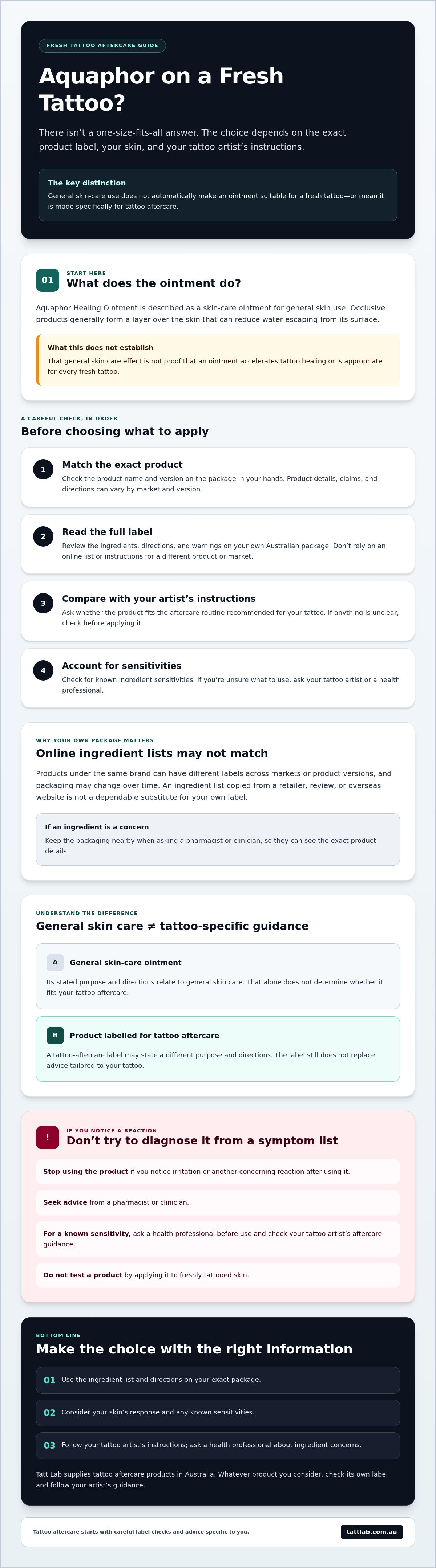
Aquaphor Healing Ointment is a skin-care ointment intended for general skin use. That description alone doesn’t tell you whether it’s suitable for a fresh tattoo. Product formulations, label claims and directions can vary by market, so use the packaging for the exact product you have in Australia rather than relying on an online ingredient list or instructions for another version. For background on the product’s history and commonly reported formulation, see this Aquaphor Healing Ointment overview, then check your own pack for the details that apply to you.
How does an ointment support the skin barrier?
Your skin barrier is the outer layer that helps limit moisture loss and shields the body from irritants. Occlusive products generally form a layer over the skin that can reduce water escaping from its surface. That function describes a general skin-care effect, not proof that an ointment accelerates tattoo healing or is appropriate for every fresh tattoo.
A new tattoo needs gentle care while the skin recovers. Follow the aftercare instructions from your tattoo artist, who can account for your tattoo and the approach used during your appointment. If you’re considering an ointment, check its label and ask your artist whether it fits their specific instructions.
Is Aquaphor made specifically for tattoo aftercare?
Don’t assume a product is intended for tattoo aftercare just because people recommend it online or share personal experiences using it. An ointment labelled for general skin care and a product explicitly labelled for tattoo aftercare may have different stated purposes and directions. Neither label, by itself, replaces advice tailored to your tattoo.
Before deciding, check:
- Product identity: Make sure you’re reading the label for the exact Aquaphor product and market version.
- Ingredients and directions: Review the packaging, especially if you have known sensitivities, and don’t transfer instructions from a different product.
- Artist guidance: Confirm whether the product suits the routine recommended for your tattoo. If anything is unclear, ask before applying it.
The practical distinction is simple: a product may serve a general skin-care purpose without being a tattoo-specific recommendation. Choosing Aquaphor Healing Ointment for a fresh tattoo should depend on its actual label, your skin and your artist’s guidance, not on its name or popularity alone.
Aquaphor Healing Ointment Ingredients: What Should Tattoo Clients Check?
Before putting any ointment on a new tattoo, check the ingredient list printed on the package in your hands. Online descriptions may refer to another product version or market, so they can’t confirm what’s in your Australian pack. The exact label also gives you the product’s own directions and warnings to consider alongside your tattoo artist’s advice.
The ingredient list on your specific pack matters because it’s the best guide to the product you actually have, not a formula described for a different market or version. Healthline’s comparison discusses ingredients like mineral oil and lanolin alcohol in its product context, but that information shouldn’t be treated as confirmation of the formula in an Australian package. Check the label itself, and keep the packaging nearby if you need to ask a health professional about an ingredient.
Could an ingredient irritate sensitive or freshly tattooed skin?
Individual responses to skin-care ingredients vary, and a reaction can’t be reliably diagnosed from a short list of symptoms. If you notice irritation or another concerning reaction after using a product, stop using it and seek advice from a pharmacist or clinician. Don’t try to test a product by applying it to freshly tattooed skin. If you’re concerned about a known sensitivity, ask a health professional before use and check your tattoo artist’s aftercare guidance.
Why can Aquaphor ingredient lists differ?
Products sold under the same brand name can have different labels across markets or product versions. Packaging may also change over time. That’s why an ingredient list copied from a retailer, review or overseas website isn’t a dependable substitute for the label on your own product.
Before deciding whether Aquaphor Healing Ointment fits your aftercare routine, take these practical steps:
- Match the product: Check the exact product name and version on the package.
- Read the full label: Review the ingredients, directions and warnings rather than relying on a partial list online.
- Ask with the pack in hand: A pharmacist or clinician can assess ingredient concerns more accurately when they can see the label.
- Confirm with your artist: Check that your choice aligns with the aftercare instructions for your tattoo.
Careful label checking helps you make a more informed choice, but it doesn’t replace individual professional advice. If you’re comparing options made for tattoo aftercare, you can explore tattoo aftercare supplies from Tatt Lab, an Australian supplier. Check each product’s own label and follow your artist’s guidance.
Aquaphor for Tattoos vs Tattoo Aftercare Products: How to Assess the Difference
A familiar ointment can seem like a reassuring choice, but familiarity doesn’t make it suitable for every fresh tattoo. Compare what a product says it’s for, how its label directs you to use it, and whether that fits the aftercare routine your tattoo artist gave you. A tattoo-specific label can clarify a product’s stated purpose, but it doesn’t replace checking ingredients, warnings or your individual sensitivities.
General skin-care use describes a product’s broader purpose; tattoo-aftercare directions describe how its maker intends it to be used for tattoo care. That distinction helps you assess Aquaphor Healing Ointment without treating it as interchangeable with every product labelled for tattoo aftercare.
| What to compare | General skin-care ointment | Product labelled for tattoo aftercare |
|---|---|---|
| Intended use | Check the skin-care purposes stated on its packaging. | Look for an explicit tattoo-aftercare purpose on the label. |
| Directions and warnings | Follow the directions and cautions for that exact product. | Read its tattoo-related instructions and warnings; don’t assume they suit every tattoo or person. |
| Artist guidance | Ask whether it fits the routine your artist recommended. | Check that its directions align with your artist’s instructions, too. |
What should you compare before choosing an aftercare product?
Start with the label, not online rankings. Compare the stated use, directions, ingredient list and relevant warnings, then consider known sensitivities. Ask your tattoo artist how the product fits the care plan for your tattoo. Customer reviews can describe someone’s experience, but they don’t establish that a product is more effective or suitable for your skin.
Aftercare advice should be relevant to your own tattoo and circumstances. If you’re unsure how to interpret a product’s directions alongside your artist’s instructions, ask your artist for clarification. For ingredient concerns, a pharmacist or clinician can help you consider the information on the exact package.
Does a thicker ointment mean better tattoo healing?
No. Texture alone doesn’t show whether a product is suitable or more effective for a fresh tattoo. A thicker feel also isn’t a reason to apply more. Follow the directions on the exact product label and your tattoo artist’s specific guidance rather than assuming a heavier layer will improve healing. If the instructions seem to conflict, ask for clarification before choosing a routine.
How to Use Aquaphor on a New Tattoo: Questions to Ask First
Before applying Aquaphor Healing Ointment to a new tattoo, pause and check that it fits both the product’s directions and the aftercare plan for your tattoo. A familiar ointment isn’t automatically suitable for freshly tattooed skin, and recommendations can differ. If you’re unsure, it’s safer to ask than to guess or change your routine based on advice meant for someone else.
What should you do before applying any ointment?
Use this simple sequence to make an informed decision:
- Read the exact package. Confirm the product version and review its directions, ingredients and warnings. Don’t rely on instructions copied from another market or product.
- Check with your tattoo artist. Ask whether the ointment fits the aftercare plan for this particular tattoo. If the packaging and artist’s instructions seem inconsistent, get clarification before applying it.
- Consider your sensitivities. If you have a known allergy, sensitive skin or a skin condition, ask a pharmacist or clinician about the ingredients before use. Keep the package available so they can review the exact label.
- Don’t improvise application directions. Follow the product’s own instructions and your artist’s guidance. If neither gives clear direction for your situation, ask before deciding how often, how long or how much to use.
This approach doesn’t establish that Aquaphor is right for every tattoo. It helps you assess the actual product in front of you, your personal considerations and the advice given for your aftercare.
When should you stop and seek professional advice?
If irritation worsens or you notice spreading redness, unusual discharge or increasing pain, stop using the ointment and seek advice from a health professional. These signs don’t confirm a particular cause, so avoid trying to diagnose the problem yourself. Don’t apply more ointment to try to settle symptoms or suspected infection without professional guidance.
If symptoms are severe or you’re concerned about a serious reaction, seek prompt medical care. A pharmacist or clinician can advise on product-related concerns, while your tattoo artist can clarify aftercare instructions. If you’re unsure which step to take, contact a health professional rather than waiting for an ointment to resolve the issue.
For broader guidance on caring for a healing tattoo, read this professional tattoo aftercare guide. If you’re exploring products specifically for tattoo aftercare, browse Tatt Lab’s tattoo aftercare supplies. Always check the chosen product’s label and follow your artist’s instructions.
Choosing Tattoo Aftercare with Tatt Lab: A Calm Next Step
There isn’t one ointment that automatically suits every new tattoo. A considered choice comes from weighing the product’s own directions against your skin’s needs and the aftercare instructions from your tattoo artist. That applies whether you’re considering Aquaphor Healing Ointment or a product labelled for tattoo aftercare. Read the packaging you have, rather than relying on information for another product version or market.
How can you make a considered aftercare choice?
Use a clear sequence before settling on a product. First, check that its labelled directions fit the aftercare instructions your tattoo artist provided. Then review the ingredients and warnings, especially if you have a known sensitivity, allergy or skin concern. A label can help you understand the product, but it can’t determine how your individual skin will respond.
If suitability remains unclear, ask your tattoo artist about the routine they recommend for your tattoo. For ingredient concerns, existing skin conditions or symptoms that worry you, speak with a pharmacist or clinician. This keeps product selection grounded in the information relevant to you, rather than unsupported promises about healing or someone else’s experience.
Where can you find professional tattoo aftercare supplies?
Tatt Lab is an Australian supplier of professional tattoo and medical supplies, including tattoo aftercare products. Its artist-owned and operated background brings professional tattoo-supply context to the category, while your artist’s instructions remain the guide for your individual aftercare. Check the information available for each item and make your choice based on its stated use, ingredients and directions. Tatt Lab’s range does not confirm the availability of Aquaphor Healing Ointment.
For broader context on selecting professional equipment and supplies, explore the professional tattoo supplies guide. It can help you understand the wider supply landscape without turning a general ointment into a tattoo-specific recommendation.
A measured approach is enough: check the label, consider your skin, and follow your tattoo artist’s aftercare guidance. If you’d like to compare options in the tattoo aftercare category, you’re welcome to browse Tatt Lab’s tattoo aftercare supplies and review the available product information at your own pace.
Choose Aftercare with Confidence
Aquaphor Healing Ointment may have a general skin-care purpose, but that alone doesn’t establish whether it suits a fresh tattoo. Check the exact product label, consider your skin and any sensitivities, and follow the aftercare guidance from your tattoo artist. If you’re unsure about an ingredient or a reaction, ask a pharmacist or clinician rather than changing your routine by guesswork.
The right choice is an informed one, not simply the most familiar product. Tatt Lab is an artist-owned and operated Australian supplier with tattoo aftercare products among its confirmed offerings. Its online store serves customers across Australia, but availability of Aquaphor specifically isn’t confirmed.
Explore the category at your own pace and review product information before choosing. Explore Tatt Lab’s tattoo aftercare supplies to see options from an Australian professional supplier. Keep your artist’s advice at the centre of your routine, and take each step of the healing process with care.
Frequently Asked Questions
Is Aquaphor Healing Ointment good for a new tattoo?
Not automatically; a general skin ointment isn’t suitable for every fresh tattoo. Check the directions and warnings on the exact Australian product package, then ask your tattoo artist whether it fits the aftercare instructions for your tattoo. Your skin and any sensitivities matter too. If you’re unsure about an ingredient or have a skin concern, a pharmacist or clinician can help assess it. Don’t rely on online anecdotes as personalised guidance.
Can I use Aquaphor on a healing tattoo?
It depends on the product version, its label directions, your skin and your tattoo artist’s advice. Read the packaging before use, and don’t assume recommendations for dry skin also apply to a fresh tattoo. If irritation develops or symptoms worsen, stop using the product and seek advice from a health professional. Applying more ointment may not address the cause, so don’t increase use without professional guidance.
Does Aquaphor help tattoos heal faster?
There’s no basis here to assume Aquaphor speeds tattoo healing. A product’s general skin-care purpose doesn’t establish that it changes healing time, and individual outcomes vary. Follow your tattoo artist’s aftercare instructions and the directions on the exact product label. Be cautious about claims promising faster healing unless they’re supported by reliable evidence that specifically applies to tattoos. If you have concerns about how your tattoo is progressing, seek professional advice.
How often should you apply Aquaphor to a tattoo?
There isn’t one application schedule that’s appropriate for everyone. Follow the directions on your exact product packaging and the aftercare plan from your tattoo artist. Don’t apply it more often or use a thicker layer based on assumptions that more will help. If the directions are unclear or seem to conflict with your artist’s guidance, pause and ask your artist, a pharmacist or a clinician before deciding how to proceed.
Can Aquaphor cause a reaction on tattooed skin?
It may not suit everyone, especially someone with a relevant sensitivity. Check the ingredient list on your own package, and ask a pharmacist or clinician about known allergies or ingredient concerns. If irritation or another concerning reaction develops, stop using the product and seek professional advice. Don’t try to diagnose or manage a significant reaction yourself, and don’t apply more ointment to try to settle symptoms without guidance.
What should I do if my tattoo becomes more painful or irritated after applying ointment?
Stop using the ointment and contact a health professional for advice, particularly if pain or irritation is worsening or there are other concerning changes. Don’t assume the product is the only possible cause, and avoid adding products to mask symptoms. For severe or urgent symptoms, seek appropriate urgent care. Your tattoo artist can clarify aftercare instructions, but a health professional is the right person to assess a medical concern.
Is Aquaphor the same as a tattoo aftercare product?
Not necessarily. Aquaphor Healing Ointment is a named skin-care product, while products labelled for tattoo aftercare may state a different intended use and provide their own directions. Compare the exact packaging, ingredients and warnings, then consider your tattoo artist’s guidance. Don’t assume a general ointment is designed or tested specifically for fresh tattoo care simply because people discuss using it for that purpose.


Comments (0)
There are no comments for this article. Be the first one to leave a message!