
What if professional tattoo equipment’s greatest advantage isn’t a better tattoo, but a more dependable working process? Understanding why professional tattoo equipment matters starts with treating it as part of your studio workflow, not a shortcut to artistry. Equipment that suits your technique can help you work with greater control and reduce avoidable interruptions. Careful hygiene practices remain essential to safety.
Quality claims can be difficult to assess. A premium label alone doesn’t tell you whether a supply is fit for your style, comfortable to use or compatible with the way you work. The practical difference comes from choosing tools for their purpose, checking product information and assessing how they fit your own workflow.
This article explains how professional-grade supplies can support controlled technique and consistent routines without promising that equipment alone guarantees an outcome. We’ll look at what to assess across needles and cartridges, inks and stencils, and how your preferences and working methods should guide those choices. The aim is a clearer, more considered approach to selecting supplies for your practice.
Key Takeaways
- Learn why professional tattoo equipment matters as part of a dependable workflow, while recognising that tools can’t replace training, judgement or sound practice.
- Assess how machine choice, needle configuration and compatible supplies affect handling and setup for your technique.
- Compare supplies by task fit, compatibility, product information and replenishment needs, rather than purchase price alone.
- Use a simple selection process and record setup preferences to support more consistent routines.
- Understand how needles, cartridges, inks, stencils and aftercare each contribute to a considered studio setup.
Why professional tattoo equipment matters beyond the tools themselves
Professional tattoo equipment matters because each tool is part of a wider studio process. Supplies need to suit the task, work with the rest of the setup and provide clear information for the artist to assess before use. These are more useful criteria than relying on a premium label or a low price as a proxy for suitability.
Professional tattoo equipment is purpose-made, fit-for-task equipment and supplies selected to support an artist’s technique within a controlled studio workflow. It can help an artist work with familiar tools and repeat a considered setup, but it can’t replace training, sound hygiene practices or the judgement needed to adapt to each client and procedure.
What makes tattoo equipment professional-grade?
Start with fit for purpose: does the item suit the task and your way of working? Check compatibility with other parts of your setup, how it handles in practice and whether its product information gives you enough detail to make an informed choice. Specialist equipment is selected for these practical reasons, not simply because it costs more or carries a professional-sounding claim. Suitability depends on the artist, procedure and studio workflow.
What professional equipment can and cannot do
Dependable tools can support controlled work and reduce avoidable interruptions, such as having to rethink a setup because a supply doesn’t suit the task. That can make a workflow more predictable. Still, equipment can’t guarantee healed results, client comfort or artistic quality. Those depend on multiple factors, including technique, individual response and aftercare. Tattooing also has potential health risks, including infection and allergic reactions, as outlined in this overview of tattooing’s health risks. Equipment alone doesn’t eliminate them.
For a broader view of how supplies fit together, explore this professional tattoo supplies guide. It covers categories such as traditional needles, cartridges, inks and stencils. Rather than asking whether a tool is marketed as the best, check its purpose, compatibility and place in your studio routine.
How professional tattoo equipment supports control, consistency and workflow
Technique develops through practice, but the setup around it matters too. Machine choice, needle or cartridge configuration, ink and other compatible supplies all affect how an artist prepares and handles equipment for a particular task. If a component doesn’t suit the machine or intended work, setup may become less predictable and require extra checking or adjustment.
When equipment suits the task and is compatible with the setup, artists can work through a more controlled, predictable workflow. That doesn’t mean every tattoo should look or feel the same. Consistency means being able to use familiar, suitable equipment and repeat a considered process while adapting to the design, the client and the work in front of you.
Machine and needle compatibility in everyday practice
Choose machine settings and needle configurations with the task and your own technique in mind. Traditional needles and cartridges aren’t automatically interchangeable, and compatibility can vary between equipment. Check the relevant manufacturer information before pairing components rather than relying on appearance or assumption. Base configuration choices on your experience and the task, and consult specialist needle guidance if you need more technical detail.
Consistent supplies and a predictable studio setup
Familiar supplies can make it easier to prepare a repeatable setup because you know what information to check and how each item fits your workflow. Planning stock also helps you notice when frequently used needles, cartridges, inks or stencils need replenishing, rather than discovering a gap during preparation. The goal is to reduce avoidable interruptions, not to claim that a particular brand will improve technique or guarantee an outcome.
Consistency still depends on judgement. An artist may adjust equipment choices for different work, and the same setup won’t produce identical results across different clients or circumstances. Keep notes on preferred configurations and setup details to help identify what’s working and make deliberate changes instead of relying on memory alone.
Safety considerations also extend beyond handling. The U.S. Food and Drug Administration’s tattoo safety information discusses inks and potential adverse reactions. It’s a US consumer resource, not a guide to Australian requirements. For Australian practice, check relevant local guidance and the information supplied with each product.
Artists reviewing options across their studio routine can browse tattoo supplies for studio workflows, including needles, cartridges, inks and stencils. Assess each category against your compatibility and replenishment needs.
Professional tattoo equipment versus cheaper alternatives: what should artists compare?
A lower upfront price can be appealing, but it doesn’t show whether a supply suits your work, fits your setup or is practical to replace. Understanding why professional tattoo equipment matters includes learning to compare product information and workflow fit rather than relying on price, prestige or promises of guaranteed results. Apply the same questions to any option, whether it’s positioned as entry-level or professional-grade.
| What to compare | Questions to ask |
|---|---|
| Fit for task | Is the equipment intended for the work you plan to do, and does it suit your technique? |
| Compatibility | Does the manufacturer explain which machine, needle or cartridge components it works with? |
| Handling | Can you assess how it feels and functions within your established setup? |
| Product information | Are specifications, intended use and instructions clearly provided? |
| Ongoing use | What maintenance or replacement does the manufacturer describe, and can you obtain compatible supplies when needed? |
How to assess quality without relying on hype
Separate verifiable details from personal preference. Specifications, manufacturer instructions and stated compatibility can be checked; comfort, balance and handling need to be assessed in your own workflow. Marketing phrases such as “premium” or “better results” don’t replace useful product information. If a detail is missing or unclear, ask the supplier or manufacturer to clarify it. Treat uncertainty as something to verify, not automatic proof that a product is unsuitable.
Maintenance and replacement also affect practical value. Follow the manufacturer’s instructions, consider how often a component may need attention or replacement, and check whether compatible supplies are accessible through your usual purchasing channels. Tattooing carries health considerations beyond equipment selection. The Mayo Clinic’s overview of tattoo risks and precautions offers broader context. Equipment choices should sit alongside sound studio practices, not stand in for them.
When an upgrade may be worth considering
Review your current setup if recurring compatibility questions, handling difficulties or supply gaps interrupt preparation. Then compare alternatives against the specific issue. A new tool may be worth considering if its documented features address a real need and it works with the rest of your setup. Novelty or status alone isn’t a reason to change.
Before adopting unfamiliar equipment, learn its instructions and setup requirements, then assess it in a controlled way before relying on it in your routine. Don’t switch tools mid-process without understanding how they’re used. The most useful choice is one you can evaluate, maintain and replenish with confidence, not necessarily the one with the highest price or boldest claim.
How to choose and maintain professional tattoo equipment responsibly
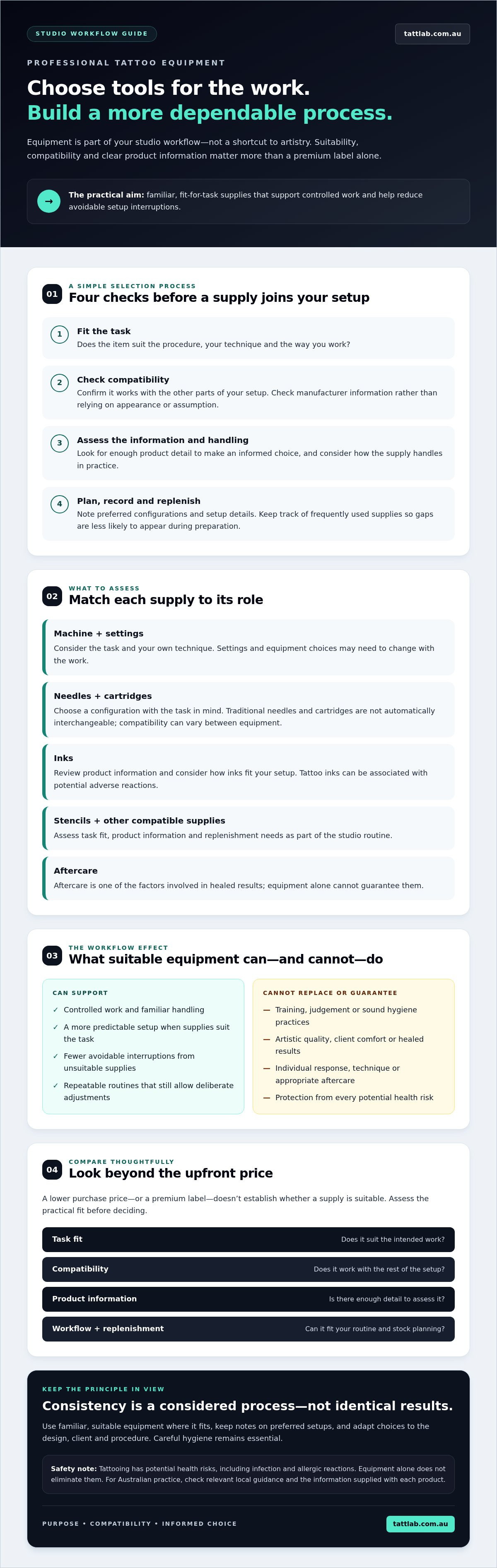
A considered setup begins with the work, not a shopping list. Before choosing or replacing equipment, follow a consistent sequence: define the task, check compatibility, read the product instructions, assess how it fits your workflow, then plan how you’ll replenish suitable supplies. This makes decisions easier to explain and review over time. It also shows why professional tattoo equipment matters: responsible selection is about fit and informed use, not simply acquiring more tools.
A practical equipment selection checklist
- Identify the task. Start with the intended procedure and your established technique, then identify the tools and consumables needed.
- Confirm compatibility. Check manufacturer information for machine, needle or cartridge compatibility. Don’t assume components will work together because they look similar.
- Review documentation. Read product instructions and the information supplied about intended use, handling and care. If a detail is unclear, seek clarification before relying on an assumption.
- Assess workflow fit. Consider how the equipment handles in your usual setup and whether it meets the studio’s practical needs.
- Plan replenishment. Note which supplies are used regularly and consider how you’ll source compatible replacements without disrupting preparation.
These checks help distinguish factual information, such as stated compatibility, from personal preferences about handling. Neither should be replaced by broad marketing claims.
Care, storage and replacement decisions
Care depends on the specific item. Follow product instructions and applicable professional guidance for storage, cleaning, maintenance and disposal. Don’t apply one item’s directions to another without checking. For infection-control topics, refer to the medical supplies for tattoo artists safety guide alongside relevant, authoritative guidance for your location in Australia.
Build a simple studio record. Document preferred equipment and setup details, and note visible wear, faults or changes in function using a consistent process. When an item needs attention or replacement, consult its instructions and assess whether a replacement is compatible with the rest of your setup. A record can help you spot recurring issues and make deliberate choices without treating every change as an upgrade.
Australian guidance may depend on the issue and the relevant authority. Check current information from an appropriate Australian government or professional source rather than assuming advice from another country applies. For artists comparing supplies for their workflow, browse tattoo needles, cartridges and inks and assess each category against your task, compatibility needs and product information.
Building a dependable professional tattoo setup with the right supplies
A dependable setup is a considered group of tools and consumables, chosen to suit the artist’s work and fit together in practice. The aim isn’t to collect every available option. It’s to know what each supply is for, confirm compatibility where relevant and keep the studio prepared for its regular work.
Match supply categories to studio needs
Start with the supplies your studio uses regularly, then assess alternatives against an actual need. Traditional needles and cartridges suit different equipment setups; inks support the tattooing process, while stencils help prepare and position a design. Aftercare has a distinct role after the session. Other studio and medical supplies may also be part of a broader workflow, but assess each item according to its purpose and the guidance that applies to it.
These categories aren’t interchangeable, and a wider selection doesn’t automatically make a setup more suitable. Check product information and compatibility before adding a new option. For example, confirm that a needle or cartridge is appropriate for the machine and task rather than choosing it only because it’s readily available. Detailed decisions about ink, needle configuration and aftercare call for product-specific guidance.
Plan replenishment around your studio’s usage and service requirements. Keep track of regularly used supplies, the options that fit your established setup and any gaps that could interrupt preparation. This helps direct purchasing toward practical needs instead of novelty, while leaving room to reassess when your work changes.
A measured next step for artists
Review your current setup as a connected system. Are the supplies compatible? Do recurring gaps or changes create avoidable interruptions? Is the product information clear enough for you to make an informed choice? These questions bring the focus back to why professional tattoo equipment matters: it supports a considered workflow, but it doesn’t replace an artist’s training, judgement or sound studio practices.
Tatt Lab is an artist-owned Australian supplier serving established studios and emerging artists nationally. Its online ordering and wholesale purchasing structures for registered professional studios provide options for artists assessing supplies against their own requirements. Browse categories such as traditional needles, cartridges, tattoo inks, stencils and aftercare, and evaluate each item by its intended role and fit with your workflow.
Explore professional tattoo supplies at your own pace, using the criteria from this guide to decide what belongs in your setup.
Make your next equipment choice with confidence
Understanding why professional tattoo equipment matters comes down to more than the tools themselves. Supplies that suit your technique and work together can support a considered, repeatable studio workflow. Clear product information, compatibility and practical replenishment needs are more useful comparison points than price or marketing claims alone.
Keep your setup matched to the work you do, and remember that equipment supports practice. It doesn’t replace training, sound judgement or appropriate studio routines. A measured review of your current supplies can help you identify what fits, what needs clarification and where a change may be worthwhile.
Tatt Lab is an artist-owned Australian supplier with categories including traditional needles, cartridges, inks, stencils, aftercare and medical supplies. Wholesale purchasing structures are available for registered professional studios and medical clinics. Explore the range and assess each category against your studio’s needs.
Explore professional tattoo supplies and take your next step toward a setup that feels clear, compatible and dependable.
Frequently Asked Questions
Why does professional tattoo equipment matter?
Professional tattoo equipment matters because fit-for-task tools and supplies can support a more controlled, predictable studio workflow. Compatibility, clear product information and dependable operation help artists prepare with greater confidence and reduce avoidable setup disruptions. Quality isn’t defined by price or prestige alone. Equipment also can’t replace training, sound judgement or appropriate studio practices, and it doesn’t guarantee a particular tattoo result or prevent health risks on its own.
Does professional tattoo equipment improve tattoo results?
Suitable equipment can support an artist’s technique and make a familiar setup easier to repeat, but it can’t guarantee better results. Tattoo outcomes also depend on the artist’s skill and decisions, the individual client and how the tattoo heals. Consider whether each tool suits the intended task and works with the rest of the setup. Treat claims promising identical outcomes or guaranteed improvements with care, and check product information before choosing.
Is professional tattoo equipment worth the investment for a new artist?
It can be worthwhile to choose fit-for-purpose supplies from the start, but a new artist doesn’t need to assume the most expensive option is automatically best. Prioritise equipment that suits your training, intended work and developing workflow. Check compatibility, instructions and how you’ll obtain suitable replacements. Build your setup thoughtfully, and seek guidance from an experienced professional where needed. Your technique and judgement remain essential; equipment is a support, not a substitute for them.
Can different tattoo machines use the same needles or cartridges?
Not necessarily. Compatibility varies, so don’t assume a needle or cartridge will fit or function with every machine. Check the manufacturer’s information for the specific machine and component before pairing them, and confirm the intended use and setup requirements. Traditional needles and cartridges may also belong to different configurations. If documentation doesn’t clearly answer your question, verify compatibility with the manufacturer or supplier rather than testing an uncertain combination during work.
How do I know whether tattoo equipment is suitable for professional use?
Assess whether it’s appropriate for the task, compatible with your setup and supported by clear product information and instructions. Consider how it handles within your established workflow, plus maintenance, replacement and access to compatible supplies. Look for verifiable details such as stated intended use rather than relying on labels like “premium” or broad performance claims. If specifications are missing or unclear, ask for clarification before deciding; uncertainty alone doesn’t prove poor quality.
What equipment should a professional tattoo artist prioritise first?
Prioritise the tools and consumables required for your intended work and established technique. That usually means assessing machine compatibility alongside suitable traditional needles or cartridges, then considering inks and stencils used in your workflow. Plan for aftercare and relevant medical supplies as distinct categories with their own purposes. There’s no universal shopping list: identify what your studio needs, check product information and compatibility, then plan replenishment around actual use.
How should tattoo equipment be maintained between sessions?
Follow the instructions supplied for each item, since cleaning, storage, maintenance and disposal needs can differ. Apply relevant professional guidance and your studio’s established infection-control procedures rather than relying on a single routine for every tool or supply. Record wear, faults or changes in function consistently, and check manufacturer advice when an item needs attention or replacement. For Australian practice, verify applicable guidance with an authoritative source rather than assuming overseas advice applies.


Comments (0)
There are no comments for this article. Be the first one to leave a message!