

What if the true barrier to your studio's growth isn't your creative talent, but the untracked cents disappearing from every ink cap and needle cartridge? Many artists feel their profits are being eroded by the rising costs of medical grade PPE and complex station setups, making the task of calculating tattoo supply cost per client feel like a daunting mathematical hurdle. You aren't alone if you find it difficult to reconcile a busy calendar with a bank balance that seems stagnant due to invisible overheads.
We're here to help you transform your practice from a creative pursuit into a high performance business with protected margins. This guide provides a methodical framework to quantify your consumable expenses, covering everything from tattoo stencils and traditional needles to specialized aftercare. We will move beyond guesswork to establish a clear dollar value for every setup, allowing you to professionalize your inventory and achieve a sustainable, results oriented career in the 2026 market.
Key Takeaways
- Understand how 2026 inflation rates impact the unit price of essential consumables like nitrile gloves and needle cartridges.
- Master the precise methodology for calculating tattoo supply cost per client by distinguishing between standard setups and complex, large-scale sessions.
- Learn how to implement a logical inventory tracking system to prevent "dead stock" from depleting your studio's liquid cash flow.
- Discover why transitioning to wholesale accounts for professional-grade needles and stencils is a critical step for protecting your long-term profit margins.
- Explore how integrating high-performance tattoo aftercare into your operational model enhances both clinical outcomes and business sustainability.
The Financial Foundation: Why Calculating Your Tattoo Supply Cost per Client is Critical in 2026
Profitability in a modern studio requires more than artistic mastery; it demands a clinical approach to your financial ledger. We define the cost per client as the precise sum of every single-use consumable utilized during a single procedure. This calculation includes the obvious items like tattoo cartridges and inks, but it also encompasses the often overlooked medical-grade PPE, barriers, and cleaning agents. By viewing each session as a specialized procedure with a measurable cost, you move from a reactive business model to one of deliberate growth.
Calculating tattoo supply cost per client is no longer optional in 2026. Global supply chains have seen consistent price fluctuations for nitrile gloves and precision cartridges, meaning that the margins you relied on just a few years ago may have evaporated. Transitioning from "guesstimating" your expenses to data-driven accounting replaces the low-level anxiety of financial uncertainty with a sense of controlled, predictable progress. When you know your exact numbers, you stop leaking profit through invisible overheads and start building a foundation for long-term self-assurance.
The Difference Between Fixed and Variable Overheads
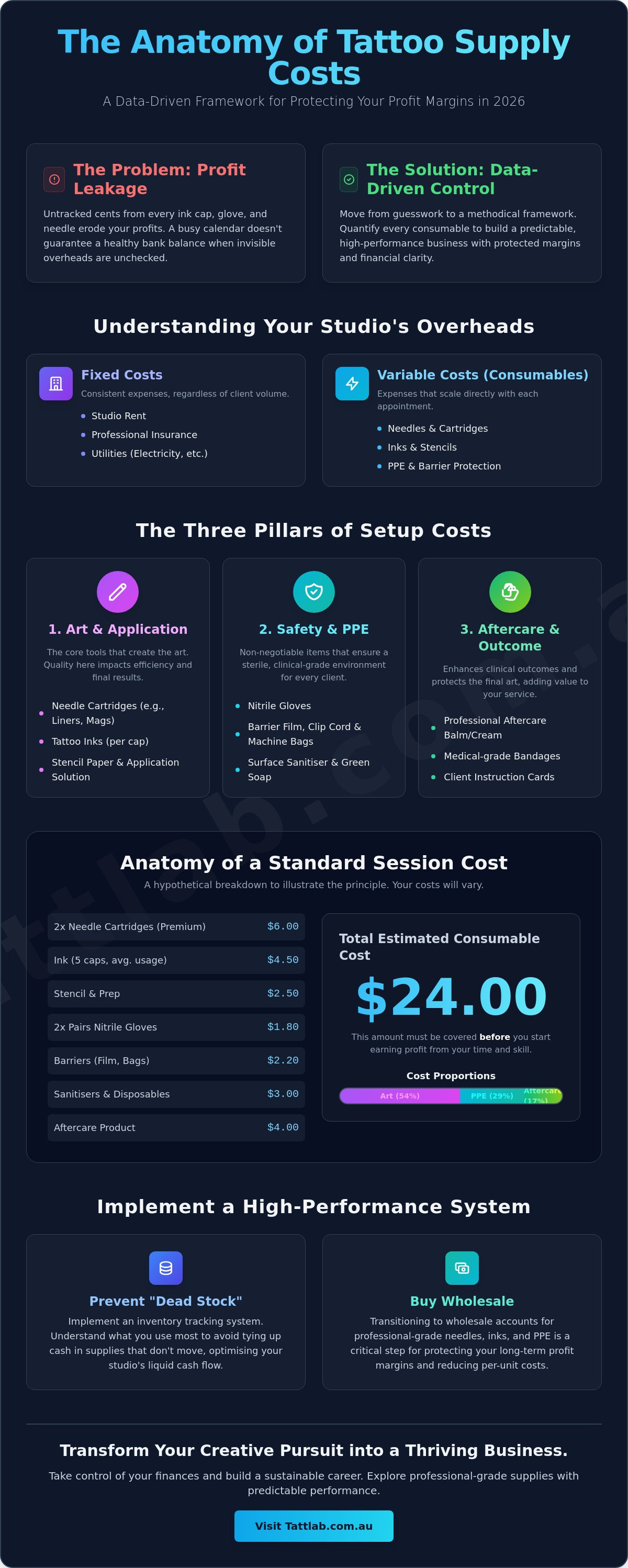
To master your finances, you must distinguish between your fixed and variable costs. Fixed overheads remain constant regardless of how many clients you see. These include your studio rent, professional insurance, and electricity. Variable costs are the supplies that disappear with every new appointment. Every time you open a new needle or pour fresh ink, your variable costs increase. Understanding this relationship is vital because your variable costs must dictate your minimum shop charge. If your consumable cost isn't covered by your base fee, you're essentially paying for the privilege of working. A methodical approach to these variables ensures that every session contributes to your studio's physical and financial integrity.
Protecting Your Margins in a Competitive Australian Market
The Australian market values both safety and aesthetic outcomes. While the history and cultural significance of tattooing is rooted in deep tradition, the modern business environment requires scientific rigor. Utilizing high-performance tattoo supplies allows you to benchmark your studio's performance against professional standards. Precise accounting provides the evidence needed for ethical price increases. Clients rarely push back when they understand their investment covers medical-grade safety and superior materials. Additionally, investing in premium needles and inks often results in better pigment retention and reduced touch-up rates. This saves you significant time and money over the financial year, turning a standard procedure into a liberating narrative of quality and professional pride.
The Consumable Checklist: Categorising Your Professional Tattooing Overheads
Organising your inventory into distinct categories is the first step toward clinical precision in your business. By segmenting your setup into three core pillars: Art, PPE, and Aftercare, you can identify exactly where your resources are flowing. Using artist-vetted, professional-grade materials for every procedure isn't just about quality; it's about predictable performance. Generic alternatives often lead to higher waste and increased long-term costs because they lack the reliability of specialised equipment. Implementing a standardised "Setup Sheet" ensures that every artist in your studio maintains this level of meticulousness, protecting your collective margins.
Needles, Cartridges, and Pigments
Your artistic tools represent a significant portion of your variable overhead. When determining the cost of tattoo ink, you should calculate the expense per cap based on average drops per session. This granularity is essential, especially when following FDA guidance on tattoo ink safety to ensure you're using compliant, high-performance pigments. You'll also notice a distinct price difference between premium cartridges, such as Elite III or EZ V-Select, and traditional needles. While cartridges offer efficiency and safety, they require a higher per-unit investment. Don't forget to factor in specialty items like large-volume magnums or curated grey wash sets, as these can quickly shift your baseline figures.
Medical PPE and Barrier Protection
Safety is the foundation of physical integrity. The true cost of medical supplies for tattoo artists includes more than just the obvious box of nitrile gloves. Barrier film, clip cord covers, and machine bags are the "cents that add up to dollars" over a busy month. Every lap cloth and bottle of surface sanitiser contributes to the total when you're calculating tattoo supply cost per client. Even skin prep solutions like green soap must be accounted for to ensure your pricing reflects the clinical rigor of your environment. This methodical approach mirrors the precision of the work itself, replacing uncertainty with a sense of controlled progress.
Tattoo Aftercare and Stencilling
The final phase of the procedure involves stencilling and post-operative care. You should track the cost of stencil paper and transfer gel per square inch of skin to maintain accuracy. We recommend including a "starter" amount of tattoo aftercare in your base price. Providing high-end aftercare isn't just an expense; it's a marketing investment in the longevity of the artwork and the safety of the client's skin. To keep your studio stocked with these essentials, you can browse our professional inventory to find supplies that align with your commitment to excellence.
The Calculation Framework: How to Determine Your Exact Cost per Procedure
Establishing a quantifiable baseline for your studio starts with distinguishing between a "Standard Setup" and a "Large Scale Session." While your artistic approach evolves with every piece, your financial tracking should remain constant. By utilizing a simple spreadsheet to log unit prices directly from your invoices, you create a transparent narrative of your studio's health. The Unit Cost Method for tattoo supplies is a systematic accounting practice where the total price of a bulk supply package is divided by its individual components to reveal the exact expense of a single application. This methodical rigor ensures that no detail is left to chance, replacing guesswork with data-driven confidence.
When calculating tattoo supply cost per client, it's essential to incorporate "buffer percentages." We recommend adding a 10% to 15% margin to your final total to account for the biological realities of the studio environment, such as accidental contamination, ink spills, or the need for an extra needle. This buffer protects your margins from the unpredictable nature of physical procedures, ensuring your progress remains steady and your business remains sustainable.
Step 1: Determine the Unit Price of Every Item
Precision begins with the formula: Box Price ÷ Number of Units. For example, if a box of 20 tattoo cartridges costs $40, your unit cost is exactly $2.00. Liquids require a slightly different approach; you should estimate the average milliliters of tattoo inks or skin prep solutions used during a typical session. It's easy to overlook the small items, yet tongue depressors, ink caps, and razors are the quiet overheads that can erode your profit if ignored. Tracking these micro-costs is a vital step in professionalizing your inventory management.
Step 2: Sum the Total Consumables for a Session
Once you have your unit prices, you can build profiles for different session types. A "Standard Small Tattoo" profile might include one needle, two pairs of gloves, and three ink caps. In contrast, a "Full Day Session" profile will require four or more needles, six pairs of gloves, and multiple barrier protection changes. When you compare the supply cost of a $150 tattoo versus a $1,200 tattoo, the necessity of calculating tattoo supply cost per client becomes undeniable. It allows you to see exactly how much of your fee is being reinvested into the procedure itself.
Step 3: Factoring in Equipment Depreciation
Professional studio owners understand that physical integrity extends to their equipment. Adding a modest "machine maintenance" fee, such as $5 per client, creates a dedicated fund for eventual replacement or repair. This step also accounts for the wear and tear on your furniture and the regular servicing cycles required for autoclaves or thermal printers. Factoring in depreciation is the definitive marker of a business owner who values long-term results over quick fixes, ensuring your studio remains a modern, high-functioning facility for years to come.
Strategic Cost Management: Improving Your Studio’s Profit Margins Without Sacrificing Safety
Strategic management is the bridge between clinical rigor and financial freedom. Once you've mastered the mathematics of calculating tattoo supply cost per client, the next logical progression is optimizing those figures to enhance your studio's physical and financial integrity. Improving your profit margins shouldn't involve compromising the safety of your procedures. Instead, it requires a methodical approach to how you source, store, and utilize your professional inventory. By treating every consumable as a tracked business investment, you replace financial uncertainty with a sense of controlled, predictable progress.
Evaluating the return on investment for premium supplies is a critical component of this strategy. High-performance tools, such as precision-engineered Round Liners or Curved Magnums, aren't just aesthetic choices. They often allow for smoother pigment implantation and greater efficiency, which can lead to faster tattooing times. When an artist can complete a high-quality procedure more quickly without sacrificing safety or skin integrity, the studio's hourly profitability increases. This is how the precision of your work directly translates into the health of your business.
The Benefits of Wholesale Supply Chains
Wholesale accounts are a necessity for any artist seeking to scale their practice in the Australian market. By shifting from retail purchases to bulk procurement, you significantly lower the unit price of every needle and ink cap. Tatt Lab’s wholesale pricing structures are specifically designed to help local studios grow by providing access to artist-vetted equipment at a lower entry point. While "cheap" generic supplies might seem attractive initially, they often carry hidden costs. Breakage during a procedure, skin irritation, and slow healing narratives can damage your reputation and increase your touch-up rates. Utilizing express nationwide shipping also allows for lean inventory management, ensuring you don't have to over-order to maintain your service standards.
Inventory Auditing and Waste Reduction
Preventing "dead stock" is essential for maintaining liquid cash flow. Having hundreds of dollars tied up in obscure ink colors that haven't been used in months is a common profit leak that can be avoided with regular auditing. We recommend setting "Par Levels" for your most-used items, such as nitrile gloves, black ink, and cartridges. This ensures you never run out of essentials while avoiding the trap of over-purchasing. Implementing the "First-In, First-Out" (FIFO) method for perishable items like inks and balms ensures your products remain fresh and effective. Furthermore, training artists to pour only the ink they realistically need for a specific session prevents expensive pigments from being discarded. A clean, organized workstation reduces the chance of wasting expensive PPE, reinforcing the clinical authority of your brand. To begin optimizing your studio's overheads today, you can apply for a professional wholesale account and secure the high-performance tools your business deserves.
Investing in Excellence: How Tatt Lab Supports Sustainable Australian Tattoo Businesses
Sustainability in the Australian tattoo industry is built on a foundation of clinical rigor and financial transparency. At Tatt Lab, our commitment goes beyond merely stocking traditional needles and tattoo cartridges; we act as a dedicated partner in your studio's narrative of progression. As an artist-owned supplier, we possess a deep, lived understanding of the daily overhead pains you face. We know that every ink cap poured and every barrier film applied represents a measurable investment in your craft. The process of calculating tattoo supply cost per client becomes significantly more streamlined when your procurement is centralized through a professional platform. Our integrated Shopify system is designed to simplify your end-of-month expense tracking, allowing you to export precise data and replace administrative anxiety with a sense of controlled progress.
By treating your supply chain as a high-end laboratory where science meets health, you ensure that your studio maintains a minimalist, boutique persona that aligns with modern expectations. This methodical approach mirrors the precision of the work itself, ensuring that your financial health is as robust as the physical integrity of the skin you treat. We support the Australian industry by prioritizing safety-first medical and tattoo supplies, providing the tools necessary for you to focus on the liberating narrative of personal transformation for your clients.
Sourcing Vetted Supplies Nationally
We curate our inventory with a meticulous focus on world-renowned brands like Panthera, Elite, and Dr. Pickles. This ensures that every pigment and aftercare product meets our high standards for safety and long-term performance. Maintaining physical integrity within your studio requires the use of TGA-compliant medical PPE, providing the peace of mind that your barrier protection is as professional as your artwork. Rigorous product selection is a non-negotiable aspect of our operation. We help studios avoid the "invisible leaks" caused by unreliable equipment, ensuring that when you're calculating tattoo supply cost per client, you're accounting for products that deliver consistent, predictable results every time.
Building a Reliable Supply Partnership
Reliability is the cornerstone of any successful business partnership. We understand that an urgent need for round shaders or long tapers can arise unexpectedly, which is why we offer local click-and-collect options alongside express nationwide shipping. This logistical efficiency ensures you maintain lean inventory levels without the risk of procedural delays. By establishing a professional wholesale account, you gain access to the specialized equipment necessary to optimize your margins and protect your studio's longevity. This steady, low-pressure procurement model allows you to focus on artistic excellence while we handle the technical rigor of your supply chain. We invite you to view our professional range and start optimizing your costs today, ensuring your business remains as meticulous and high-performing as the tattoos you create.
Mastering Your Studio’s Financial Evolution
Transitioning your studio from a space of creative uncertainty to one of measurable, sustainable growth requires a commitment to both clinical rigor and financial precision. We've explored how categorizing your consumables into art, PPE, and aftercare provides a clear narrative of your overheads. By implementing the Unit Cost Method, you replace the anxiety of "invisible leaks" with the confidence of data-driven accounting. This methodical approach ensures that every session protects your margins while upholding the physical integrity of your clients' skin.
As an artist-owned and operated partner, we understand that your success depends on access to reliable, high-performance equipment. Whether you require premium medical-grade PPE or precision-engineered tattoo cartridges, our focus remains on supporting the Australian industry with integrity and speed. Mastering the discipline of calculating tattoo supply cost per client is the definitive step in professionalizing your operation for 2026 and beyond.
Optimise your studio margins with Tatt Lab professional supplies and benefit from our express nationwide Australian shipping. You've built the talent; now it's time to build the legacy your hard work deserves.
Frequently Asked Questions
How much does an average tattoo setup cost in supplies?
An average setup cost depends entirely on the procedure's complexity and the specific brands you select. You must account for every needle, ink cap, and glove used during the session. While market averages exist, your internal data is the only reliable metric for your studio. Tracking these variables ensures your pricing reflects the clinical rigor of your workspace and covers all single-use consumables.
Should I charge my clients a separate "supply fee"?
Integrating your overheads into a comprehensive hourly or flat rate is generally preferred over a separate supply fee. This approach maintains a professional, high-end studio persona while ensuring your margins remain protected. Clients value transparency regarding safety and quality. Explaining that your rate includes premium pigments and medical-grade PPE builds immediate trust without the friction of additional line items on their invoice.
How do I calculate the cost of tattoo ink per drop?
To find the cost per drop, divide the total bottle price by the estimated number of drops it contains. This granular level of detail is a fundamental component of calculating tattoo supply cost per client. It allows you to track the usage of expensive specialty pigments or high-volume black inks. This methodical approach replaces guesswork with a clear understanding of your liquid inventory's value.
Is it cheaper to use traditional needles or cartridges?
Traditional needles typically offer a lower per-unit price, but they often require more setup time and additional hardware like tubes and grips. Cartridges provide a higher level of efficiency and integrated safety membranes, which can streamline your workflow and station teardown. For many modern artists, the time saved during a procedure often outweighs the higher unit cost of a cartridge system.
How often should I audit my tattoo supply inventory?
Conducting a formal inventory audit once a month is a standard practice for high-performance studios. This rhythm allows you to identify dead stock and adjust your par levels before they impact your liquid cash flow. Regular checks ensure you don't run out of essentials like nitrile gloves or stencils. It also provides the necessary data to update your financial spreadsheets with current market pricing.
What is the most expensive consumable in a tattoo setup?
Precision cartridges and specialized aftercare products are often the most significant per-unit expenses in a professional setup. While individual ink caps or razors seem negligible, the cumulative cost of high-quality barrier film and medical-grade PPE is also substantial. Identifying these high-cost items helps you focus your strategic management efforts where they will have the greatest impact on your total profit margins.
Can I use cheaper medical supplies to save money?
Using non-vetted or lower-grade medical supplies can compromise the safety of the procedure and the healing narrative of your client. Professional-grade PPE is designed to withstand the specific rigors of the tattooing environment, such as chemical exposure and puncture risks. Investing in artist-vetted materials ensures physical integrity and reduces the likelihood of adverse reactions, which protects your studio's long-term reputation and success.
How does bulk buying tattoo supplies affect my taxes?
Bulk purchasing allows you to lower your unit costs and is typically recorded as a business expense under the Cost of Goods Sold. For self-employed artists, these purchases are vital for calculating tattoo supply cost per client and maximizing tax deductions. It's important to consult with a qualified accountant to ensure your inventory tracking aligns with current tax regulations, such as the thresholds for reporting business income.


Comments (0)
There are no comments for this article. Be the first one to leave a message!