

A tattoo cartridge is far more than a disposable tool; it is the critical clinical interface where mechanical precision meets biological integrity. When you are choosing professional tattoo cartridges, you're making a decision that dictates the trajectory of skin trauma, pigment saturation, and long-term machine health. You likely understand the quiet frustration of inconsistent needle groupings that force you to overwork the skin, or the anxiety of a potential membrane failure that threatens your equipment's motor. These technical failures don't just slow you down; they compromise the professional results and the sense of safety your clients expect.
Mastering the nuances of needle geometry and membrane tension will allow you to achieve crisp, consistent lines and smooth saturation with minimal passes. This guide provides a methodical look at the technical specifications required to protect skin integrity and ensure absolute studio safety in an era of evolving MoCRA and REACH regulations. We will examine how to select configurations that offer predictable resistance, ensuring your focus remains on the artistry while the science of the cartridge handles the safety and precision of every stroke.
Key Takeaways
- Understand how medical-grade 316L stainless steel construction and needle stability directly influence pigment deposit efficiency for superior saturation.
- Master the technical criteria for choosing professional tattoo cartridges by decoding how different needle tapers and groupings impact your specific artistic technique.
- Learn to verify the presence of high-performance safety membranes to prevent fluid backflow and ensure long-term protection for your machine’s motor.
- Identify the precise configurations required to achieve crisp lines and smooth shading while significantly reducing dermal trauma and improving client healing times.
- Transition to a specialist-vetted selection process that prioritizes clinical safety and consistent, predictable results in every session.
The Science of Precision: Why Professional Tattoo Cartridges Dictate Artistic Outcomes
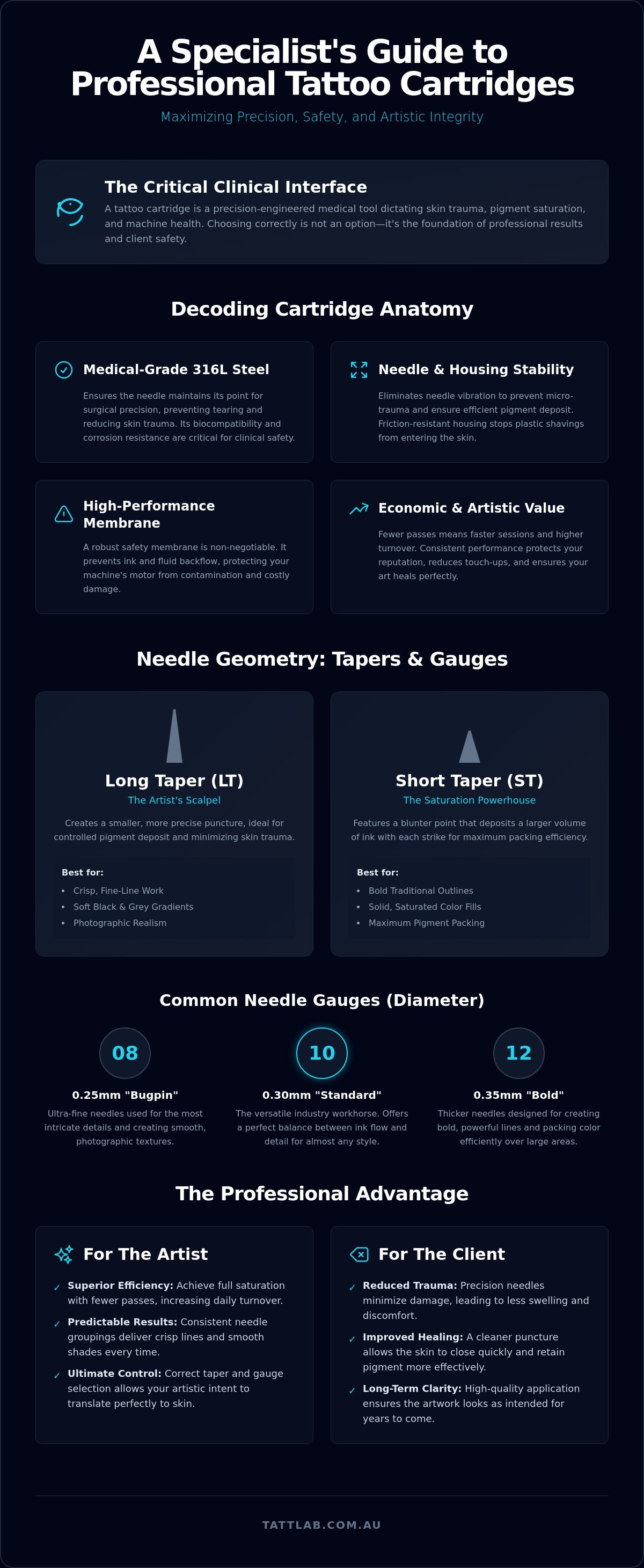
A professional tattoo cartridge is not a mere accessory; it is a precision-engineered medical tool designed for a specific biological purpose. While modern tattoo machines provide the mechanical force, the cartridge acts as the clinical interface between pigment and the dermis. When choosing professional tattoo cartridges, the primary focus should be on needle stability. A needle that oscillates or vibrates within its housing fails to deposit pigment efficiently. Instead of a clean insertion, the needle creates a fragmented wound, causing the ink to scatter rather than settle in a saturated layer. High-quality housing also plays a critical role. Superior cartridges use friction-resistant materials to prevent the internal needle bar from scraping against the plastic. This prevents microscopic plastic shavings from being driven into the skin, a common issue with budget-grade alternatives. At Tatt Lab, our philosophy is rooted in the belief that artistic excellence is only possible when supported by rigorous clinical standards.
The Impact on Skin Integrity and Healing
Needle vibration is the silent enemy of a successful heal. In low-quality cartridges, even minor instability causes unnecessary micro-trauma. This excessive trauma triggers a heightened inflammatory response, leading to increased swelling and prolonged healing times. Using professional-grade 316L stainless steel ensures the needle maintains its point throughout multi-hour sessions. A dull needle tears the tissue, while a specialist-grade point enters with surgical precision. This allows the skin to close quickly and retain pigment with minimal distress, resulting in a smoother recovery process for the client.
Economic Value vs. Unit Price
It's easy to focus on the unit price per box, but the true cost of a cartridge includes the time spent on touch-ups and the speed of the session itself. Choosing professional tattoo cartridges that offer consistent performance directly improves your workflow. You'll find you need fewer passes to achieve full saturation, which increases your daily studio turnover. Beyond the immediate session, the reputation of a specialist is built on the long-term clarity of their work. High-quality consumables ensure your art looks as intended years later, which is the most valuable marketing a studio can have. Consistency reduces the risk of expensive "re-dos" and fosters deep trust with your clientele.
Decoding Cartridge Anatomy: Tapers, Groupings, and Housing
The anatomy of a cartridge is a study in microscopic engineering. Every component, from the needle tip to the plastic casing, influences how the skin responds to the procedure. When choosing professional tattoo cartridges, the material of the needle itself is the first point of clinical assessment. Specialist-grade needles are constructed from 316L stainless steel, a medical-grade alloy valued for its biocompatibility and resistance to corrosion. This material ensures the needle maintains its structural integrity even during long, demanding sessions. Beyond the metal, the housing must offer absolute optical clarity. Transparent housing allows you to monitor ink flow and needle depth with total confidence, preventing the guesswork that leads to uneven saturation. Internal stabilization is equally vital. High-quality cartridges utilize a guide system that prevents the needle from rattling within the tip, ensuring a silent, fluid movement that mirrors the artist's intent. Maintaining high standards for tattoo safety requires more than just a clean studio; it demands consumables that don't compromise biological integrity.
The Science of the Taper
The taper refers to the length of the needle's point, and it is a critical variable in dermal interaction. Long Tapers (LT) are favored for fine-line work and soft black-and-grey gradients because they create a smaller puncture, allowing for more control over pigment density. In contrast, Short Tapers (ST) are designed for maximum pigment packing. Because the point is more blunt, it deposits a larger volume of ink with each strike, making it the ideal choice for bold traditional work or solid colour fills. The length of the taper directly dictates the puncture diameter of the skin, with longer tapers creating a narrower entry point that reduces trauma and facilitates a more efficient healing narrative. When you are exploring professional tattoo cartridges, selecting the correct taper is the first step toward achieving a predictable result.
Needle Gauges and Their Specific Applications
Needle gauge, or diameter, further refines the technical precision of your work. Each gauge serves a specific purpose in the narrative of a tattoo's creation:
- 08 (0.25mm): Known as "bugpins," these ultra-fine needles are used for intricate detail and smooth, photographic realism.
- 10 (0.30mm): This is the versatile industry standard. It offers a perfect balance between ink flow and detail, making it suitable for almost any style.
- 12 (0.35mm): These thicker needles are the professional choice for heavy saturation and traditional lining where a bold, consistent presence is required.
Your decision when choosing professional tattoo cartridges should always align the gauge with the specific dermal layer you intend to target. Using a gauge that is too heavy for fine detail can lead to "blowouts," while a gauge that is too fine for packing will result in patchy, inconsistent colour that requires multiple, traumatizing passes to correct.
Matching Configurations to Your Artistic Technique
Selecting a configuration is a clinical decision involving fluid dynamics and skin tension. When choosing professional tattoo cartridges, you're essentially selecting the specialized "brush" required for the dermis. Round Liners (RL) are designed for singular precision. Because the needles are soldered into a tight, circular point, they provide a consistent line weight that resists "snagging" the dermis. This stability is critical for delicate work where even a minor tremor in needle tracking can lead to visible imperfections. Round Shaders (RS), while similar in shape, feature needles that are spaced further apart. This spacing acts as a bridge between lining and shading, allowing for efficient tattoo ink saturation in tight spaces where a traditional magnum would be too cumbersome.
Shifting to Magnums (Mag) requires an understanding of pigment distribution across larger surface areas. Standard magnums are flat, making them ideal for solid colour packing. However, Curved Magnums (also known as Soft Edge Magnums) utilize a staggered, rounded grouping that follows the natural topography of the body. This technical design prevents the "hard edges" or "railroad tracks" often seen with flat magnums, making them indispensable for realistic portraits and smooth transitions. As noted in the FDA fact sheet, the safety of the tattooing process is heavily influenced by how these tools interact with pigments and the skin barrier. Choosing professional tattoo cartridges with the correct curvature ensures you respect the biological limits of the skin while achieving artistic depth.
Mastering Liners for Fine-Line Work
The distinction between tight and loose liners often dictates the final aesthetic of the piece. Tight liners pull the needles into a sharp, narrow point for maximum crispness and "single-pass" lining. Loose liners allow for a slight "bleed," which can be beneficial for traditional styles or bolder outlines. A key technical indicator of quality is the soldering height. If the needles are soldered too low, the grouping can splay under pressure, leading to inconsistent lines and increased trauma. Integrating these specific choices into your broader tattoo supplies inventory ensures you have the right tool for every client's unique skin profile.
Shading Strategies with Magnums
Curved Magnums are essential for achieving the soft, ethereal gradients required in modern realism. They reduce the risk of over-working the skin at the edges of a shaded area, which is where most scarring occurs. To prevent "puddling" or ink pooling, specialists prioritize cartridges with a textured needle surface that holds ink more effectively. Choosing a Long Taper magnum further enhances this effect. The extended point allows for a more gradual deposit of pigment, which is the secret to seamless black-and-grey gradients that maintain their clarity long after the initial healing narrative is complete.
The Professional Selection Framework: Safety and Compatibility
The selection process for a specialist is a multi-step verification of engineering and hygiene. When choosing professional tattoo cartridges, your first priority is the internal barrier. A true safety membrane is a flexible silicone seal that creates a physical divide between the needle bar and the machine grip. This prevents ink, blood, and interstitial fluid from traveling upward, which is the primary cause of cross-contamination and motor failure. Lower-quality alternatives often use a simple rubber band or spring system. These might provide the necessary "bounce back" for the needle, but they offer zero protection against backflow. A failure here doesn't just ruin a session; it compromises the biological safety of your entire studio environment.
Membrane Technology and Machine Protection
Machine health is inextricably linked to the tension of your chosen cartridge. High-tension membranes provide a snappy response, but they require more torque from your tattoo machine motor. Using excessively stiff membranes in a lightweight rotary machine can lead to premature motor burnout or inconsistent hit strength. Conversely, a membrane that is too soft may lack the resistance needed for clean needle retraction, leading to pigment "spitting" and uneven lines. Testing for needle "play" is the final mechanical check. If the needle has lateral movement within the plastic tip, your work will lack the surgical precision required for professional results. We recommend investing in specialist-vetted cartridges to ensure your hardware remains protected and your lines stay sharp.
Clinical Sterilisation Standards
Hygiene is a non-negotiable pillar of the modern studio, especially with the 2026 MoCRA regulations now in full effect. Every professional cartridge must undergo Ethylene Oxide (EO) gas sterilization, a process that penetrates the entire packaging to eliminate microbial life without damaging the delicate needle points. When choosing professional tattoo cartridges, always verify the presence of a sterilization indicator on each individual blister pack. These indicators change colour once the EO gas has successfully processed the item. Studio compliance now demands meticulous record-keeping, so checking batch numbers and expiration dates is a mandatory part of your daily setup. For a deeper look at the broader protocols required for a sterile environment, consult our guide on medical supplies for tattoo artists. This methodical approach ensures that every session is a predictable, safe, and professional experience for both the artist and the client.
Elevating Your Practice with Specialist-Vetted Cartridges
The final stage of professional development involves curating a toolkit that aligns with your clinical standards. When choosing professional tattoo cartridges, the source is as important as the technical specification. At Tatt Lab, our commitment is built on a foundation of artist-led testing and rigorous clinical approval. We view the cartridge as a critical biological interface, not just a disposable accessory. Every configuration in our inventory has been subjected to performance evaluations to ensure it meets our standards for needle stability and membrane integrity. This methodical vetting process ensures you are investing in tools that respect the physical integrity of your client's skin.
Our selection includes specifically curated ranges like Elite III and EZ V-Select, chosen for their superior membrane tension and consistent manufacturing quality within the Australian market. These ranges represent a sophisticated balance between premium artistic performance and the reliability required by high-volume studios. By maintaining a steady supply of these verified brands, we help artists avoid the mid-session surprises that occur with unvetted batches. This focus on the initial procedure is the first step in a successful tattoo aftercare narrative. When the skin is treated with surgical precision from the first strike, the subsequent healing process becomes a predictable journey toward a preserved aesthetic.
Artist-Led Curation
The advantage of an artist-owned and operated enterprise lies in the depth of technical support available. General retailers often lack the specialized knowledge required to demystify the science behind membrane resistance or needle taper geometry. Because we operate from a position of practical expertise, we vet new technologies through the lens of a practitioner before they reach our national inventory. We look for the subtle indicators of quality, such as the smoothness of the needle bar's glide and the optical clarity of the housing. This ensures that every box delivered to your studio supports your professional reputation and your client's safety.
Streamlining Your Studio Supply Chain
Efficiency in a modern studio depends on a predictable supply chain. Managing multiple vendors for ink, needles, and medical-grade PPE introduces variables that can compromise your workflow. When you are choosing professional tattoo cartridges from a specialist supplier, you ensure consistent quality across your entire consumable inventory. This consistency allows you to focus on the creative process, knowing that your tools will perform with the same precision every time you open a new blister pack. A streamlined supply chain reduces the anxiety of inventory management and replaces it with a sense of controlled, professional progress. Explore our professional cartridge range and elevate your work today.
Precision Engineering for Professional Outcomes
The journey toward technical mastery is built on the foundation of clinical rigor and specialized tools. As we have explored, the difference between an average result and a professional masterpiece often lies in the microscopic details of needle stability and membrane integrity. By prioritizing 316L Medical Grade Stainless Steel and true safety barriers, you protect both your client's skin and your machine's longevity. This methodical approach to choosing professional tattoo cartridges transforms a standard procedure into a predictable, high-end service that fosters deep client trust and ensures consistent healing narratives.
At Tatt Lab, we provide more than just supplies; we offer artist-owned and operated expertise to support your studio's evolution. Our curated selection is designed to meet the demands of modern Australian artists who value physical integrity and artistic precision above all else. Shop Professional Tattoo Cartridges at Tatt Lab and enjoy the reliability of national express shipping across Australia to keep your practice moving forward. Your commitment to using specialist-vetted consumables is the most effective way to ensure every session results in a clean, vibrant, and safe transformation.
Frequently Asked Questions
What is the difference between a safety membrane and a rubber band in a cartridge?
A safety membrane is a solid silicone barrier that provides a physical, impermeable seal between the needle and the machine motor. In contrast, a rubber band only serves as a mechanical return mechanism to retract the needle. Because rubber bands lack a seal, they allow ink and biological fluids to flow back into the grip and machine, posing a significant cross-contamination risk.
Can I use any brand of cartridge with my rotary tattoo machine?
Most modern rotary machines use a universal connection, but compatibility depends heavily on the internal membrane tension. High-tension membranes can strain smaller motors, leading to overheating or inconsistent hit strength. When choosing professional tattoo cartridges, you must ensure the resistance of the internal seal aligns with your machine's torque specifications to protect your hardware's longevity.
Why do some tattoo cartridges cause more skin trauma than others?
Excessive skin trauma is typically caused by needle vibration or "rattle" within the cartridge housing. Lower-quality tips allow for lateral movement, which creates jagged punctures rather than clean, surgical entries. Furthermore, needles not constructed from 316L stainless steel can dull prematurely, leading to tissue tearing and a more difficult healing narrative for the client.
What needle gauge is best for fine-line tattooing?
A 08 (0.25mm) or 10 (0.30mm) gauge is the professional standard for achieving crisp, fine-line results. The 08 gauge, often referred to as a bugpin, creates a smaller puncture diameter that is ideal for intricate detail and delicate scripts. Selecting these smaller diameters allows for high-precision work while minimizing the risk of pigment blowout in shallow dermal layers.
How do I know if my tattoo cartridges are properly sterilised?
You can verify sterilization by inspecting the Ethylene Oxide (EO) Gas indicator on each individual blister pack. This chemical sensor changes colour only after the pack has been successfully processed through a sterilization chamber. Always check the batch number and expiration date before use to maintain clinical compliance and ensure absolute studio safety.
What is the advantage of using Curved Magnums over standard Magnums?
Curved Magnums feature a staggered, rounded profile that follows the natural topography of the skin. This technical design prevents the "harsh edges" or "railroad tracks" often associated with flat magnums, allowing for much smoother blending. They are the specialist choice for realistic portraits and ethereal gradients where seamless pigment distribution is required.
How often should I change my tattoo cartridge during a long session?
You should replace your cartridge if you notice a decline in pigment saturation or increased resistance during needle entry. While 316L steel is highly durable, needles can eventually lose their surgical point during intensive, multi-hour sessions. Choosing professional tattoo cartridges and replacing them when dull ensures that you maintain consistent precision and minimize trauma throughout the entire procedure.
Are bugpin needles better for shading or lining?
Bugpin needles are exceptionally versatile but excel at smooth, photographic shading due to their smaller diameter. This reduced size allows for more gradual pigment layering, making them perfect for soft black-and-grey work. However, many specialists also utilize them for ultra-fine lining where a delicate, understated presence is the desired artistic outcome.


Comments (0)
There are no comments for this article. Be the first one to leave a message!