

What if the difference between a buttery, seamless gradient and irreversible skin trauma came down to the microscopic geometry of your needle taper? In a professional studio environment, the technical margin for error is razor-thin. Choosing the right magnum tattoo cartridges is not just a matter of preference; it's a clinical decision that affects the biological integrity of your client's skin and the longevity of the art itself.
It's a challenge every dedicated artist faces: the struggle for consistent ink flow during large-scale shading or the confusion of when to deploy a curved versus a straight configuration. You want to provide a transformative experience that prioritizes both safety and aesthetic excellence. This guide will empower you to master these technical nuances, ensuring you achieve flawless saturation and clinical precision in every session. We'll examine the specific mechanics of needle gauges, the science of ink displacement, and how the right cartridge selection leads to faster healing times and a superior result for your clients.
Key Takeaways
- Master the science of force distribution to ensure that large-scale shading remains a gentle, efficient process rather than a source of excessive skin trauma.
- Decipher the technical impact of needle gauges and tapers to achieve saturated colour with the clinical precision required for professional results.
- Determine when to deploy Curved Magnums for seamless transitions in realism or Straight Magnums for the crisp, traditional packing of saturated pigments.
- Evaluate the specific features of professional magnum tattoo cartridges to maintain a consistent studio workflow that prioritizes physical integrity and aesthetic longevity.
- Learn how to optimize your supply chain to ensure your boutique studio maintains the meticulous standards and steady progress your clients expect.
What are Magnum Tattoo Cartridges and Why Do They Matter?
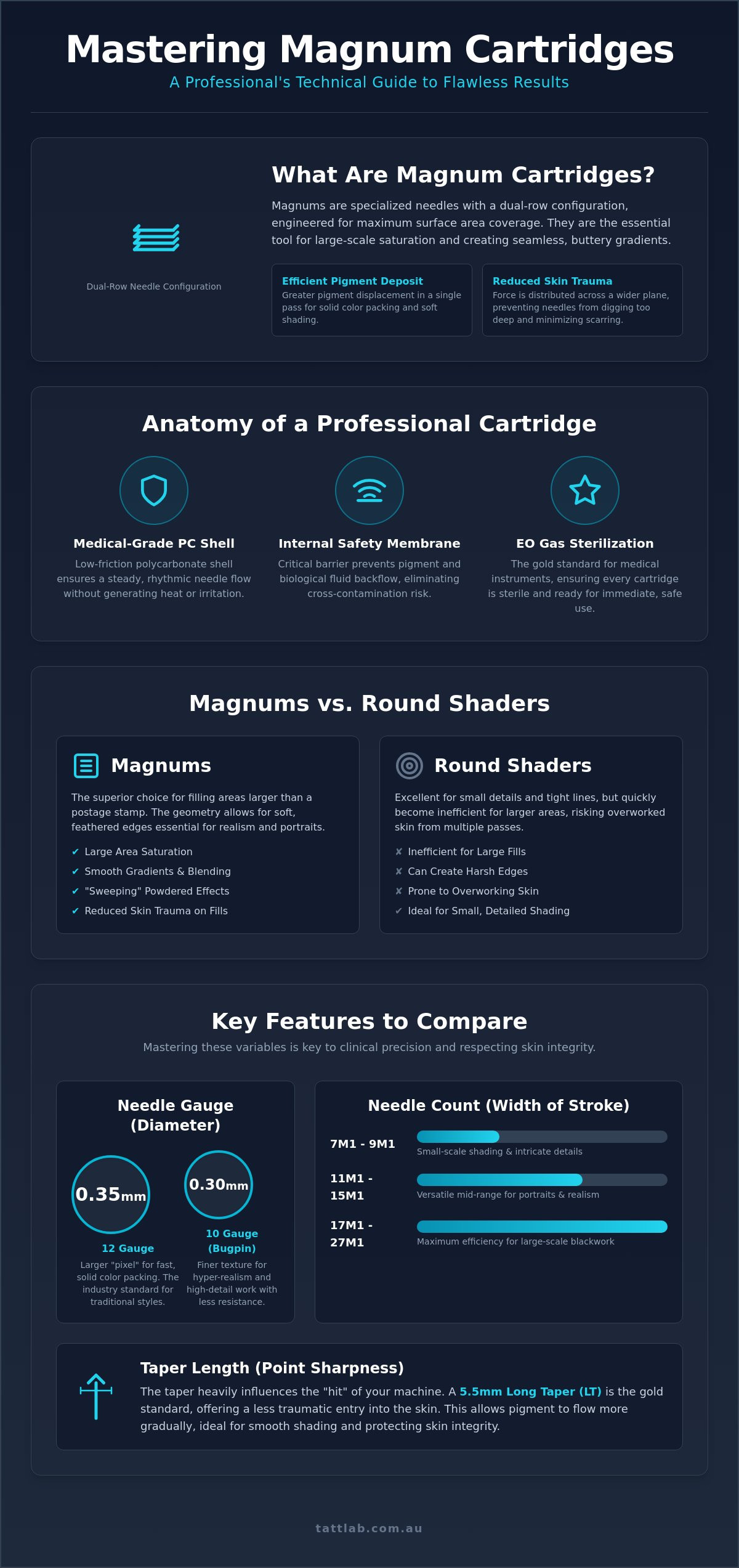
Magnum tattoo cartridges are the essential instruments for any artist focused on large-scale saturation and seamless tonal transitions. Defined by a dual-row needle configuration, these tools are engineered to provide maximum surface area coverage without compromising the physical integrity of the skin. By staggering the needles in two rows, the design allows for greater pigment displacement in a single pass, which is a fundamental requirement for efficient solid colour packing and soft grey wash shading. This layout ensures that the pigment is deposited evenly, creating the foundation for smooth, buttery gradients and consistent saturation.
The science behind this efficiency lies in the distribution of force. Understanding how tattoo machines work helps clarify why magnums are so effective; instead of the concentrated pressure of a single point, a magnum spreads the machine's impact across a wider plane. This prevents the needles from "digging" too deep, which significantly reduces the risk of excessive skin trauma and subsequent scarring. As the Australian industry moves toward a standard of clinical-level hygiene, the shift from traditional bar needles to sterile cartridges has become the professional norm, offering a safer, more predictable environment for both artist and client.
The Anatomy of a Professional Magnum Cartridge
A high-performance cartridge is more than just a housing for needles; it's a sophisticated delivery system. Professional-grade magnum tattoo cartridges utilize medical-grade polycarbonate (PC) shells. This material is chosen for its low-friction properties, ensuring the needles move with a steady, rhythmic flow that doesn't generate heat or irritation. Within this shell, the internal membrane system acts as a critical barrier. It prevents pigment and biological fluids from backflowing into the machine, which eliminates the risk of cross-contamination. To ensure absolute safety, every unit undergoes EO (Ethylene Oxide) gas sterilisation, the gold standard for medical instruments, ensuring the cartridge is sterile and ready for immediate use in a boutique studio setting.
Magnums vs. Round Shaders: When to Switch
While round shaders are excellent for small details, they reach an efficiency threshold quickly. If you're filling an area larger than a standard postage stamp, a round shader often requires multiple passes, which can overwork the skin. In contrast, magnum geometry allows for softer, feathered edges that are essential for high-end realism and portraits. This configuration lets you "sweep" the pigment into the skin, creating powdered effects that are nearly impossible to replicate with circular needle groupings. For a deeper dive into the technical specifications of different needle types, you can explore The Ultimate Guide to Tattoo Needles & Cartridges to ensure your kit is optimized for every artistic challenge.
Key Features to Compare: Gauge, Taper, and Count
Selecting professional magnum tattoo cartridges requires a deep understanding of how technical specifications translate into biological outcomes. The configuration you choose dictates how the skin receives pigment and how it recovers after the session. Every detail, from the width of the grouping to the sharpness of the points, serves a specific clinical and artistic purpose. By mastering these variables, you can transition from simply applying ink to orchestrating a precise medical-grade procedure that respects the physical integrity of your client.
The gauge of a needle refers to the diameter of each individual wire within the grouping. In the studio, gauge directly correlates to the 'pixel' size of the tattoo, determining the granularity of the pigment deposit. A 12 gauge (0.35mm) needle provides a larger "pixel," which is ideal for packing solid colour quickly. Conversely, a 10 gauge (0.30mm) needle, often called a bugpin, creates a finer texture that is indispensable for high-detail work. The needle count represents the total number of needles in the configuration, which dictates the width of your stroke:
- 7M1 to 9M1: Ideal for tight corners, small-scale shading, and intricate details.
- 11M1 to 15M1: The versatile mid-range for most portrait and realism work.
- 17M1 to 27M1: Engineered for maximum efficiency during large-scale blackwork or colour packing on expansive areas.
The Impact of Needle Gauge on Skin Integrity
Choosing the right gauge for your magnum tattoo cartridges is a decision that directly impacts the healing process. Hyper-realism and soft textures demand the subtle touch of 0.30mm needles, as these finer points allow for a higher density of pigment with less resistance. For traditional styles or heavy black fills, the 0.35mm gauge remains the industry standard due to its ability to carry a heavier pigment load. Balancing this load with the biological limits of the dermis is central to professional tattooing safety standards, as it prevents the "blown out" look caused by excessive depth or unnecessary trauma.
Deciphering Taper Lengths for Shading
Taper length is the measure of the needle's point, and it heavily influences the "hit" of your machine. A 5.5mm Long Taper (LT) is widely considered the gold standard for smooth gradients because the gradual incline allows the needle to enter the skin with minimal resistance. This creates a softer entry, giving the artist more control over tonal transitions without overworking the tissue. Medium Tapers (MT) provide a more aggressive entry, which can be useful for certain packing techniques but requires a disciplined hand to avoid trauma. To maintain this level of control, many artists explore professional magnum configurations that ensure consistent ink flow without the frustration of spitting or pooling.
Curved Magnums vs. Straight Magnums: A Technical Comparison
The choice between curved and straight magnum tattoo cartridges is a fundamental decision regarding how the needle grouping interacts with the three-dimensional reality of human anatomy. While both configurations offer high-efficiency pigment delivery, their geometric differences dictate the softness of your transitions and the sharpness of your edges. In a professional studio, selecting the wrong edge profile can lead to uneven saturation or unnecessary trauma, particularly when navigating the body's natural contours. Understanding the physics of how these needles meet the dermis is what separates a standard application from a work of clinical precision.
Straight Magnums (M1) are grouped in a flat, linear row. This makes them the surgical choice for tribal work, solid black fills, and traditional styles where a crisp, defined border is required. However, because human skin wraps around bone and muscle, a flat needle grouping often creates an "umbrella effect" if not handled correctly. This occurs when the outer needles of a flat magnum bite deeper into the skin than the center needles, leading to "tracks" or uneven pigment density. Curved Magnums (CM) solve this biological challenge by arching the needle points, allowing the grouping to follow the skin's surface more naturally and distribute pressure evenly across the entire width of the stroke.
Adhering to professional standards, such as those outlined in NEHA's Body Art Model Code, ensures that while you focus on these technical nuances, you're also maintaining the highest level of single-use equipment safety. This commitment to both technical mastery and safety builds the immediate trust necessary for a successful long-term artist-client relationship.
When to Reach for Curved Magnums (RM)
Curved Magnums, often referred to as Round Magnums (RM), are essential for achieving seamless blends in grey wash without visible tracks. The tapered edges of the curve allow you to "feather" the pigment into the skin, making them the preferred choice for modern illustrative styles and high-end realism. This configuration is also significantly more forgiving in sensitive areas like the inner arm or ribs. The arched profile reduces the risk of snagging the skin during movement, providing a smoother experience for the client and a more predictable outcome for the artist.
The Precision of Straight Magnums
Straight magnums excel when you need to execute sharp borders and defined geometric shapes. They allow for a technique known as "pendulum shading," where the artist uses a rocking motion to pack pigment into tight corners with absolute control. The primary risk with straight configurations is over-saturation at the edges of a pass. To avoid this, you must maintain a consistent needle depth and machine angle, ensuring the flat edge doesn't tilt and cause the corner needles to overwork the tissue. When used with a disciplined hand, the straight magnum remains the most efficient tool for solid, traditional packing.
Standout Magnum Cartridges: Professional Recommendations
Selecting the right magnum tattoo cartridges involves more than just identifying a needle configuration; it requires choosing a technical partner for your artistic process. In a high-pressure studio environment, the mechanical reliability of your equipment directly influences the physical integrity of the skin. When you're performing a six-hour session, the stability of the needle housing becomes as critical as your artistic vision. We've curated these recommendations based on their clinical performance, engineering precision, and ability to deliver consistent results across various skin types.
Elite Series: The Workhorse of the Australian Studio
The Elite range has earned its reputation as a staple in professional kits due to its uncompromising focus on needle stability. For daily studio use, the Elite III Magnums provide a reliable, grounded performance that artists trust for heavy saturation. If your work requires a more meticulous touch, the Elite EVO series offers enhanced precision, making it the superior choice for the softest grey wash transitions and high-detail realism. These cartridges are designed to hold their point throughout large-scale projects, ensuring that the first pass is as sharp as the last. You can explore the full technical variety in the Magnum Tattoo Cartridges collection, which features a comprehensive 39-product range to suit every stylistic requirement.
EZ & Revolution: Innovation in Needle Stability
Innovation in cartridge design often focuses on reducing the environmental stressors that lead to artist fatigue. The EZ V-Select utilizes a unique 'V-System' that significantly reduces machine vibration. This engineering choice allows for a steadier hand and a more predictable "hit" during long sessions, which is essential for maintaining uniform saturation. Similarly, Revolution cartridges are favoured by artists using high-speed rotary machines because of their ergonomic housing and superior ink-flow consistency. These brands align with the rigorous Medical Supplies for Tattoo Artists standards, ensuring that every component, from the PC shell to the internal membrane, prioritizes client safety and clinical hygiene.
Ensuring your studio is equipped with these high-performance tools is a commitment to both your craft and your clients' long-term healing outcomes. To elevate your technical setup with industry-leading equipment, browse our professional magnum configurations and experience the difference that clinical-grade engineering makes.
Optimising Your Workflow with Tatt Lab’s Magnum Collection
Achieving a state of flow in the studio requires more than just artistic talent; it necessitates a predictable, high-performance environment. When you commit to a consistent brand of magnum tattoo cartridges, you develop an intuitive muscle memory for how the needle grouping responds to different skin tensions and machine speeds. This predictability reduces the cognitive load during complex sessions, allowing you to focus entirely on the artistic transformation of your client. By streamlining your inventory and relying on a single, vetted supply chain, you replace the anxiety of equipment failure with a sense of controlled, professional progress.
Managing a modern boutique studio also involves the practical reality of overhead costs. Wholesale opportunities allow Australian artists to reduce these expenses without compromising on the quality of their medical-grade supplies. Tatt Lab supports this professional growth by offering a streamlined procurement process, ensuring that your studio remains stocked with the precise configurations required for high-end results. Whether you utilize click-and-collect for immediate needs or nationwide express delivery for your regular restocking, a secure supply chain is the backbone of a successful practice.
Integrating Magnums into Your Daily Practice
Organising your workstation for maximum efficiency is a hallmark of the trusted specialist. During a session, you might transition from a 27M1 for large-scale saturation to a 9M1 for intricate tonal work. Maintaining sterility during these transitions is paramount. Every cartridge should be easily accessible within your sterile field, allowing for seamless swaps that don't disrupt the creative rhythm. To further safeguard the physical integrity of the skin, it's essential to pair your chosen needle with a high-quality Professional Tattoo Ink. This synergy between needle geometry and pigment science ensures that the ink is deposited with minimal trauma, leading to faster healing and more vibrant long-term outcomes.
Secure Your Professional Supply Chain
Tatt Lab meticulously vets every cartridge in our collection, ensuring they meet the rigorous standards for safety and mechanical performance that modern artists demand. We understand that your reputation is built on the health and satisfaction of your clients, which is why we prioritize transparency and clinical rigor in our selection process. Before you finalize your next order, use this final checklist to verify your selection:
- Gauge: Does the diameter (e.g., 0.30mm vs 0.35mm) match the desired texture?
- Taper: Is the taper length optimized for your shading or packing technique?
- Configuration: Have you selected the correct curved or straight edge for the anatomical placement?
- Sterility: Are the units EO gas sterilized with intact medical-grade packaging?
Ready to elevate your studio's technical capabilities? Browse the full range of 39+ professional Magnum Tattoo Cartridges here and secure the tools you need for clinical precision and flawless artistry.
Master Your Craft with Clinical Precision
Mastering the technical nuances of your equipment is the final step in bridging the gap between artistic vision and biological reality. We've explored how the specific geometry of your needle selection dictates the physical integrity of the dermis and the ultimate longevity of the art. By aligning your configuration choice with the natural contours of the body and the specific requirements of the pigment, you ensure that every session is a predictable narrative of progress. Choosing high-performance magnum tattoo cartridges is a commitment to a standard of excellence that your clients will notice in both the chair and the mirror.
As an artist-owned and operated specialist, Tatt Lab is dedicated to providing the technical edge required for modern studio success. We maintain a curated inventory of 39+ professional configurations, each adhering to strict medical-grade safety standards, including EO gas sterilisation and low-friction PC shells. This rigorous focus on quality allows you to focus on the creative transformation of your clients with absolute confidence in your tools. Elevate your practice and secure the results your dedication deserves by choosing a supply partner that values physical integrity as much as you do.
Shop Tatt Lab's Professional Magnum Tattoo Cartridge Collection
Frequently Asked Questions
What is the difference between a Magnum and a Curved Magnum?
The primary difference lies in the arrangement of the needle points at the tip. A standard magnum has a flat edge, while a curved magnum features an arched profile that mimics the natural curvature of the skin. This arch allows for even pressure distribution across the entire stroke, preventing the outer needles from biting too deep and causing "tracks" or uneven saturation during soft shading sessions.
Can I use Magnum cartridges for lining?
While magnums are engineered for shading and packing, they aren't suitable for traditional lining. The dual-row configuration is designed to disperse pigment over a wide area rather than creating a singular, crisp line. Attempting to line with a magnum often results in a blurry, diffused edge that lacks the clinical precision required for defined outlines or intricate script work.
How do I know which needle gauge (0.30mm vs 0.35mm) to choose?
Your choice depends on the desired texture and the biological sensitivity of the area being tattooed. A 0.30mm gauge is the ideal selection for hyper-realistic textures and soft grey wash because the finer needles create smaller pigment "pixels." Use a 0.35mm gauge for traditional styles or heavy blackwork where you need a larger pigment load and faster saturation in a single pass.
Are Tatt Lab cartridges compatible with all rotary tattoo machines?
Yes, our professional magnum tattoo cartridges utilize a universal fitment system compatible with the vast majority of modern rotary machines. This industry-standard connection ensures a secure lock and consistent needle drive across various brands. Whether you're using a pen-style machine or a traditional rotary, the internal engineering maintains stability to prevent vibration and ensure a predictable hand feel throughout your session.
What does 'Long Taper' mean for a magnum needle?
A 'Long Taper' refers to the gradual sharpening of the needle point over a 5.5mm distance. This elongated point reduces the resistance the needle faces when entering the skin, which translates to a softer "hit." For artists, this means more control over tonal transitions and a significant reduction in skin trauma, making long tapers the gold standard for achieving smooth, buttery gradients in realism.
How many needles should a magnum have for large-scale back pieces?
For expansive areas like back pieces, configurations ranging from 17M1 up to 27M1 are the most efficient choices. These larger groupings allow you to cover significant surface area in less time, reducing the overall duration of the session. Using a higher needle count minimizes the number of passes required for solid saturation, which protects the physical integrity of the skin and supports a more comfortable healing process.
Is a membrane system really necessary in a tattoo cartridge?
A high-quality membrane system is an essential safety feature in modern magnum tattoo cartridges. This internal barrier prevents pigment and biological fluids from backflowing into the machine's motor, which eliminates the risk of cross-contamination between clients. Beyond hygiene, the membrane provides the necessary tension for the needle to retract quickly and consistently, ensuring a rhythmic flow that is critical for precise technical work.
How often should I change my magnum cartridge during a long session?
You should change your cartridge if you notice any decrease in saturation efficiency or if the needle points feel "hooked." While our medical-grade needles are designed for durability, the constant friction against the skin can eventually dull the points during exceptionally long sessions. Monitoring your machine's performance and the skin's reaction ensures you maintain clinical precision from the first hour to the last.


Comments (0)
There are no comments for this article. Be the first one to leave a message!