

The difference between a flawless gradient and unnecessary skin trauma often comes down to the microscopic precision of your tools. While your skill is the foundation, upgrading your tattoo equipment is the clinical pivot point that transforms a taxing session into a streamlined, high-performance procedure. It's a strategic evolution that respects both your physical longevity and the biological integrity of the canvas you work on.
You probably know the fatigue that follows a long day of fighting machine vibration or the frustration of seeing inconsistent needle depth compromise a delicate line. It's a standard hurdle in a professional's journey where existing gear no longer supports the level of detail you want to achieve. This guide offers a comprehensive framework for identifying which hardware investments will yield the highest return for your craft. We will analyze how transitioning to advanced tools, such as precision-tapered tattoo cartridges and ergonomic wireless machines, creates a narrative of progress. You will learn how to select gear that ensures crisper line work, superior ink saturation, and significantly faster healing times for your clients.
Key Takeaways
- Identify critical technical indicators such as machine drift and power inconsistency to determine the precise moment for a hardware transition.
- Evaluate the biological and ergonomic benefits of high-performance rotary pens to minimize physical fatigue while maximizing technical precision.
- Master the science of needle tapers and membrane tension to ensure superior skin integrity and predictable ink flow during complex procedures.
- Discover how upgrading your tattoo equipment with high-pigment inks and specialized PPE improves saturation efficiency and tactile control.
- Leverage artist-vetted supply partnerships to build a workstation that reflects a commitment to clinical excellence and long-term professional growth.
Identifying the Technical Limits: When to Upgrade Your Tattoo Gear
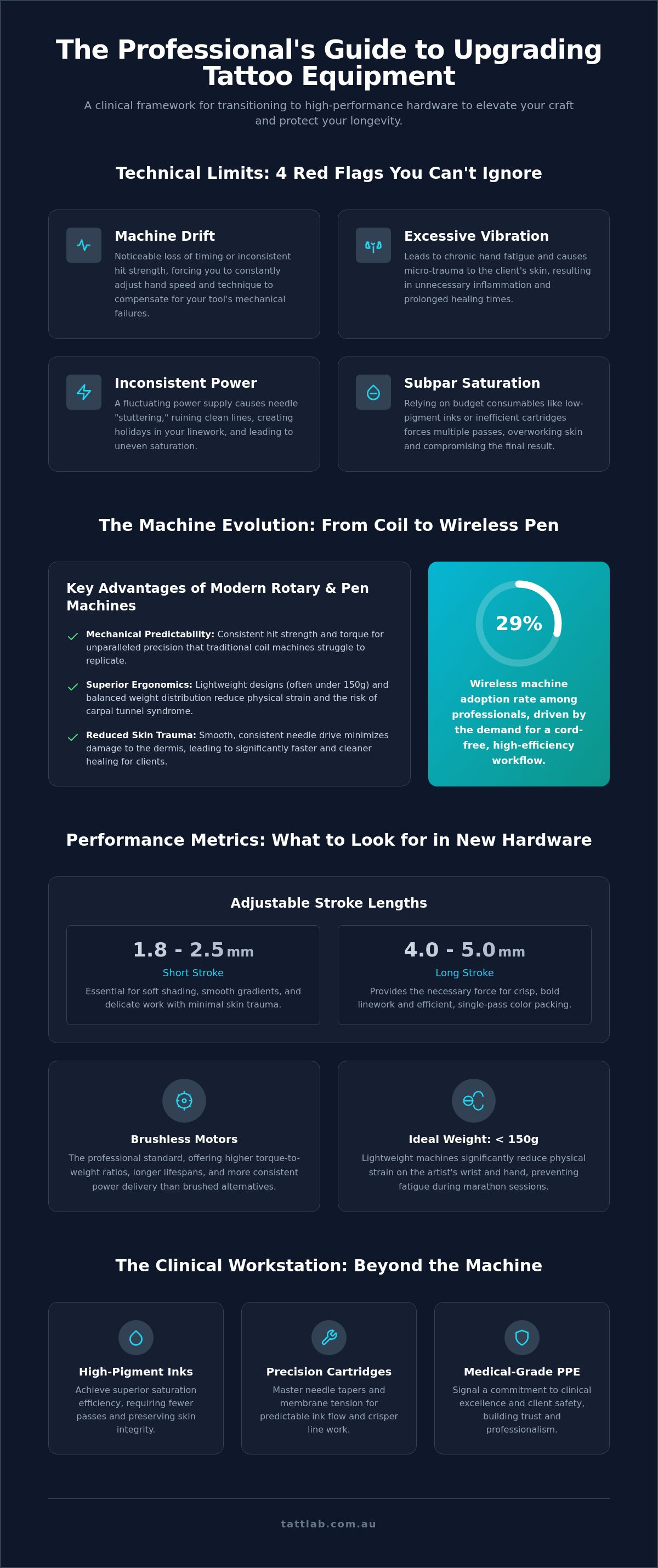
Every artist reaches a plateau where their ambition outpaces their hardware. Recognizing the subtle signs of mechanical decline is essential for maintaining skin integrity and professional consistency. Modern tattoo machines, whether coil or rotary, eventually exhibit machine "drift." This manifests as a loss of timing or hit strength, forcing you to adjust your technique to compensate for the tool's failures. When you're constantly recalibrating your hand speed to match a fluctuating power supply, you're no longer focused on the art; you're managing a malfunction.
Your ability to command premium rates depends entirely on your technical outcomes. If machine vibration leads to chronic hand fatigue or subpar saturation, your efficiency and your career longevity are at risk. Upgrading your tattoo equipment isn't just a hardware purchase; it's a clinical decision to protect your physical health and your reputation. Relying on budget consumables might save costs in the short term, but it compromises the safety and predictability that high-end clients expect. A professional workstation should feel like a high-end laboratory where science meets health, ensuring every pass is intentional and controlled.
The Performance Bottleneck
Low-tier machines often lack the stabilization needed for delicate work. Excessive vibration doesn't just tire your hand. It causes micro-trauma to the client's dermis, leading to unnecessary inflammation and prolonged healing times. A failing power supply might struggle to maintain a consistent duty cycle, resulting in "stuttering" that can ruin a clean line. This is the moment for a psychological shift. You move from the phase of simply learning the tools to a stage where the tools must serve your artistic vision without interference. If your gear is fighting you, it's time to evolve.
Safety and Compliance Upgrades
Professional growth requires a transition from basic hygiene to a medical-grade sterile environment. This evolution is essential for artists who want to scale their business and project a sense of meticulousness. Upgrading to medical supplies for tattoo artists ensures that your studio meets modern compliance standards while prioritizing physical integrity. High-quality PPE and specialized tattoo ink with high pigment loads do more than improve results. They signal to your audience that you value their wellness as much as the aesthetic outcome. This methodical approach builds immediate trust, positioning your studio as a sophisticated, modern facility.
The Machine Evolution: Transitioning to High-Performance Rotaries and Pens
The transition from traditional coil setups to high-performance rotaries represents more than a change in aesthetic. It's a shift toward mechanical predictability. While coils offer a nostalgic "soul," the torque and consistent hit of a modern rotary machine allow for a level of precision that traditional magnets struggle to replicate. As of early 2026, wireless tattoo machines have seen a 29% adoption rate among professionals, driven by the need for a seamless, cord-free workflow that doesn't sacrifice power delivery. This evolution is a core component of continuing education for tattoo artists who prioritize both technical mastery and studio efficiency.
A significant advantage of upgrading your tattoo equipment is the ability to utilize adjustable stroke lengths. Relying on a single machine for every task is a technical limitation. Short strokes (1.8mm to 2.5mm) are essential for soft shading and smooth gradients, whereas long strokes (4.0mm to 5.0mm) provide the necessary force for bold linework and efficient color packing. Modern professional gear is often designed to be lightweight, frequently weighing under 150 grams, which significantly reduces the physical strain on the artist's wrist and hand during marathon sessions.
Rotary vs. Wireless Pen Machines
When evaluating new hardware, motor quality is the primary indicator of long-term reliability. Brushless motors have become the professional standard because they offer higher torque-to-weight ratios and longer lifespans compared to brushed alternatives. Weight distribution also plays a critical role in preventing carpal tunnel syndrome; a well-balanced pen machine keeps the center of gravity close to the hand. This balance, combined with voltage stability, ensures that ink saturation remains uniform, preventing the need for multiple passes that can overwork the skin. For those looking to refine their setup, exploring the curated selection at Tatt Lab provides access to machines vetted for these specific performance markers.
Investing in Power Supplies
A steady current is the silent partner of every successful tattoo. If your power supply fluctuates even slightly, your needle depth becomes inconsistent, leading to "holidays" in your linework or uneven shading. Professional-grade power supplies offer features like jump-start modes for large magnum groupings and multiple presets that allow you to switch between lining and shading configurations instantly. Digital readouts are no longer a luxury; they are a requirement for precise technical replication, allowing you to return to the exact settings that worked for a specific client's skin type in previous sessions. This methodical approach ensures that your results are predictable, safe, and consistently high-quality.
Precision at the Point: Upgrading to Premium Needle Cartridges
The needle is the final, most critical link in your technical chain. While a high-end machine provides the drive, the cartridge determines how that energy is transferred into the dermis. Upgrading your tattoo equipment requires a shift from viewing needles as simple consumables to seeing them as precision-engineered medical instruments. Subpar cartridges often suffer from internal friction and inconsistent soldering, which can lead to "needle wobble" and erratic ink flow. Professional-grade brands prioritize batch consistency, ensuring that every needle in a box of twenty performs exactly like the last.
Modern cartridges incorporate safety membranes that serve a dual purpose. They provide the necessary tension for the needle's retraction and act as a physical barrier to prevent ink and biological fluids from backflowing into your machine. This level of hygiene aligns with Washington State safety and sanitation standards, which emphasize the importance of preventing cross-contamination in a clinical environment. Investing in high-quality tattoo needles and cartridges is the most effective way to ensure that your technical precision isn't undermined by hardware failure at the point of contact.
Round Liners vs. Advanced Magnums
As your technique evolves, standard needle configurations may feel restrictive. Many realism and fine-line artists find that moving to "bugpin" liners allows for tighter detail without increasing skin trauma. These needles have a smaller diameter, typically 0.20mm or 0.25mm, creating a more delicate footprint. For shading, curved magnums offer a significant upgrade over traditional flat magnums. The slight arch of the needle grouping matches the natural contour of the skin, allowing for soft-edge gradients that blend seamlessly into the surrounding tissue. This stabilization is vital; it eliminates the lateral vibration that often causes "choppy" shading in lower-tier equipment.
The Biological Impact of Quality Needles
The sharpness of a needle isn't just about ease of entry. It's about skin integrity. Dull or poorly tapered needles "chew" the skin, causing excessive weeping and inflammation that complicates the healing process. High-quality needle tapers minimize inflammatory responses by reducing the mechanical force required for dermal penetration, thereby preserving the skin's natural barrier during the procedure. This reduction in trauma correlates directly to tattoo aftercare success. When the initial wound is clean and controlled, the body can focus on pigment retention rather than intensive tissue repair, resulting in more vibrant, long-lasting art.
Holistic Upgrades: Inks, PPE, and Studio Ergonomics
Upgrading your tattoo equipment extends beyond the mechanical drive of the machine; it encompasses every substance and surface that interacts with the client's body. Switching to high-pigment load tattoo ink is a primary strategy for achieving "one-pass" saturation. This efficiency reduces the total time the skin is open, which directly lowers the risk of inflammation and promotes a more stable healing environment. When you can achieve full saturation with fewer passes, you preserve the skin's biological integrity and ensure a more comfortable experience for the client.
Professional studio standards in 2026 demand a meticulous approach to hygiene and tactile precision. Moving from general-purpose gloves to specialized nitrile options provides the grip and sensitivity necessary for managing microscopic needle depth. To exceed Australian standards, investing in ultrasonic cleaners and medical-grade sterilization units transforms your workspace into a facility that prioritizes health above all else. This methodical approach to studio safety doesn't just protect the client; it builds a narrative of professional assurance that justifies premium rates.
For artists looking to establish a facility that meets these clinical benchmarks through professional construction, you can learn more about Multicon Group and their expertise in specialized medical-grade fit-outs.
Aesthetics also contribute to this professional narrative. For those planning a studio renovation or expansion, Wall & Ink provides professional insights on achieving high-quality finishes, such as the best practices for painting newly plastered walls to ensure a clean, durable workspace.
Pigment Science and Longevity
Professional-grade inks are engineered to resist fading and lateral "spreading" within the dermis over time. With a 34% increase in consumer demand for vegan-friendly options, selecting pigments that are both ethically sourced and compliant with modern safety standards is essential for market relevance. Organizing your palette with standardized ink caps and mixing solutions ensures technical replication, allowing you to achieve the same tonal values across multiple sessions. This consistency is the hallmark of a specialist who understands the chemistry of their craft as well as the artistry.
The Ergonomic Workstation
Your physical longevity as an artist depends on the furniture you choose to support your body. Artist chairs and client beds must be designed to maintain neutral spinal alignment during long procedures, preventing the chronic fatigue that leads to technical errors. When upgrading your tattoo equipment, don't overlook the impact of studio lighting on your accuracy. High-CRI (Color Rendering Index) LEDs provide accurate color representation, ensuring the pigments you see under the lamp match the final healed result. A streamlined workstation with disciplined cable management and sterile barrier protection reflects the boutique-studio persona that high-end clients value. To refine your clinical environment with vetted supplies, explore the professional range at Tatt Lab.
Strategic Sourcing: Building Your Career with Tatt Lab
Sourcing gear is often viewed as a logistical necessity, but for the professional, it's a strategic career investment. Tatt Lab serves as a dedicated partner for Australian artists, providing a curated selection of hardware and consumables vetted for clinical performance. When upgrading your tattoo equipment, the reliability of your supplier is as critical as the stroke length of your machine. An artist-owned supply house offers a unique advantage; our team understands the technical friction of a six-hour session and the biological requirements of complex saturation because we've been there ourselves.
Streamlining your studio operations requires more than just high-end tools. It demands a reliable inventory management system that prevents work stoppages. By utilizing wholesale accounts and taking advantage of fast, nationwide shipping, you ensure your workstation remains fully stocked with the precision instruments your craft requires. This methodical approach to sourcing allows you to focus on the artistic procedure, replacing logistical anxiety with a sense of controlled, predictable progress.
The Tatt Lab Difference
Our facility functions as a bridge between world-renowned manufacturing and the boutique-studio environment. We provide access to industry-leading brands and medical-grade PPE that exceed standard safety expectations. This transparent, results-oriented approach to product selection ensures that every item in our inventory supports the physical integrity of your clients. We view each tool as a component in a larger narrative of personal transformation. When you use equipment that you trust implicitly, you project a composed, knowledgeable persona that builds immediate rapport with your audience.
Next Steps for Your Upgrade
The path to a more efficient workstation begins with a comprehensive gear audit. Identify the specific bottlenecks in your current setup, whether it's machine drift, hand fatigue, or inconsistent ink saturation. Prioritize replacing the components that have the most significant impact on your technical outcomes and client safety. If you're unsure which direction to take, our specialists are available to provide tailored recommendations based on your specific style and volume of work. Explore our professional range and start your upgrade today.
Future-Proofing Your Craft through Technical Excellence
The transition to professional-grade hardware is a commitment to both your artistic legacy and your client's long-term wellness. By identifying the technical limits of your current setup and moving toward high-performance rotaries and premium needle cartridges, you eliminate the mechanical variables that hinder precision. This methodical approach ensures that every procedure is a controlled narrative of progress rather than a struggle against inconsistent tools. It's about ensuring your equipment finally matches the level of your skill.
Upgrading your tattoo equipment is the most direct path to reducing physical fatigue and achieving the one-pass saturation that defines a modern specialist. As you refine your studio with medical-grade safety standards and ergonomic workstations, you position yourself at the forefront of a sophisticated, urban aesthetic. Tatt Lab is dedicated to supporting this evolution with artist-owned expertise and nationwide express shipping across Australia. We invite you to upgrade your craft with Australia’s specialist tattoo supplies. Your dedication to constant improvement is the foundation of your success; we're here to provide the tools that match your ambition.
Frequently Asked Questions
Is it better to upgrade my tattoo machine or my needles first?
Upgrading your tattoo machine generally provides the most significant shift in power delivery, but needles are your most frequent point of contact. If your current machine has a stable duty cycle, prioritize high-quality cartridges to see immediate improvements in skin trauma reduction. However, if your motor is drifting, no needle quality can compensate for the inconsistent hits of a failing machine.
What are the signs that my rotary machine motor is beginning to fail?
Watch for increased operating temperature and audible "stuttering" during long sessions as primary indicators of motor fatigue. If the machine struggles to start at low voltages or loses torque when meeting skin resistance, the internal components are likely degrading. These mechanical inconsistencies compromise the precision required for delicate gradients and can lead to uneven ink saturation.
Are wireless tattoo pens reliable enough for 8-hour sessions in 2026?
Modern wireless pens are highly reliable for full-day sessions provided you utilize a dual-battery system to avoid interruptions. With adoption rates reaching 29% in 2026, the technology has matured to offer stable voltage for the duration of a long procedure. Most professionals find that having a secondary battery pack ensures zero downtime while maintaining the freedom of a cordless workflow.
Does upgrading to expensive ink really make a difference in healing?
High-pigment load inks significantly impact healing by allowing for "one-pass" saturation, which minimizes the total time the skin remains open. Lower-quality pigments often contain fillers that can trigger inflammatory responses or require multiple passes to achieve depth. Upgrading your tattoo equipment to include EU REACH compliant, high-density inks ensures a cleaner biological recovery and better long-term vibrancy.
How do I know if a cartridge brand is truly medical-grade?
A truly medical-grade cartridge features an internal safety membrane to prevent backflow and is individually blister-packed with an Ethylene Oxide gas sterilization indicator. Look for housings made from medical-grade polycarbonate rather than standard recycled plastics. These standards ensure the cartridge acts as a sterile barrier, aligning with clinical hygiene protocols and protecting the internal integrity of your machine.
Can better equipment actually help me tattoo faster without losing quality?
Superior equipment increases your efficiency by ensuring that every needle strike is effective, which reduces the need for corrective passes. When your machine maintains a perfect duty cycle and your needles are precision-tapered, you achieve saturation faster without increasing skin trauma. This technical reliability allows you to complete complex pieces in less time while maintaining a high standard of physical integrity.
What are the essential medical supplies I need when moving to a professional studio?
Transitioning to a professional studio requires a baseline of medical-grade PPE, including high-tactile nitrile gloves and fluid-resistant barriers. You should also prioritize hospital-grade surface disinfectants and ultrasonic cleaners to maintain a sterile environment. These supplies are non-negotiable for studio growth as they reflect a commitment to health and safety that exceeds standard industry expectations.
How often should I be upgrading my power supply unit?
You should consider upgrading your power supply unit if you notice voltage fluctuations or if the digital readout no longer reflects the actual output. While a high-quality unit can last several years, the internal capacitors eventually degrade, leading to inconsistent power delivery. Upgrading your tattoo equipment every two to three years ensures you're benefiting from the latest advancements in current stabilization and wireless compatibility.


Comments (0)
There are no comments for this article. Be the first one to leave a message!