

Could your current studio setup withstand a rigorous clinical audit under the updated 2026 health and safety standards? You likely recognize that a tattoo is far more than a technical procedure; it's a transformative experience that relies on the physical integrity of your tools. It's exhausting to filter through the noise of low-quality copycat needles while searching for a reliable tattoo artist tool kit checklist 2026 that balances cost with medical-grade performance.
We've developed this guide to help you master your workstation with clinical precision and empathetic care. By integrating high-grade medical PPE with the latest wireless technology, you can ensure your studio functions like a high-end laboratory where science meets aesthetic excellence. This guide provides a methodical breakdown of every essential, from specialized tattoo cartridges and round liners to the precise aftercare protocols required for elite healing results. We'll explore how to meet Australian health standards while maintaining a sophisticated, results-oriented approach that your clients deserve. Replacing uncertainty with a sense of controlled, predictable progress starts with the right inventory.
Key Takeaways
- Discover why wireless rotary machines and consistent voltage power supplies are the foundation of a modern, mobile-efficient studio setup in 2026.
- Learn why safety membranes in cartridges are non-negotiable for cross-contamination prevention and how to select the right Round Liners or Magnums for every task.
- Access a clinically-informed tattoo artist tool kit checklist 2026 to ensure your studio meets the highest standards for medical-grade PPE and workstation ergonomics.
- You'll understand the science behind skin barrier recovery and how professional-grade tattoo aftercare solutions improve long-term pigment retention.
- Master the technical requirements for high-quality tattoo stencils to ensure every design is transferred with absolute precision before you start.
The Core Hardware: Machine and Power Configuration for 2026
The evolution of hardware has shifted from the mechanical buzz of traditional coils to the silent, clinical precision of high-torque rotary motors. This transition isn't just an aesthetic choice; it's a fundamental requirement for the modern studio. Integrating a high-performance wireless pen into your tattoo artist tool kit checklist 2026 allows for a level of maneuverability that corded setups simply cannot match. By removing the physical tether of an RCA cord, you reduce the risk of cross-contamination and create a more sterile, streamlined environment that respects both the artist's workflow and the client's safety.
Rotary Pens vs. Traditional Machines
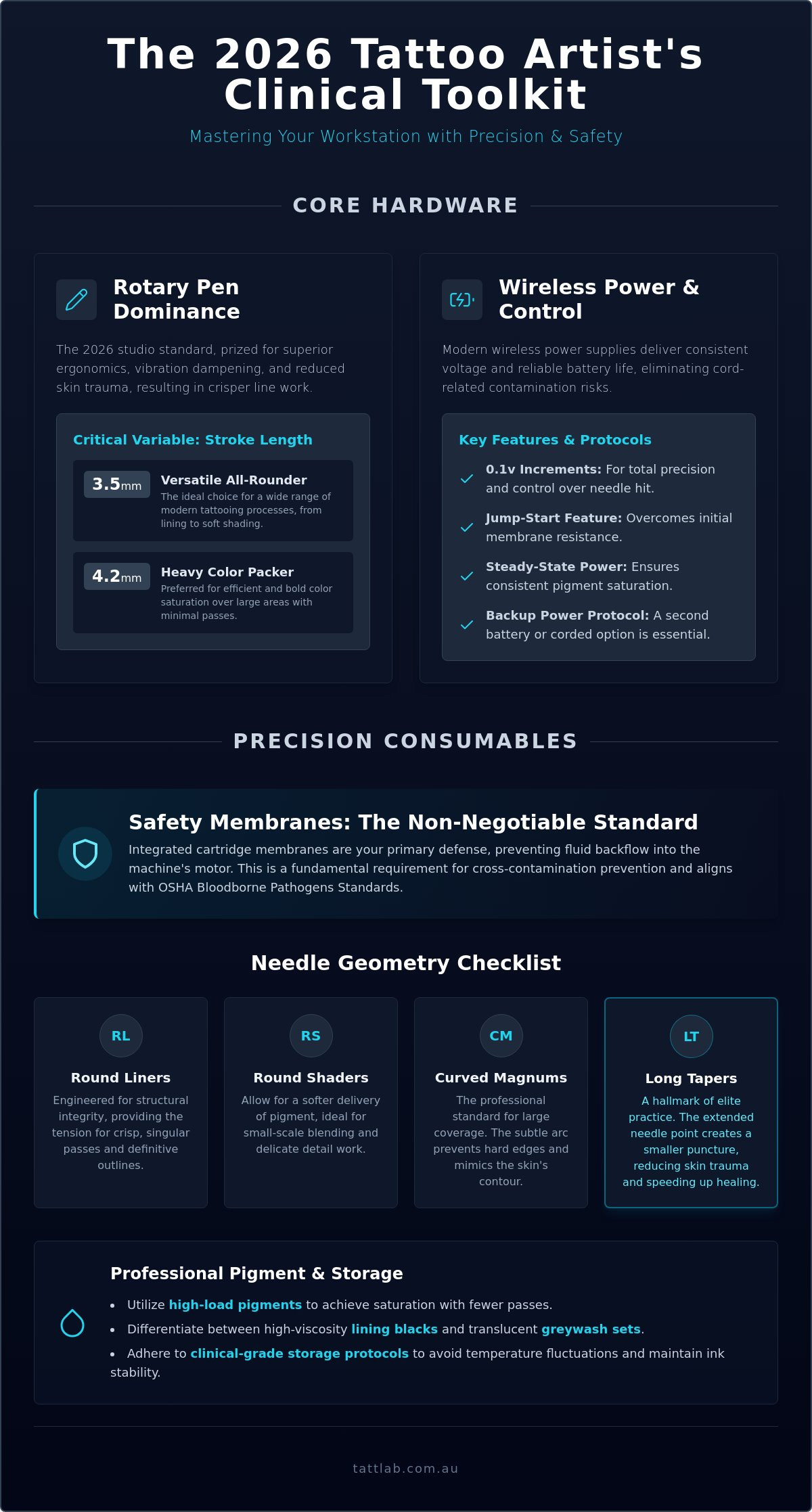
In 2026, the professional landscape is dominated by pen-style rotaries due to their superior ergonomics and vibration dampening. Engineering advancements have significantly reduced the "chatter" of the motor, which directly translates to crisper line work and reduced skin trauma. When selecting your primary machine, stroke length remains the critical variable. A 3.5mm stroke provides the versatility needed for the modern tattooing process, while a 4.2mm stroke is often preferred for heavy color packing. Maintaining these high-precision motors requires a disciplined approach to internal lubrication and regular checks of the drive bar to ensure peak performance remains consistent over long sessions.
Power Management and Voltage Control
Wireless power supplies have reached a point of maturity where battery life and voltage consistency are no longer concerns but standard expectations. Modern batteries now offer digital displays that allow for precise increments of 0.1v, giving you total control over the needle's hit. Many 2026 models include a jump-start feature, which is necessary for overcoming the initial resistance of high-tension cartridge membranes. Steady-state power is the requirement for consistent pigment saturation, ensuring the motor maintains a constant torque regardless of skin resistance. This stability is what prevents the "bogging down" that leads to uneven saturation or unnecessary epidermal damage.
Ergonomics play a vital role in your long-term career health. The balance of a machine, specifically how the weight is distributed toward the grip, determines how much strain is placed on your carpal tunnel and wrist tendons. A well-balanced machine feels like an extension of your hand, allowing for effortless precision. Even with the reliability of modern batteries, your tattoo artist tool kit checklist 2026 must include a backup protocol. Whether it's a second interchangeable battery or a corded fail-safe, having a secondary power source ensures that the narrative of your client's transformation isn't interrupted by a technical failure. This methodical preparation reflects a professional commitment to the craft and the physical integrity of the work.
Precision Consumables: Needles, Cartridges, and Pigment Science
The precision of a contemporary tattoo relies on the intersection of biological science and mechanical accuracy. In your tattoo artist tool kit checklist 2026, the selection of consumables represents your primary defense against cross-contamination and suboptimal healing. The industry has transitioned toward high-performance Tattoo Cartridges featuring integrated safety membranes. These membranes act as a physical barrier, preventing fluids from backflowing into the machine's motor. This level of protection aligns with the OSHA Bloodborne Pathogens Standard, ensuring that your workflow remains as sterile as a high-end laboratory environment.
The Needle Geometry Checklist
Choosing the correct needle grouping is essential for achieving the intended aesthetic outcome without overworking the skin. Round Liners are engineered for structural integrity, providing the tension needed for crisp, singular passes. Conversely, Round Shaders allow for a softer delivery of pigment, making them ideal for small-scale blending and detail work. For larger coverage, Magnums and Curved Magnums are the professional standard. The subtle arc of a curved magnum mimics the natural contour of the dermis, preventing the hard edges often associated with flat groupings. Additionally, the use of Long Tapers is a hallmark of elite practice. The extended needle point creates a smaller puncture, which significantly reduces skin trauma and facilitates a faster healing progression for the client.
Professional Ink and Pigment Storage
A professional's palette is only as reliable as the stability of the Tattoo Inks within it. High-load pigments ensure that saturation is achieved with fewer passes, respecting the physical integrity of the client's skin. It is vital to distinguish between lining blacks, which are formulated for high-viscosity stability, and greywash sets designed for translucent layering. Maintaining these pigments requires clinical-grade storage protocols; temperature fluctuations can alter the chemical composition, leading to inconsistent results. Utilizing sterile ink caps and holders during the session ensures your palette remains uncontaminated from start to finish. For those seeking to elevate their inventory with medical-grade precision, sourcing professional-grade tattoo cartridges and pigments is the first step toward predictable, high-end results.
The relationship between the artist and the body is one of profound trust. By prioritizing high-grade consumables, you aren't just buying supplies; you are investing in a liberating narrative of personal transformation for your clients. Every needle choice and pigment drop contributes to a final result that is both safe and visually striking, maintaining the meticulousness that defines the modern specialist.
The Clinical Barrier: Medical PPE and Studio Sanitisation
Your professional reputation is anchored in the physical integrity of your workspace. While the machine provides the power and the needles provide the precision, your personal protective equipment (PPE) provides the safety that allows the art to exist. Maintaining a rigorous tattoo artist tool kit checklist 2026 means looking beyond the aesthetic tools and prioritizing the clinical barriers that protect both you and your client. In a modern studio, the environment should mirror a high-end laboratory, where every surface is managed with scientific rigor to prevent the transmission of bloodborne pathogens.
Achieving this clinical standard often begins with the structural surfaces of the room itself; for those planning a studio renovation, you can learn more about Express Tiling Limited to see how professional-grade tiling supports a sterile and easily maintainable environment.
Nitrile gloves are the non-negotiable industry standard for this environment. Unlike latex, nitrile offers superior chemical resistance to the petroleum-based products often used during tattooing, and it provides the tactile sensitivity required for fine-line work. Surface disinfection must also move beyond standard household cleaners. You require hospital-grade, tuberculocidal disinfectants that can eliminate resilient pathogens on hard surfaces within minutes. Standards such as the Oregon Tattooing Safety and Sanitation Rules provide a clear framework for these clinical expectations, ensuring that your studio remains compliant with modern safety benchmarks. Barrier films and equipment covers act as a "second skin" for your hardware, sealing off your machine and power supply from bio-hazardous splash-back.
Essential Medical PPE Checklist
Your personal barrier must be comprehensive. High-quality nitrile gloves should be selected based on both thickness and texture; a textured fingertip is essential for maintaining a secure grip on your machine in wet environments. Disposable aprons and sleeve covers protect your clothing from fluid splashes, which is a critical step in maintaining a professional, uncontaminated persona. Face masks and eye protection are no longer optional in a high-contact environment, as they preserve the sterile field from respiratory droplets and accidental pigment spray.
Sanitisation and Skin Prep Protocols
Preparing the skin is the first physical interaction in the tattooing narrative. You must use medical-grade skin prep solutions to ensure a pathogen-free canvas before the first needle stroke. Green soap, a traditional surfactant, remains vital for removing excess ink and biological debris without causing unnecessary epidermal irritation. The sterile field is the foundational requirement for any professional tattoo procedure. By following a methodical progression of disinfection, you replace the anxiety of potential contamination with the calm of a controlled, predictable outcome. This meticulousness is what defines a trusted specialist in 2026.
This commitment to a sterile field mirrors the rigorous safety protocols found in leading healthcare facilities, such as the Caroline Springs Dental Clinic, where clinical excellence and patient safety are the primary objectives.
The Professional Station: Ergonomics and Stencil Precision
The physical architecture of your workspace acts as a silent partner in your artistic success. Integrating a refined station layout into your tattoo artist tool kit checklist 2026 is about more than just convenience; it's about protecting your career longevity through ergonomic precision. A well-organized station reflects the meticulousness of a scientific facility, allowing you to move through the procedure with a steady, low-pressure rhythm. By minimizing repetitive strain and maximizing efficiency, you ensure that your focus remains entirely on the client's transformation rather than physical discomfort. This methodical approach mirrors the precision of the work itself, transforming a technical task into a calm, controlled progression.
Stencil Application and Precision
The blueprint of any successful tattoo is the stencil. In 2026, the technical requirement for high-quality thermal paper is non-negotiable for complex, multi-layered designs. While hand-drawn stencils offer a bespoke touch for freehand mapping, thermal transfers provide the mathematical accuracy required for geometric or fine-line work. To keep these lines locked to the skin through heavy wiping, you must use high-performance transfer gels that act as a medical-grade adhesive. For freehand adjustments, surgical skin markers allow you to map the body's natural contours with clinical accuracy. Shop professional tattoo stencils and transfer solutions to ensure your blueprint remains indelible throughout the session.
Studio Furniture and Ergonomics
Your furniture is the foundation of client stability and your own physical integrity. Professional client beds and adjustable armrests aren't just about comfort; they provide the physical stability required for high-precision needle work. If a client is uncomfortable, their involuntary movements can compromise the integrity of your lines. For the artist, an adjustable stool that supports spinal health is essential for surviving sessions that exceed six hours. Workstation trolleys should ideally be constructed from high-grade stainless steel, which serves as the gold standard for rapid, effective disinfection between procedures. This choice reflects a personality that values physical integrity above all else.
High-CRI (Colour Rendering Index) lighting is a critical, yet often overlooked, component of the professional station. Standard studio lights can distort the appearance of pigments, leading to unexpected results once the client leaves the clinical environment. Using lights with a CRI of 95 or higher ensures that the color saturation you see under the lamp is exactly what will appear in the final, healed result. This commitment to visual accuracy is a hallmark of a trusted specialist who values long-term outcomes. By arranging your station with these scientific principles in mind, you replace uncertainty with a sense of controlled, predictable progress.
The Narrative of Healing: Professional Aftercare Integration
The final needle stroke marks the beginning of the healing narrative, not the conclusion of your professional responsibility. A comprehensive tattoo artist tool kit checklist 2026 must account for the biological reality of skin barrier recovery to ensure that the precision of your linework is preserved through the inflammatory phase. When you view aftercare as an extension of the clinical procedure, you transition from being a technician to a dedicated partner in the client's journey of self-assurance. This methodical approach replaces the uncertainty of home-care with a sense of controlled, predictable progress, protecting both the client's physical integrity and your artistic reputation.
Top-Tier Aftercare Solutions
Modern healing protocols have moved beyond heavy ointments toward breathable, medical-grade barriers. Breathable film dressings, often referred to as "second skin," are the current professional standard for the initial 24 to 48 hours. These films create a sterile environment that allows for oxygen exchange while sealing out opportunistic pathogens. As the wound transitions, vitamin-enriched Tattoo Aftercare balms become essential. These formulations should be non-comedogenic and free from synthetic fragrances to avoid triggering contact dermatitis or clogging pores. High-quality balms use specific ingredients to support cellular regeneration, ensuring the epidermal barrier closes efficiently without stripping the Tattoo Inks from the dermis. Gentle, fragrance-free cleansers are equally vital, providing hygiene during the peeling phase without causing unnecessary irritation.
Building Client Trust Through Education
The quality of a healed tattoo is a direct result of the cause-and-effect relationship between the artist's technique and the client's post-session discipline. Educating your client on the science of skin recovery is a low-pressure way to build immediate trust. Providing structured, written protocols demystifies the biological processes at play, lowering the reader's anxiety about scabbing or pigment shifts. Many elite studios now include 'take-home' kits as a professional value-add, ensuring the client has immediate access to artist-vetted products rather than relying on generic, supermarket lotions. This commitment to holistic wellness highlights a comprehensive approach to the body that extends far beyond the studio chair.
Your studio's legacy is ultimately defined by the long-term results of your work. By integrating professional-grade recovery solutions into your inventory, you ensure that every piece of art maintains its vibrancy and structural clarity for years to come. Secure your studio's reputation with professional tattoo aftercare solutions from Tatt Lab to maintain the highest standards of skin integrity and healing. This final step in your workstation setup is what separates a standard service from a truly elite, transformative experience.
Elevating Your Studio Standards for 2026
Mastering the modern studio environment requires a deliberate alignment between your artistic vision and the highest clinical standards. We've detailed the necessity of high-torque wireless hardware, the non-negotiable role of safety membranes in modern cartridges, and the scientific importance of medical-grade aftercare in preserving skin integrity. Utilizing a comprehensive tattoo artist tool kit checklist 2026 ensures your workstation remains a sterile, high-precision environment where science meets aesthetic transformation. This methodical approach doesn't just improve your daily workflow; it protects the physical integrity of your clients and reinforces your reputation as a trusted specialist.
When you're ready to upgrade your inventory, shop Australia's leading range of professional tattoo supplies at Tatt Lab. As an artist-owned and operated business, we provide the specific tools required for elite tattooing results. We offer express nationwide shipping across Australia and click-and-collect options for local professionals. Your commitment to meticulousness and safety is what transforms a simple procedure into a liberating narrative of self-assurance. We're proud to be your partner in that progression.
Frequently Asked Questions
What are the most essential items for a beginner tattoo artist's kit in 2026?
A beginner's kit must prioritize physical integrity and safety over artistic flair. Essential items include a high-torque wireless rotary pen, medical-grade nitrile gloves, and a curated selection of Round Liners and Magnums. You'll also need professional-grade stencil paper and hospital-grade disinfectants. Including these in your tattoo artist tool kit checklist 2026 ensures your early work heals with the precision you intended while maintaining a sterile workstation.
How do I choose between traditional needles and cartridge needles?
The choice depends on your machine setup and safety priorities. Traditional Needles are often favored for their specific feel in coil machines. However, Tattoo Cartridges with integrated safety membranes are the 2026 standard for preventing cross-contamination. Most professionals favor cartridges for their rapid-swap efficiency and the clinical protection they offer the machine's internal motor, ensuring a cleaner, more predictable workflow during complex, multi-hour sessions.
Why is medical-grade PPE specifically required for tattooing in Australia?
Medical-grade PPE is a non-negotiable part of any tattoo artist tool kit checklist 2026 to meet rigorous Australian health and safety standards. Standard consumer-grade gloves often lack the chemical resistance or tactile sensitivity necessary for a professional tattooing environment. Using professional-grade nitrile gloves and fluid-resistant aprons ensures you maintain a sterile field. This meticulousness protects both the artist's health and the client's physical integrity during the procedure.
What is the difference between a round liner and a round shader?
Round Liners feature needles grouped tightly together in a circular pattern to create crisp, singular lines and structural outlines. In contrast, Round Shaders have a more spaced-out grouping, allowing for softer pigment delivery and smoother blending. While a liner is your primary tool for definition, the shader is essential for small-scale color packing and transitions. Choosing the right grouping prevents overworking the skin and ensures a more comfortable healing narrative.
How often should I replace my tattoo machine's power supply?
You should consider replacing a wireless power supply when you notice a decline in battery health or inconsistent voltage output. Steady-state power is critical for consistent pigment saturation, so any fluctuation is a sign of internal wear. While high-quality lithium batteries are durable, many professionals update their power source every 18 to 24 months. This ensures they are utilizing the most stable technology to maintain the precision required for elite results.
What are the best practices for storing professional tattoo ink?
Professional Tattoo Inks should be stored in a cool, dark environment away from direct sunlight to prevent pigment degradation. Maintaining a consistent temperature prevents the chemical composition from separating or thickening unexpectedly. It's also vital to implement a regular shaking protocol to ensure the pigment load remains evenly distributed. Always check expiration dates to guarantee the ink's stability and safety before it interacts with the client's skin.
Can I use standard rubbing alcohol for all studio sanitisation needs?
Standard rubbing alcohol is insufficient for comprehensive studio sanitisation because it doesn't eliminate all resilient pathogens or bloodborne viruses. You must use hospital-grade, tuberculocidal disinfectants specifically formulated for hard surfaces in clinical settings. These solutions provide the rapid kill-times required to maintain a safe environment between clients. Alcohol is better suited for localized skin prep rather than serving as the primary tool for environmental decontamination in a modern studio.
How does high-quality aftercare impact the final look of a tattoo?
High-quality aftercare is the final step in preserving the vibrancy and clarity of your work. Professional-grade Tattoo Aftercare supports the skin's natural barrier recovery, preventing excessive scabbing that can pull pigment from the dermis. By providing the skin with essential nutrients and a breathable protective layer, you ensure the final healed result matches the precision achieved during the procedure. This holistic approach respects the body and supports long-term aesthetic outcomes.


Comments (0)
There are no comments for this article. Be the first one to leave a message!