

What if the shop minimum you've set isn't actually a profit margin, but a slow leak in your studio's financial health? Many Australian artists feel a quiet anxiety when they realise that a small, thirty-minute fine-line piece often consumes the same volume of barrier film, nitrile gloves, and premium cartridges as a much larger project. It's a common frustration to watch your revenue disappear into the clinical waste bin before you've even finished the stencil. Efficient tattoo studio inventory management is the only way to stop guessing and start growing.
You deserve a business model that treats your technical supplies as a clinical investment in skin integrity rather than a frustrating overhead. We'll help you meticulously audit your consumable expenses to create a sustainable, professional pricing model that protects your margins. This guide provides a clear formula for supply-inclusive pricing, giving you the data-driven confidence to explain your value to clients while ensuring your studio remains a high-performance environment.
Key Takeaways
- Shift your financial mindset from a simple hourly rate to a total cost-of-service model to eliminate "silent" studio debt and protect your business longevity.
- Audit every disposable item on your tray to master tattoo studio inventory management, ensuring every cartridge and barrier film is accounted for in your pricing.
- Establish a calculated "set-up floor" to ensure that even the smallest procedures remain profitable after covering the baseline costs of clinical preparation.
- Compare the psychology of flat supply fees versus all-inclusive hourly rates to find the most transparent and professional billing structure for your clientele.
- Utilise strategic bulk sourcing and Australian wholesale accounts to stabilise your monthly inventory costs and minimise unnecessary shipping overheads.
The Economic Foundation of Professional Tattooing
Relying solely on an hourly rate is a common oversight that can quietly destabilise even the most creative studio. While time is a finite resource, the physical materials required to execute a safe, high-quality procedure are equally critical variables. Professionalism requires a shift in mindset: we must move from a simple hourly fee to a comprehensive total-cost-of-service model. This evolution ensures that your business remains resilient against the "silent debt" caused by unmonitored consumable usage.
Ignoring the granular costs of your setup leads to eroded margins. Every pair of nitrile gloves, every strip of barrier film, and every premium cartridge represents a specific financial investment. When these aren't accounted for, the artist effectively subsidises the client's procedure out of their own profit. Implementing rigorous inventory control practices allows you to identify exactly where your revenue is being diverted. It's not just about counting boxes; it's about understanding the clinical weight of your tray. By mastering tattoo studio inventory management, you ensure that your workspace operates with the precision of a high-end laboratory, protecting both your margins and your clients' health.
There is a direct relationship between high-performance supplies and procedural efficiency. Tools designed for medical-grade precision, such as specialised Round Liners or Magnums, allow for faster pigment saturation and significantly less skin trauma. This technical edge translates to less time spent under the machine and fewer touch-ups later. By framing your commitment to superior supplies as a premium value-add, you build immediate trust. Clients value the transparency of knowing their safety and aesthetic outcome are prioritised through the use of world-class consumables.
The Clinical Cost of Skin Integrity
Every puncture of the dermis is a biological event that requires sterile barriers and absolute precision. Using high-quality tattoo ink isn't just about the final aesthetic; it's about biocompatibility and predictable healing. When you invest in superior consumables, you reduce the biological stress on the client's body. This methodical approach mirrors the precision of the work itself, ensuring that your tattoo studio inventory management supports a liberating narrative of personal transformation without compromising physical integrity.
Inflation and the Australian Supply Market
The Australian market in 2026 faces unique economic pressures, particularly with the rising costs of medical supplies for tattoo artists. Attempting to cut costs by purchasing cheaper, sub-par alternatives often results in higher waste and lower clinical standards. Low-quality barriers frequently fail, and inconsistent needles lead to discarded units that drive up the cost per session. Predicting your supply needs to maintain a consistent inventory buffer is essential for long-term results. This strategy replaces uncertainty with a sense of controlled, predictable progress for your business.
Auditing Your Tray: Identifying Every Consumable Cost
Achieving clinical precision starts with a meticulous audit of your workspace. To move from theoretical economics to practical application, you must deconstruct the tray. Every procedure begins with a series of sterile barriers that artists often overlook when calculating their overheads. These aren't just accessories; they're the foundation of a safe environment. Refining your tattoo studio inventory management requires looking beyond the obvious high-ticket items and focusing on the cumulative impact of small, sterile decisions.
The "Invisible Cost" list is where many studios lose their margins. This includes clip cord covers, machine bags, dental bibs, medical-grade tapes, and barrier film. These items are discarded without a second thought, yet they represent a fixed cost for every single setup. Effective tattoo studio inventory management means knowing exactly how many centimetres of barrier film are used per session. Even your ink usage should be calculated by the drop rather than the cap. A 30ml bottle of premium pigment contains hundreds of drops. If you're filling large caps for a small script piece, you're literally pouring profit down the drain. Matching cap size to the actual pigment volume required is a simple but powerful way to preserve your resources.
Needle configurations also introduce significant variables. Round Liners and Magnums serve different procedural roles, but they also represent different financial weights on your tray. If a complex piece requires four different configurations, you've used four distinct units. Maintaining a steady supply of these essentials is easier when you source from specialists who understand the rigour of the Australian industry.
The PPE and Barrier Audit
Nitrile gloves are a significant recurring expense. If you change gloves four times during a session-for setup, skin prep, tattooing, and teardown-you've used eight individual gloves. Multiply this by your cost per box to find the true per-session impact. You must also factor in surface disinfectants and skin prep sanitisers. The cost of maintaining a clinical environment isn't just a business expense; it's a reassuring commitment to your client's physical integrity.
Needles and Cartridges: The Primary Variable
While traditional needles might seem more affordable per unit, the efficiency gained from using professional cartridges often justifies the investment. Cartridges allow for rapid configuration changes, which reduces the total procedure time. However, you must account for waste. Opening a multi-pack of needles when you only require one unit increases your cost per puncture. Specialised long tapers can improve your procedural speed, but only if their cost is integrated into your baseline pricing model.
Establishing Your Minimum Set-Up Floor
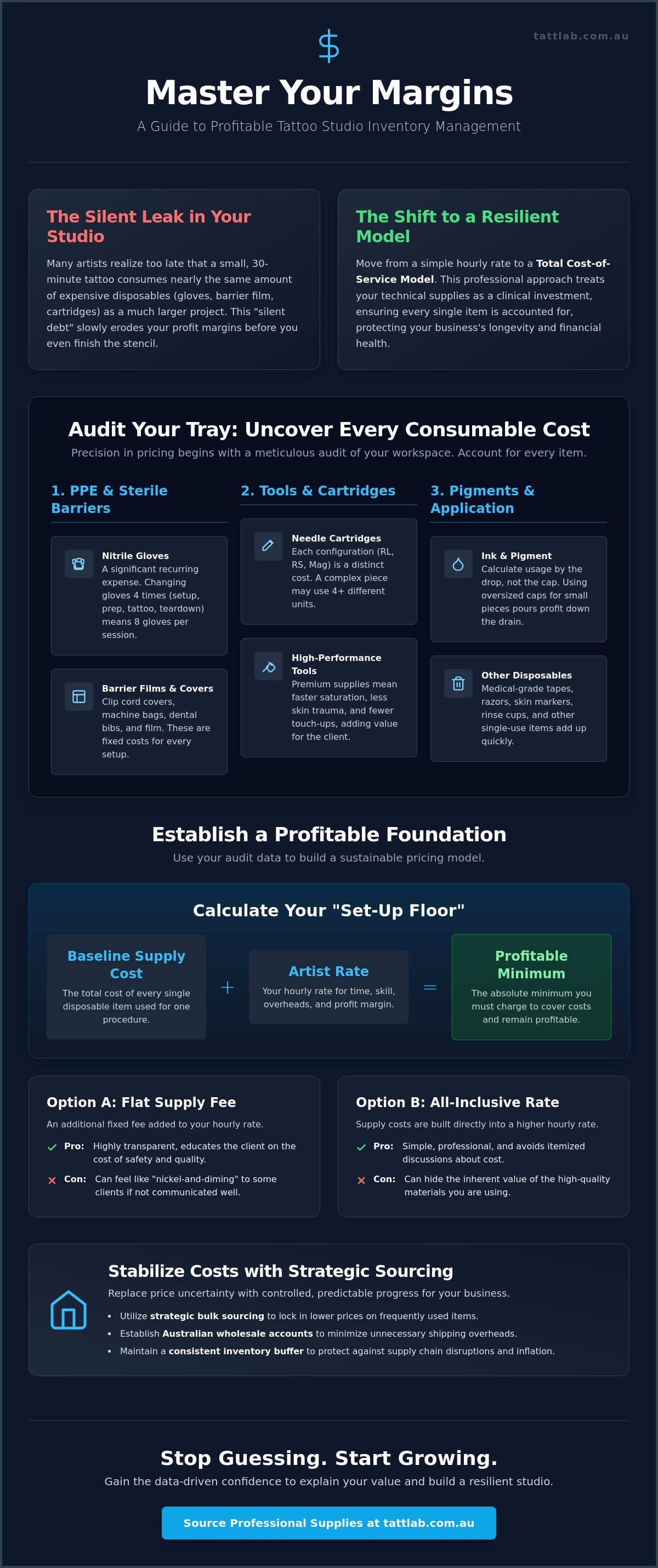
The set-up floor represents the absolute baseline cost of transforming a workstation into a sterile, clinical environment before the machine makes its first puncture. It's the "entry fee" for procedural integrity. Many artists mistakenly believe their shop minimum is pure profit, but without a calculated floor, that minimum might barely cover the physical materials on the tray. Developing a sophisticated approach to tattoo studio inventory management allows you to separate your creative time from the non-negotiable costs of studio readiness.
Small tattoos are frequently the least profitable sessions because the set-up costs remain constant regardless of the tattoo's size. Whether you're tattooing a single dot or a small script piece, you still consume a full set of barriers, a pair of premium nitrile gloves, and at least one sterile cartridge. A professional formula for an Australian studio might look like this: (Total Cost of Fixed Disposables) + (Pro-rata Sterilisation Labour) + (Clinical Waste Disposal Fee) = Base Set-up Floor. By identifying this number, you ensure that every appointment on your calendar contributes to the studio's health rather than eroding your margins.
This methodical approach mirrors the precision of the work itself. It moves the conversation away from "what the shop down the road charges" and toward a transparent, results-oriented business model. When you understand your floor, you can communicate your pricing with a sense of clinical authority that builds immediate trust with your audience. You aren't just charging for art; you're charging for a controlled, predictable environment where safety is the priority.
Fixed vs. Variable Supply Costs
Your tattoo studio inventory management should distinguish between fixed items used for every client and variable items that scale with the project. Fixed costs include stencil paper, green soap, dental bibs, and surface disinfectants. Variable costs include the volume of ink used and the number of specialised cartridges required, such as Round Shaders or Curved Magnums. Determining your break-even point for every setup ensures that variable costs don't surprise you during complex, multi-cartridge sessions.
The Role of Aftercare in Your Pricing
Deciding how to handle tattoo aftercare is a strategic choice for your pricing model. Some boutique studios include a premium healing kit in their set-up floor to ensure the best possible skin recovery. This inclusive approach reduces long-term costs by minimising the need for touch-ups caused by poor initial healing. Alternatively, offering aftercare as a retail upsell can provide an additional revenue stream while maintaining a lower entry price for the client. Both methods benefit from a transparent explanation of how proper care protects the technical investment in their body.
Implementation: Supply Fees vs. All-Inclusive Hourly Rates
Once you've established your set-up floor, the next step is choosing a billing structure that aligns with your brand's aesthetic. This is a pivotal moment in tattoo studio inventory management where clinical rigor meets client psychology. The way you present these costs can either reinforce your status as a trusted specialist or create unnecessary friction during the booking process. Most Australian studios find success by choosing between a flat supply fee and an all-inclusive hourly rate.
A flat supply fee, often listed as a "Clinical Setup Fee" or "Materials Surcharge," provides immediate liquidity for inventory replenishment. This model is particularly effective for studios that use high-performance consumables like specialised Round Shaders or premium Curved Magnums. It allows the artist to keep their hourly rate purely for their time while the fee covers the tangible medical-grade barriers. However, you must communicate this clearly to avoid the perception of "nickel-and-diming." Transparency is your greatest tool here. Explaining that the fee covers 100% sterile, single-use materials shifts the narrative from a cost to a safety guarantee.
The all-inclusive model, conversely, offers a seamless and minimalist experience. By baking the supply burden into a higher hourly rate, you reduce the mental load on the client. This approach feels modern and boutique, mirroring the calm environment of a high-end laboratory. To maintain your margins in this model, you must ensure your tattoo studio inventory management is precise enough to account for average material usage across different session lengths. If you're ready to stabilise your costs and professionalise your tray, you can order clinical-grade tattoo supplies that match your studio's standards.
The All-Inclusive Model
Simplifying the financial interaction reduces client anxiety and reinforces a sense of progress. If your data shows a supply burden of A$30 to A$60 per session, adjusting your hourly rate to absorb this cost creates a frictionless transaction. This model is ideal for artists who value a clean, professional narrative. It positions the procedure as a holistic service where the science and the art are inextricably linked. It's a sophisticated way to ensure your physical integrity is never compromised by fluctuating supply prices.
The Transparent Supply Fee Model
For large-scale work or complex medical procedures, a separate fee often makes more sense. It allows you to itemise high-cost items like multiple specialty cartridges or extensive aftercare kits without inflating your baseline hourly rate. When you itemise, do so with clinical authority. Use descriptors that highlight safety, such as "sterile barrier protection" or "precision needle cartridges." This level of detail doesn't just justify the price; it builds long-term trust by showing the client exactly how you prioritise their health and the longevity of their transformation.
Strategic Sourcing: Optimising Margins with Tatt Lab
Mastering the mathematical side of your business is only half the battle. The final pillar of professional tattoo studio inventory management is securing a supply chain that mirrors your own commitment to precision. In the Australian market, where shipping overheads and logistical delays can quickly erode profits, finding a one-stop shop is more than a convenience. It's a strategic move to stabilise your monthly expenses and ensure your clinical standards remain uncompromised for every client who walks through your door.
Bulk purchasing through professional wholesale accounts allows you to lock in predictable costs for your most-used items. When you source your Round Liners, Magnums, and barriers from a specialist who understands the local regulatory landscape, you eliminate the uncertainty of international customs or variable quality. This partnership transforms your supply room from a chaotic expense into a controlled asset. By consolidating your orders, you reduce the cumulative cost of freight, allowing those saved dollars to be reinvested into your studio's growth. It's a methodical approach that replaces the stress of fluctuating overheads with a sense of calm, predictable progress.
Partnering with a dedicated Australian specialist ensures that your tattoo studio inventory management aligns with local safety expectations. You aren't just buying products; you're investing in a relationship with a supplier that vets every medical-grade consumable for the specific rigours of the Australian industry. This level of scrutiny provides the reassurance you need to focus entirely on the liberating narrative of your work, knowing that the physical integrity of your setup is backed by expert knowledge.
The Efficiency of Quality
High-quality tattoo supplies pay for themselves through reduced waste and improved procedural speed. Reliable cartridge membranes prevent backflow and ensure consistent needle tension, while high-pigment inks often require fewer passes to achieve saturation. These technical advantages mean you use fewer materials per session, directly improving your bottom line. Using artist-owned suppliers ensures that every product has been tested in a studio environment. This professional edge reduces the frequency of discarded needles and wasted pigment, turning your tray into a high-performance laboratory where science meets health.
Streamlining Your Studio Operations
Efficiency also comes from logistical consistency. Setting up recurring orders for essentials like stencil paper and nitrile gloves prevents the panic of emergency, high-cost local purchases when stock runs low. Utilising express nationwide shipping ensures your inventory remains in a state of just-in-time readiness, matching the minimalist, boutique-studio persona of a modern workspace. This steady rhythm lowers anxiety and replaces uncertainty with a sense of controlled progress. To begin integrating these efficiencies into your business, you can register for a professional wholesale account with Tatt Lab and secure your studio's financial and clinical future.
Securing Your Studio's Financial Longevity
Integrating supply costs into your pricing isn't just a business calculation; it's a commitment to the physical integrity of your craft and the long-term health of your business. By moving away from arbitrary shop minimums and establishing a rigorous set-up floor, you ensure that every session is a sustainable investment. Mastering tattoo studio inventory management allows you to replace financial uncertainty with a predictable narrative of growth. You've learned how to audit every consumable and choose a billing structure that reflects your clinical authority, ensuring that your expertise is never undervalued; for those looking to secure their digital operations, Aspire Computing provides the technical support necessary to ensure your business systems remain as precise as your art.
Optimise your studio margins with Tatt Lab Professional Supplies. As an artist-owned and operated specialist, we provide industry-specific expertise and premium medical-grade PPE and consumables vetted for absolute safety. With express nationwide shipping across Australia, we ensure your studio maintains its professional edge without the burden of excessive overheads or logistical delays. Your studio deserves a business foundation as meticulous as the art you create. Start today to build a more transparent, profitable future for your practice.
Frequently Asked Questions
Is it better to charge a flat supply fee or raise my hourly rate?
The choice depends on your studio's communication style and brand aesthetic. A flat fee provides immediate transparency regarding the cost of medical-grade barriers and sterile cartridges. Conversely, raising your hourly rate simplifies the billing process and aligns with a minimalist, boutique aesthetic. Both methods require precise tattoo studio inventory management to ensure your margins remain protected as supply prices fluctuate in the Australian market.
How much does the average tattoo set-up actually cost in Australia?
The cost of a professional setup includes high-volume consumables like nitrile gloves, barrier films, and specialized cartridges. While the exact figure depends on your choice of premium materials, the financial burden is often higher than many artists anticipate. You must factor in everything from the sterile field preparation to the clinical waste disposal fees. This cumulative investment is what ensures the physical integrity of every procedure you perform.
Should I charge more if I use multiple needle cartridges?
You should absolutely account for the additional expense of multiple needle cartridges. Each unit is a sterile, single-use clinical investment that adds to your baseline set-up floor. If a project requires shifting between Round Liners and Magnums, the cost per session increases significantly. Integrating these variables into your pricing prevents complex pieces from becoming less profitable than simpler, single-needle designs.
How do I explain a price increase to my regular clients?
Frame the discussion around safety and the quality of the final result. Most clients value their physical integrity and are willing to pay for premium supplies that ensure a predictable, healthy healing process. Explain that your pricing reflects a commitment to using the best medical-grade consumables available. This transparent, results-oriented approach builds immediate trust and positions the increase as an investment in their personal transformation.
Does factoring in supply costs make me less competitive?
Factoring in these costs actually strengthens your competitive edge by ensuring your studio remains financially healthy and professional. High-quality supplies lead to better pigment saturation and fewer touch-ups, which saves you and the client time in the long run. Studios that ignore these expenses often face "silent debt," eventually compromising on the very safety standards that sophisticated clients value most.
What are the most expensive hidden supplies in a tattoo studio?
PPE and surface barriers are frequently the most expensive "hidden" costs due to their high volume. Items like nitrile gloves, clip cord covers, and medical-grade disinfectants are discarded after every session but represent a significant portion of your monthly overhead. Without diligent tattoo studio inventory management, the cumulative cost of these essential items can quietly erode your profit margins without you realizing where the revenue went.
Can I tax-deduct my tattoo supplies in Australia?
Tattoo supplies are generally considered tax-deductible business expenses in Australia when used exclusively for your professional practice. Consumables like needles, inks, and protective equipment are essential for generating income and maintaining clinical standards. You should keep meticulous records of all invoices and consult with a qualified accountant to ensure you're maximizing your deductions according to current ATO regulations.
How often should I audit my tattoo studio inventory management and costs?
You should conduct a formal audit of your inventory and costs at least once a month. This steady rhythm allows you to identify usage patterns, track the impact of inflation, and adjust your pricing floor before margins become dangerously thin. Monthly reviews replace uncertainty with a sense of controlled, predictable progress, ensuring your studio operations remain as precise as the technical work you provide.


Comments (0)
There are no comments for this article. Be the first one to leave a message!