
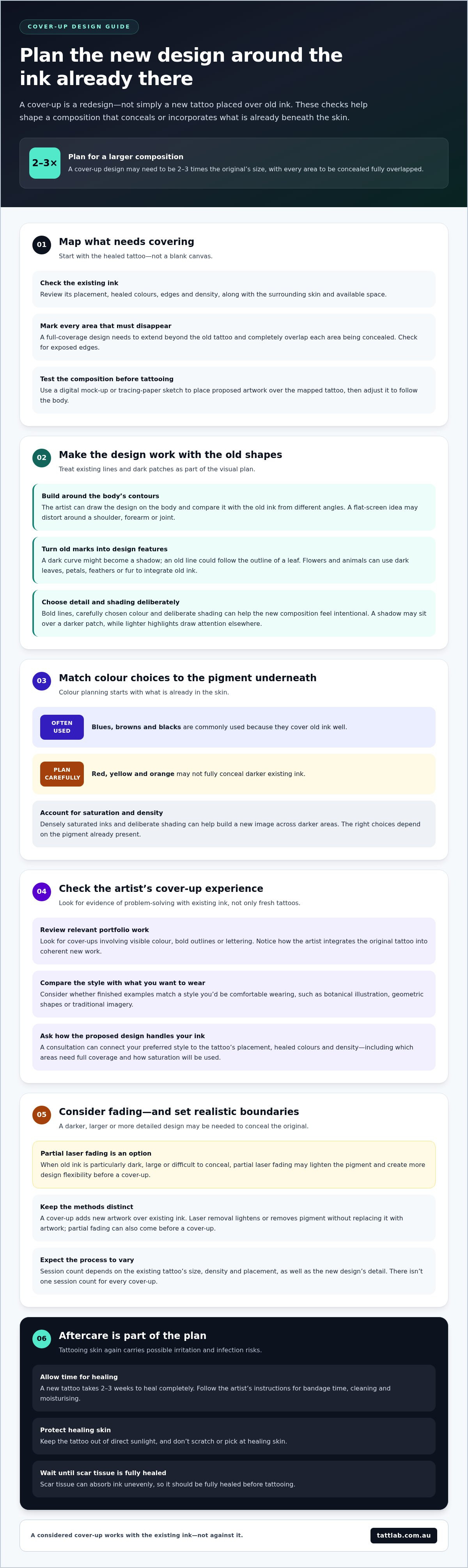
A cover-up is a redesign, not simply a new tattoo placed over old ink. Effective cover-up tattoo techniques usually rely on a design 2-3 times the size of the original, with every area to be concealed fully overlapped. Without prior laser fading, the new design generally needs to be darker than the existing tattoo.
It’s understandable to want old ink hidden without ending up with a design that feels like a compromise. The right approach depends on how the tattoo has healed, its placement, colour and size, as well as your skin and the surrounding space. Bold lines, carefully chosen colours and a design that works with the existing shapes can help the result feel intentional.
This guide explains how cover-ups work and what influences the design, including artist experience, colour selection, optional fading, and how flowers or animals can use detail and texture to conceal old ink. It also explains why realistic expectations matter: a successful cover-up may need to be larger, darker or more detailed than the tattoo it replaces.
Key Takeaways
- Map the existing tattoo before settling on a concept; a digital mock-up or tracing paper can help test how the new design follows the body.
- Review an artist’s cover-up portfolio for examples that show how they work with existing ink, healed skin and different design styles.
- Colour choices depend on the old tattoo’s pigment and density, so design details and shading need to work with what is already beneath the skin.
- Partial laser fading may create more design flexibility when old ink is particularly dark, large or difficult to conceal.
- Flowers and animals can use features such as dark leaves, petals, feathers or fur to integrate areas of old ink into the new composition.
What Is A Cover Up Tattoo?
A cover-up replaces or reworks existing ink, using a new composition to conceal or incorporate it. Planning starts with the tattoo’s placement, healed colours, edges and surrounding skin.
Planning the Design Digitally or on Tracing Paper
A digital mock-up or tracing-paper sketch lets the artist test how new shapes interact with the existing tattoo before tattooing begins. First, the old design is mapped; then the proposed artwork is placed over it, adjusted and checked for exposed edges. A full-coverage design generally needs to extend beyond the old tattoo, with every area to be concealed overlapped. A cover-up can hide the original, incorporate it, or use a blast-over approach.
In Australia, tattooing rules and age restrictions depend on the state or territory where the tattoo is done. There isn’t one national age rule that applies everywhere.
Cover-up costs in Australia depend on the design’s size, detail and placement, and the work needed to cover the existing ink. A larger composition or more complex shading requires more tattooing than a small, simple design.
Aligning the Design with Body Contours and Existing Ink
Contour planning adapts the artwork to the body’s shape, so its lines and focal points sit naturally at the tattoo’s placement. The artist can draw the design directly on the body, then compare it with the old ink from different angles. This matters because a design that works on a flat screen may distort around a shoulder, forearm or joint. Placement also determines how much surrounding skin the new composition can use.
Aligning new shapes with existing ink makes the old design part of the visual plan. For example, a dark curve might become a shadow, or an old line could follow the outline of a leaf. The new design should completely overlap each area to be hidden. A design 2-3 times the original’s size may be needed, so realistic boundaries belong in the early planning stage.
Cover-Up Steps and Session Counts
The process moves from assessment to design, placement and tattooing. The artist reviews the healed tattoo’s colours, edges and position, develops a concept, then maps it onto the body and checks that the overlap is complete. Once the design is agreed, tattooing follows the planned composition. These cover up tattoo techniques work best when the design responds to the ink beneath it, rather than treating it as a blank surface.
The number of sessions depends on the existing tattoo’s size, density and placement, as well as the new design’s detail. The design and the amount of tattooing required shape the schedule, so there isn’t one session count that applies to every cover-up.
Cover-ups involve tattooing skin again, so irritation and infection are possible risks. A new tattoo takes 2-3 weeks to heal completely, and the artist’s aftercare instructions guide bandage time, cleaning and moisturising. Keep it out of direct sunlight and don’t scratch or pick at healing skin. Scar tissue needs particular care because it can absorb ink unevenly; it should be fully healed before tattooing.
Choosing an experienced cover-up artist
A cover-up artist plans around existing pigment rather than treating the skin as a blank canvas. Choose a tattoo artist with specific cover-up experience and a style you admire. Their portfolio should show how they transform older designs into coherent new work.
People choose cover-ups for different reasons: a tattoo may no longer suit their taste, an image may carry difficult memories, or the original work may have faded unevenly. For example, an artist might reshape old lettering into part of a larger illustrative design. Knowing what you want the new tattoo to express helps guide the redesign.
Start by reviewing the artist’s cover-up portfolio. Look for examples where the original tattoo had visible colour, bold outlines or lettering, and notice how the artist used composition to integrate it. Consider whether the finished work matches a style you’d be comfortable wearing, such as botanical illustration, geometric shapes or traditional imagery. A portfolio focused only on fresh tattoos doesn’t show the same problem-solving.
During an in-person consultation, the artist can assess the existing tattoo’s placement, healed colours and density. They can then discuss how the new design will use the original ink, which areas need complete coverage, and whether partial laser fading could help lighten the old pigment first. This assessment connects your preferred style to the practical limits of the existing tattoo.
Ink choice matters because a cover-up needs to work with the colour underneath. Densely saturated inks are a key tool: the artist can use strong colour and deliberate shading to build a new image across darker areas. For example, a shadow within a design can sit over a darker patch, while lighter highlights draw attention elsewhere. Ask to see how the artist handles saturation and detail in comparable cover-up work. For artists selecting supplies, professional tattoo inks support the colour planning required for this work.
Cover-ups, laser removal and re-tattooing serve different purposes. A cover-up adds a new design over existing ink, while laser removal lightens or removes pigment without replacing it with artwork. Partial laser fading can also come before a cover-up; tattooing over the old design is the cover-up approach, not a separate removal method.
Prioritise an artist who can explain how their chosen design responds to your tattoo, rather than promising a universal result. Black-lined script and a faded coloured motif create different design challenges. Reviewing the artist’s portfolio, assessment and explanation of ink saturation helps you understand the proposed direction before tattooing begins.
Colour choices for covering old ink
Colour planning begins with the pigment already in the skin, not a blank palette. Blues, browns and blacks are commonly used because they cover old ink well. Red, yellow and orange may not fully conceal darker pigment. This matters because tattoo ink heals slightly translucent. A light yellow placed over black, for example, can allow the original design to show through after healing.
Think of colour as a layered system. The artist maps the darkest areas first, then selects saturated colours and shading that can sit over them. Densely saturated inks are a key tool in cover-up work because stronger pigment helps build visual coverage. Saturation alone doesn’t erase every line, though. The placement of each colour, the design’s shape and the contrast between dark and light areas all affect how the old tattoo reads.
Existing pigment can also become part of an optical illusion. Instead of covering every old line with one solid shade, the artist can position it within a new image’s shadow, texture or background. For example, a dark blue-based tattoo beneath foliage can be worked into the darker parts of the leaves. Heavy greens can cover those areas, while lighter green containing white creates highlights and shifts attention across the new composition.
Black and grey designs need tonal variation, too. When diluted black or grey ink is used for a cover-up, at least three shades of black or grey are recommended. That range lets the artist distinguish shadows, mid-tones and lighter details. A single grey can flatten the design, while distinct values create depth and distribute visual weight over the old tattoo. The original ink can then contribute to the deepest shadows instead of competing with every detail.
Colour decisions should follow the old tattoo’s darkest marks, not just its overall appearance. A design with broad, dark sections can make those areas purposeful, while pale focal details belong where the underlying ink is lighter. If removal or fading is being considered, the colour plan still needs to account for the pigment that remains. A clear palette balances concealment with an image that feels intentionally designed, rather than like a patch of colour over unwanted ink.
That translucency makes the relationship between the new palette and the old pigment central: the visible result is a combination, not simply the fresh colour viewed alone. A pale accent over a dark mark can therefore remain visually influenced by what lies underneath, even when the design looks covered before healing. Treating the original ink as part of the colour map helps keep expectations realistic and directs attention to how the finished image will read.
The same logic can be used constructively. Rather than treating every remnant as an interruption, a composition can position old pigment where darkness or visual texture supports the new image. This makes concealment a design choice: the artist can consider which marks should disappear from attention and which can contribute to the illusion. The goal isn’t necessarily to make every trace behave like untouched skin, but to make the combined image read as coherent. Reviewing the old tattoo’s darkest areas alongside the proposed colours helps set the direction before the design is finalised, giving each mark a clear role.
Fading an existing tattoo before a cover-up
Laser fading is an optional preparation stage that lightens the original tattoo before new work. A cover-up artist can assess the existing ink during an in-person consultation and determine whether fading would help. This matters when the proposed design needs more colour flexibility than the current pigment allows. The aim is to make the original ink less dominant, not to treat fading as a separate design.
Some tattoos create specific planning challenges. Deep colour, a large design or difficult-to-cover colours can make a new tattoo harder to plan directly over the original. In those cases, partial laser removal can lighten the ink before the cover-up, giving the artist more room to plan around the pigment that remains.
The decision starts with the tattoo itself. The artist considers its colour, size and placement, and how those features interact with the design you want. For example, a large, deeply coloured image may need a different plan from a small, faded motif. The intended artwork matters, too: a design relying on lighter colours may benefit more from fading than one built around dark, bold shapes.
Think of the process as coordinated design planning, rather than fading first and choosing artwork later. At consultation, the artist can discuss:
- Which parts of the original tattoo dominate the area.
- How those marks relate to the proposed composition.
- Whether partial fading could make the new design easier to plan.
- How remaining pigment will influence colour and placement.
This conversation connects each fading decision to a design purpose. If the old tattoo has a concentrated dark area, for instance, the artist can consider whether lightening that ink would open up more options. If the planned artwork already uses strong shapes in that area, the original pigment might instead be incorporated into the composition.
Laser removal and cover-up tattooing have different roles. Laser treatment lightens existing ink; a cover-up places new artwork over or around it. Partial fading combines these approaches, creating a lighter starting point for the artist’s design. It doesn’t remove the need to plan around the pigment that remains.
Keep the intended outcome central throughout the process. The artist’s assessment connects the original tattoo, possible fading and new design in one plan. This can clarify why laser sessions are being considered and how the remaining ink will shape the cover-up. The useful question isn’t simply whether fading is possible, but whether it meaningfully supports the artwork you want.
Using flowers and animals to conceal old tattoos
Flowers and animals offer natural ways to integrate old shapes, dark patches and uneven lines. Their layered forms create options for working with the original tattoo instead of placing a plain block of colour over it. A petal, leaf, feather or patch of fur can become part of the new image’s structure, helping the cover-up read as a deliberate composition.
For a rose over dark pigment, a bright, highly saturated red can build the petals, while milk chocolate adds richness and black is used sparingly. This approach uses colour and shading to form the flower without relying on heavy black across every area. The rose’s curves also give the artist shapes to position around existing marks, keeping the new image cohesive.
Sunflowers offer another useful arrangement. A dark centre can sit over a concentrated patch of old ink, while leaves provide further areas for integrating darker lines. The petals extend the composition outward, so the eye reads a flower rather than focusing only on the covered section. The centre, leaves and direction of the petals should respond to where the old tattoo sits.
Animal designs can use texture to make existing pigment feel intentional. Dark feathers in a bird or shaded fur on a mammal can incorporate areas where the original tattoo is strongest. For example, feather groups can create layered dark sections, while lighter gaps suggest separation and movement. The design’s texture needs to fit the underlying marks, not compete with them.
When comparing floral and animal concepts, map the darkest parts of the old tattoo against the features of each design. Consider which elements naturally provide suitable coverage: shaded rose petals, a sunflower’s centre, dark leaves, feathers or fur. The best fit depends on the existing ink’s location and shape, as well as the image you want to wear. A motif should address the coverage challenge and remain visually coherent.
Keep the design’s focal point in mind. Its most detailed or interesting parts can sit away from the area covering the old tattoo, drawing attention beyond the original marks. For instance, a flower’s detailed petals can extend outward from a darker centre, or an animal’s face can sit apart from textured fur used over old ink. This balance makes concealment part of the artwork’s visual logic.
If you’re preparing a floral or animal cover-up, explore tattoo design supplies to support the planning process.
Tatt Lab: Tattoo Aftercare
Tatt Lab offers Tattoo Aftercare for the healing stage after a cover-up, alongside Tattoo Inks, Traditional Needles and Tattoo Cartridges for tattoo professionals. Once your artist has completed the design, follow their aftercare instructions, including guidance on cleaning, moisturising and protecting the new tattoo. Aftercare is part of the process: careful healing supports the skin as it recovers from fresh tattooing.
For artists planning cover-up work, suitable inks and equipment support the technical demands of applying a new design over existing pigment. Tatt Lab’s product range fits into that studio workflow, while Tattoo Aftercare supports the wearer’s recovery.
For Tattoo Aftercare or professional tattoo supplies, visit tattlab.com.au.
Make your next step a considered one
A cover-up can mark a change in how you want your story represented. Give the design room to feel like yours: consider what you want the new tattoo to express, then carry that intention into planning with your tattoo artist. The right cover up tattoo techniques support both the visual design and how you want to feel wearing it.
For the practical studio and healing stages, Tatt Lab offers Tattoo Aftercare, Traditional Needles and Tattoo Cartridges. These supplies support tattoo professionals and the care of a new tattoo, while design decisions remain part of your discussion with your artist.
Contact Tatt Lab about supplies for your cover-up, and take the next step with a clear sense of what matters to you.
Frequently Asked Questions
What tattoo designs and colours work best to cover an existing tattoo?
Designs with strong contrast, bold outlines and enough visual texture usually offer more ways to integrate old marks. For example, a portrait or mostly pale design can be difficult over dark ink because the original may remain visible after healing. Consider how the design reads from a distance, not only up close: clear shapes can make the new image feel cohesive rather than crowded by underlying detail.
When is tattoo removal or fading needed before a cover-up?
Partial laser fading is worth considering when the existing tattoo’s dark pigment, size or colour makes the intended design difficult to plan. It can be especially relevant if you want a lighter palette that would be difficult to achieve over dense ink. The cover-up artist can assess the tattoo in person and consider whether fading would create useful design options. The remaining pigment still needs to inform the final artwork.
What aftercare is needed for a cover-up tattoo?
Follow your tattoo artist’s aftercare instructions, including how long to keep any bandage on. Clean the tattoo with clean water and fragrance-free soap, then apply moisturiser as directed. Keep the area out of direct sunlight, and don’t scratch or pick at healing skin. A new tattoo takes 2-3 weeks to heal completely, so continue caring for it throughout that period and follow your artist’s guidance.


Comments (0)
There are no comments for this article. Be the first one to leave a message!