

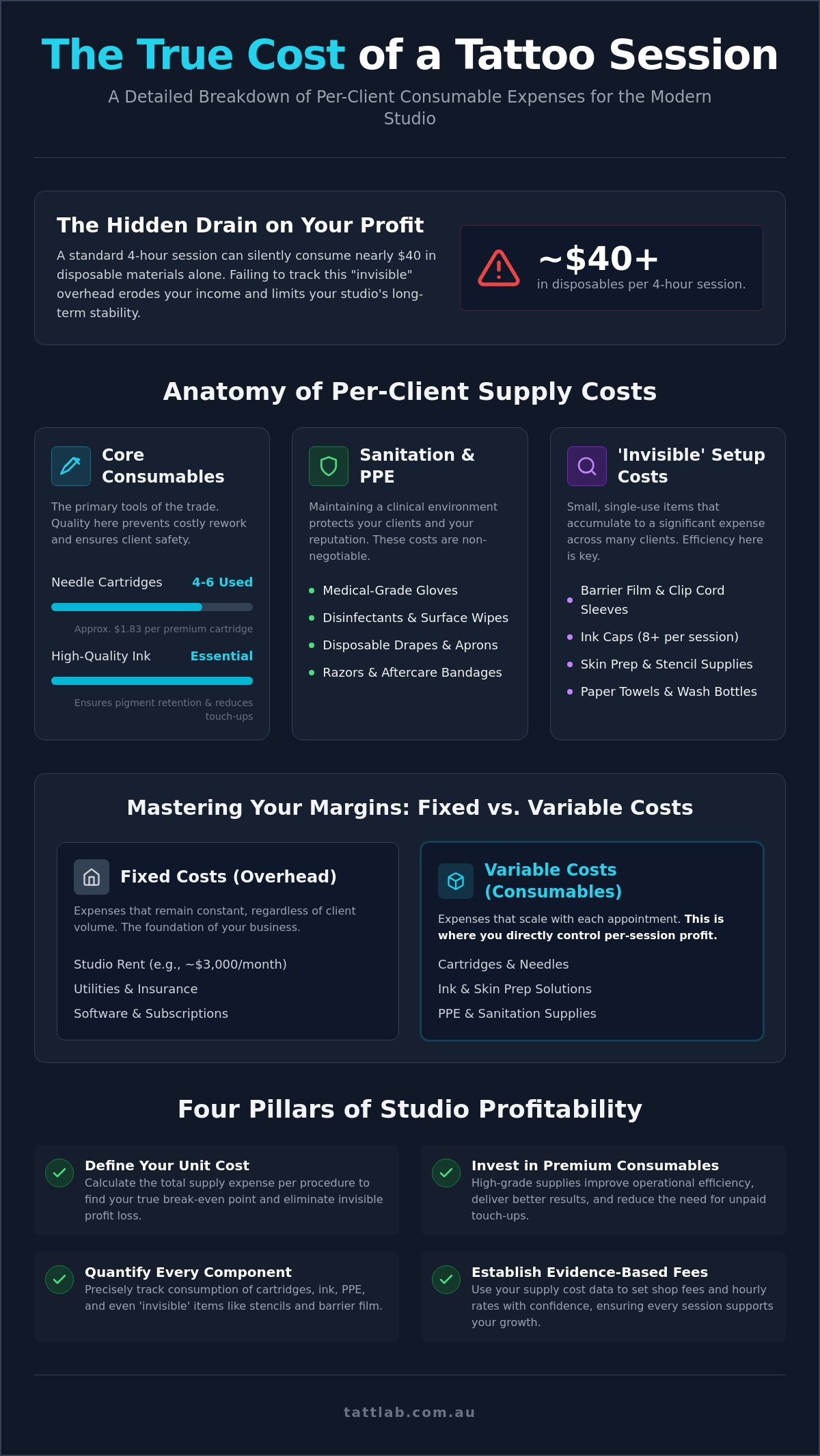
Did you know that a standard four-hour session can consume nearly $40 in disposable materials before you even account for your studio's fixed overhead or your own artistic labor? It's a common source of silent stress for many dedicated professionals. You likely feel the tension between maintaining a sterile, high-end environment and the reality of rising medical-grade PPE costs. Understanding how much do tattoo supplies cost per client is not just about balancing books; it's about protecting the physical integrity of your practice and your personal peace of mind. Wasted consumables shouldn't be the factor that limits your creative growth or your studio's long-term stability.
We agree that your focus should remain on the liberating narrative of your art, not on the anxiety of fluctuating margins. This guide promises to help you master the mathematics of your studio by providing a precise cost analysis for every procedure. We'll provide a clear per-client estimate, a logical framework for setting shop fees, and scientific methods to reduce waste without compromising your clinical standards. By the end, you'll have a predictable path forward for your business health that feels as controlled and precise as your line work.
Key Takeaways
- Define your unit cost to eliminate invisible profit loss and ensure every procedure supports your studio’s financial health.
- Calculate precisely how much do tattoo supplies cost per client by breaking down the specific consumption rates of cartridges, inks, and specialized needles.
- Quantify the impact of medical-grade sanitation and PPE to maintain clinical safety standards while protecting your bottom line.
- Factor in the hidden expenses of skin preparation and stencils to establish a transparent, evidence-based setup fee for every session.
- Identify your session break-even point and discover why investing in premium consumables leads to greater operational efficiency.
The Unit Cost of Art: Why Consumable Tracking Matters
Precision in the studio extends far beyond the tip of your needle. It begins with a clinical understanding of your unit cost, which is the total expense of every single-use item required to complete one professional procedure. When you treat your studio like a high-end laboratory, you move away from the anxiety of "guessing" your margins and toward a results-oriented business model. Many artists overlook the cumulative impact of their disposables, yet failing to track these variables leads to an invisible profit loss that erodes your income over months and years. Understanding exactly how much do tattoo supplies cost per client allows you to set your hourly rates or shop minimums with a sense of composed authority rather than a hopeful estimate.
There is a profound psychological benefit to mastering these mathematics. When you sit down for a client consultation, knowing your precise overhead transforms the conversation. You aren't just charging for your time and talent; you are accounting for a sterile environment that prioritizes the client's physical integrity. This transparency builds immediate trust, especially when you can reference the use of high-quality products sourced through professional platforms like GetMedicalDevice. If you don't know your numbers, you can't accurately value your expertise, which often results in undercharging for complex sessions that require heavy consumable usage.
The Difference Between Fixed and Variable Costs
To master your margins, you must distinguish between the expenses that stay the same and those that shift with every appointment. Your fixed costs include studio rent, which might average around $3,000 per month, alongside utilities and insurance. These remain constant regardless of whether you see one client or fifty. In contrast, your variable costs are the consumables that leave the shelf for every specific session. Consumable overhead is the foundation of studio sustainability. By tracking these variables, you can identify which styles of work, such as high-pigment color realism versus minimalist fine line, are your most profitable narratives of progression.
The 'Invisible' Costs of a Tattoo Setup
Profit leaks rarely happen in large bursts; they occur through the small, uncounted items that facilitate a safe procedure. While you likely track your primary tools, the "invisible" costs of barrier film, clip cord sleeves, and wash bottle covers are just as vital. Even minor components like ink caps and tongue depressors represent a significant investment when calculated across 100 clients. The composition of tattoo inks and the specific pigment loads required for different styles also dictate how many caps you'll fill and discard. For example, a medium session might require eight or more ink caps, each contributing to the total unit cost.
Wasted supplies are essentially wasted income. If your setup is inefficient, you might find yourself discarding unused cartridges or excessive lengths of barrier film. A methodical approach to your station setup mirrors the precision of the tattoo itself, ensuring that every ml of disinfectant and every sheet of paper towel serves a purpose. Protecting your bottom line requires the same meticulousness you apply to the skin, replacing uncertainty with a controlled, predictable framework for growth.
Core Consumables: Breaking Down Needles, Ink, and Cartridges
Precision in the studio begins with the tools that bridge the gap between artistic vision and biological reality. While some artists still debate the upfront expense of professional tattoo ink and modern cartridges, the clinical reality is that high-grade tools streamline the narrative of skin transformation. Traditional needles on a bar may appear more budget-friendly at first glance. However, they lack the safety membranes and stabilized housing found in modern cartridges, which help prevent ink backflow and machine contamination. When evaluating how much do tattoo supplies cost per client, you must look beyond the purchase price to the "cost of trauma." Low-quality needles often result in poor saturation and increased skin irritation, leading to longer sessions and unpaid touch-ups that eat into your profit.
High-quality pigments also play a vital role in your studio's efficiency. Using world-renowned inks ensures that the skin retains the pigment correctly the first time, reducing the need for corrective work later. This methodical approach to choosing your core consumables protects the physical integrity of the client while ensuring your results are predictable and professional. If you are ready to elevate your setup with medical-grade precision, consider the curated range of supplies available at Tattlab.
Cartridge Economics: Precision vs. Price
Modern cartridge needles have become the industry standard for a reason. A single shader needle cartridge typically averages approximately $1.83, while a box of 20 can range from $12 to $30 depending on the brand and technical features. In a standard four-hour session, an artist might use between four and six cartridges to achieve different line weights and shading gradients. Premium brands focus on minimizing "side-play" or needle wobble. This stability is essential for fine-line precision and consistent color packing. The reliability of a professional cartridge prevents the revenue loss associated with needle failure or blunt tips mid-session, making the slightly higher unit cost a sound investment in your workflow.
Ink Management and Pigment Waste
Ink is a highly quantifiable variable in your cost analysis. A one-ounce bottle of professional black ink typically costs between $8.00 and $9.00. Since it takes roughly 1/25th of an ounce to fill a small ink cap, the cost per cap is approximately $0.36. Blackwork is relatively predictable, but full-color realism often requires a broader palette, which can double or triple the number of ink caps used per session. Adhering to FDA tattoo safety regulations ensures that the pigments you select are formulated for safety and long-term skin health. To manage costs, avoid the habit of overfilling caps; pouring only what is necessary for the specific procedure preserves your margins without compromising the aesthetic outcome.
The Sanitation Shield: PPE and Medical Supply Costs
While needles and ink are the primary tools of your trade, the sanitation protocol is the invisible architecture that protects both the artist and the client. In a professional studio, safety is not a variable; it is a clinical standard that ensures the physical integrity of every procedure. When assessing how much do tattoo supplies cost per client, the sanitation protocol often represents the most underestimated expense. It isn't merely the price of a single pair of gloves. It's the cumulative cost of a multi-stage aseptic technique that begins long before the first drop of pigment is poured and continues until the final surface is disinfected.
A methodical approach to sanitation requires high-quality medical supplies for tattoo artists that meet rigorous safety standards. This isn't just about compliance. It's about building a reassuring environment where science meets health. Every barrier film, clip cord sleeve, and wash bottle cover contributes to this shield. For a large session, these barrier disposables can cost approximately $1.50, ensuring that your equipment remains a sterile extension of your expertise. Ignoring these micro-costs leads to a distorted view of your session margins and can compromise the boutique-studio persona that modern clients value.
The PPE Audit: More Than Just Gloves
Nitrile gloves are the most frequently used item in your inventory. Research indicates that a box of gloves costs around $8.50, which breaks down to about $0.01 per glove. However, a professional procedure involves multiple changes. You'll use different pairs for station setup, the tattooing process itself, and the eventual teardown. For a large session, you might go through 12 pairs of gloves to maintain a sterile field. Beyond gloves, your PPE audit must include face masks, aprons, and lap cloths. As we witness significant tattoo industry growth, the demand for TGA-approved products in Australia has increased, making bulk purchasing a vital strategy to lower your per-client average without sacrificing quality.
Sterilisation and Biohazardous Waste
The narrative of safety concludes with the responsible disposal of contaminated materials. Factoring in the cost of sharps containers and biohazard bag disposal is essential for a transparent cost analysis. Each disinfectant wipe used to scrub your station can cost nearly $0.09, and a large session may require 15 or more sheets to meet clinical standards. If your studio still utilizes an autoclave, you must also account for the energy and chemical costs associated with every cycle. Cutting corners on PPE is a liability, not a saving. By identifying these costs clearly, you replace the anxiety of rising expenses with a sense of controlled, predictable progress for your business.
Beyond the Skin: Stencils, Aftercare, and Setup Fees
The transformation of the body is a multi-phase narrative that begins long before the machine is powered on. Calculating how much do tattoo supplies cost per client requires looking at the preparatory steps that ensure the skin is a perfect canvas for your art. These "pre-skin" and "post-skin" costs are often where studio margins are quietly eroded by uncounted consumables. By treating skin preparation and aftercare as essential clinical components, you move away from a transactional mindset toward a comprehensive approach to holistic wellness and long-term results. This section explores the often-overlooked expenses that bridge the gap between a technical procedure and a professional service.
Stencil Precision and Transfer Costs
When you analyze how much do tattoo supplies cost per client, you begin to see that stencil application is the blueprint of your work's financial health. Professional thermal paper typically costs between $0.50 and $1.50 per procedure, depending on the scale and complexity of the design. While entry-level options exist, they often lead to "stencil drift" or the need for time-consuming re-draws mid-session. A professional-grade transfer gel ensures a "perfect" first stick, which preserves your hourly efficiency and reduces the waste of repeated applications. Additionally, you must factor in the cost of aseptic skin clearing. This includes single-use razors, prep-wipes, and the ml-per-client cost of green soap and distilled water. These micro-costs create a predictable framework for your shop minimum and protect your physical integrity as an artist.
The Aftercare Investment
The procedure does not end when the client leaves the chair; it ends when the skin has successfully integrated the pigment. Investing in specialized tattoo aftercare is a strategic decision that protects the integrity of your work. Providing a sample sachet or a dedicated healing balm costs approximately $1.00 to $2.00 per client. This investment significantly reduces the "cost" of free touch-up sessions caused by poor healing protocols or the use of low-quality drugstore alternatives. Positioning professional aftercare as a standard inclusion in your flat fee justifies a higher price point while lowering the client's anxiety about the healing process. It shifts the focus from a technical task to a dedicated partnership between the specialist and the client.
A methodical approach to these setup fees allows you to maintain a clinical yet contemporary vibe that respects the craft while prioritizing safety. To ensure your studio maintains the highest standards of performance and pigment retention, source your clinical-grade tattoo supplies from a trusted specialist who understands the precision your craft requires. This level of meticulousness ensures that every session is a step forward in your studio's growth and reputation.
Optimising Your Studio Margin Without Compromising Safety
Achieving financial stability in a modern studio requires a shift from reactive purchasing to proactive management. By understanding precisely how much do tattoo supplies cost per client, you can implement the "Buy Once, Cry Once" philosophy. This mindset suggests that investing in premium tattoo supplies is more efficient than choosing budget alternatives that might fail mid-session. High-quality tools reduce the time spent on saturation and correction; this directly lowers your variable costs per hour. A methodical approach to station management, where every barrier film and ink cap is placed with intent, ensures that your resources are preserved for the procedure rather than the bin.
Calculating your break-even point is the next step in this logical progression. You must combine your itemised consumable costs with a portion of your fixed overhead, such as your studio's monthly rent, which may average $3,000, and the depreciation of equipment like your $500 tattoo machine. This data-driven perspective replaces the anxiety of rising costs with a sense of controlled progress. It allows you to focus on the liberating narrative of your art, knowing that every movement of the needle is backed by a sustainable business model.
Bulk Purchasing and Wholesale Advantages
The Tatt Lab wholesale structure is designed to support studio scaling by providing a steady, predictable supply chain. When you buy medical supplies in bulk, you significantly lower your per-client average. For instance, purchasing nitrile gloves by the case rather than the box protects you from the price fluctuations of the medical market. The financial benefit of express nationwide shipping on high-volume orders means you can maintain a minimalist, boutique-studio inventory without the risk of running out of essential cartridges. Calculating the ROI of switching to premium, artist-vetted needles often reveals that the reduced "side-play" and superior tapers result in faster healing times and fewer unpaid touch-up sessions.
Setting Your Professional Shop Fee
To ensure your studio's physical integrity and financial health, you should adopt a simple, transparent formula for your base shop fee: (Consumables + Studio Overhead + 15% Buffer) = Base Shop Fee. This buffer accounts for unexpected waste or the use of additional cartridges during complex procedures. Communicating these standards to your clients is a powerful way to justify your pricing. When a client understands that their fee covers medical-grade sanitation, TGA-approved pigments, and specialized aftercare, it builds immediate trust. Safety and quality are the ultimate drivers of professional reputation; they transform a technical task into a high-end service that respects the body and the craft alike—a commitment to excellence that many artists also reflect in their personal style by sourcing premium gear from Lab X Supply.
Mastering the Mathematics of Your Studio
Mastering the mathematics of your consumables is a transformative step in your professional journey. It shifts your focus from the anxiety of overhead to the precision of your craft. You've learned that tracking unit costs and prioritizing medical-grade sanitation aren't just administrative tasks; they are fundamental to protecting the physical integrity of your clients and your studio's reputation. By choosing premium cartridges and clinical-grade pigments, you ensure that every procedure is a predictable narrative of progression. Understanding exactly how much do tattoo supplies cost per client empowers you to set shop fees that reflect your true expertise and the high standards of your laboratory-style environment.
Refined your margins? Restock your studio with professional-grade supplies at Tatt Lab. As an artist-owned and operated facility, we provide express nationwide shipping across Australia for all your TGA-standard medical and tattoo consumables. This meticulous approach to your inventory ensures that science meets health in every session you lead. Your commitment to quality is the ultimate driver of your long-term success.
Frequently Asked Questions
What is the average cost of supplies for a small tattoo setup?
The estimated cost for a small tattoo setup, typically lasting one to two hours, is approximately $7.63. This figure accounts for essential consumables such as needles, ink, and basic sanitation disposables like gloves and barrier film. While this provides a baseline, your specific technique and choice of premium materials will influence the final calculation of how much do tattoo supplies cost per client. Maintaining a detailed inventory log helps you track these micro-expenses with clinical precision.
Is it cheaper to use traditional needles or cartridges?
Traditional needles on a bar are generally cheaper per unit, but cartridges offer superior efficiency and safety that often justify the higher price point. A shader cartridge averages about $1.83, whereas traditional needles cost significantly less. However, the time saved during setup and the reduced risk of machine contamination make cartridges the preferred choice for modern studios. They prioritize physical integrity and a streamlined workflow, which ultimately protects your hourly margin.
How many pairs of gloves should I use per tattoo client?
You should plan to use between four and twelve pairs of nitrile gloves per client, depending on the session's length and complexity. A small procedure typically requires four pairs to cover setup, application, and teardown. For a large session exceeding four hours, you'll likely use twelve pairs to maintain a sterile field. Since a box of gloves costs around $8.50, the per-glove cost is roughly $0.01, making frequent changes an affordable clinical standard.
Should I charge my clients a separate 'material fee'?
Most professional studios choose to incorporate consumable expenses into a flat shop fee or an hourly minimum rather than charging a separate material fee. This approach feels less transactional and aligns with a sophisticated, boutique-studio persona. When you understand how much do tattoo supplies cost per client, you can set a transparent base rate. This covers your clinical-grade disposables while building immediate trust through a professional, all-inclusive pricing model.
How do I lower my tattoo supply costs without losing quality?
Lowering your supply costs is best achieved through bulk purchasing and establishing professional wholesale accounts. Buying high-volume items like gloves, paper towels, and barrier film in bulk reduces the unit price significantly. Additionally, implementing a methodical station setup helps minimize waste. Pouring only the necessary amount of pigment and using precisely measured barrier protection ensures your margins remain healthy without compromising the safety or aesthetic outcomes your clients expect.
What are the most expensive consumables in a tattoo studio?
Needle cartridges and specialized sanitation wipes are typically the most expensive variable consumables in a modern studio. A single disinfectant wipe can cost nearly $0.09, and a large session may require fifteen or more sheets to meet sterile requirements. When combined with multiple cartridges used for different line weights, these items represent the primary expenses that dictate your session’s break-even point. Tracking these specific costs ensures your studio operates like a high-end laboratory.
Does the type of ink I use significantly impact my per-client cost?
The type of ink impacts your costs primarily through the volume of pigment caps required for the specific tattoo style. A standard blackwork cap fill costs approximately $0.36. While the ink itself is affordable, complex color realism requires a broader palette, which can triple the number of caps used and discarded. Investing in high-pigment, reputable brands ensures better saturation, which reduces the time spent on the procedure and protects your overall profitability.
How much should I budget for biohazard waste disposal per month?
Budgeting for biohazard waste disposal depends on your studio's volume, but it remains a non-negotiable expense for clinical safety. This budget must cover sharps containers and professional waste collection services. While these are often fixed monthly fees rather than per-client costs, they are essential components of your professional overhead. Maintaining a dedicated partnership with a waste management specialist ensures your facility remains compliant and respects the biological nature of the work.


Comments (0)
There are no comments for this article. Be the first one to leave a message!