

A thoughtful tattoo intake starts with a calm conversation, not a clipboard of unexplained questions. Getting a client’s medical history means asking about relevant health conditions, medicines, allergies and healing concerns, then clarifying the answers before the session. Family history may also be worth discussing if it relates to the client’s wellbeing or healing.
These questions can feel personal. Explain why you’re asking, invite the client to share what’s relevant and give them room to raise concerns in their own words. A respectful approach helps build trust and keeps the conversation focused on practical decisions about the appointment.
This guide explains how to establish rapport, gather key medical details, discuss family history sensitively and recap what you’ve heard. It also clarifies the limits of a tattoo intake: it supports an informed conversation, but it isn’t a medical diagnosis.
Key Takeaways
- Set a respectful tone by explaining the purpose of the conversation and giving clients space to describe their concerns in their own words.
- Use a consistent intake process to capture relevant health details, then summarise key points so the client can correct misunderstandings.
- Ask about family and genetic history sensitively, focusing on information that could affect the client’s health or tattoo planning.
- Handle health information thoughtfully by limiting collection to what’s relevant and considering how it will be stored and accessed.
Building rapport and communicating clearly
For a child or an adult whose mental state affects their ability to participate, gather relevant history from a relative, friend or carer. Involve the client as much as possible and establish appropriate consent before collecting information.
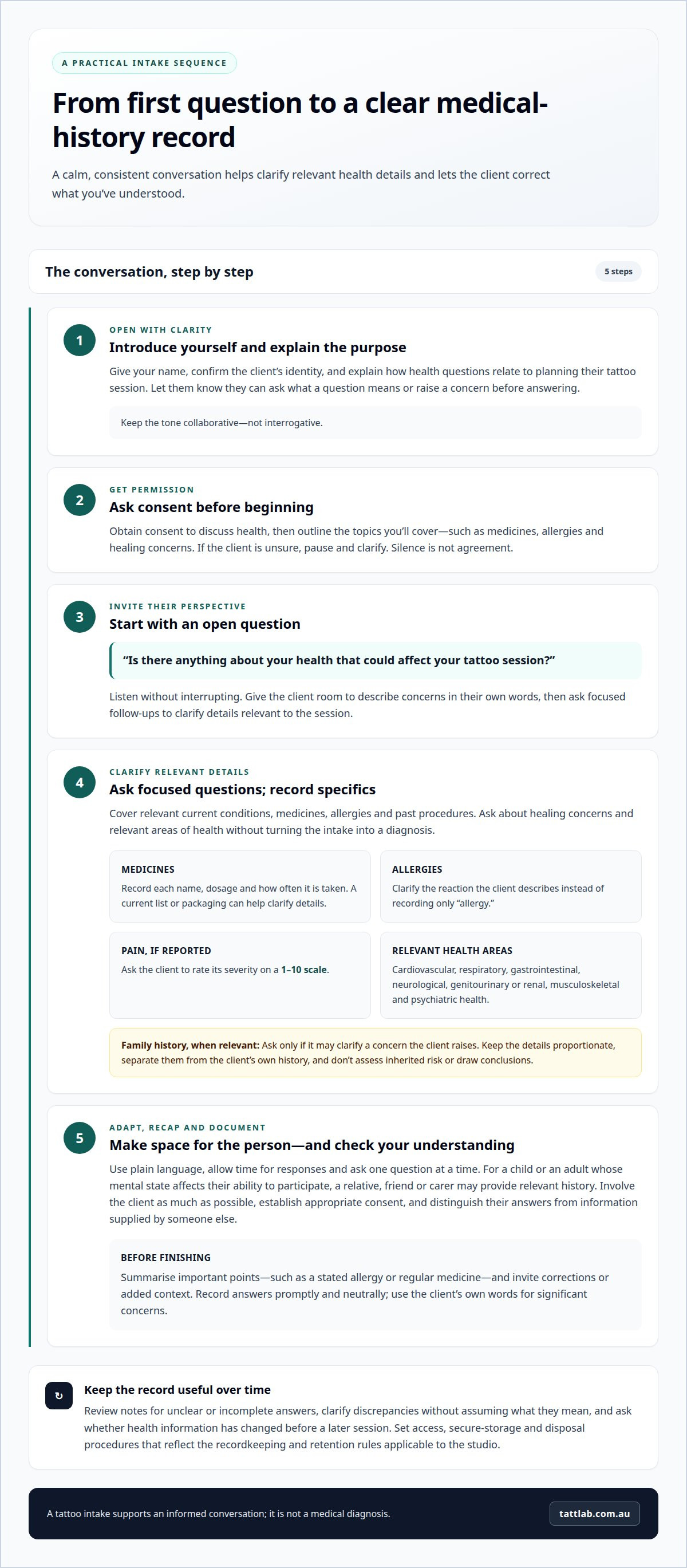
- Introduce yourself and explain the purpose. Give your name, confirm the client’s identity, and describe how the health questions relate to planning their tattoo session. Explain that they can ask what a question means or share a concern before answering. A clear opening makes the process collaborative rather than interrogative.
- Ask permission before beginning. Obtain the client’s consent to discuss their health, then outline what you’ll cover, such as medicines, allergies and healing concerns. If they seem unsure, pause and clarify the purpose of the intake. Don’t treat silence as agreement or rush through the conversation.
- Start with an open question. Invite the client to explain their health concerns in their own words, using a prompt such as, “Is there anything about your health that could affect your tattoo session?” Listen without interrupting, then ask focused follow-up questions to clarify relevant details.
- Adapt the conversation to the person. Use plain language, allow time for responses, and ask one question at a time. For a child or a client with impaired mental state, a relative, friend or carer can provide collateral history. Address the client directly where possible, and distinguish their answers from information provided by someone else.
- Summarise and invite corrections. Before finishing, repeat the important points you recorded, such as a stated allergy or regular medicine. Ask the client whether you understood correctly and give them a chance to correct errors or add context. Record responses neutrally, using the client’s own words for significant concerns.
A clear sequence makes the conversation easier to follow: introduce yourself, identify the client and obtain consent before taking a history. Use open-ended questions and give them room to describe their experiences in their own words. Before finishing, summarise the important points so the client can correct anything you’ve misunderstood. This final check confirms that you’ve understood their account as intended.
Core medical history components
A structured intake captures relevant health details and creates a consistent record to review. Getting a client’s medical history means asking focused questions, documenting the answers clearly and updating the record when circumstances change.
Ask about health conditions and history
Ask about current conditions, medicines, allergies and past procedures. For each medicine, record its name, dosage and how often the client takes it. Clarify what an allergy involves, including the reaction they describe. If the client reports pain, ask them to rate its severity on a 1-10 scale. Keep questions relevant to the session, and don’t turn the conversation into a diagnosis.
Document the medical history
Record the client’s answers promptly and distinguish what they report from what you observe. Briefly cover any relevant areas not already discussed, such as cardiovascular, respiratory, gastrointestinal, neurological, genitourinary or renal, musculoskeletal and psychiatric health. Write specific details rather than vague entries such as “medication” or “health issue”. Review the notes for unclear or incomplete responses.
- Follow a consistent sequence. Ask about the presenting concern, health conditions, medicines, allergies, past procedures and relevant systems. This makes the intake easier to complete and review.
- Clarify the medication list. Ask the client to confirm each medicine’s name, dosage and frequency. If they have a current list or packaging, use it to clarify details rather than relying on memory.
- Review for changes. Before a later session, ask whether the client’s health information has changed. Getting a client’s medical history is an ongoing recordkeeping process, not simply a form completed once.
- Handle records responsibly. Australian recordkeeping and retention requirements depend on the rules applicable to the studio and record. Set procedures for access, secure storage and disposal that reflect those requirements.
- Check accuracy before relying on the notes. Incomplete or inaccurate details may obscure relevant concerns and affect session planning. Ask the client to clarify discrepancies, then document their answer without assuming what it means.
Family and genetic history
Ask about family history only when it may clarify a concern the client raises. Focus on what they know, avoid interpreting inherited risk and record family information separately from the client’s own medical history.
- Explain why you’re asking. Tell the client that family history can help identify concerns they may wish to discuss with a health professional. Make clear that you’re gathering context, not assessing genetic risk or diagnosing a condition. This distinction keeps the conversation within the tattoo practitioner’s role.
- Use a neutral, open prompt. Ask, “Is there a health condition in your family that you think could be relevant to your tattoo?” This lets the client choose what to share. Don’t assume a particular condition runs in their family or press them for details they don’t know.
- Clarify the connection in the client’s own words. If they mention a diagnosed inherited condition, ask what they understand about its relevance to their own health. For example, record that the client reports a family history and has discussed it with a clinician. Don’t draw conclusions from the relative’s diagnosis.
- Keep family details proportionate. Record only information relevant to the client’s stated concern, such as the condition they identify and their relationship to the affected relative. Avoid collecting names or extra medical details about relatives when they don’t help clarify the client’s own situation.
- Separate reported history from confirmed personal history. Label whether information concerns the client or a relative. If the client is unsure whether a condition is genetic, document that uncertainty accurately rather than presenting it as fact. This prevents assumptions from becoming part of the client’s record.
- Respond appropriately to unresolved concerns. If a client believes family history could affect their health or tattoo plans, note the concern and encourage them to discuss it with a qualified health professional before proceeding. Don’t provide genetic counselling or reassure them that a family condition poses no risk.
What Australian privacy laws apply to collecting and storing client health information?
In Australia, privacy requirements for health information can vary with the studio’s jurisdiction and business circumstances. Use a careful process to collect, access and store each client’s record.
- Identify the privacy framework relevant to your studio. Consider where the studio operates and how its business is structured, because these factors can affect which privacy requirements apply. Don’t assume every tattoo studio follows an identical set of rules. Build your record-handling process around the requirements that govern your own business.
- Collect only information relevant to the session. Explain why you need a particular health detail before recording it. For example, ask about a stated allergy if it may affect session planning, rather than gathering unrelated family medical details. A focused intake reduces unnecessary collection and makes the record easier to manage.
- Limit access to health records. Decide which staff members need access to client histories and keep records away from casual viewing. For a digital file, use access controls; for a paper form, store it securely. Don’t leave a completed intake visible at reception or in a shared work area.
- Set a clear retention and disposal process. Decide how records will be kept, who is responsible for them, and how they’ll be securely disposed of when retention is no longer required. Don’t assume one retention period applies to every Australian studio or every type of record. Apply the relevant requirements to your circumstances.
- Prepare for a privacy incident. Establish who will respond if a paper file goes missing or someone accesses a digital record without permission. Document the incident and the actions taken. A defined response process helps staff act consistently and supports responsible handling of sensitive client information.
Once your intake and record-handling process is organised, keep session preparation consistent with tattoo aftercare supplies suited to your studio’s workflow.
SOAP notes organise patient information into subjective findings, objective findings, assessment and plan. If you use this format, keep the categories distinct when recording relevant session information. Apply the same access, storage and disposal practices you use for other client health records. This helps organise information consistently without collecting details unrelated to the session.
Tatt Lab: Tattoo Aftercare
Tatt Lab offers Tattoo Aftercare for studios preparing clients for the care stage after a tattoo session. Once the intake is complete, aftercare products can support a clear handover that complements the health and healing information discussed with each client.
Include Tattoo Aftercare in your studio’s practical preparation, alongside the other tattoo supplies you use. Tatt Lab also offers Traditional Needles, Tattoo Cartridges and Tattoo Inks. Keeping these essentials in view helps organise your workflow without confusing product selection with medical assessment. Aftercare products don’t replace individual health advice or a client’s clinician, but they can form part of your post-session guidance.
To explore Tattoo Aftercare for your studio, visit tattlab.com.au.
Make each intake a deliberate part of studio practice
A consistent approach to getting a client’s medical history can become part of how your studio prepares for each appointment. Use the conversation to understand the client’s circumstances, keep the record focused and make space for them to raise concerns without pressure. If a health question falls outside your role, keep the discussion factual and let the client decide how to seek appropriate health advice.
Review your intake process as your studio’s needs evolve. Clear questions and careful record handling help your team treat each client as an individual, not just a form to complete. This supports a thoughtful experience from preparation through aftercare.
For tattoo safety-related enquiries, contact Tatt Lab. Take the next step with a calm, considered approach to every session.
Frequently Asked Questions
What information should be included in a client medical history form in Australia?
Include identifying details, the planned tattoo location, relevant health conditions, medicines, allergies and past procedures. Leave space for clients to describe allergy reactions, healing concerns or other details that don’t fit a tick box. Date the information and prompt clients to note changes before later sessions. Keep family history separate from the client’s own conditions, and don’t present the form as a medical diagnosis.
What are the record-keeping and retention requirements for client medical histories in Australia?
Requirements depend on the studio’s jurisdiction, business circumstances and the type of record. Set procedures for access, secure storage, retention and disposal that reflect the requirements applicable to your studio. There is no single retention period for every studio or record.


Comments (0)
There are no comments for this article. Be the first one to leave a message!