

A perfectly executed line isn't just the result of a steady hand; it's a calculated victory over physics and biology. When you select a round liner tattoo needle, you aren't just picking a tool, you're choosing how you'll manage skin displacement and pigment delivery at a microscopic level. It's a common frustration to feel your equipment fighting you, where needle wobble or poor ink flow forces you to overwork the skin. You've likely experienced those moments where a single pass isn't enough, leading to the kind of trauma that complicates both the art and the client's recovery.
We understand that your professional reputation relies on the integrity of every mark you make. This technical guide will help you master the science of needle configurations, from understanding the relationship between gauge and taper to navigating the 2026 industry standards for sterile production. You'll learn how to achieve crisp, surgical precision and flawless saturation while prioritizing the long-term health of the skin. We will break down the mechanics of needle geometry and ink flow, providing you with a clear framework for selecting the exact configuration needed to ensure predictable, professional results in every session.
Key Takeaways
- Learn how the circular soldering pattern of a round liner tattoo needle creates the specific tension required for razor-sharp outlines and intricate detail work.
- Master the technical distinction between needle gauges and taper lengths to precisely control ink flow and minimize unnecessary skin trauma.
- Identify the ideal needle groupings for diverse techniques, ranging from 1RL precision for micro-tattoos to 14RL configurations for bold traditional work.
- Understand the critical role of safety membranes and internal housing in eliminating needle wobble and preventing cross-contamination.
- Discover how professional-grade liners enhance technical stability, allowing for single-pass saturation and superior healing outcomes.
Understanding Round Liner Geometry and Function
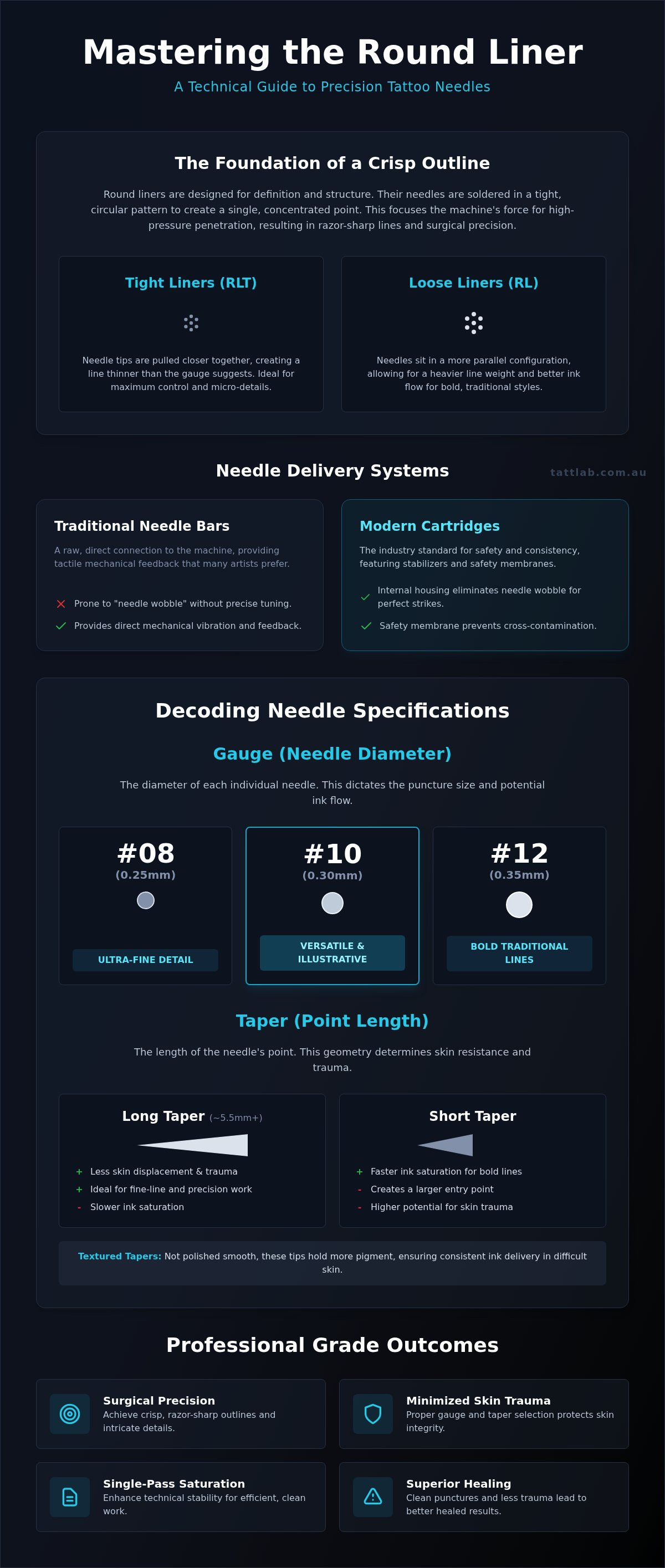
The round liner tattoo needle is the technical foundation of every precise outline. Unlike shaders or magnums that distribute pigment across a broader surface area, round liners consist of multiple needles soldered together in a tight, circular configuration. This geometry creates a singular, concentrated point of contact. By focusing the machine's force into this small area, you can achieve the high-pressure skin penetration required for crisp, surgical precision. It's the difference between a broad brushstroke and a technical pen; the round liner is designed for definition, intricate geometry, and the structural "skeleton" of a tattoo.
Within this category, you will encounter both "tight" and "loose" configurations. Tight liners (often labeled RLT) have tips that are pulled even closer together toward the point, resulting in a line that is thinner than the needle gauge would normally produce. Loose liners allow the needles to sit in a more natural parallel, which facilitates a slightly heavier line weight and better ink flow for traditional styles. Choosing between them is a matter of managing skin displacement. A tight liner offers maximum control for micro-details, while a loose liner provides the steady saturation needed for bolder work.
The Anatomy of a Round Liner
Every professional round liner tattoo needle is a composite of three critical elements: the grouping, the solder point, and the needle bar or plunger. The grouping defines the physical diameter of your line, but the solder point determines how that grouping behaves under tension. A higher solder point creates a stiffer needle with more "snap," providing predictable resistance when the needle meets the skin. We use 304 medical-grade stainless steel for these components to ensure structural integrity. This high-grade steel resists the microscopic "hooking" that can occur with lower-quality metals, which significantly reduces skin trauma and improves the client's healing narrative.
Traditional Needles vs. Modern Cartridges
The evolution of modern tattooing methods has created a choice between traditional needle bars and modern cartridge systems. Traditional bars provide a direct, mechanical feedback that many artists find reassuring; it's a raw connection to the machine's vibration. However, cartridges have become the standard for those prioritizing safety and consistency. In a cartridge system, the internal housing acts as a stabilizer. This housing eliminates the needle wobble that often occurs with traditional setups, ensuring every strike is perfectly centered. For a deeper look at how these tools fit into a sterile studio environment, consult our Professional Guide to Tattoo Supplies in Australia. Whether you choose the tactile feedback of a bar or the clinical precision of a cartridge, the objective is a clean, single-pass line.
Decoding Needle Specifications: Gauges, Tapers, and Groupings
Understanding the technical specifications of a round liner tattoo needle is about more than matching numbers to a design. It's about predicting how the metal interacts with the dermis. Every specification, from the diameter of the wire to the length of the point, alters the fluid dynamics of the ink and the biological response of the skin. When you master these variables, you move from guessing to a state of controlled, predictable progress.
Selecting the Right Gauge for Your Style
The gauge refers to the diameter of each individual needle in the grouping. This measurement dictates the volume of the "puncture" and the amount of ink deposited in a single strike. In 2026, professional artists generally rely on three primary standards. The #12 (0.35mm) is the industry workhorse for bold, traditional linework. Its larger surface area provides the structural strength needed for "bold-will-hold" outlines. For medium-weight lines and illustrative work, #10 (0.30mm) offers a versatile balance of precision and saturation. If your work involves micro-realism or delicate gradients, #08 (0.25mm) needles, often called Bugpins, are the preferred choice for ultra-fine detail. These thinner wires allow for higher-density groupings that still produce a remarkably fine line.
Taper Lengths and Skin Trauma
The taper is the length of the needle's point before it reaches its full diameter. This geometry is critical because it determines skin resistance. Long Tapers (typically 5.5mm or greater) allow for deeper penetration with significantly less surface tension. Because the point is so gradual, it enters the skin with minimal displacement, making it ideal for the surgical precision required in fineline work. Conversely, Short Tapers reach their full diameter quickly. This creates a larger entry hole, which facilitates faster ink saturation in bold lines but requires a more experienced hand to avoid excessive trauma.
For artists working with difficult or thick skin types, the "Textured Taper" is an invaluable innovation. These needles aren't polished to a mirror finish at the tip; instead, they maintain a microscopic texture that holds more pigment, ensuring consistent delivery even when resistance is high. Managing these technical nuances is vital for maintaining skin integrity and ensuring long-term aesthetic outcomes. As highlighted in the FDA Tattoo Safety Fact Sheet, using sterile, high-quality equipment is the first step in preventing complications. Selecting professional-grade cartridges with the correct taper for your specific technique ensures that the healing process is as smooth as the procedure itself.
Matching Round Liners to Tattooing Styles
Selecting the correct round liner tattoo needle is the bridge between technical theory and artistic execution. While your machine provides the power, the needle configuration determines how that power is translated into the skin. Every tattooing style demands a specific approach to skin tension and pigment load. By aligning your needle choice with your specific technique, you reduce the variables that lead to inconsistent results and unnecessary skin trauma.
The Fineline Specialist’s Toolkit
Fineline and micro-tattooing require an uncompromising level of stability. When you work with 1RL and 3RL configurations, the margin for error is microscopic. One of the primary risks with these ultra-thin groupings is "hooking" the skin, where the needle snags the dermis because the angle or hand speed is slightly off. To mitigate this, artists often pair low-gauge bugpins with high-pigment tattoo ink to ensure a crisp, single-pass line. This combination allows you to maintain a steady rhythm without needing to revisit the same area, which is essential for preserving the delicate integrity of the skin in smaller, more detailed compositions.
Bold Linework and Saturation
Traditional and Neo-Traditional styles rely on the "bold-will-hold" philosophy, often utilizing 7RL to 14RL groupings. A common technical hurdle with these larger configurations is the "hollow" line, where the center of the mark lacks saturation. This typically occurs when the voltage is too low to drive the increased surface area of the needle grouping into the skin or when hand speed is too fast for the ink to flow. Managing your voltage and maintaining a consistent hand speed ensures that the entire circular pattern of the needle deposits pigment evenly. It's also vital to choose the correct taper in these scenarios; a shorter taper can help pack ink more aggressively, though you must be cautious in delicate areas to prevent blowouts caused by excessive force.
Illustrative work and dotwork also benefit from the surgical precision of smaller liners. Using a 3RL or 5RL for stippling allows you to build gradients through controlled, repetitive contact. This method relies on the needle's ability to release a consistent amount of pigment with every strike, creating the soft, textured appearance that defines modern stipple shading. Whether you are pulling a heavy outline or building a soft shadow, your choice of liner serves as the technical foundation for Mastering Tattoo Aftercare. A clean, efficient procedure leads to a predictable healing narrative, allowing the body to focus on recovery rather than repairing avoidable trauma.
Technical Performance: Membranes, Ink Flow, and Stability
The technical integrity of a round liner tattoo needle is defined by the engineering within its housing. While geometry determines the mark, the internal mechanism ensures that mark is made safely and consistently. A critical feature in modern cartridges is the safety membrane. This impermeable barrier prevents pigment and biological fluids from migrating back into the machine's grip. This isn't just about protecting your equipment; it's a fundamental pillar of studio safety. By 2026, ISO 13485 certification has become the baseline requirement for manufacturers to ensure these membranes perform reliably under the high-frequency tension of wireless rotary machines.
Every professional-grade needle must undergo Ethylene Oxide (EO) Gas Sterilization. This process penetrates the packaging and the needle grouping itself, ensuring total elimination of microbial life. This rigorous standard protects the client's physical integrity and ensures the needle's 304 medical-grade steel remains sterile until the moment of contact. Using unvetted supplies risks cross-contamination, a variable that no professional studio can afford to overlook.
Needle Stability and Precision Systems
High-end cartridges utilize a precision plunger system that guides the needle grouping with surgical accuracy. This design eliminates the lateral needle wobble that often plagues lower-quality alternatives. When a round liner tattoo needle is perfectly centered, the machine's vibration is dampened. This stability significantly reduces hand fatigue during long sessions, allowing for a more composed and meticulous workflow. The use of medical-grade PC (polycarbonate) plastic for the housing further enhances performance. This material reduces friction between the metal and the plastic, which prevents heat buildup and ensures the needle maintains its "snap" from the first minute to the last.
Optimising Ink Flow and Visibility
"Ink spitting" is a common frustration that stems from poor tip reservoir design. Modern cartridges solve this by using matte internal surfaces that act as a capillary. This texture encourages the pigment to cling to the needle rather than pooling and splashing. Visibility is equally important for maintaining precision. Many artists prefer transparent tips to monitor ink levels in real-time, while others choose tinted tips to reduce glare under high-intensity studio lighting. If you find yourself struggling with "dry" lines or pigment starvation, it's often a sign that the reservoir isn't facilitating a steady flow. To experience this level of technical stability in your own work, shop our range of artist-vetted round liners.
Elevating Your Craft with Professional-Grade Liners
Mastering the technical nuances of a round liner tattoo needle represents a shift from being a technician to becoming a specialist. By synthesizing your knowledge of needle geometry, gauge selection, and taper science, you create a framework for predictable, professional performance. This methodical approach ensures that every line you pull is a reflection of your expertise rather than a gamble with your equipment. When you choose a configuration based on the specific biological needs of the skin and the aesthetic requirements of the style, you prioritize long-term results over quick fixes.
Why Quality Consumables Define Your Reputation
Your professional reputation is built on the physical integrity of your work. High-quality consumables are the primary factor in determining client comfort during the procedure and the speed of their recovery afterward. While cheap disposables might seem cost-effective initially, the hidden costs of needle wobble, inconsistent ink flow, and excessive skin trauma can damage your brand's credibility. Investing in premium cartridges allows you to develop a signature style with equipment that responds identically every time you open a new box. This consistency is what transforms a technical procedure into a liberating narrative of self-assurance for your clients.
The Tatt Lab Selection Process
At Tatt Lab, we act as a dedicated partner in your professional progression from the initial interaction to the final result. We don't just stock products; we meticulously vet every brand, including industry leaders like Elite and EZ, to ensure they meet our rigorous standards for 304 medical-grade steel and sterile EO gas processing. Our Victoria-based headquarters provides nationwide express shipping across Australia, ensuring your studio remains stocked with the medical-grade PPE and needles you require for a sterile, modern workflow.
We offer wholesale accounts and bulk ordering options to support the growth of Australian studios, providing the convenience of a clinical laboratory with the persona of a boutique studio. If you're looking to refine your setup or transition to a more stable cartridge system, we invite you to consult with our specialist team for a custom kit build that aligns with your technical goals. Upgrade your linework today by selecting artist-tested round liners that respect the body's integrity as much as the art's aesthetic.
Achieving Technical Excellence in Every Line
The journey to mastering the perfect outline requires a deep alignment with your tools. Precision is a deliberate choice. By understanding how the circular geometry of a round liner tattoo needle interacts with biological tissue, you can move beyond inconsistent results and embrace surgical precision. We've explored how selecting the correct gauge and taper length allows you to manage skin resistance effectively. This ensures that every mark contributes to a clean, single-pass outcome that respects the body's integrity.
Prioritizing 304 medical-grade stainless steel and sterile EO gas processing isn't just a technical requirement. It's a commitment to the safety and long-term wellness of your clients. When your equipment is artist-vetted and backed by nationwide express shipping, you can focus entirely on the transformation taking place under your hand. You've worked hard to develop your style; your tools should work just as hard to protect it.
Ready to refine your technical toolkit? Shop Professional Round Liner Needles & Cartridges and experience the difference that precision-engineered equipment makes. Your dedication deserves tools that perform with the same meticulousness you bring to every session.
Frequently Asked Questions
What is the difference between a Round Liner and a Round Shader?
A round liner tattoo needle features tips soldered in a tight, circular pattern to converge at a single point, creating crisp, defined lines. In contrast, a round shader has needles that run parallel to each other with more space between the tips. This configuration allows for softer ink distribution and smoother blending. While the liner is a precision tool for structural work, the shader is designed for filling and transition.
Can I use a Round Liner for shading or colour packing?
You can use a round liner for specialized techniques like stippling or whip shading in small, intricate areas. However, it isn't an efficient choice for large-scale colour packing or broad gradients. Because the point of contact is so concentrated, attempting to fill large sections with a liner often leads to excessive skin trauma and patchy results. For those tasks, magnums or round shaders provide more consistent saturation with fewer passes.
What gauge needle is best for fineline tattooing?
For the highest level of detail in fineline work, artists typically select #08 (0.25mm) or #10 (0.30mm) gauges. The #08 gauge, known as a bugpin, allows for a tighter grouping that produces a remarkably thin mark without sacrificing stability. These thinner wires penetrate the skin with minimal resistance. This is essential for maintaining the delicate aesthetic of micro-tattoos while ensuring a predictable, steady healing process for every client you serve.
How do I know if I need a Long Taper or a Short Taper round liner?
Choose a Long Taper (LT) when you require surgical precision and minimal skin resistance, as the gradual point enters the dermis with very little displacement. This is ideal for fineline and illustrative styles. A Short Taper (ST) is better suited for bold, traditional outlines where you want to deposit a larger volume of pigment quickly. The shorter point creates a slightly larger entry hole, facilitating faster saturation in single-pass linework during your sessions.
Why is my round liner cartridge spitting ink?
Ink spitting usually occurs when there is an imbalance in the cartridge reservoir or a lack of surface tension on the needle. High-quality cartridges solve this by utilizing matte internal surfaces that act as a capillary to hold the pigment. If your round liner tattoo needle is spitting, check for dried ink buildup in the tip or ensure your needle hang is adjusted correctly. Transparent tips also help you monitor the reservoir levels more effectively.
Are all round liner cartridges compatible with my tattoo machine?
Most modern cartridges use a universal twist-and-lock design that is compatible with the majority of rotary and pen-style machines. While some older or proprietary systems require specific brands, the industry has largely standardized these connections for convenience. It's always best to verify the fit with your specific machine manufacturer. The professional-grade cartridges we stock are designed to integrate seamlessly with standard rotary equipment used by specialists across the national Australian industry.
How often should I change my round liner during a long session?
You should replace your needle if you notice a change in the snap of the grouping or if the tips become dull. While 304 medical-grade steel is highly durable, repetitive contact with the skin during a long session can eventually compromise the sharpness. If the needle begins to snag or if ink flow becomes inconsistent despite cleaning, a fresh cartridge will restore the precision and saturation required for a professional and predictable result.
What are bugpin needles and when should I use them?
Bugpin needles are defined by their smaller diameter, typically #08 (0.25mm), compared to the standard #12 (0.35mm). Use them when your work demands ultra-fine detail, smooth stippling, or high-density groupings that still produce a thin line. Because each wire is thinner, a bugpin 7RL will produce a line weight similar to a standard 3RL or 5RL. This offers the added stability and ink-holding capacity of a larger grouping without the extra thickness.


Comments (0)
There are no comments for this article. Be the first one to leave a message!