

Selecting the best black tattoo ink is often treated as a matter of artistic preference, but in reality, it's a high-stakes calculation of molecular stability and pigment density. In an Australian market where national regulatory frameworks for ink composition remain absent as of late 2026, the burden of safety and quality falls entirely on the artist's expertise. You've likely felt the frustration when a crisp line drifts into a muddy blue-grey months later, or the physical strain of making multiple passes to achieve a truly solid fill. These aren't just technical hurdles; they're risks to the long-term integrity of your work and your client's trust.
We understand that achieving a velvet-like saturation requires more than just a heavy hand; it demands a sophisticated understanding of how carbon particles interact with the dermis. This guide will help you discover the technical criteria for superior black pigments and how to select the ideal ink for lining, packing, and long-term healed results. We'll explore the science of particle milling and carrier solution viscosity, providing a clear path to predictable, high-integrity outcomes that respect the skin's biological limits while ensuring your work remains as vivid as the day it was applied.
Key Takeaways
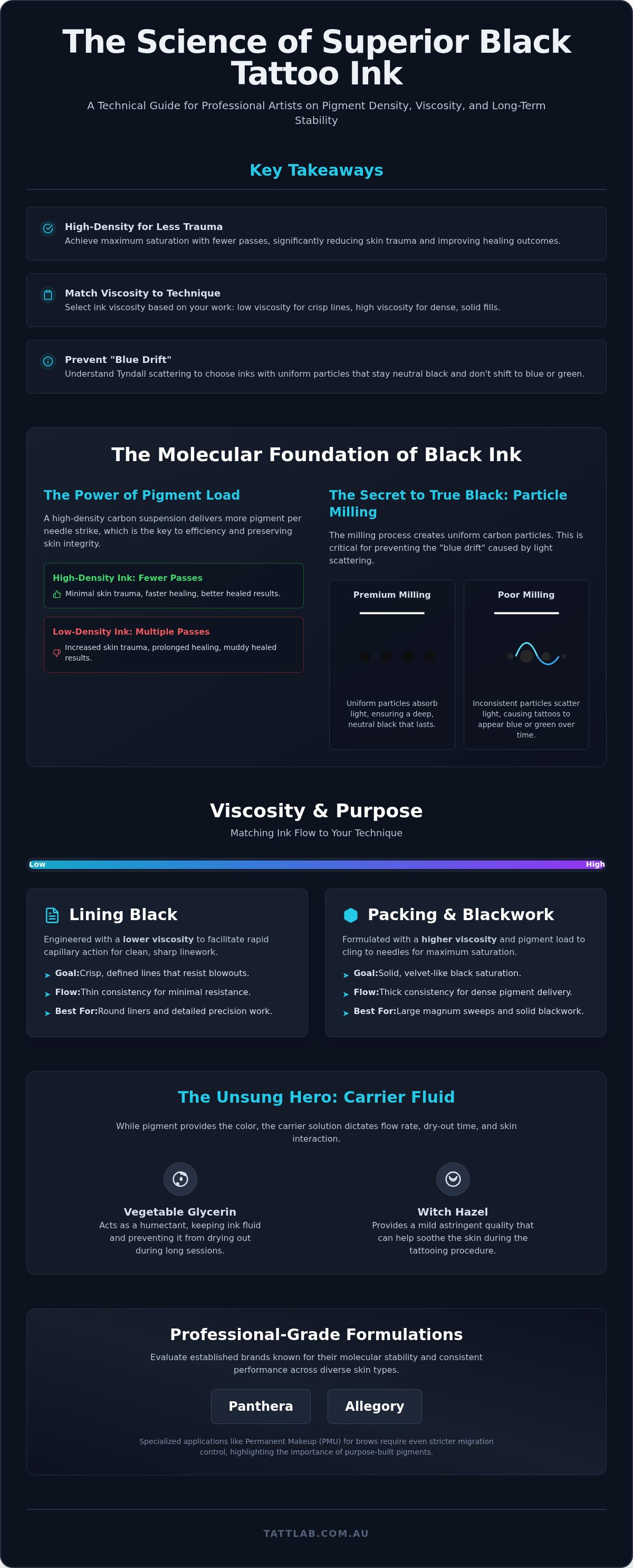
- High-density carbon suspensions allow for maximum saturation with fewer passes, significantly reducing skin trauma and improving the healing narrative.
- Selecting the best black tattoo ink involves matching pigment viscosity to your technique, ensuring rapid capillary action for crisp lines and dense saturation for solid fills.
- Understand the physics of Tyndall scattering to prevent pigment drift and ensure your blackwork remains neutral rather than shifting to blue or green over time.
- Evaluate professional-grade formulations like Panthera and Allegory for their molecular stability and consistent performance across diverse skin types.
- Learn how the specialised precision of permanent makeup (PMU) requires pigments with even stricter migration control to ensure long-term brow definition.
The Molecular Foundation: What Defines the Best Black Tattoo Ink?
Professional black ink is far more than a simple liquid; it's a precisely engineered high-density carbon-based pigment suspension. To understand why certain inks perform better than others, we must look at the tattoo ink composition and how it interacts with human biology. The best black tattoo ink achieves a delicate equilibrium between pigment load and fluid dynamics, ensuring that the carbon remains trapped within the dermis without migrating or fading into unwanted hues.
A higher pigment load is the primary driver of efficiency during a session. When an ink possesses a dense concentration of carbon, it delivers more pigment with every needle strike, which naturally leads to fewer passes. This isn't just about speed; it's about physical integrity. By reducing the number of times you must traumatise the skin to achieve solid saturation, you foster a faster healing process and preserve the skin's natural texture. This results-oriented approach builds immediate trust with clients who value both the aesthetic outcome and the health of their skin.
Carbon Black and Particle Milling
The secret to a deep, permanent black lies in the milling process. Manufacturers of premium inks custom-mill their carbon to achieve a uniform particle distribution. When particles are consistent in size, they settle evenly within the dermis, creating a solid wall of colour that resists the "blue drift" often seen in cheaper alternatives. This drift is caused by light scattering; smaller, inconsistent particles reflect shorter wavelengths of light, making the tattoo appear blue or green over time. Pigment load is the ratio of dry pigment to carrier fluid. By maintaining a high ratio of perfectly milled carbon, you ensure the work stays as neutral and dark as the day it was tattooed.
The Clinical Importance of Carrier Fluids
While the pigment provides the colour, the carrier fluid dictates the performance. Common ingredients like vegetable glycerin and witch hazel aren't just fillers; they are essential for controlling the flow rate and "dry-out" time on your palette. Glycerin acts as a humectant, keeping the ink fluid during long sessions, while witch hazel provides a mild astringent quality that can help soothe the skin during the procedure. The balance of these ingredients determines how easily the ink wipes away and how quickly it enters the skin. For a deeper look at how these components impact your daily practice, refer to The Professional Guide to Tattoo Ink for comprehensive safety and selection details.
Viscosity and Purpose: Matching Your Ink to Your Technique
The best black tattoo ink isn't a universal solution; it's a technical variable that must be matched to your specific mechanical approach. Professional black pigments are categorised by their flow characteristics into three primary tiers: lining, packing, and grey wash formulations. This distinction is vital because the mechanical requirements of a single-needle pass differ vastly from a large magnum sweep. Using a high-viscosity packing ink for fine lines often results in poor flow and patchy results, while using a thin liner for solid fill requires excessive passes that increase skin trauma and compromise the healing narrative.
Selecting the wrong viscosity for a specific needle grouping can lead to unpredictable healed results. A thin ink used with a large magnum might not hold enough pigment load to saturate the skin in one pass, leading to a greyish, inconsistent finish. Conversely, a thick ink in a tight liner can clog the tube, forcing the artist to increase machine voltage and potentially cause unnecessary scarring. Achieving a professional result requires a methodical alignment between the ink's fluid dynamics and the needle's surface area.
Lining Black: Precision and Flow
Lining ink must possess a lower viscosity to facilitate rapid capillary action. When you're using round liner cartridges, the pigment needs to travel down the needle grouping and into the skin with minimal resistance. This ensures that the line remains crisp and defined without blowouts, which often occur when the pigment spreads uncontrollably in the dermal layer due to poor formulation or improper depth. A true lining black maintains its sharp edges for years, resisting the natural expansion of the skin. Selecting a formulation with a stable carrier fluid is essential for the health and safety of tattoo inks within the biological environment, ensuring that the precision you achieve on day one remains intact long-term.
Packing and Blackwork: Density and Saturation
Achieving a velvet black fill requires an ink with higher viscosity and a concentrated carbon load. Packing inks are engineered to cling to magnum needles, allowing for a dense delivery of pigment into the dermis. This thickness prevents the ink from running too quickly, which is crucial when covering large anatomical areas or performing heavy blackwork. The result is a solid, light-absorbing finish that feels deep and permanent. For artists seeking these precise characteristics, exploring artist-vetted tattoo inks ensures that the viscosity matches the intended technique, providing a reliable foundation for every procedure.
| Characteristic | Lining Black | Packing Black |
|---|---|---|
| Viscosity | Low (Fluid) | High (Dense) |
| Ideal Needle | Round Liners | Magnums / Shaders |
| Primary Goal | Edge Definition | Deep Saturation |
| Flow Rate | Rapid | Controlled |
Pigment Drift and Longevity: Why Quality Inks Stay Neutral
The transition from a sharp obsidian line to a murky teal or forest green is the most common concern for both artists and their clients. This shift, often called "blue drift," isn't just a sign of an aging tattoo; it's a measurable physical phenomenon. When you use the best black tattoo ink, you're investing in a formulation designed to resist the optical distortions that occur within the skin's complex biological environment. Ensuring that a tattoo remains neutral over decades requires a deep understanding of how light interacts with pigment particles trapped beneath the epidermis.
This visual change is largely driven by Tyndall scattering. As light passes through the upper layers of the skin, it strikes the pigment particles. If those particles are inconsistent in size or have begun to break down, they scatter shorter blue and violet wavelengths more effectively than longer red ones. To the human eye, this makes the black appear blue or green. Professional-grade inks use stable, larger carbon particles that absorb light across the entire visible spectrum, maintaining their deep, neutral character. High-quality pigments also resist "ghosting," where the edges of a tattoo lose their definition as the body attempts to break down and transport smaller, unstable particles away from the site.
Photodegradation from UV exposure further accelerates this breakdown. Ultraviolet radiation acts as a molecular catalyst, snapping the bonds of inferior pigments and causing them to fade or shift in hue. Stable pigments are engineered with higher lightfastness, providing a defensive barrier against the sun's energy and ensuring the work retains its original saturation and structural integrity for years to come.
The Chemistry of Neutral Blacks
Manufacturers of premium pigments achieve long-term neutrality by meticulously balancing undertones during the formulation process. While carbon black is the industry standard for its deep opacity, its performance depends on its purity and the absence of contaminants. This differs significantly from iron-oxide-based pigments, which are often used in lower-grade inks and can shift toward reddish or greyish tones as the body processes the mineral components. Neutrality in black ink is a result of balanced light absorption, where the pigment reflects almost no visible light. This chemical stability is a core focus of international safety benchmarks, including FDA tattoo ink safety regulations, which provide a framework for understanding how pigment composition affects long-term safety and aesthetic outcomes.
Protecting the Healed Result
The final appearance of your work is a partnership between the ink's quality and the skin's biological response. If the dermis is excessively traumatised or the healing process is interrupted, the pigment can settle unevenly, leading to a patchy or distorted finish. Maintaining skin integrity is essential for creating a clear, transparent shield over the pigment. To support this process, we recommend following the principles outlined in Mastering Tattoo Aftercare. When the skin heals perfectly, it allows the true depth and neutrality of the ink to be perceived without the interference of scar tissue or uneven texture.
Professional Selections: Top-Tier Black Inks for Australian Studios
Tatt Lab operates as a trusted specialist, curating a selection that prioritises physical integrity and predictable healing outcomes. Choosing the best black tattoo ink involves more than just selecting a popular label; it requires a methodical verification of batch-coded, sterile-processed formulations. We vet every brand for the Australian professional market, ensuring that the pigments we provide offer the molecular stability required for high-end studio environments. This rigorous selection process removes the uncertainty of pigment performance, allowing you to focus on the precision of your craft.
The inks we stock are chosen for their ability to deliver consistent results across various skin types and anatomical locations. By focusing on brands that value safety and technical edge, we help artists build a liberating narrative of personal transformation for their clients. Whether you're executing heavy geometric blackwork or fine-line illustrative pieces, the reliability of your pigment is the foundation of long-term client trust.
Panthera: The Clinical Standard for Saturation
Panthera has established itself as a leader in molecularly stable pigments, offering a level of smoothness that is difficult to replicate. Its specific pigment load is engineered for maximum light absorption, making it a preferred choice for large-scale blackwork and ultra-detailed realism. Unlike inferior inks that can feel abrasive or "gritty" during the procedure, Panthera’s formulation facilitates a fluid application that reduces skin resistance. It heals with a deep, satin-black finish that maintains its neutrality long after the initial procedure, avoiding the blue-grey drift that compromises the integrity of aged work.
Allegory and Dynamic: The Versatile Workhorses
For artists focused on structural precision and rapid application, Allegory Blak and Ultra Blak are exceptional tools. Allegory is renowned for its consistent flow, specifically engineered to prevent the stuttering or clogging that can occur during high-speed lining. It provides a reliable, crisp edge that remains stable through the healing narrative. Dynamic Black remains a legacy staple in the industry, valued for its high pigment concentration and its ability to be easily broken down into custom grey washes. These brands are essential components of Professional Tattoo Supplies in Australia, forming the technical backbone of a high-performance kit. Allegory Ultra Blak is particularly useful for those moments when absolute opacity is required in a single stroke, ensuring that your work remains bold and permanent.
Explore our curated range of professional tattoo inks to find the perfect match for your studio's technical requirements.
The Evolution of Black: Transitioning to PMU and Brow Pigments
The transition from body art to permanent makeup (PMU) represents a significant evolution in technical precision. While the pursuit of the best black tattoo ink usually centres on deep dermal saturation for large-scale work, facial aesthetics demand a more nuanced approach to pigment density. The skin of the brow area is thinner and more vascular than the limbs or torso, meaning the margin for error regarding pigment migration is virtually non-existent. For the high-precision artist, this shift requires a move away from standard carbon-heavy inks toward specialised formulations engineered specifically for facial retention.
Stricter control over pigment drift and fading is the cornerstone of successful PMU. Unlike a traditional tattoo where a slight softening of edges might be acceptable over decades, a brow that shifts to a blue or grey hue can fundamentally alter a client's facial harmony. This is why brow pigments are formulated with a specific balance of warm and cool undertones to counteract the skin's natural tendency to scatter light. It's a process of controlled, predictable progress where the goal is a liberating narrative of self-assurance rather than just a technical procedure.
Precision in Permanent Makeup
PMU pigments are meticulously crafted for optimal retention within the unique biological environment of the face. The molecular structure of these pigments allows them to sit comfortably in the dermis without the risk of spreading into surrounding tissue. Achieving natural-looking eyebrows depends entirely on colour stability; the pigment must fade true to tone rather than shifting in temperature as it breaks down over time. Within the Tatt Lab collection, artists can access a comprehensive gradient ranging from soft, ethereal blondes to deep, saturated blacks. This variety ensures that every procedure respects the client's physical integrity while delivering a sophisticated aesthetic outcome.
Selecting Your PMU Palette
Successful PMU artistry relies on the ability to perform custom blending for every individual client. No two skin tones are identical, and a "one-size-fits-all" approach often leads to unnatural results. By selecting pigments from an exquisite range designed for microblading and machine work, you can layer tones to create bespoke brow designs with genuine depth. This methodical approach mirrors the precision of our traditional ink selections but with the added refinement required for the face. Just as you would vet the best black tattoo ink for a traditional sleeve, selecting your PMU palette requires a commitment to safety and long-term stability. It's the logical next step for artists who value safety and results-oriented products. To elevate your practice, explore the professional range of PMU Brow Pigments at Tatt Lab and discover how specialised chemistry can transform your healed results.
Elevating Your Technical Practice with Precision Pigments
Achieving professional-grade saturation is a methodical process that begins with understanding the physics of light and the chemistry of carbon. By matching the viscosity of your pigment to your specific needle grouping, you eliminate the risks of patchy healing and unnecessary skin trauma. Whether you are executing dense blackwork or fine-line illustrative pieces, selecting the best black tattoo ink ensures your work remains neutral and stable long after the initial procedure. This commitment to quality transforms the tattooing process from a mere technical task into a liberating narrative of self-assurance for your clients.
As you expand your expertise into high-precision fields like permanent makeup, the requirement for molecular stability becomes even more critical. Tatt Lab provides artist-vetted pigments designed for optimal retention, offering a spectrum of shades from soft blondes to deep blacks. With express nationwide shipping across Australia, we are dedicated to supporting your professional progression with results-oriented supplies. Craft flawless results with Tatt Lab's exquisite range of PMU Brow Pigments and build a foundation of lasting trust with every client you serve. Your dedication to physical integrity and technical excellence is what defines the future of your craft.
Frequently Asked Questions
What is the difference between lining black and packing black ink?
Lining black ink is formulated with a lower viscosity to facilitate rapid flow through round liner needles, ensuring crisp, defined edges. Packing black ink possesses a higher pigment concentration and a thicker carrier solution, allowing it to cling to magnum needles for dense, solid saturation. Using the correct formulation prevents excessive skin trauma and ensures the pigment settles at the intended dermal depth for a permanent, velvet-like finish.
Why does some black tattoo ink turn blue or green over time?
This visual shift is primarily caused by Tyndall scattering, where light reflects off pigment particles beneath the skin's surface. If the ink contains inconsistent particle sizes or inferior carbon, it scatters shorter blue and violet wavelengths more effectively than red ones. Selecting the best black tattoo ink involves choosing brands that use uniform, high-purity carbon to ensure the healed result remains neutral and dark over many years of aging.
Is carbon black ink safe for all skin types?
High-purity carbon black is considered the industry standard for safety and is generally compatible with all skin types when sourced from professional manufacturers. However, the safety profile depends on the absence of heavy metal contaminants and the stability of the carrier fluid. Professional artists should always verify that their pigments are batch-coded and sterile-processed to maintain physical integrity and minimise the risk of adverse biological reactions during the healing process.
Can I use traditional black tattoo ink for PMU eyebrow procedures?
We don't recommend using traditional body art ink for PMU eyebrow procedures due to the unique characteristics of facial skin. Brow-specific pigments are engineered with stricter migration control and specific undertones to prevent the blue brow effect. Facial skin is thinner and more vascular, requiring a specialised formulation that fades true to tone rather than shifting as the body naturally processes the pigment particles over time.
What makes an ink professional grade compared to cheaper alternatives?
Professional-grade inks are distinguished by their precision-milled particles and clinical-grade carrier solutions. Cheaper alternatives often lack uniform particle distribution, leading to patchy healing and unpredictable pigment drift. Specialist providers like Tatt Lab only offer artist-vetted brands that undergo rigorous sterile processing and batch coding. This meticulous approach ensures that the ink performs consistently under the machine, providing a reliable foundation for your artistic work and client safety.
How does pigment load affect the healing process of a black tattoo?
A higher pigment load directly improves the healing narrative by allowing for maximum saturation with fewer passes of the needle. When the ink is densely concentrated, the artist doesn't need to traumatise the skin repeatedly to achieve a solid fill. This reduction in mechanical stress preserves the skin's natural texture and fosters a faster, more predictable recovery, resulting in a deeper and more permanent black once the tissue has fully regenerated.
What is the best black ink for fine line tattooing?
The best black tattoo ink for fine line work is a low-viscosity formulation that offers rapid capillary action. Inks like Allegory Blak are specifically designed to flow smoothly through tight round liners without clogging or stuttering. This fluid consistency allows the artist to maintain a steady hand and consistent depth, ensuring that delicate geometric or illustrative lines remain sharp and crisp without the risk of dermal blowouts or unintended spreading.
How should I store my black ink to ensure maximum longevity?
To ensure maximum longevity, store your ink in a cool, dark environment away from direct sunlight and extreme temperature fluctuations. Ultraviolet light can cause photodegradation of the pigment molecules, while heat can alter the viscosity of the carrier fluid. Always keep the caps tightly sealed to prevent evaporation or contamination. We recommend shaking your bottles regularly to maintain a uniform suspension of carbon particles, ensuring consistent saturation for every procedure.


Comments (0)
There are no comments for this article. Be the first one to leave a message!