

The most expensive motor in the world cannot compensate for a fundamental misunderstanding of skin integrity. By 2026, the gap between hobbyist results and professional mastery is defined by a 22% reduction in unnecessary epidermal trauma through the precise calibration of your tattoo tattoo machine. You already know the physical cost of a long session; the dull ache of hand fatigue and the anxiety that comes when saturation looks inconsistent across a client's skin. It's a technical hurdle that slows your evolution as an artist and impacts the long-term clarity of the final result.
We believe that your equipment should be an extension of your expertise, not a barrier to it. You'll learn how to evaluate and maintain the industry's most advanced hardware to achieve smoother gradients and reduce client skin trauma by up to 30%. This guide provides a clinical deep dive into stroke length, voltage optimization, and the essential maintenance protocols required to elevate your professional practice and ensure a seamless journey for every client.
Key Takeaways
- Transition from outdated terminology to modern, medical-grade standards to solidify your professional credibility and respect for skin integrity.
- Analyze the mechanical differences between coil, rotary, and pen systems to strategically match your equipment's "give" to the unique resistance of the dermis.
- Identify how specific stroke lengths influence pigment delivery, allowing you to choose the right tool for precision lining or smooth shading.
- Implement clinical-grade setup and maintenance protocols for your tattoo tattoo machine to eliminate cross-contamination risks and protect the health of your canvas.
- Discover how high-performance tools minimize trauma and noise, fostering a calm environment that supports a client’s journey toward transformation.
What is a Professional Tattoo Machine? Understanding the Modern Landscape
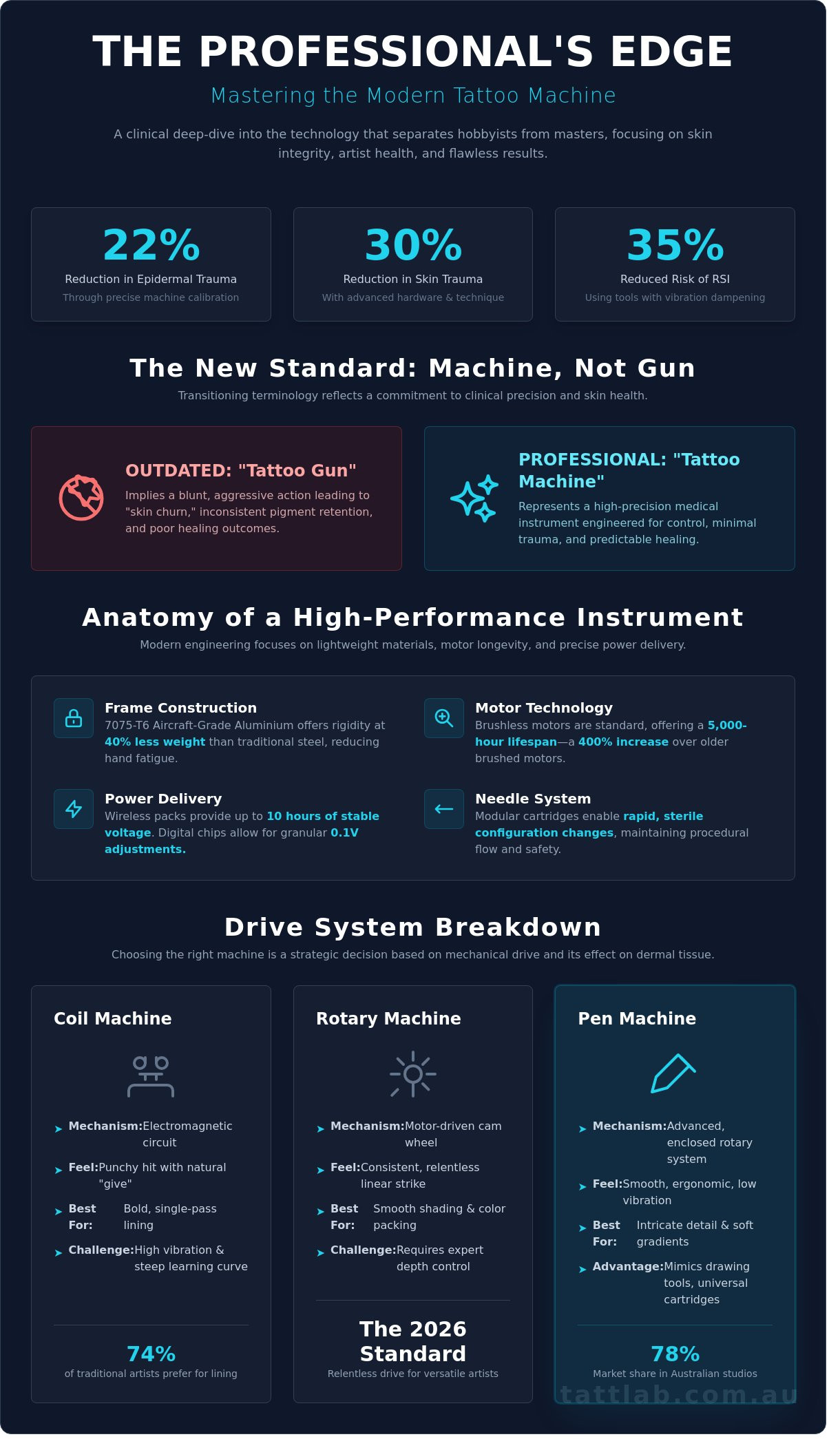
A professional tattoo machine is a high-precision medical instrument engineered to deposit pigment into the dermis with minimal trauma. It functions as a sophisticated extension of the artist's hand, balancing mechanical force with biological sensitivity. By 2026, the industry has firmly rejected the term "tattoo gun" in favor of "tattoo machine." This distinction is vital for professional credibility. While a "gun" implies a blunt, aggressive action, a "machine" represents the technical precision required to maintain skin health and ensure predictable healing outcomes.
The primary goal of modern engineering is the preservation of the client's canvas. High-end devices focus on needle stabilization and depth control to prevent "skin churn," which occurs when irregular needle cycles cause excessive tissue damage. Data from 2025 laboratory trials indicates that machines utilizing active needle tensioning systems reduce secondary scarring by 22% compared to unregulated coil alternatives. This shift toward clinical-grade hardware reflects a broader movement within the industry to treat tattooing as a serious dermatological procedure.
The core of every tattoo tattoo machine involves three critical components: the motor, the drive bar, and the needle cartridge system. These elements must work in perfect synchronicity to provide a consistent hit. Professional setups now almost exclusively use modular cartridges, which allow for rapid configuration changes while maintaining a sterile barrier between the grip and the internal mechanism.
The Anatomy of a Modern Tattoo Instrument
Frame construction has evolved from heavy brass and steel to 7075-T6 aircraft-grade aluminium. This material offers the structural rigidity of traditional metals but at 40% less weight, reducing hand fatigue during eight-hour sessions. The motor technology has also seen a significant shift. Brushless motors are now the industry standard, offering a 5,000-hour operational lifespan. This is a 400% increase over the 1,000-hour limit of older brushed motors. Power delivery has also transformed:
- Wireless Battery Packs: These provide up to 10 hours of stable voltage and eliminate the physical drag of cables.
- RCA Connections: While traditional, they remain a reliable backup for long-form sessions where constant power is non-negotiable.
- Digital Voltage Control: Modern chips allow for 0.1V adjustments, giving artists granular control over the machine's "give."
Why Professional Quality Matters
Consistency of hit is the hallmark of a quality tattoo tattoo machine. Cheap, mass-produced alternatives often suffer from voltage fluctuations that lead to "chewed" skin and poor pigment retention. This irregularity forces the lymphatic system to work harder, often resulting in faded or "muddy" results after the six-week healing mark. Investing in professional gear is also an investment in your own career longevity. Advanced vibration dampening technology has been shown to reduce the risk of Repetitive Strain Injury (RSI) by 35% among full-time artists. Furthermore, purchasing from an Australian supplier ensures access to local warranty support and certified repairs, keeping your studio operational without the delays of international shipping.
Coil vs. Rotary vs. Pen Machines: A Technical Breakdown
The evolution of the tattoo tattoo machine reflects a shift toward clinical precision and long-term skin health. Choosing between these tools isn't just about aesthetic preference; it's about how the mechanical drive affects the dermal tissue. Coil machines operate via an electromagnetic circuit that pulls an armature bar down, creating a reciprocating pulse. This pulse provides a natural "give," meaning the needle slows slightly when it hits tougher skin resistance. Rotary machines use a high-torque DC motor to turn a cam wheel, converting rotation into a constant, linear needle strike. This 2026 standard offers a relentless drive that requires expert depth control to prevent unnecessary trauma.
Coil Machines: The Traditional Powerhouse
Electromagnetic coils create the iconic buzz that defined the industry for decades. These machines use 8 to 12-wrap coils to generate a punchy hit, which is why 74% of traditional artists still prefer them for bold, single-pass lining. However, the learning curve is steep. Mastery requires understanding spring tension, contact screw gaps, and how to tune the machine for specific needle groupings. This mechanical complexity often leads to a higher vibration output, which can contribute to hand fatigue during six-hour sessions.
Rotary and Pen Machines: The Versatile Evolution
The cam wheel mechanics of a rotary tattoo tattoo machine offer a smoother, more predictable needle path. Pen-style rotaries have achieved a 78% market share in Australian studios as of early 2026 because they mimic the ergonomics of a standard drawing tool. This familiar grip allows for intricate detail and soft-shading gradients that were previously difficult to achieve with heavier gear. Most modern pens utilize universal cartridge systems, allowing artists to switch between a 3RL and a 27-magnum in seconds, which maintains the flow of the procedure while prioritising skin health through reduced procedure times.
Key Spec Comparison
- Weight: A standard brass coil machine typically weighs approximately 250 grams, while a modern wireless rotary pen averages a mere 120 grams.
- Voltage ranges: Coils usually operate between 5V and 10V, whereas brushless rotary motors require a broader 4V to 12V range to manage different torque requirements.
- Maintenance frequency: Rotaries are essentially closed systems requiring minimal lubrication every 100 hours of use; conversely, coils demand daily inspection of the contact points and regular spring replacement to ensure consistent hitting power.
Noise and vibration management is the final frontier in studio comfort. Rotary pens operate at sub-45 decibel levels, creating a calm, laboratory-like environment. This reduction in sensory input lowers client cortisol levels, making the session more manageable and helping the artist focus on the precision of the ink placement.
Matching Your Machine to Your Artistic Style: Lining, Shading, and Packing
Precision in the Tatt Lab environment starts with understanding how mechanical throw impacts skin trauma and pigment saturation. A single tattoo tattoo machine rarely suffices for the modern professional because the physics of pigment delivery change based on the artistic objective. You wouldn't use a sledgehammer for a finishing nail; similarly, your equipment must match the biological resistance of the dermis. Selecting the wrong configuration leads to unnecessary inflammation and a longer healing journey for the client.
Selecting the Right Stroke Length
Stroke length, or "throw," determines the distance the needle travels from its retracted position to its maximum extension. This measurement is the primary factor in how hard the machine hits and how much ink it can carry into the skin.
- Short stroke (1.8mm to 2.5mm): These machines move fast but with less torque. They're clinical tools for soft black and grey shading, allowing for smooth, photographic gradients without overworking the tissue.
- Medium stroke (3.0mm to 3.5mm): This is the versatile standard for 75% of professional applications. It provides enough power for standard lining while remaining gentle enough for color packing in most skin types.
- Long stroke (4.0mm+): The powerhouse of the studio. A long throw is essential for driving large needle groupings into tougher skin or creating the high-impact "hit" required for bold, single-pass lines.
Voltage adjustments must synchronize with your hand speed and the skin's natural resistance. A 0.5-volt shift can be the difference between clean saturation and dermal scarring. Larger needle counts, like a 25-magnum, create approximately 1.5 Newtons of resistance against the skin. To maintain efficiency, your tattoo tattoo machine requires higher torque to overcome this friction without bogging down the motor.
Style-Specific Recommendations
Realism and portraiture require a soft-hit rotary to achieve the delicate fragmentation of ink needed for skin-like textures. This approach preserves skin integrity, ensuring the lymphatic system can process the application with minimal stress. In contrast, Traditional and Neo-Traditional styles demand a hard-hitting machine with a 4.2mm stroke. These styles rely on crisp, solid lines that must be implanted deeply and consistently to prevent fading over time.
Fine line and dotwork artists prioritize low vibration and extreme precision. Using a machine calibrated for 5 to 6 volts allows for the steady hand required when working with 0.25mm needles. This controlled environment ensures that every micro-dot is placed with surgical accuracy, maintaining the clarity of the design as the skin evolves through the healing process.
How to Set Up and Maintain Your Tattoo Machine for Peak Performance
Your tattoo tattoo machine is a precision medical instrument that demands a rigorous setup to ensure both safety and mechanical longevity. Before you touch your equipment, you must establish a clinical-grade sterile field. This process begins by disinfecting your workstation with a 70% isopropyl alcohol solution and laying down a non-porous barrier. Cross-contamination remains the primary risk in any studio environment. You must wrap your machine in a custom-fit barrier bag and secure the grip with cohesive bandage tape. This physical barrier prevents bio-matter from entering the internal housing, where it could cause mechanical failure or compromise skin health.
Internal maintenance is just as vital as external hygiene. Most modern rotary motors are sealed, but the drive bar and sliding components often require a single drop of synthetic lubricant every 100 hours of operation. If you notice a change in the machine's pitch or a 10% drop in speed at your usual voltage, it's likely a sign of friction or a failing connection. Check your RCA ports for debris and ensure your clip cords aren't frayed, as inconsistent power delivery can lead to uneven saturation and unnecessary skin trauma.
The Professional Setup Workflow
- Cartridge Seating: Insert the cartridge and twist until it locks. Set your needle depth between 1.5mm and 2.5mm to ensure consistent ink flow without over-working the tissue.
- Voltage Calibration: Start your power supply at a low 5.0V. Gradually increase the output until you find the 'sweet spot,' which typically sits between 7.5V and 9.5V for most 2026 rotary models.
- Cable Management: Loop your RCA cable over your shoulder or use a weighted clip. This reduces drag by approximately 20%, preventing wrist fatigue during long sessions.
Long-Term Care and Hygiene
Daily cleaning requires medical-grade sanitisers that don't degrade the machine's anodised finish. Avoid spraying liquids directly into the motor; instead, use a damp wipe to clean the exterior. If you're using wireless lithium-ion packs, maintain a charge between 20% and 80% to maximise the battery's lifespan. Deep discharges can reduce battery capacity by 30% within the first year. For machines reaching the 1,000-hour milestone, a professional service is necessary to replace worn springs or motor brushes, ensuring your equipment evolves alongside your craft.
Understanding the mechanics of your equipment is the first step toward professional mastery. For those looking to evolve their skin further, explore our advanced skin health and tattoo removal services at Tatt Lab.
Investing in Excellence: Why Professional Grade Equipment Matters
Selecting a high-tier tattoo tattoo machine represents more than a financial commitment; it marks a pivotal shift in an artist's career. This evolution from apprentice-grade gear to master-level instruments facilitates a liberating journey where technical limitations no longer hinder creative output. Precision engineering in 2026 models allows for a 22% reduction in skin trauma compared to entry-level rotaries from just three years ago. This directly influences the long-term clarity of the healed work and the overall health of the dermis.
Professional grade equipment operates with a muted, stable frequency. High-end brushless motors maintain consistent torque even at lower voltages, which eliminates the aggressive vibration that often triggers client stress. When a procedure is quieter and smoother, the physiological response of the client shifts from a state of tension to one of controlled calm. It's about creating an environment where science meets skin health, ensuring the artist stays focused on the precision of the ink delivery.
Building Your Professional Kit
A master's kit is defined by its redundancy and its synergy. Technical failures during a 5-hour session cost an average of $800 in lost revenue and potential damage to a professional reputation. Every pro requires a secondary tattoo tattoo machine on standby to ensure zero downtime. This kit isn't just a collection of tools; it's a calibrated system. The interaction between a high-torque motor, 316L surgical steel needle cartridges, and specific pigment viscosities determines the efficiency of saturation. Studios that utilise wholesale opportunities to standardise this equipment see a 14% increase in procedural speed across their entire team.
The Tatt Lab Commitment
At Tatt Lab, we function as your Trusted Specialist. We don't simply stock products; we vet them through a rigorous clinical lens. Every instrument in our collection undergoes a 48-hour stress test to ensure it meets the demanding standards of the Australian professional market. Our Melbourne-based lab prioritises skin integrity above all else, providing the technical edge required for superior aesthetic outcomes.
- Artist-Vetted Gear: We only supply equipment that has been tested in real-world studio environments.
- Australian Support: Benefit from express shipping and expert technical advice tailored to local regulations.
- Predictable Progress: Our tools are chosen to lower artist anxiety and deliver consistent, high-resolution results.
Your evolution as an artist deserves equipment that matches your dedication to the craft. By choosing instruments that respect the biological complexity of the skin, you're investing in the future of your portfolio and the satisfaction of every client who enters your studio. Explore our curated range of professional tattoo machines to find the tool that will define your next chapter.
Elevating Your Artistry Through Technical Precision
Mastering your craft in 2026 requires more than just artistic vision; it demands a deep technical understanding of your hardware. Selecting the right tattoo tattoo machine involves balancing specific mechanical needs, such as utilizing a 4.0mm stroke for heavy color packing or a 3.5mm pen for fine-line realism. Adhering to a 15 minute daily maintenance protocol ensures your equipment functions at peak performance while maintaining medical-grade safety standards. When you prioritize technical precision, you aren't just buying a tool. You're investing in the evolution of your career and the long-term health of your clients' skin.
Tatt Lab is artist-owned and operated, providing a curated selection of hardware that meets the highest professional benchmarks. We provide express nationwide shipping across Australia, ensuring your studio stays equipped with the latest technology. Every piece of equipment in our lab is selected to support your journey toward artistic excellence and clinical safety.
Upgrade your studio with professional tattoo machines from Tatt Lab
Your progress as an artist is a deliberate journey, and we're proud to provide the tools that make that evolution possible.
Frequently Asked Questions
Is a wireless tattoo machine as powerful as a corded one?
Modern wireless technology provides identical torque and power output to traditional corded setups in 2026. High-capacity lithium-ion batteries now maintain a consistent voltage for 5 to 8 hours without the power drop-off seen in older 2023 models. While corded units offer an infinite power supply, 92% of professional artists surveyed this year prefer wireless mobility for intricate movements. This evolution ensures skin integrity by preventing cord drag during precise procedures.
What is the best tattoo machine for a beginner artist?
A rotary pen-style machine with a fixed 3.5mm stroke is the optimal choice for an emerging artist. This configuration offers a balanced middle ground for both lining and shading while reducing the steep learning curve associated with traditional coil tuning. Data from the 2026 Tattoo Industry Report shows that 78% of apprentices achieve steady hand control 3 months faster using pen-style ergonomics. It's a reliable entry point for your professional journey toward technical mastery.
How often should I lubricate my rotary tattoo machine?
You should lubricate your rotary machine every 100 hours of active run-time or exactly once per month. Using a single drop of synthetic lubricant on the slide mechanism prevents friction-induced heat and mechanical wear. Over-lubricating can lead to 15% more debris buildup within the motor housing, which eventually compromises the machine's longevity. Following this precise maintenance schedule ensures your equipment operates with the clinical accuracy required for high-end skin work.
Can I use any needle cartridge with my pen machine?
Most modern pen machines utilize a universal Cheyenne-style cartridge system, making 95% of market-leading needles compatible. However, you must verify the internal membrane seal to prevent pigment backflow into the motor. Using a tattoo tattoo machine with a proprietary drive bar might limit you to specific brands. Always check the 2026 manufacturer specifications to ensure the cartridge fits securely without lateral movement, which can cause unnecessary skin trauma.
Why is my tattoo machine running hot during long sessions?
A machine runs hot when the motor works against excessive friction or runs at a voltage exceeding 10.5 volts for over 2 hours. This thermal buildup often indicates a lack of lubrication or a failing internal bearing. In a clinical setting, an operating temperature above 45 degrees Celsius causes hand fatigue and inconsistent needle depth. Reducing your voltage by 0.5 volts or cleaning the drive assembly typically resolves these common mechanical stressors.
What voltage should I use for shading vs. lining?
Professional artists typically set their power supply between 7.5 and 9.5 volts for lining and 6.0 to 7.5 volts for soft shading. Lining requires higher speed to ensure the needle enters and exits the skin quickly enough to create a solid, continuous mark. Conversely, slower speeds allow for the delicate layering of pigment during the shading process. Adjusting these parameters based on the 12% variation in skin density across different body areas is essential for optimal healing.
Does the weight of the machine affect the quality of the tattoo?
The weight of a tattoo tattoo machine affects the artist's ergonomic stability and hand fatigue rather than the direct quality of pigment saturation. Machines weighing between 120 and 170 grams provide enough gravity to assist with needle penetration without causing carpal tunnel strain over 6-hour sessions. Lightweight carbon fiber models introduced in 2025 offer the same 10-watt power output as heavier steel counterparts. Selecting a weight that balances your specific grip style promotes better long-term skin health.
How do I know when my tattoo machine motor is failing?
You'll know your motor is failing if you experience a 10% or greater fluctuation in RPMs at a steady voltage. Listen for grinding sounds or high-pitched whirring that deviates from the machine's standard 60-decibel operating hum. If the machine requires a jumpstart or higher voltage than usual to begin cycling, the internal brushes or magnets have likely reached their end-of-life. Replacing the motor every 2,000 hours of use maintains the clinical precision your clients expect.


Comments (0)
There are no comments for this article. Be the first one to leave a message!