

What if the longevity of your work has less to do with your machine's stroke and more to do with the specific molecular weight of your tattoo ink? While the Australian Industrial Chemicals Introduction Scheme (AICIS) updated its regulatory framework in July 2020, many professionals still find themselves guessing when it comes to pigment stability and carrier chemistry. You already know that your reputation rests on how a piece looks five years after the final pass, not just five minutes after the needle stops. It's frustrating when a deep black shifts toward a dull blue or when a client experiences an unexpected reaction due to a lack of ingredient transparency.
We've designed this guide to help you master the technical nuances of pigment chemistry and select the highest-performing inks for every skin type and style. You'll gain total confidence in your kit by understanding the precise interaction between organic pigments and their suspension fluids. We will explore the science of pigment fragmentation, the nuances of Australian safety compliance, and the exact formulations required to ensure maximum skin health and lasting saturation for every client who walks through your studio doors.
Key Takeaways
- Deepen your technical understanding of how the dermis captures and holds pigment particles to achieve long-term saturation and clarity.
- Navigate the chemical complexities of professional tattoo ink, including the vital distinctions between organic and inorganic pigments for optimal skin safety.
- Evaluate leading global brands through a clinical lens to understand how different manufacturing philosophies influence final healed results in the Australian market.
- Master the art of selection by matching pigment loads and dispersion types to your specific tattooing technique and the client's skin integrity.
- Learn why partnering with a specialist supplier for artist-vetted, authentic supplies is essential for maintaining a high-end, results-oriented studio practice.
The Science of Saturation: Understanding Professional Tattoo Ink
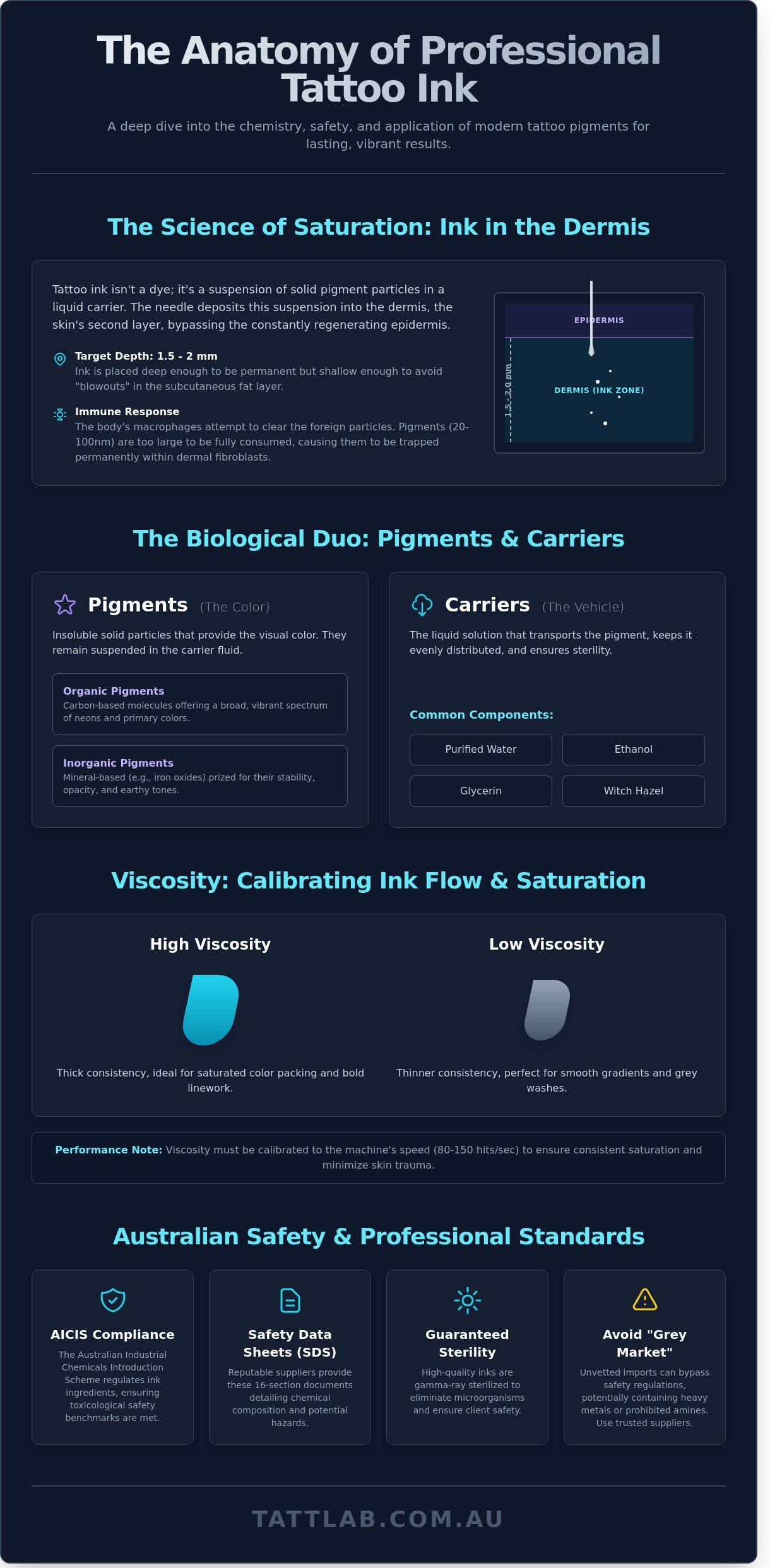
Professional tattoo ink isn't a simple dye that stains the skin. It's a specialized suspension of solid pigment particles held within a liquid carrier. While dyes are soluble and soak into a material, pigments are insoluble solids that remain suspended. This distinction is vital for longevity and safety. Since the late 19th century, the composition has evolved from basic soot and charcoal to sophisticated synthetic organic pigments. Understanding The Science of Tattoo Ink reveals how these modern formulations prioritize both vibrant saturation and biological compatibility.
The dermis acts as the permanent vault for these particles. When the needle penetrates the skin, it bypasses the epidermis to deposit ink approximately 1.5 to 2 millimetres deep. At this depth, the body’s immune system attempts to clear the foreign matter. Large pigment particles, often ranging from 20 to 100 nanometres in diameter, are too substantial for macrophages to consume entirely. This results in the pigment becoming trapped within the dermal fibroblasts. At Tatt Lab, we recognize that skin health is the primary variable in this equation. A healthy dermal matrix ensures the ink settles predictably, reducing the risk of excessive scarring or "blowouts" that occur when ink is placed too deep or in compromised tissue.
Pigments vs. Carriers: The Biological Duo
Pigments provide the visual impact, but they can't travel alone. The carrier acts as the delivery vehicle, keeping the pigment evenly distributed and preventing clumps. Common carriers include vegetable glycerine, ethanol, and purified water. Once injected, the carrier's job changes. Alcohol and water-based components begin to evaporate or be absorbed by the lymphatic system within the first 48 hours. This process initiates the healing phase, leaving the concentrated pigment behind to interface with the skin's cellular structure.
The "Lab" Perspective on Ink Viscosity
Viscosity dictates how an artist works. A high pigment load creates a thick ink, ideal for saturated packing of colour in traditional styles. Conversely, grey washes are diluted to a lower viscosity for smooth gradients. In the context of ink flow and needle capillary action, viscosity is the measure of the fluid's internal friction that determines how efficiently the pigment travels down the needle grouping and into the skin. If the viscosity isn't calibrated to the machine's speed, which often fluctuates between 80 and 150 hits per second, the result is inconsistent saturation or unnecessary skin trauma.
- Synthetic Pigments: Modern labs use organic pigments that offer a wider colour gamut than 20th-century mineral ores.
- Sterility: High-quality tattoo ink is gamma-ray sterilized to ensure the liquid is free from microorganisms.
- Stability: Carriers prevent the pigment from drying out in the cap during a 4-hour session.
Pigment Chemistry and Safety: What is Inside the Bottle?
Tattoo ink isn't a simple dye; it's a sophisticated suspension of solid pigment particles within a liquid carrier. In a professional Australian studio, this carrier typically consists of a blend of distilled water, ethyl alcohol, and witch hazel. These liquids act as the delivery vehicle, transporting the color into the dermis. To keep the mixture stable, manufacturers add humectants like glycerin, which prevents the ink from drying out during a five hour session, and surfactants that ensure the pigment spreads evenly across the needle grouping.
Pigments generally fall into two chemical categories: organic and inorganic. Inorganic pigments often utilize mineral origins, such as iron oxides for earthy reds and browns. These are prized for their stability and opaque finish. Organic pigments are carbon-based molecules that offer a much broader, more vibrant spectrum of neons and primary colors. While they provide incredible visual impact, their complex molecular structures require precise manufacturing to ensure they don't migrate or cause adverse reactions within the skin's immune system.
This level of precision relies on expertly calibrated weighing equipment to ensure every batch is consistent. While in a different sector, specialists like Independent Scale Service provide the foundational accuracy that Australian manufacturing standards depend on.
Safety is the foundation of every successful procedure. Every reputable supplier provides a Safety Data Sheet (SDS) for their products. These 16-section documents detail the chemical composition and potential hazards of the formula. Reviewing Tattoo Ink Safety protocols helps artists and clients identify common allergens like nickel or chromium before the first drop of tattoo ink touches the skin. This clinical approach to ingredient transparency is what separates professional results from high-risk amateur work.
Australian Safety Standards and Compliance
In Australia, the AICIS (Australian Industrial Chemicals Introduction Scheme) oversees the chemicals used in tattoo ink. This regulatory body ensures that substances introduced to the market meet specific toxicological benchmarks. Professional artists must avoid "grey market" imports from unvetted international sources. These unregulated products often bypass the A$1,200 plus registration and testing fees required for legal sale in Australia, potentially containing heavy metals or prohibited amines. Authentic supplies are produced in ISO-certified sterile environments with clear batch tracking to protect skin health.
The Role of Vegan and Cruelty-Free Formulations
Modern pigment chemistry has evolved to meet ethical demands without sacrificing performance. Historically, some black inks utilized bone char, while gelatin served as a binding agent. Today, synthetic alternatives and vegetable-based glycerin have replaced these animal derivatives. These vegan-friendly options often provide a more consistent molecular weight, leading to more predictable healing and long-term clarity. This shift toward synthetic precision allows the industry to maintain a "cool but clinical" standard that respects the body and the environment. If you're beginning a journey to clear your skin or change your look, the specialists at Tatt Lab can help you understand how your specific ink type might respond to the removal process.
The Specialist’s Palette: Comparing Leading Global Ink Brands
The selection of a professional tattoo ink is a decision that dictates the longevity of a piece and the biological health of the canvas. In the Australian market, three manufacturers dominate the landscape due to their predictable chemical behavior and pigment stability. At Tatt Lab, we vet every brand for clinical rigor before they enter our ecosystem. We understand that the way a pigment sits in the dermis today determines how effectively it can be fragmented by laser technology years from now. Brand consistency isn't a luxury; it's a requirement for professional portfolio growth and predictable skin outcomes.
Dynamic Color Co: The Industry Standard for Black
Dynamic Black remains the baseline for Australian artists who prioritize high-contrast lining and solid saturation. Its formula is recognized for a legendary heal-down that maintains a crisp, deep finish without the common blue-shift seen in lower-quality alternatives. The Triple Black variant offers an even higher pigment concentration, designed specifically for light-absorbing fills. This density is achieved through precise carbon suspension. It ensures the ink remains fluid during the session but stable once trapped within the skin's macrophage cells, preventing the "washed out" look that can occur with inconsistent pigment loads.
World Famous Tattoo Ink: Vibrant Innovation
World Famous has redefined high-saturation color realism through its "limitless" palette. They achieve vibrancy by utilizing high-quality pigments that meet stringent global safety protocols, including the European ResAP(2008)1 standards. This brand is the preferred choice for artists requiring a massive range of pre-mixed gradients. However, transparency in manufacturing is vital for safety. A study on Tattoo Ink Composition by Binghamton University recently highlighted that 90% of inks tested contained ingredients not listed on the label. World Famous counters this industry-wide issue by providing detailed Material Safety Data Sheets (MSDS), a level of transparency that Tatt Lab values for long-term skin health.
Panthera and Specialty Black Inks
Panthera represents the technical edge of Italian manufacturing, focusing on molecular technology to reduce skin irritation. Unlike DIY dilutions that can introduce contaminants or inconsistent ratios, Panthera’s pre-mixed greywash sets provide a sterile, consistent gradient every time. When selecting a tattoo ink for shading, artists must choose between "Cool" blacks, which have a blue undertone, and "Warm" blacks, which lean toward brown. This choice affects the visual temperature of the work as it ages. Panthera’s gamma-sterilized formulas are specifically engineered to minimize the inflammatory response, supporting a smoother healing journey and preserving the clarity of the artist's original vision.
A Buying Guide for Every Style: Selecting Your Ink
Choosing the right tattoo ink is a clinical decision that dictates the long-term health of the skin and the clarity of the artwork. The pigment load, which refers to the concentration of dry pigment suspended in the carrier liquid, must match your specific machine speed and hand movement. High-load pigments offer exceptional saturation but require a disciplined hand to avoid over-working the tissue. For those early in their career, pre-dispersed pigments are the gold standard. These are blended in controlled laboratory environments to ensure a uniform consistency; this prevents the common issue of "settling" where the pigment separates from the carrier, leading to inconsistent shading.
Building a functional inventory doesn't require hundreds of bottles. A professional starter palette of 12 essential colours covers 90% of standard client requests. This kit should include a dedicated lining black, a high-pigment tribal black for filling, and a primary spectrum of stabilized organics. Proper maintenance is non-negotiable for skin safety. Store your collection in a cool, dark environment between 18 and 24 degrees Celsius. Exposure to direct Australian sunlight for as little as 4 hours can begin to degrade the molecular bonds of certain synthetic pigments, compromising the ink's sterility and shelf life.
Inks for Traditional and Neo-Traditional Styles
Traditional work relies on high-opacity primary colours that can withstand decades of UV exposure. The search for a "true red" is a common challenge; many formulations use Pigment Red 170, which provides deep saturation but requires careful application to avoid inflammatory responses. Bold traditional lining requires a specific pigment-to-carrier ratio that is viscous enough to stay put. This prevents the ink from migrating in the dermis, ensuring those 14-round liner marks remain crisp for 20 years or more.
Inks for Realism and Fine Line Work
Realism demands a sophisticated approach to value. While some artists mix their own, a 6-stage greywash set is the most reliable way to achieve 15% incremental shifts in tone. This precision allows for the "ghost washes" necessary for realistic skin textures. When applying white highlights, the ink must be deposited at a precise depth of 1.5mm to 2mm. If placed too shallow, the pigment sheds during the 28-day skin regeneration cycle; if too deep, it risks "blooming," where the delicate lines blur into the surrounding tissue.
Understanding the science of pigment is the first step toward responsible skin art. If you are reconsidering a previous choice, explore how we approach professional ink removal with clinical precision.
Elevating Your Craft with Tatt Lab’s Curated Collection
Choosing a supplier is a strategic decision for your business. Tatt Lab functions as more than a vendor; we act as your technical partner in the studio environment. Every bottle of tattoo ink in our inventory is 100% authentic and vetted by senior artists who understand the biological interaction between pigment and the lymphatic system. We maintain a "cold-chain" approach to storage, keeping our stock in climate-controlled environments to prevent the chemical separation or degradation often caused by Australia's fluctuating temperatures. This protocol ensures that the viscosity and sterility of the pigment remain uncompromised from the moment it leaves the manufacturer until it reaches your machine.
For established studios, we provide wholesale support that goes beyond a simple transaction. Our bulk supply options are designed to protect your overheads while ensuring you never have to settle for inferior alternatives. We focus on clinical precision to ensure your work remains a testament to your skill for decades. Our team provides detailed safety data sheets (SDS) and technical specifications for every product line, giving you the transparency needed to answer client questions with absolute confidence.
The Journey from Purchase to Portfolio
Efficiency drives your studio's reputation. We utilize fast nationwide shipping across Australia to ensure your workstation remains stocked, minimizing the risk of rescheduling due to inventory gaps. A tattoo's evolution depends on the synergy between high-grade tattoo ink and medical-standard aftercare. Tatt Lab provides both, ensuring the skin heals with minimal trauma. When you join the Lab, you join a network of professionals committed to high safety standards. This community shares insights on pigment performance and skin health, helping you stay ahead of industry regulations and technical trends.
Your Next Step in Professional Excellence
Browse our curated collection to find the specific formulations your style demands. Local Melbourne professionals can access our "Click & Collect" option for immediate replenishment, bypassing standard transit times. We prioritize skin integrity to deliver results that look as sharp in five years as they do on day one. Our commitment to professional excellence means we only stock brands that meet our rigorous "Lab-vetted" criteria. Secure your supplies today and elevate the standard of your professional output with products designed for the modern, safety-conscious artist.
Mastering the Science of Your Craft
Selecting the right tattoo ink is a decision that balances technical chemistry with artistic vision. You've explored how pigment stability impacts long-term saturation and why safety-tested formulations are non-negotiable for skin integrity. Professional results depend on this precision. Tatt Lab is an artist-owned and operated specialist; we provide only 100% authentic global brands to the Australian market. We understand that your reputation relies on the quality of the pigments you deposit. Every bottle in our collection meets rigorous standards to ensure your work ages with clarity. With Australia-wide express shipping, you can access world-class supplies without the wait. It's time to refine your palette with products that respect both the artist's hand and the client's health. Your journey toward superior technical execution starts with a foundation of quality. We're here to support your evolution as an artist with tools that prioritize safety and aesthetic excellence.
Explore the Lab-Vetted Tattoo Ink Collection
Frequently Asked Questions
Is tattoo ink regulated in Australia?
Tattoo ink is regulated in Australia as an industrial chemical under the Australian Industrial Chemicals Introduction Scheme (AICIS). This framework ensures that all ingredients imported or manufactured for use in tattoo ink meet specific safety standards before they enter the skin. While the AICIS monitors chemical safety, individual state health departments govern the hygienic application of these pigments. Practitioners must ensure their supplies comply with the Industrial Chemicals Act 2019 to maintain skin integrity.
What is the difference between organic and inorganic tattoo ink?
The primary difference lies in their chemical origin; organic inks are carbon-based while inorganic inks use mineral or metallic salts like iron oxide. Organic pigments often provide a wider spectrum of 50 or more vibrant shades, but they generally have smaller particle sizes that may fade faster. Inorganic inks offer superior stability and are less likely to migrate. At Tatt Lab, we observe that inorganic pigments often respond more predictably to laser fragmentation during the removal process.
Can tattoo ink cause an allergic reaction?
Yes, tattoo ink can trigger allergic reactions, with red pigments accounting for approximately 80% of all reported adverse skin responses. These reactions often manifest as contact dermatitis or granulomas because the immune system identifies specific metal salts or azo dyes as foreign invaders. If you experience persistent itching or swelling after 48 hours, consult a specialist. Understanding your ink's chemical profile is a vital step in your skin health journey.
How long does tattoo ink stay fresh once opened?
Most professional tattoo ink remains viable for 12 months once the seal is broken, provided it's stored correctly. Manufacturers include a "Period After Opening" symbol on the bottle to guide this timeline. Using ink beyond this 365 day window increases the risk of bacterial contamination or pigment evaporation. Always record the date of opening on the bottle label to ensure you're working with sterile, high-quality materials that won't compromise the healing process.
Why does some black tattoo ink turn blue or green over time?
Black tattoo ink often shifts toward blue or green hues due to the way light scatters through the skin, a phenomenon known as the Tyndall effect. Over a period of 10 to 15 years, the body's lymphatic system naturally carries away smaller pigment particles, leaving behind the base undertones of the original formula. High-quality black inks formulated with stable carbon bases resist this evolution better than cheaper alternatives containing lower-grade soot or unstable dyes.
Is vegan tattoo ink as good as traditional ink?
Vegan tattoo ink performs with the same technical precision as traditional formulas but replaces animal-derived ingredients like bone char or glycerin with plant-based alternatives. These modern pigments offer 100% ethical compliance without sacrificing color saturation or longevity. Many leading Australian studios now exclusively use vegan options to minimize the risk of shellac-based reactions. This shift represents a positive evolution in the industry, prioritizing both ethical standards and predictable aesthetic outcomes.
What is the best tattoo ink for beginners?
Beginners should start with pre-dispersed inks from established brands like Eternal or Fusion, which offer a consistent pigment-to-carrier ratio. These formulas don't require manual mixing, reducing the risk of uneven saturation or contamination in the studio. Choosing a starter set of 12 primary colors in 30ml bottles allows for controlled experimentation. This methodical approach ensures the apprentice learns how different pigments interact with the skin's biological layers under safe, predictable conditions.
How should I store my tattoo ink to prevent drying or contamination?
You should store your tattoo ink in a cool, dark environment maintained between 15°C and 25°C to prevent pigment separation or drying. Direct sunlight can degrade the chemical bonds of the pigment within 30 days of exposure, leading to inconsistent results. Ensure all caps are tightened immediately after use to block airborne contaminants. Maintaining a sterile storage lab is a fundamental part of protecting the skin integrity of every client you treat.


Comments (0)
There are no comments for this article. Be the first one to leave a message!