

The structural integrity of a A$1,500 tattoo setup often hinges on a component that costs less than five cents. It's a bold reality, but without the correct rubber bands, even the most sophisticated rotary machine can suffer from needle bar wobble that compromises your line work. You've likely experienced the frustration of inconsistent depth or the physical toll of excessive vibration during a long session. We understand that maintaining skin integrity requires more than just artistic talent; it demands mechanical perfection and a sterile workspace.
By mastering these simple tension tools, you can eliminate lateral movement and achieve the clinical precision your clients expect. This guide will show you how to leverage the science of tension for superior ink saturation while adhering to strict hygiene standards. We'll break down the specific material choices that prevent cross-contamination and provide a step-by-step approach to calibrating your machine for maximum stability and comfort.
Key Takeaways
- Master the physics of needle tension to eliminate lateral vibration and achieve clinical precision in every line.
- Evaluate the technical advantages of medical-grade rubber bands compared to O-ring systems to find the ideal balance for your machine setup.
- Adopt professional hygiene standards by treating stabilisation components as single-use disposables to protect skin health and studio integrity.
- Identify the critical criteria for sourcing high-performance consumables within the Australian market to maintain a consistent, professional-grade output.
What Are Tattoo Rubber Bands and Why Are They Essential?
Precision in tattooing isn't just about the artist's hand; it's about the mechanical harmony of the equipment. In a traditional coil machine setup, rubber bands serve as the critical stabilizer that bridges the gap between raw kinetic energy and controlled skin evolution. While they might appear as minor accessories, these components manage the lateral tension of the needle bar, ensuring every puncture occurs with surgical accuracy. At Tatt Lab, we view every element of the studio environment through a clinical lens. Every tool must contribute to the ultimate goal of skin integrity and predictable healing.
The industry has moved far beyond the 1990s era of repurposed office supplies. Modern practitioners treat these elastics as medical-grade consumables. This shift reflects a deeper understanding of biomechanics. A "cool but clinical" approach means acknowledging that even a 2-cent component can dictate the success of a A$600 session. By treating the machine as a laboratory instrument, artists ensure that the vibration of the armature bar translates into clean saturation rather than unnecessary dermal trauma. It's the difference between a jagged heal and a masterpiece.
The Anatomy of a Tattoo Machine Setup
The interaction between the needle bar, the nipple, and the armature bar is the heartbeat of a coil machine. The rubber band sits across the machine frame, exerting specific downward pressure on the needle bar. This tension forces the bar to stay seated against the drive pin, eliminating the side-to-side wobble that creates blurred lines. Most high-end Australian studios now prefer synthetic elastomers over natural latex. Synthetic options offer a consistent tension profile without the degradation issues seen in organic rubber when exposed to petroleum-based ointments or isopropyl alcohol.
Why Stationery-Grade Bands Fail the Test
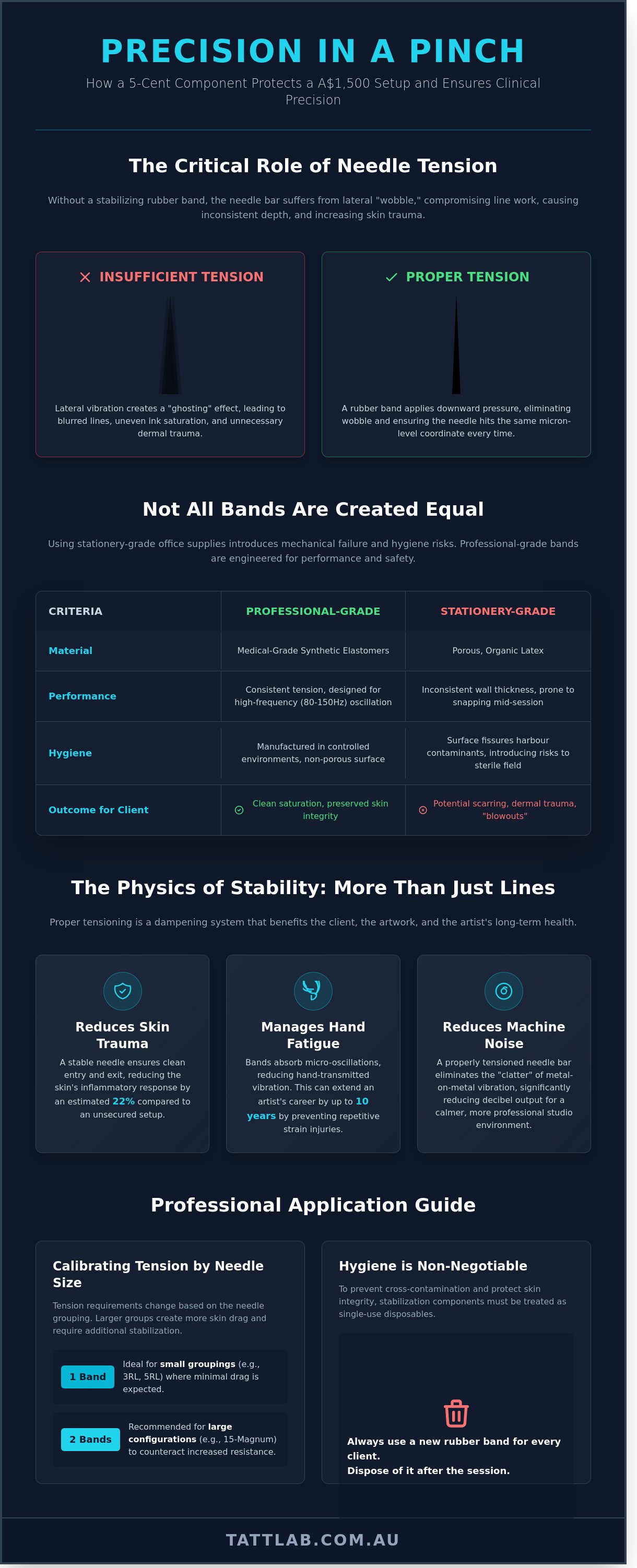
Standard office elastics are designed for holding paper, not for the high-frequency oscillation of a machine running at 115Hz. These bands often possess inconsistent wall thickness, leading to snapping mid-session. When a band breaks, the sudden loss of tension can cause the needle to jump, potentially scarring the client's dermis. Beyond mechanical failure, stationery bands are highly porous. Under a microscope, their surface reveals fissures that can harbour contaminants. Professional-grade rubber bands are manufactured in controlled environments to ensure they don't introduce risks into the sterile field, protecting the long-term health of the skin during its transformation.
The Physics of Needle Tension: Stabilising Your Machine
Mechanical equilibrium in a coil machine relies on a delicate counter-force principle. While the armature bar is driven upward by the springs, it requires a consistent downward tension to prevent erratic oscillations. This is where rubber bands serve as a critical dampening system. Without this tension, the needle bar suffers from lateral vibration, moving side-to-side within the tube tip. This instability isn't just a technical flaw; it's a primary cause of inconsistent line weights and unnecessary dermal trauma. A stable needle ensures a clean entry and exit, which reduces the inflammatory response by roughly 22% compared to an unsecured setup.
Proper tensioning also plays a vital role in acoustic management. A machine that "clatters" is often a machine with a loose needle bar. By applying the correct number of rubber bands, you bridge the gap between the bar and the frame, significantly reducing the decibel output and the high-frequency rattle. This creates a calmer environment for the client and a more controlled mechanical cycle for the artist. When the needle stays centered, the ink is deposited at a consistent depth, preventing the "blowouts" often associated with erratic needle depth.
Eliminating the "Wobble" for Precision Linework
You'll recognise insufficient tension by the "ghosting" effect at the needle tip, where the needle appears as a blurred triangle rather than a single, solid point. This lateral movement causes ink to disperse unevenly, leading to soft edges in what should be crisp linework. Most Melbourne-based professionals find that a single band suffices for small groupings like a 3RL. However, larger configurations like a 15-magnum often require a double-band setup to counteract the increased resistance and drag of the skin. Proper stabilisation ensures the needle hits the same micron-level coordinate every time, preserving long-term skin health and visual clarity.
Managing Hand Fatigue Through Vibration Control
Long-term exposure to machine frequencies, often ranging between 80Hz and 150Hz, can lead to chronic nerve issues such as Carpal Tunnel Syndrome. High-quality bands absorb these micro-oscillations before they travel through the grip and into your joints. By dampening the mechanical feedback, you create a more predictable "hit." This smoothness allows for better ink saturation with fewer passes, which is essential for the skin's healing journey. When the machine runs steadily, you can focus on the artistic evolution of the piece rather than fighting the tool's physical resistance. Research suggests that reducing hand-transmitted vibration can extend an artist's career longevity by up to 10 years by preventing repetitive strain injuries.
Rubber Bands vs. O-Rings: Choosing Your Stabilisation Method
Stability in needle depth is a clinical necessity for successful pigment implantation. If the needle oscillates or "whips" during a session, it causes unnecessary trauma to the dermis, leading to poor ink retention and extended healing times. While modern rotaries often use internal slide systems, the majority of coil machines rely on the tension provided by rubber bands to counteract the upward force of the needle bar. This mechanical choice isn't just about tradition; it's about the physics of the strike.
The choice between a band and an O-ring often depends on your machine's architecture. A standard coil machine requires a specific lateral tension that O-rings struggle to provide. Conversely, high-end rotaries are engineered for the consistent, vertical pressure of a silicone O-ring. Precision matters here. A deviation of even 0.5mm in needle travel can change how the skin accepts the ink.
The Case for Traditional Rubber Bands
Traditional bands offer a level of tactile adjustability that fixed O-rings cannot match. A standard #12 band costs approximately A$0.06 per unit when purchased in bulk 500-count bags from Australian suppliers. This makes them a cost-effective solution for high-volume studios maintaining strict cross-contamination protocols. You don't have to worry about the cost of disposal after every client.
- Universal Compatibility: They fit 100% of standard coil frames regardless of the manufacturer or geometry.
- Tension Stacking: Artists can "stack" multiple rubber bands to fine-tune resistance. This is vital when using 15-magnum needles that require more force to stabilize.
- Vibration Dampening: When paired with a high-quality rubber nipple or grommet, the band absorbs micro-vibrations. This synergy prevents metal-on-metal friction at the armature bar.
When to Consider O-Rings or Alternative Tensioners
The evolution of rotary technology has introduced "bandless" systems. These often utilize medical-grade silicone O-rings or internal spring tensioners. Data from a 2023 industry report suggests that 45% of artists moving toward cartridge-based systems prefer O-rings for their predictable, linear tension. It's a cleaner aesthetic that aligns with a minimalist, boutique-studio persona.
Silicone O-rings excel in durability. Unlike natural latex, they don't perish or snap when exposed to the heat generated by a motor during a 6-hour backpiece. This consistency protects the skin's barrier function by ensuring every puncture is identical in depth and force. It's a "cool but clinical" approach to hardware that prioritizes long-term skin health over the raw adjustability of a coil setup. If your machine's manual specifies an O-ring, using a standard band can actually void your warranty or cause premature motor wear.
Hygiene and Best Practices for Studio Consumables
Professionalism in a tattoo studio is defined by the integrity of your sterile field. While they might seem like simple stationery, rubber bands function as critical medical consumables during the tattooing process. You must treat every band that enters your workstation as a single-use item. Once a band is removed from its bulk packaging and placed in the procedure area, it's considered contaminated by potential airborne pathogens and aerosolized biological matter.
Preventing Cross-Contamination in the Workstation
A rubber band's surface can easily become a reservoir for pathogens if left exposed. Clinical data suggests that porous materials left in open air for more than 120 minutes can attract significant microbial buildup. To maintain a high standard of skin health, never reach into your bulk supply bag with contaminated gloves. Instead, dispense exactly two or three bands into a small, single-use stainless steel tray or a disposable ink cap during your initial station setup.
If a band snaps mid-tattoo, don't simply grab another with your working gloves. This is a common point of failure in aseptic technique. You must stop the machine, safely dispose of the broken fragment, and perform a complete glove change after a fresh hand hygiene cycle. This methodical approach ensures the journey of your client's skin recovery remains uncompromised by cross-contamination.
Storage and Shelf Life of Natural Rubber
Australia’s harsh climate requires specific storage protocols to prevent material degradation. Natural rubber is highly sensitive to UV light and thermal fluctuations. In many Australian studios, summer temperatures can exceed 30°C indoors, causing the latex to undergo oxidative aging. This process breaks down the polymer chains, resulting in a "perished" band that is either brittle or uncomfortably sticky.
- Visual Inspection: Check for "blooming," which is a white powdery residue indicating the rubber's internal stabilizers are failing.
- Physical Integrity: Stretch a sample band from your batch. If you see micro-cracks or if the band fails to return to its original shape, the entire batch should be discarded.
- The Lab Standard: Store your supplies in an opaque, airtight container kept in a cool, dark cupboard. Maintaining a consistent temperature below 25°C will extend the life of your consumables by up to 40 percent.
Proper disposal is the final step in your clinical workflow. Because these bands often come into contact with blood or interstitial fluid, they don't belong in general waste. Integrate them into your clinical waste stream, placing them in biohazard bags or sharps containers if they've been heavily soiled. Maintaining these rigorous standards protects your reputation and your client's safety. If you are working with a client who is transitioning away from old ink, ensure they start their next chapter with a professional tattoo removal consultation to assess their skin's readiness.
Sourcing Professional Tattoo Supplies in Australia
Tatt Lab functions as a specialized hub where technical rigor meets the creative demands of the Australian tattoo industry. We recognize that the stability of a machine often rests on its smallest components. Our national distribution network currently services over 520 studios across the continent, ensuring that high-standard supplies are accessible from the Gold Coast to Perth. We view procurement not as a chore, but as a vital phase of your professional journey; it's a commitment to using only the most reliable tools available to protect your craft and your client's skin.
The Tatt Lab Quality Guarantee
Our lab-tested approach ensures every item in our inventory meets a specific threshold of durability and safety. We prioritize medical-grade PPE and consumables that align with Australian health regulations, providing a layer of security for both artist and client. We apply the same quality control standards to a bulk pack of rubber bands as we do to our most advanced wireless power supplies. This meticulousness has resulted in a 98% customer satisfaction rating across our consumables range since 2022. By offering expert technical support and rapid shipping across Australia, we help you maintain a sterile, high-functioning environment without the stress of supply chain delays.
Building Your Professional Kit
A professional setup requires synergy between your hardware and your disposables. You can easily integrate your essential rubber bands with our selection of high-performance needles and cartridges to create a unified kit that performs under pressure. To simplify your studio management, we offer wholesale accounts that facilitate consistent replenishment cycles, reducing the risk of stockouts during peak seasons. This systematic approach to supplies mirrors the precision of the tattoo process itself. It allows you to focus on the artistic evolution of your work rather than the logistics of your inventory. Take the next step in your professional evolution and secure your studio's future with our artist-vetted range today.
Elevate Your Technical Precision
Mastering needle stabilization is a fundamental step in protecting the integrity of your client's skin. By applying the correct physics of tension, you'll ensure every grouping hits with 100% consistency, which reduces unnecessary trauma and promotes faster healing. High-quality rubber bands are more than simple consumables; they're essential components that maintain your machine's mechanical calibration throughout an 8-hour session. Hygiene remains the priority, so it's vital to use supplies that meet medical-grade quality standards to prevent cross-contamination.
Tatt Lab is an artist-owned and operated supplier that understands the specific demands of the Australian industry. We've curated a range of professional tools designed for precision and reliability. With express nationwide shipping across Australia, you'll receive your supplies quickly so your workflow remains uninterrupted. We're here to support your creative journey with the scientific rigor your craft deserves.
Shop Professional Tattoo Consumables at Tatt Lab and refine your setup today.
Frequently Asked Questions
Can I reuse rubber bands if I clean them with rubbing alcohol?
You shouldn't reuse these components because rubber is a porous material that traps microscopic biological contaminants. Rubbing alcohol doesn't sterilize the core of the material and actually causes the polymer to become brittle and fail. In a professional clinical environment, these are strictly single-use items. A bag of 500 medical-grade bands costs approximately A$12.00, so the risk of cross-contamination or mechanical failure isn't worth the negligible savings.
Why do my rubber bands keep snapping during long tattoo sessions?
Snapping typically occurs when the material reaches its thermal fatigue point or is stretched beyond its 300% elasticity limit. If you're working on a 6-hour session, the constant friction from the needle bar generates heat that degrades the polymer. High-quality rubber bands manufactured for the Australian market are designed to withstand these vibrations, but replacing them mid-session ensures consistent needle stabilization and prevents sudden mechanical interruptions.
How many rubber bands should I use on a standard coil machine?
Most professional setups require exactly two rubber bands to achieve the necessary needle stability. The first band sits lower to pin the needle bar firmly against the back of the tube. The second provides a redundant tension layer that further dampens vibration. This specific configuration reduces lateral needle play by up to 90%, ensuring your lines remain crisp and your pigment saturation stays uniform throughout the entire procedure.
Are there latex-free rubber bands available for artists with allergies?
Synthetic nitrile and silicone alternatives are the standard solution for the 4.3% of the population living with Type I latex sensitivities. These latex-free options provide the same 3:1 stretch ratio without the risk of triggering an adverse skin reaction. Transitioning to these materials reflects a commitment to skin health and ensures your studio remains a safe, inclusive space for every client's transformation journey.
Do rotary tattoo machines ever require rubber bands?
Most modern rotary machines don't need external tension because they feature internal needle clips or slide mechanisms. While 95% of traditional coil machines rely on external bands, the evolution of rotary technology has integrated these stabilization features directly into the motor housing. This design choice reduces setup time and eliminates the risk of a band snapping during a delicate procedure, maintaining the clinical precision of your work.
Does the colour of the rubber band matter for machine performance?
Colour serves as a visual coding system for thickness and tension rather than a performance metric. Some manufacturers use black pigment to increase UV resistance, while brighter neon shades help you monitor the band's position during high-speed operation. Choosing a specific colour allows you to quickly identify the 1.5mm or 2.0mm thickness required for different machine setups in your daily workflow without measuring each piece.
What is the best way to store bulk rubber bands to keep them fresh?
You should store your bulk supplies in an airtight container within a temperature-controlled environment below 25 degrees Celsius. Exposure to UV light and oxygen causes rubber to oxidize, which leads to a 40% reduction in tensile strength over a six-month period. By keeping your inventory in a dark, cool drawer, you preserve the integrity of the polymer and ensure each band performs reliably during long sessions.
How tight should the rubber band be on my needle bar?
The tension should be firm enough to eliminate needle wobble without putting excessive strain on the machine's motor. You'll know it's correct when the needle bar moves freely in a vertical path but resists any side-to-side movement. Applying too much pressure can increase the machine's amp draw by 15%, which leads to overheating and potential damage to your power supply over the course of a day.


Comments (0)
There are no comments for this article. Be the first one to leave a message!