

Could the most useful addition to your PMU setup be a measuring tool rather than another disposable? Choosing medical supplies for tattoo artists by the task each item supports makes it easier to decide what belongs at your workstation and what does not.
For brow work, mapping strings, calipers and ruler stickers can support different approaches to planning and checking symmetry. For lip preparation and pigment handling, predraw pencils, brushes, pigment cups and cotton swabs serve different purposes. No single accessory is essential for every artist, and a convenient tool is not automatically an infection-control measure.
This guide compares PMU accessories by task, format and handling. You’ll learn how to choose measuring tools for your mapping process, compare disposable and reusable options, and build a focused selection without confusing workflow aids with hygiene supplies. The goal is a practical setup shaped around the procedures you perform.
Key Takeaways
- Choose medical supplies for tattoo artists by the task they support, from brow mapping to pigment handling, rather than buying every accessory category.
- Match accessories to your PMU procedures and workstation routine, considering how each tool is used and handled.
- Compare disposable, reusable and task-specific formats by their intended role, not convenience alone.
- Check that a tool fits your technique and other equipment, such as choosing a sharpener suited to your eyebrow pencil format.
- Consider brow-mapping options such as Black and White Mapping String, Pink and Black Eyebrow Vernier Calipers and Eyebrow Ruler Stickers, while keeping accessories separate from infection-control supplies.
Medical Supplies for Tattoo Artists: Which PMU Accessories Support Your Workflow?
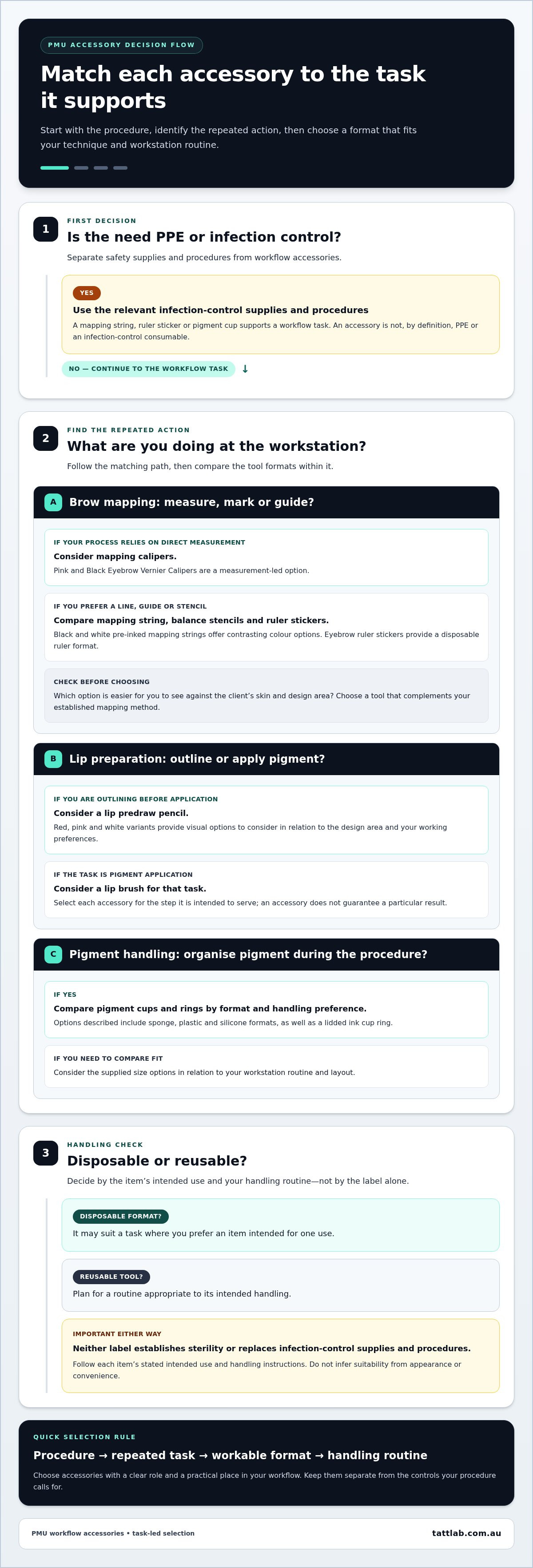
PMU accessories support tasks such as preparation, measurement, pigment handling and studio organisation. They are not, by definition, personal protective equipment (PPE) or infection-control consumables. Their value is practical: a well-chosen tool can make a repeated step easier to manage consistently. Start with the procedure, identify the steps you repeat, then compare formats that fit your technique and workstation.
This distinction matters. An accessory used in a studio is not necessarily sterile, single-use or medically classified. Follow each item’s stated intended use and handling instructions, and keep workflow tools separate from the PPE and other supplies required by your infection-control procedures. Accessories support your workflow; they do not replace those measures. For a broader overview, see this professional studio safety guide.
Which PMU tasks do accessories help with?
For brow design, mapping strings can help create guide lines, calipers support measurement and comparison, and ruler stickers offer another mapping format. Choose based on how you plan the design and check symmetry. If you already have a mapping method that works for you, select tools that complement it rather than adding products without a clear task.
Lip predraw pencils support outlining before permanent makeup application. Pigment cups and rings help organise pigment during a procedure. When comparing formats such as sponge, plastic, silicone or lidded options, consider how the item fits your handling preferences and workstation layout. A tool is more useful when its role is clear and it has a practical place in your routine.
Are PMU accessories the same as medical supplies?
The phrase medical supplies for tattoo artists can describe a broad range of items used in a professional studio, but that does not make every studio tool a safety product. A mapping string, ruler sticker or pigment cup supports a workflow task. PPE and infection-control supplies serve different purposes and must be managed through the relevant procedures for your practice.
Do not infer sterility or suitability for a particular use from an item’s appearance or convenience. Follow the stated intended use and your established handling routine, and maintain the separate controls your procedure calls for. For context on tattooing, health risks and risk reduction, read about Modern tattooing safety standards. Clear roles at the workstation help keep preparation tools useful without confusing them with infection-control essentials.
How to Choose PMU Accessories for Brows, Lips and Pigment Handling
The right accessory depends on the task it needs to support. Start with the procedure, narrow the need to a repeated action, then compare tool formats and handling requirements. Use this sequence to keep your medical supplies for tattoo artists focused on your actual workflow:
- 1. Identify the procedure. Separate brow mapping, lip outlining and pigment handling needs instead of treating them as one general setup.
- 2. Pinpoint the recurring task. Decide whether you need to measure, mark, outline or organise pigment.
- 3. Choose a workable format. Compare the tool’s construction and visual options with your established technique.
- 4. Plan how you will handle it. Consider where it fits into your workstation routine and follow its intended use and handling instructions.
What should brow artists compare in mapping tools?
Start with visibility. Black and white pre-inked mapping strings offer contrasting colour options. Consider which is easier for you to see against the client’s skin and the design area. This is a visual preference, not evidence that one colour performs better.
Next, compare how each tool fits your mapping method. Calipers support a measurement-led approach. Balance stencils provide a stencil-based option, while ruler stickers offer a disposable ruler format. If your process relies on direct measurement, calipers may fit naturally; if you prefer a guide or stencil, compare those formats instead. Choose a tool that complements your established process rather than changing your method to suit an accessory.
How do you select tools for lip and pigment work?
For lip preparation, predraw pencils support outlining before application. Red, pink and white variants give you visual options to consider in relation to the design area and your working preferences. Lip brushes can support pigment application tasks. Select each tool for the step it is intended to serve, without assuming that an accessory guarantees a particular result.
Pigment cup rings vary in construction and format. Compare sponge, plastic and silicone options by material and handling preference. Supplied size options may help you choose a fit for your workstation routine, while a lidded ink cup ring is another format to consider for organisation. For background on pigment-related safety information in the United States, consult the FDA guidance on tattoo and PMU inks; it is not Australian regulatory guidance.
To compare task-specific formats in one place, browse the PMU accessories collection. Compare the stated product details against the procedures and routine you have in mind.
PMU Accessory Comparisons: Disposable, Reusable and Task-Specific Tools
Compare accessories by the job they perform and the handling routine they require. A disposable format may suit a task where you prefer an item intended for one use. A reusable tool belongs in a routine appropriate to its intended handling. Neither label, by itself, establishes sterility or replaces infection-control supplies and procedures.
| Task | Accessory type | Format | Practical selection question |
|---|---|---|---|
| Separate lashes or assist with grooming | Eyelash brush | Disposable | Does this format suit the task and your handling routine? |
| Apply cleaning solutions or other appropriate products precisely | Cotton swab | Swab | Does its intended use fit the product and area? |
| Hold client hair back during a procedure | Hair net | Hair restraint | Does it keep hair clear of your working area? |
| Support brow measurement | Ruler sticker | Disposable measurement aid | Does this format fit your mapping method? |
| Support brow balance and design | Balance caliper stencil | Reusable tool | Does a reusable aid suit your established workflow? |
When are disposable accessories useful in a PMU workflow?
Disposable eyelash brushes can support lash separation and grooming-related tasks. Hair nets help hold client hair back, while cotton swabs can support precise application of cleaning solutions or other appropriate products. Ruler stickers provide a disposable option for measurement. Choose each item for its intended task, then follow its product information and your established handling procedure.
Balance caliper stencils offer a reusable alternative to disposable measurement aids. The practical difference is the format and how it fits your mapping routine, not an assumed durability advantage. A tool’s presence in a studio does not prove that it is sterile, single-use or suitable for every procedure. Base product claims on current product information.
How do you compare pigment cup ring formats?
Pigment cup rings are available in sponge, plastic, silicone and lidded formats. Compare the stated construction and consider how each fits your pigment-handling routine and workstation organisation. Use product descriptions for any supplied size or pack-quantity details. Do not infer these details from the format alone.
Keep practical descriptions separate from claims about hygiene or contamination prevention. For context, the OSHA Bloodborne Pathogens Standard is US guidance, not Australian regulatory advice. Australian practitioners should follow the requirements and procedures applicable to their setting. A considered selection of medical supplies for tattoo artists keeps workflow accessories in their proper role alongside, not in place of, appropriate safety measures.
Common PMU Accessory Buying Mistakes and a Practical Selection Checklist
A crowded workstation does not automatically make a procedure better supported. A common mistake is buying from every accessory category before identifying the procedures you perform and the tasks you repeat. Start with a specific need, such as brow mapping or lip outlining, then select a tool that serves it.
Fit matters, too. A sharpener designed for a standard round pencil may not suit a flat eyebrow pencil. Check the pencil’s shape against the sharpener format before choosing. A mismatch can make an otherwise useful accessory awkward to use.
Which product details should artists check before choosing?
Read the product description for the details it states. Compare listed colours, variants, dimensions and pack quantities with your intended task and workstation setup. If small, medium and large options are offered, choose from the listed sizes based on how you plan to use the tool. Do not infer performance, compatibility or other features that are not described.
Apply the same care to safety claims. An accessory description is not, by itself, proof of sterility, regulatory compliance or suitability for every procedure. Treat workflow tools as accessories, and manage PPE and infection-control supplies through the appropriate procedures for your studio.
How should accessories fit into studio safety procedures?
Accessories can support preparation, measurement and organisation, but they are not a safety system on their own. For Australian practice, use current national and relevant state or territory guidance for your setting. A broader overview of supply considerations is available in this tattoo supplies quality and safety guide.
Before adding an item to your setup, use this checklist:
- Procedure: Which service will use the accessory?
- Task: What specific step will it support?
- Format: Does the tool suit your technique and other equipment?
- Size or variant: Do the stated options fit your intended use?
- Storage: Where will it sit between tasks and procedures?
- Handling routine: How will you handle it according to its intended use and your studio procedures?
A focused checklist keeps medical supplies for tattoo artists aligned with actual workflow needs rather than assumptions based on a product category. Browse PMU accessories for your studio tasks and compare the listed options against your checklist.
PMU Accessories at Tatt Lab: Standout Tools by Studio Task
A useful PMU setup is built around the steps you perform, not a checklist of products every artist must own. These examples from Tatt Lab’s accessory range support brow mapping, lip preparation, pigment handling and workstation organisation. Choose according to your routine, and use each accessory for its intended task.
Which accessories support brow mapping and lip preparation?
For brow design, Black Mapping String and White Mapping String are pre-inked options for creating mapping guides. Choose a colour based on which stands out against the client’s skin and the area you are mapping. Pink and Black Eyebrow Vernier Calipers support measuring eyebrow dimensions, while Eyebrow Ruler Stickers offer another measurement format. These tools support different mapping approaches, so focus on the method you already use.
Lips Predraw Pencils support outlining and designing lip shapes before application. They are a preparation tool for planning the outline as part of your established procedure. As with brow accessories, choose one that fits the task and your handling preferences rather than assuming a particular tool will create a specific result.
Which accessories support pigment handling and workstation organisation?
Pigment cup rings come in different stated formats: sponge, plastic, silicone and lidded options. Compare them by construction and how you prefer to arrange pigment at your workstation. A sponge format differs from plastic or silicone, while a lidded ring is another option to consider for organisation. Choose based on the item’s stated features and the needs of your routine. Do not treat a format as proof of sterility or contamination prevention.
PMU Cotton Swabs provide a small, task-specific option for precise application of appropriate products. A stainless steel surgical kidney dish can hold pigments, tools and supplies, helping keep selected items together at the workstation. These accessories support preparation and organisation, but remain distinct from the supplies and procedures used for infection control.
Think of these options as a focused toolkit. An artist who regularly maps brows may prioritise string, calipers or ruler stickers. Lip-focused preparation may call for predraw pencils, while pigment handling may make cup formats more relevant. You do not need every category to create a considered setup. Match each choice to a real step in your workflow, then compare the stated product details before selecting.
Browse Tatt Lab’s PMU accessories to compare options for your studio tasks and choose tools that fit your routine.
Build a PMU Setup That Fits Your Practice
Choosing medical supplies for tattoo artists starts with a clear view of your procedures and the tasks you repeat. Select accessories for their role, whether that is brow mapping, lip preparation, pigment handling or workstation organisation. Check the format and stated product details against your routine rather than buying every category by default.
Keep the distinction between workflow tools and safety essentials clear. Accessories can support a considered setup, but they do not establish sterility or replace appropriate infection-control supplies and procedures. Keeping those roles separate helps you make practical choices while maintaining the standards your studio requires.
Tatt Lab is an artist-owned and operated Australian supplier focused on professional tattoo and PMU supplies. Its PMU accessory collection brings together task-specific options for mapping, measuring, pigment handling and preparation. Focus your selection on tools that serve a real step in your workflow.
Browse Tatt Lab’s PMU accessories and build a setup that supports your practice with purpose. A few well-matched tools can help make your routine more organised and deliberate.
Frequently Asked Questions
What medical supplies do tattoo artists need for PMU procedures?
The supplies needed depend on the procedure and the requirements of your studio’s safety routine. Separate essential infection-control supplies and PPE from workflow accessories used for preparation, mapping, measuring or pigment handling. For example, a brow artist may use mapping string or calipers, while lip predraw pencils support outlining. Build your accessory selection around tasks you perform, and follow current Australian and relevant state or territory guidance for safety requirements.
Are PMU accessories the same as medical-grade supplies?
No. PMU accessories are tools for tasks such as mapping, measuring, outlining and organising pigment. Calling an item an accessory, or using it in a studio, does not establish that it is medical-grade or sterile. Check the product’s stated intended use and features, and do not infer a classification from appearance or convenience. Keep workflow tools distinct from PPE and other supplies used in your studio’s infection-control procedures.
How do I choose eyebrow mapping tools for permanent makeup?
Choose eyebrow mapping tools based on your established technique and the task you need to complete. Mapping strings provide a way to create guides; calipers support measurement; balance stencils and ruler stickers offer other mapping formats. Consider which format fits your process and which string colour is visible against the skin and design area. No single tool is essential for every artist, so prioritise the options that support your regular brow workflow.
What is the difference between sponge and standard PMU ink cup rings?
The main stated difference is construction: sponge-format rings include a sponge option, while standard cup formats may be plastic or silicone. A lidded format is another option to compare for workstation organisation. Choose according to the format described and your pigment-handling routine. Do not assume a particular construction provides a hygiene benefit, prevents contamination or is sterile unless that claim is explicitly supported by current product information.
Are disposable eyelash brushes and PMU cotton swabs necessary?
They are task-specific accessories, not necessities for every PMU procedure. Disposable eyelash brushes can support separating lashes and grooming-related tasks. Cotton swabs can help apply cleaning solutions or other appropriate products with precision. Consider whether these tasks occur in your routine, then follow each item’s stated intended use and handling instructions. Their presence in a workstation does not replace the PPE or infection-control supplies required by your procedures.
Can PMU accessories replace infection-control supplies?
No. Mapping tools, predraw pencils, pigment cup rings and other PMU accessories support workflow tasks; they do not replace PPE, infection-control supplies or the procedures that guide their use. Keep those roles distinct when planning your workstation. In Australia, follow current guidance and requirements relevant to your practice, including applicable state or territory information. Do not treat an accessory’s description or convenience as evidence of sterility or regulatory compliance.
Browse Tatt Lab’s PMU accessories to compare task-specific options for your studio workflow.


Comments (0)
There are no comments for this article. Be the first one to leave a message!