
Your choice of barrier film or hospital-grade disinfectant isn't just a recurring business expense; it's the primary line of defense protecting your client’s skin integrity and your professional reputation. While it's tempting to reach for supermarket alternatives, the 2024 increase in health audits across Australian studios proves that cutting corners on medical supplies for tattoo artists is a risk no serious professional can afford. We understand that balancing the rising costs of medical-grade disposables with the need for a sterile environment often feels like a constant financial battle.
You already know that maintaining a clinical standard is what separates a boutique studio from a high-risk setup. This guide helps you master the technical side of your craft by providing a clear framework for selecting and sourcing supplies that meet Australian standards. We’ll explore how to reduce your restocking overheads by up to 15% through smarter procurement and how to optimize your workflow for total cross-contamination control. From TGA-listed solutions to advanced barrier protocols, we’re here to ensure your studio operates with the meticulous precision of a high-end laboratory.
Key Takeaways
- Elevate your studio’s reputation by understanding how medical-grade standards transform client trust and long-term skin health outcomes.
- Learn to navigate Australian regulatory landscapes, including TGA compliance and ASTM fluid resistance ratings, to ensure your protective equipment meets clinical benchmarks.
- Master the "sterile workflow" by establishing clear boundaries between clean and dirty zones, minimizing cross-contamination through clinical precision.
- Discover how to source premium medical supplies for tattoo artists that balance a sophisticated boutique aesthetic with uncompromising safety standards.
- Transition your practice into a "Lab" environment where every antiseptic choice and PPE selection supports a professional, results-oriented journey for your clients.
Beyond the Ink: Why Medical Supplies Define the Modern Tattoo Studio
The contemporary tattoo studio functions less like a traditional art gallery and more like a high-end laboratory. This shift reflects a deep commitment to skin health and clinical precision. Choosing the right medical supplies for tattoo artists isn't just a regulatory requirement; it's the foundation of a professional practice that respects the biological complexity of the skin. In Australia, the transition from traditional "tube scrubbing" and autoclave reliance to a 100% disposable workflow accelerated significantly after 2010. This evolution prioritized the elimination of human error in sterilization processes. By 2024, the industry standard has moved toward single-use cartridges and pre-sterilized disposables to mitigate the health risks of tattooing, such as Hepatitis C or bacterial infections.
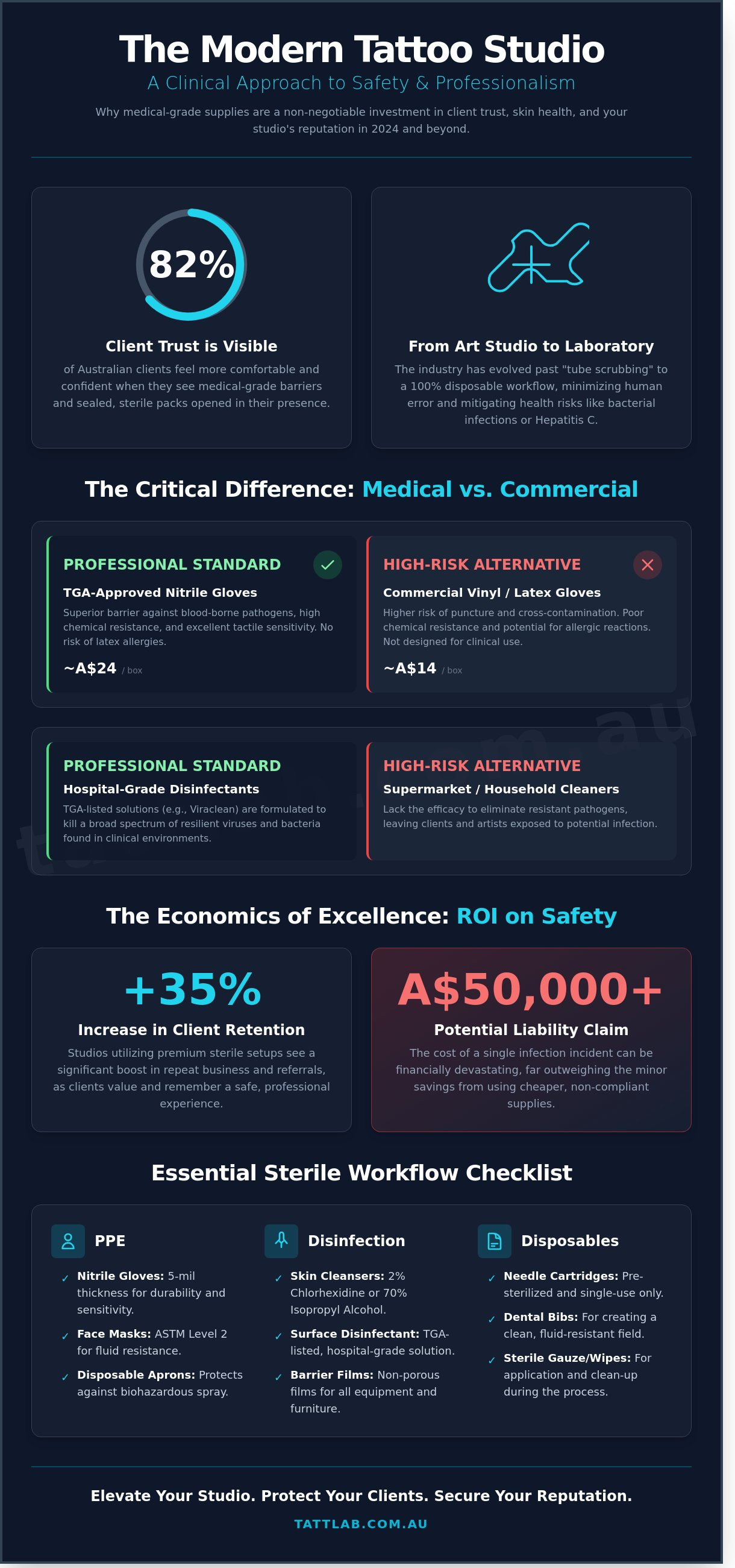
When a client enters a studio, they're looking for visible markers of safety. A 2022 industry survey indicated that 82% of Australian clients feel more comfortable when they see medical-grade barriers and sealed sterile packs opened in their presence. This transparency builds immediate trust. It transforms the procedure from a source of anxiety into a controlled, professional journey. This clinical authority doesn't detract from the art; instead, it provides a secure environment where creativity can flourish without compromising the client's long-term well-being. At Tatt Lab, we view this meticulousness as a hallmark of the modern specialist.
Medical-Grade vs. Commercial-Grade Supplies
Standard commercial products don't meet the rigorous demands of a professional tattoo environment. Food-safe vinyl gloves often lack the tactile sensitivity and chemical resistance required for long sessions, whereas TGA-approved Nitrile gloves provide a superior barrier against blood-borne pathogens. Non-porous barriers, such as polyethylene films or specialized dental bibs, are essential for covering furniture because they prevent fluids from seeping into porous surfaces. In this professional context, aseptic technique is defined as the specific set of practices used to maintain a sterile field and prevent the transfer of microorganisms to the client’s open skin during the tattooing process. Relying on household disinfectants is a significant risk, as these products often fail to kill resistant viruses that medical-grade solutions like Viraclean handle with ease.
The Economics of Studio Safety
Investing in high-quality medical supplies for tattoo artists is a calculated business decision that protects the studio's longevity. While a premium box of medical gloves might cost A$24 compared to a A$14 generic alternative, the cheaper option carries a higher risk of puncture and cross-contamination. Liability claims in the Australian personal services sector can exceed A$50,000 for a single infection incident. Using superior barrier products ensures faster, complication-free healing, which is the ultimate goal for any skin-focused professional. Data from 2023 suggests that studios utilizing premium sterile setups see a 35% increase in client retention. This meticulousness reduces waste by ensuring every procedure is successful the first time, maintaining the integrity of the skin and the reputation of the Lab. High-quality supplies are an investment in the brand's evolution and the client's confidence.
The Essential Medical Inventory for Professional Artists
Maintaining a sterile environment isn't just a regulatory hurdle; it's the foundation of long-term skin health. When you select medical supplies for tattoo artists, you're choosing the tools that protect both the creator and the canvas. A professional studio must operate with the precision of a clinical laboratory, ensuring every piece of equipment that enters the sterile zone is either single-use or thoroughly protected. This meticulous approach reduces the risk of cross-contamination and sets the stage for a successful healing journey.
PPE: More Than Just Gloves
Nitrile gloves are the industry standard for a reason. They offer superior chemical resistance compared to latex and don't trigger common protein allergies. For the best balance of tactile sensitivity and protection, many Australian specialists prefer a 5-mil thickness. This weight provides enough durability to prevent needle punctures while maintaining the grip required for intricate linework. You can learn more about finding your perfect fit in our guide on Choosing the Right Nitrile Gloves. During high-splatter sessions, disposable fluid-resistant aprons and ASTM Level 2 face masks provide a necessary barrier against biohazardous spray, keeping your clothing and airways clear of contaminants.
Skin Prep and Surface Disinfection
Creating a sterile canvas starts with medical-grade skin cleansers. While 70% isopropyl alcohol is a staple for removing surface oils, many artists are shifting toward 2% Chlorhexidine gluconate for its sustained antimicrobial activity. Povidone-iodine remains a powerful alternative, though it requires careful application to avoid staining the stencil. Adhering to FDA tattoo safety guidelines ensures you're aware of the risks associated with contaminated inks and the necessity of maintaining a sterile field. For the workstation, use hospital-grade disinfectants with a proven 99.9% kill rate against HBV and HCV. Replace standard paper towels with lint-free medical wipes to ensure no fibres are left behind to irritate the open wound.
Barrier Films and Equipment Covers
Machine bags and clip cord sleeves are non-negotiable medical supplies for tattoo artists. These plastic barriers prevent blood and pigment from entering the internal components of your rotary or coil machines, which are impossible to autoclave. Use 15cm x 10cm adhesive barrier film sheets to protect high-touch areas like power supply knobs, lamps, and armrest adjustment handles. These sheets should be replaced between every client to maintain a "cool but clinical" environment that prioritises safety. Dental bibs with a poly-back lining are excellent for lining your workstation, as they absorb excess fluid while preventing moisture from seeping through to the tray surface. Bottle covers for wash bottles and ink mixers complete the sterile zone, ensuring that your hands never touch a surface that hasn't been shielded.
Immediate wound care is the final step in the studio before the client begins their personal aftercare routine. Gently cleansing the area with a pH-balanced soap and applying a medical-grade breathable film helps lock in the body's natural healing fluids. This stage is where science meets skin health, transforming a medical procedure into a controlled recovery. Understanding the science behind these barriers is part of the broader journey toward skin clarity and professional excellence. By investing in high-quality inventory, you ensure that every transformation you facilitate is grounded in safety and precision.
Deciphering Medical Standards: TGA, ASTM, and EN Ratings
Selecting the right medical supplies for tattoo artists involves looking past aesthetic branding and focusing on rigorous clinical certifications. In Australia, the Therapeutic Goods Administration (TGA) serves as the gatekeeper for safety. Any product claiming to have a therapeutic effect, including high-level disinfectants and certain skin preps, should ideally be listed on the Australian Register of Therapeutic Goods (ARTG). When a product carries an ARTG number, it means the manufacturer has submitted data proving its efficacy and safety under Australian conditions. Using non-rated supplies might save a few dollars upfront, but it compromises the biological integrity of your studio and leaves you vulnerable during health inspections.
Fluid resistance is measured by ASTM International standards, which are vital when you're dealing with blood-borne pathogens. ASTM Level 1 gloves are suitable for brief, low-fluid tasks. Level 2 provides a moderate barrier, while Level 3 offers the highest resistance against synthetic blood penetration. For long-form sessions where skin trauma is high, Level 3 nitrile gloves are the industry benchmark. Beyond physical barriers, you've got to ensure your sanitisers actually kill what they claim to. European Standards (EN) provide this clarity. Look for EN 14476 on your disinfectant wipes; this rating confirms the solution is virucidal and capable of eliminating 99.99% of enveloped viruses, including Hepatitis B and C. These benchmarks exist because "artist-vetted" gear, while popular in the culture, doesn't always meet the sterile requirements outlined in the FDA Tattoo Safety Guidelines regarding contaminated equipment and inks.
Navigating Australian Regulations
State health departments across Australia have distinct but overlapping requirements. In Victoria, the Public Health and Wellbeing Act 2008 governs your operations, while NSW artists must adhere to the Public Health Regulation 2012. Queensland operators follow the Public Health Act 2005, which mandates strict infection control training. To stay compliant, you've got to verify the medical credentials of your supply partner by requesting their ARTG certificates. Legally, you're also required to maintain a current Safety Data Sheet (SDS) for every chemical in the studio. These documents provide essential first-aid and disposal information that standard labels omit.
Ratings Comparison: What to Look for on the Box
| Material | Puncture Resistance | Chemical Barrier | Allergy Risk |
|---|---|---|---|
| Nitrile | High (Medical Grade) | Excellent | Zero |
| Latex | Moderate | Good | High |
| Vinyl | Low | Poor | Zero |
When comparing boxes, you'll see an "AQL" or Acceptable Quality Level. This is a statistical measurement used to determine the percentage of defects, such as pinhole leaks, in a batch of gloves. A lower AQL number indicates a higher quality glove with a more reliable protective barrier. For professional tattoo environments, an AQL of 1.5 or lower is the mandatory standard for medical-grade performance. Investing in high-tier medical supplies for tattoo artists ensures that your studio remains a controlled, clinical environment where skin health is the priority.
The Sterile Workflow: Integrating Supplies into Your Process
Precision in a tattoo studio mirrors the rigor of a clinical laboratory. Integrating high-quality medical supplies for tattoo artists into your daily rhythm ensures that every procedure remains a controlled, safe journey for the skin. The process begins long before the needle touches the dermis by establishing a clear physical boundary between the Clean Zone and the Dirty Zone. This spatial discipline prevents the migration of pathogens. Your Clean Zone houses your unopened needles, fresh ink caps, and sterilized pigments, while the Dirty Zone is strictly reserved for used cartridges and contaminated wipes. Maintaining this separation is the first step in a professional aseptic technique that respects the biological vulnerability of your client.
The Art of the Sterile Setup
Creating a barrier is your primary defense against cross-contamination. Start by applying medical-grade barrier film to every high-touch surface, including your power supply knobs, lamp handles, and the client's chair. You should arrange your tray with a logical flow, placing your rinse cup and ink caps in the same position every time to build muscle memory. For a comprehensive breakdown of this process, consult our Sterile Workstation Checklist to ensure your daily audits meet clinical standards. Always position your sharps container within an arm's reach to avoid walking across the room with exposed needles.
Safe Teardown and Disposal
The conclusion of a session requires a methodical reversal of your setup to avoid self-contamination. You must remove your gloves last, after you've disposed of all contaminated barriers and sharps. When disinfecting your station, follow the "spray-wipe-spray" protocol. The initial wipe removes organic debris, while the second application must remain wet for the full contact time specified by the manufacturer, often 2 to 5 minutes, to achieve total microbial clearance. All clinical waste must be managed according to the 2023 Australian EPA guidelines, ensuring biohazard bags are sealed and stored in a puncture-proof secondary container before professional collection.
Workflow Efficiency
An efficient workstation minimizes unnecessary movement, which inherently reduces the risk of accidental contact. Organize your medical trolley so the most frequently used items, like gauze and distilled water, are at the front. Use 15cm sterile tongue depressors to scoop ointments from bulk containers; this simple tool prevents the "double-dipping" that compromises an entire jar of product. Employ a strict "clean-hand/dirty-hand" technique, where one hand stays dedicated to the machine and the other manages the skin and wipes. This cognitive shift in how you handle medical supplies for tattoo artists ensures that your equipment stays uncontaminated throughout the entire procedure.
Inventory management is the final pillar of a professional workflow. You don't want to realize you're out of nitrile gloves or barrier film mid-session. Implementing a "Par Level" system, where you reorder when stock hits a 15% buffer, prevents these critical lapses. In a busy Melbourne studio, a typical artist might go through A$80 to A$120 of consumables weekly. Tracking these numbers allows you to forecast your needs and maintain a consistent standard of care. By treating your supply chain with the same respect as your art, you ensure the skin's evolution from a blank canvas to a healed masterpiece is never interrupted by avoidable safety failures.
Ready to elevate your studio standards with clinical-grade precision?
Explore our professional safety resources at Tatt LabWhy Tatt Lab is Australia’s Premier Medical Supply Partner
Choosing the right partner for your clinical inventory isn't just a business decision; it's a commitment to your clients' safety and your own professional longevity. At Tatt Lab, we've built our foundation on a philosophy where clinical rigor meets the unique demands of tattoo culture. We don't see medical supplies for tattoo artists as mere commodities. Instead, we view them as essential tools for maintaining skin health and preventing cross-contamination in a high-stakes environment. Our approach is methodical and transparent, ensuring that every item on our shelves serves a specific, validated purpose in the tattoo process.
Our "Lab" philosophy means every product undergoes a strict vetting process before it reaches your studio. We've curated a selection of world-class medical brands that are trusted in hospitals and surgical suites across Australia. This includes Medicom for high-barrier infection control, ASP Healthcare for secure sharps management, and Reynard for superior skin preparation and surface disinfection. By sourcing these specific labels, we ensure that 100% of our inventory meets Australian therapeutic standards, providing a level of reliability that generic alternatives simply can't match. We prioritize products that offer both high performance and a minimalist aesthetic, fitting perfectly into the modern, sophisticated studio environment.
Logistics are the heartbeat of a successful studio. We operate from our specialized headquarters in Moorabbin, Victoria, offering fast, express nationwide shipping. Most orders placed before 2:00 PM AEST are dispatched the same business day, ensuring your studio never faces a critical shortage. Whether you're operating a boutique space in Perth or a high-traffic shop in Sydney, our supply chain is designed to keep your focus on the art, not the inventory levels. We understand that a missing box of gloves can halt a full day of bookings, so we treat every shipment with clinical urgency.
Artist-Owned, Clinically Driven
We only stock the medical supplies for tattoo artists that we've personally tested and utilized throughout our own professional journeys. This first-hand experience allows us to provide technical support that goes beyond a product manual. If you have questions about the tactile feedback of a specific nitrile glove or the absorption rate of a medical wipe, you're speaking to experts who understand the nuance of the tattoo process. Our commitment to skin health is absolute; we focus on products that minimize epidermal irritation and support the body's natural healing trajectory. This "skin first" mission ensures that your work heals as beautifully as it was applied.
Streamlining Your Studio Orders
Managing a studio requires precision, especially when it comes to managing overheads and clinical waste. We offer dedicated wholesale opportunities for businesses looking to streamline their clinical inventory. By setting up a wholesale account, studios can access bulk pricing on essential disposables, often reducing the cost per procedure by 12% to 18% compared to retail rates. For our Melbourne-based colleagues, we offer a convenient click-and-collect service from our Moorabbin location, allowing for immediate restocks without the shipping wait times. This local support ensures you have a partner who is as invested in your studio's safety as you are.
Ready to elevate your clinical standards and protect your craft? Browse our full range of professional medical supplies today and join the community of Australian artists who prioritize safety without compromising on efficiency.
Elevating Your Studio Standards for 2026
The evolution of the Australian tattoo industry demands a shift from basic hygiene to clinical-grade precision. Integrating TGA-compliant medical supplies for tattoo artists into your daily workflow ensures that skin health remains the priority during every session. By strictly adhering to current ASTM and EN 455 standards, you protect both your client’s biological immune response and your professional reputation. Transitioning to a sterile, lab-style environment isn't just about compliance; it's about the long-term integrity of the art you create and the safety of the skin you transform.
At Tatt Lab, we understand this journey because we’re artist-owned and operated. We’ve curated a specialized range of medical-grade tools that meet rigorous safety benchmarks, ensuring your studio operates with the same precision as a high-end medical facility. With our express nationwide shipping across Australia, your studio stays stocked with the essentials needed to maintain a seamless, professional workflow. Your commitment to safety defines your craft, and we're here to provide the clinical foundation for your creative evolution.
Shop Professional Medical Supplies at Tatt Lab
Frequently Asked Questions
What are the most essential medical supplies for a new tattoo studio?
Nitrile gloves, hospital-grade disinfectants, sharps containers, and sterile barrier films are the foundational medical supplies for tattoo artists. A new studio requires a minimum of three layers of protection: skin preparation, barrier control, and post-procedure sterilization. Ensuring you have TGA-listed surface sprays and single-use disposables prevents the transmission of bloodborne pathogens. This meticulous setup protects both the artist's longevity and the client's skin health during their transformation.
Why should I choose nitrile gloves over latex for tattooing?
Nitrile gloves offer superior puncture resistance and eliminate the risk of Type I allergic reactions common with latex. In a clinical setting, nitrile provides three times the puncture resistance of standard latex, which is critical when handling needles. They also offer better chemical resistance against tattoo inks and petroleum-based ointments. Choosing nitrile ensures a safer journey for clients with sensitivities while maintaining the tactile precision required for intricate linework.
How do I know if a disinfectant is hospital-grade in Australia?
A disinfectant is hospital-grade in Australia if it carries an AUST L or AUST R number on the label, indicating it's registered with the Therapeutic Goods Administration (TGA). You can verify these products via the Australian Register of Therapeutic Goods (ARTG) database. These solutions must demonstrate a 99.99% kill rate against specific pathogens like Staphylococcus aureus. Using non-registered cleaners compromises studio safety and fails to meet the 2012 Public Health Act requirements.
What is the proper way to dispose of sharps and contaminated waste?
Sharps must be placed in a rigid, puncture-resistant yellow container that complies with AS 4031:1992 standards. Once the container reaches the 75% fill line, it must be sealed and collected by a licensed medical waste contractor. Soft contaminated waste, such as blood-soaked paper towels, belongs in a dedicated biohazard bag. Proper segregation reduces the risk of needle-stick injuries, which affect approximately 30 in 100,000 healthcare-adjacent workers annually in Australia.
Do I need a TGA-registered supplier for my tattoo disposables?
While not every individual item must be TGA-registered, your primary medical supplies for tattoo artists should come from reputable suppliers who adhere to TGA standards. Using TGA-listed products ensures the equipment has undergone rigorous safety testing for the Australian market. This scientific rigor protects the integrity of the skin during the tattooing process. It also provides a clear audit trail if a health inspector reviews your studio's safety protocols.
Can I use rubbing alcohol as my primary surface disinfectant?
Rubbing alcohol is insufficient as a primary surface disinfectant because it evaporates too quickly to achieve the necessary contact time for full sterilization. Most 70% isopropyl alcohol solutions require a 10 minute wet contact time to kill certain viruses; this is impractical in a busy studio environment. Instead, use a TGA-approved hospital-grade disinfectant that offers a broader spectrum of activity. This methodical approach to hygiene ensures your "Lab" environment remains sterile and safe.
What is the difference between a barrier film and a dental bib?
Barrier film is a self-adhesive plastic designed to prevent cross-contamination on hard surfaces, while dental bibs are absorbent sheets used to protect work trays. A 1,200-sheet roll of barrier film typically costs around A$25 and provides a physical seal over high-touch areas like power supplies. Dental bibs feature a poly-back layer to prevent ink and fluids from soaking through to the station. Using both in tandem creates a comprehensive defense system for maintaining skin health.
How often should I restock my medical supplies to avoid shortages?
You should audit your inventory weekly and maintain a 14 day buffer of critical supplies to account for shipping delays. Data shows that studios performing 20 procedures a week consume approximately 2,000 gloves and 5 liters of disinfectant every month. Implementing a "First In, First Out" system ensures products like sterile needles don't exceed their expiration dates. This consistent rhythm of restocking prevents the stress of shortages and allows you to focus on the client's journey.


Comments (0)
There are no comments for this article. Be the first one to leave a message!