

Your choice of tattoo needle cartridges is the single most important variable between a piece that heals with crisp precision and one that suffers from unnecessary skin trauma. It is the critical interface where biological safety meets artistic intent. As an artist, you likely understand that even the most sophisticated rotary machine cannot compensate for a needle that wobbles or an ink flow that stutters mid-pass. These technical inconsistencies are more than just an annoyance; they are a risk to the professional standards you strive to maintain.
By mastering the specific technical nuances of cartridge configurations and 2026 safety standards, you can elevate your craft and ensure absolute skin integrity. This transition from intuitive selection to clinical precision allows for crisp, single-pass lines and trauma-free shading that respects the body's natural healing process. We will demystify the science behind taper lengths, membrane resilience, and medical-grade sterilization. This guide provides a methodical roadmap to help you select the ideal tools from artist-vetted ranges like Elite and EZ, ensuring your studio operates at the forefront of modern tattoo technology and safety compliance.
Key Takeaways
- Understand the technical transition from traditional bar needles to streamlined cartridge systems to enhance studio efficiency and biological safety.
- Identify how high-grade 316L stainless steel and internal stabilizers work together to eliminate needle wobble and ensure surgical precision.
- Master the selection of tattoo needle cartridges by mapping specific groupings and diameters, such as 0.25mm bugpins, to your desired artistic outcomes.
- Learn to troubleshoot pigment flow issues by understanding the relationship between needle texture and machine compatibility for smoother saturation.
- Recognise the clinical necessity of sourcing artist-vetted, medical-grade supplies to protect skin integrity and maintain your professional reputation.
The Shift to Cartridge Systems: Efficiency and Safety in Modern Tattooing
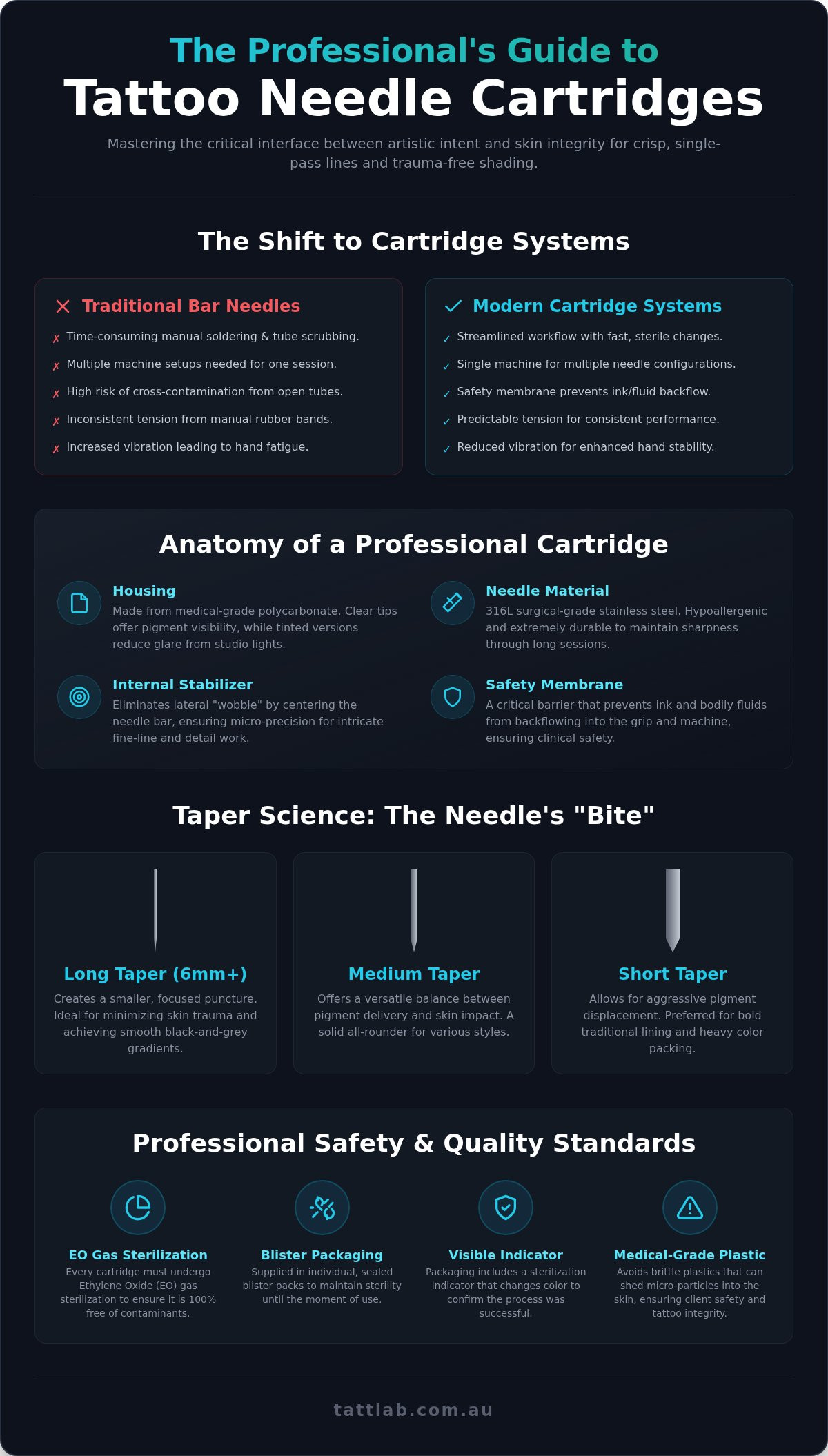
The evolution of tattooing is marked by a steady progression toward precision and hygiene. Perhaps the most significant shift in the last decade is the transition from traditional bar needles to streamlined cartridge systems. For years, artists spent hours manually soldering needles and scrubbing stainless steel tubes. Today, the adoption of tattoo needle cartridges has transformed the studio environment into a more clinical, efficient space. This change isn't just about convenience; it's a fundamental improvement in how we protect both the artist's equipment and the client's biological integrity.
One of the primary advantages is the speed of configuration. In a single session, an artist might need to move from fine detail work to heavy saturation. Cartridges allow for mid-session changes in seconds, maintaining the creative flow without the need for multiple machine setups. This efficiency is paired with a critical safety feature: the internal membrane. High-performance cartridges utilize a tensioned membrane that creates a physical barrier. This prevents ink and bodily fluids from backflowing into the machine's grip or motor. It effectively eliminates the risk of cross-contamination between clients, a standard that traditional open-tube systems could rarely guarantee.
Why Professional Artists Prefer Cartridges
The mechanical stability offered by modern systems is unparalleled. Because the needle is housed within a precise plastic casing, machine vibration is significantly reduced. This leads to improved hand stability during long sessions. Unlike traditional needles that required manual alignment and rubber band tensioning, professional cartridges arrive factory-aligned. This consistency ensures that every hit is predictable. These systems are designed to integrate seamlessly with modern tattoo machines, particularly pen-style rotaries, which prioritize a balanced, ergonomic feel that mimics a natural drawing tool.
Safety Standards for Australian Studios
In the Australian market, professional standards are non-negotiable. Every cartridge used must undergo Ethylene Oxide (EO) gas sterilization and arrive in individual blister packaging with a visible sterilization indicator. We prioritize medical-grade plastics over cheaper, brittle alternatives that can shed micro-particles into the skin. Choosing high-quality configurations isn't just a technical preference; it's the first step in a successful tattoo aftercare process. By minimizing skin trauma through sharp, stable needles, you set the foundation for superior healing and long-term pigment retention.
Anatomy of a Professional Tattoo Needle Cartridge
Understanding the internal architecture of tattoo needle cartridges is essential for any artist prioritizing technical excellence. These tools aren't just plastic shells; they're precision-engineered housings for 316L surgical-grade stainless steel. This specific alloy is chosen for its hypoallergenic properties and extreme durability, ensuring the points remain sharp throughout long sessions without degrading or causing adverse skin reactions. When you select a high-end cartridge, you're investing in the structural integrity of your primary interface with the client's skin.
High-performance cartridges feature an internal stabilizer that secures the needle bar. This component is critical because it eliminates the lateral "play" or wobble that often plagues cheaper, unvetted alternatives. By centering the needle grouping, the stabilizer allows for the micro-precision required in intricate fine-line work. The housing itself, typically crafted from medical-grade polycarbonate, comes in clear or tinted variations. Clear tips offer maximum visibility of the pigment reservoir, while tinted versions can help reduce light glare under bright studio lamps, allowing for better focus during delicate procedures.
The tension system within the cartridge dictates the responsiveness of your machine. While older designs relied on rubber bands, modern professional standards demand tensioned membranes. These systems offer a predictable "snap back" that doesn't overwork your machine's motor, maintaining a steady rhythm that aligns with global standards for Efficiency and Safety in Modern Tattooing. If you're looking to refine your setup, you can explore artist-vetted cartridges that prioritize these mechanical standards.
Taper Science: Long, Medium, and Short Tapers Explained
The taper refers to the length of the needle point before it reaches its full diameter. This geometry dictates the "bite" or how the needle penetrates the dermis. Long tapers (6mm+) create a smaller, more focused puncture. They're ideal for smooth black-and-grey gradients and minimizing skin trauma. Medium tapers offer a versatile balance between pigment delivery and skin impact. Conversely, short tapers reach their full diameter quickly, allowing for aggressive pigment displacement. They're preferred for bold traditional lining and heavy color packing where high saturation is the priority.
The Role of the Safety Membrane
The membrane is more than a tension spring; it's a sophisticated fluid dynamic seal. By creating a physical vacuum-like barrier, it prevents the siphoning of ink and biological fluids into the machine's drive bar. If a membrane is too stiff, it can cause the motor to run hot and lose power; if it's too soft, it loses its protective seal. The safety membrane is the primary barrier between the client's biology and the artist's equipment. This component ensures that your machine remains a sterile tool, protecting the longevity of your hardware and the health of every client who enters your studio.
Configuration Masterclass: Choosing the Right Needle for Your Style
Selecting the specific configuration for your tattoo needle cartridges is a technical decision that dictates both the aesthetic outcome and the biological response of the dermis. It isn't merely about the visual result; it's about calculating how much resistance the skin surface offers and how effectively the needle can penetrate without causing excessive trauma. This balance is essential for maintaining skin integrity. When the needle count is too high for the machine's power or the skin's elasticity, you risk snagging rather than piercing. This is why professional artists map their groupings to the specific density of the area they're tattooing, ensuring a predictable and controlled narrative of transformation for the client.
The diameter of the needle, or its gauge, is the next layer of this masterclass. Standard 12-gauge (0.35mm) needles are the traditional choice for bold saturation. They create a larger "well" in the skin for the tattoo ink to settle into. However, 08-gauge (0.25mm) "Bugpin" needles offer a more sophisticated approach for modern realism. Because they're finer, you can pack more needles into a single cartridge without increasing the overall footprint. This allows for incredibly soft shading and transitions that feel almost photographic, proving that your configuration choice is just as vital as the pigments you select.
Lining Configurations: Round Liners and Tight Liners
Round Liners (RL) are the foundation of structure. They feature needles soldered in a circular pattern, coming to a point. For traditional work or neo-traditional styles, a standard RL provides the stability needed for crisp, single-pass lines. If you're working on micro-realism or delicate script, Tight Liners (TL) are the superior choice. The needles are grouped even more closely at the tip, providing a needle-thin point of contact. This level of precision is exactly Why Quality Matters for Your Studio; a poorly manufactured liner will have stray needles that cause blurry edges or unintended blowouts.
Shading and Packing: Magnums, Curved Mags, and Round Shaders
Magnums (M1) are designed for efficiency. With two rows of needles, they cover more surface area, making them ideal for solid color packing. However, for soft-edge blending and realistic portraits, Curved Magnums (CM) are often preferred. The slight arc of the needle grouping matches the natural curvature of the skin, preventing the marking or "railroading" that can occur with flat groupings. Round Shaders (RS) offer a different approach. Because the needles aren't tapered to a single point like liners, they allow for thicker line detailing and shading in small, tight areas where a magnum would be too cumbersome. Professional ranges like Elite and EZ provide these varied configurations to ensure your tools never limit your artistic intent.
Optimising Performance: Pigment Flow and Machine Compatibility
Achieving a seamless tattooing experience requires more than just selecting the right configuration; it demands a technical understanding of how tattoo needle cartridges interact with your machine and the skin's surface. A common frustration in the studio is ink "spitting" or pooling, which often occurs when the air pressure within the cartridge tip is imbalanced. If the reservoir is overfilled or the vent hole is obstructed by excess pigment, the vacuum effect is lost, leading to inconsistent flow. To resolve this, ensure your needle depth is calibrated so the grouping doesn't bottom out against the plastic tip, which can also dull the points prematurely.
The texture of the needle itself plays a significant role in pigment hold. While highly polished needles offer the smoothest entry, textured needles feature microscopic indentations that "grab" more ink. This is particularly beneficial for solid colour packing where high saturation is required in fewer passes. However, increased pigment hold also increases friction. This is where professional medical supplies for tattoo artists, such as high-quality glides, become essential. Applying a thin layer of a professional glide reduces the coefficient of friction between the plastic cartridge tip and the dermis, allowing the needles to oscillate freely without dragging on the skin.
Maximising Ink Saturation
The design of the tip reservoir varies significantly between brands like Elite and EZ. Some feature a "waffle" or elongated reservoir that holds a larger volume of ink, reducing the frequency of dips. The diameter of the needle also dictates delivery; a larger 0.35mm needle carries a heavier load of pigment compared to a 0.25mm bugpin. To maintain peak performance mid-session, rinse your cartridges in distilled water or a dedicated needle cleaner. Avoid pressing the needles against the bottom of your rinse cup, as this can cause microscopic "hooks" on the tips that lead to unnecessary skin trauma.
Machine Compatibility and Voltage
Every cartridge membrane has a specific resistance level. If you switch from a soft-membrane brand to a stiffer one, you'll likely need to increase your power supply voltage to maintain the same hit. Running a stiff membrane at too low a voltage forces the motor to work harder, which can cause modern pen-style machines to overheat. Most professional tattoo needle cartridges feature a universal back-stem, ensuring a secure "click" fit into industry-standard rotary machines. This stability is the foundation of a controlled, predictable procedure. To ensure your hardware is paired with the best possible interface, shop our professional range of artist-vetted cartridges.
Sourcing Professional Supplies: Why Quality Matters for Your Studio
The integrity of your work depends on the reliability of your tools. Sourcing tattoo needle cartridges from unverified or non-specialist marketplaces introduces a level of biological and mechanical risk that professional studios shouldn't accept. These unvetted products often lack proper EO gas sterilization and suffer from inconsistent needle sharpness, which leads to increased skin trauma and poor pigment retention. At Tatt Lab, we act as a dedicated partner by vetting every brand in our catalogue for consistency. We ensure that the tools you use are as precise and safe as the environment you've built for your clients.
Efficiency in a busy studio requires more than just high-performance needles. By offering a comprehensive range of tattoo supplies and medical PPE, we streamline your logistics. This holistic approach ensures that your station is equipped with both the artistic tools and the clinical barriers necessary for a safe procedure. Supporting an artist-owned Australian distributor strengthens our local industry, keeping the focus on quality and safety rather than high-pressure sales. It's about building a relationship with a supplier that understands the vulnerability and precision of the craft.
The Tatt Lab Selection Process
We prioritize industry leaders like Elite EVO and EZ V-Select because they meet the rigorous demands of modern artists. Our selection process involves verifying that every batch complies with strict Australian safety and sterilization standards. Because Tatt Lab is artist-owned and operated, we provide technical support grounded in actual studio experience. We understand the nuance of how a specific configuration interacts with various skin types, offering a level of expertise that generic retailers can't match. This ensures you receive tattoo needle cartridges that perform predictably every time you open a blister pack.
Seamless Studio Logistics
We offer express nationwide shipping to ensure your station is never empty. For high-volume Australian studios, our wholesale accounts provide a predictable, efficient way to manage inventory. We position ourselves not just as a supplier, but as a partner in your studio's ongoing commitment to safety and artistic excellence. Your focus should remain on the craft; our role is to ensure the tools you reach for are always of medical-grade quality. This steady, reliable supply chain allows you to focus on long-term results and the personal transformation of your clients without the anxiety of equipment failure.
Elevating Your Craft with Clinical Precision
Mastering the technicalities of tattoo needle cartridges is a commitment to both your artistic growth and the physical integrity of your clients. By aligning your configuration choices with specific biological needs and machine mechanics, you create a controlled environment where healing is predictable and results remain crisp. Selecting professional tools with high-quality membranes and internal stabilizers isn't just about efficiency; it's about maintaining the highest medical-grade safety standards in every session.
As an artist-owned specialist, Tatt Lab ensures every product in our catalogue is rigorously vetted for sharpness and consistency. We provide express nationwide shipping across Australia, ensuring your studio never compromises on quality or performance. Shop Australia's Best Range of Professional Tattoo Cartridges to secure medical-grade sterilization guaranteed for your next project. Your dedication to excellence deserves tools that perform without compromise, allowing you to focus on the liberating narrative of your art while we handle the technical precision.
Frequently Asked Questions
What is the difference between a tattoo needle and a cartridge?
Traditional needles are long bars that connect to a machine's armature bar and sit within a separate tube. In contrast, tattoo needle cartridges are self-contained systems where the needle is housed in a disposable plastic casing. This design allows for rapid setup and mid-session configuration changes without the need for multiple machines. Cartridges also incorporate safety membranes that protect your machine from backflow, a feature traditional bar needles lack.
How do I know if a tattoo cartridge has a safety membrane?
You can identify a safety membrane by inspecting the rear of the cartridge for a silicone or rubber seal. High-performance brands like Elite and EZ prioritize this feature to prevent ink and biological fluids from entering your machine. If you can see the needle bar moving freely without a flexible barrier surrounding it, the cartridge likely uses a less secure rubber band system, which doesn't provide a true biological seal.
Which needle cartridge configuration is best for fine-line tattoos?
Round Liners (RL) or Tight Liners (TL) are the superior choice for fine-line work. Most specialists prefer a "Bugpin" diameter, such as 08 (0.25mm), which allows for tighter needle groupings and more delicate punctures. This configuration is essential for micro-realism and fine script, as it reduces the footprint of each hit. Selecting a high-quality liner ensures the points are perfectly centered, eliminating the "wobble" that can ruin intricate details.
Can I use any brand of cartridge with my rotary tattoo machine?
Most professional rotary machines are designed with a universal "twist-lock" receiver, making them compatible with major cartridge brands. However, you should be mindful of membrane tension. Some cartridges have stiffer membranes that require higher voltage and can strain smaller motors. It's best to stick with artist-vetted ranges like Kwadron or Elite to ensure the back-stem fits securely and the mechanical resistance aligns with your machine's power specifications.
What do the numbers on a tattoo needle cartridge mean (e.g., 1207RL)?
These codes provide a technical snapshot of the needle's geometry. In a code like 1207RL, the "12" indicates a 0.35mm needle diameter, which is the industry standard for bold work. The "07" means there are seven individual needles soldered together. Finally, "RL" stands for Round Liner. Mastering this shorthand allows you to quickly identify the correct tools for everything from heavy color packing to soft-edge blending during a session.
How often should I change my cartridge during a tattoo session?
You must change your cartridge whenever you transition between lining, shading, or color packing. Additionally, if you notice the needle "snagging" or if the client's skin seems unusually irritated, the points may have dulled or developed microscopic hooks. Because tattoo needle cartridges are strictly single-use, they must be discarded in a sharps container immediately after the session or if they become contaminated by touching a non-sterile surface.
Are bugpin needles better for shading or lining?
Bugpin needles are exceptionally effective for smooth shading and photographic realism. Since each needle is only 0.25mm in diameter, the grouping is more compact than a standard 12-gauge needle. This creates a softer "pixel" on the skin, allowing for seamless transitions and gradients. While they are used for fine lining, their primary strength lies in their ability to build up layers of pigment without causing excessive trauma to the dermis.
Why is my tattoo cartridge spitting ink?
Ink spitting is usually caused by an imbalance in fluid dynamics or a blocked vent. If you dip your cartridge too deeply into the ink cap, the reservoir can overfill and trap air, forcing the pigment out in inconsistent bursts. To fix this, ensure the needle depth is correctly calibrated and the tip is clear of dried pigment. Regularly rinsing the cartridge in distilled water helps maintain a steady, predictable flow of ink.


Comments (0)
There are no comments for this article. Be the first one to leave a message!