

The most technically brilliant illustration in your sketchbook might be the very reason a studio manager rejects your application. In the Australian industry, a portfolio isn't just an art gallery; it's a clinical record of your understanding of skin, safety, and technical precision. You likely feel the weight of this vulnerability as you wonder if your style is "tattooable" or struggle to choose between a physical binder and a digital grid. Learning how to build a tattoo portfolio requires moving beyond simple drawing skills to embrace the role of a technician who understands how ink interacts with biological tissue.
We understand that the transition from artist to professional practitioner feels daunting, especially when documenting healed work or navigating studio expectations. This guide provides a transparent, results-oriented roadmap to mastering the curation and documentation needed to secure your dream placement. You'll discover how to select pieces that demonstrate longevity, the exact standards for professional presentation in 2026, and the scientific approach to capturing healed results that build immediate trust with mentors. We'll break down the methodical progression from initial sketch to a finished, studio-ready body of work.
Key Takeaways
- Shift your focus from a high volume of sketches to a curated selection of tattooable designs that demonstrate technical potential and skin-ready composition.
- Apply the "Rule of 10" to ensure every piece in your collection represents your highest standard of precision across diverse styles like Traditional and Realism.
- Discover the essential steps of how to build a tattoo portfolio that meets 2026 Australian industry standards for both physical and digital presentation.
- Learn how the selection of professional-grade cartridges and inks directly correlates to the vibrancy and clarity of your portfolio-worthy work.
- Master the art of documenting healed results and aftercare success to prove your commitment to long-term skin health and technical mastery.
Defining the Professional Tattoo Portfolio in 2026
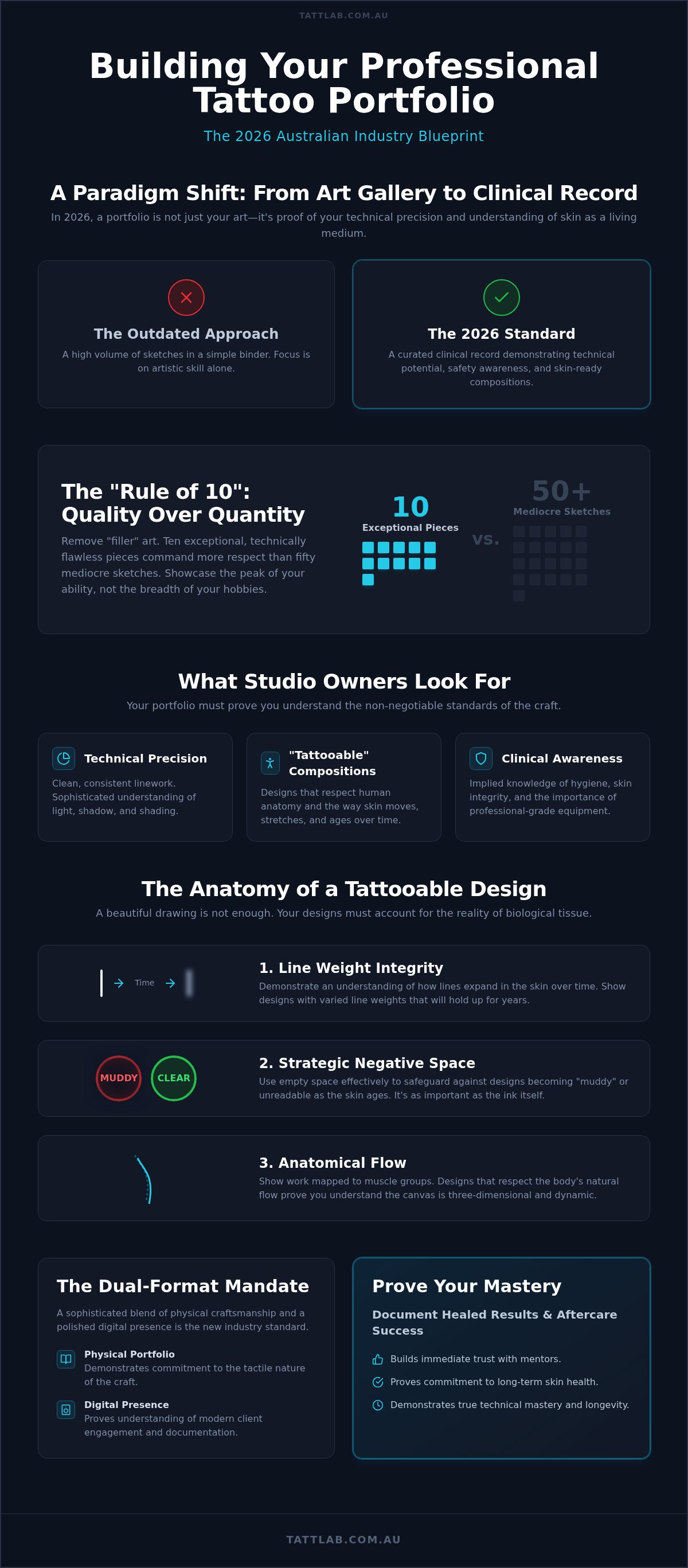
A portfolio is no longer just a collection of your best drawings. In 2026, it serves as a clinical record of your technical potential and your understanding of the skin as a living medium. Understanding how to build a tattoo portfolio involves moving away from the traditional "quantity of sketches" mindset. Instead, you must focus on a curated narrative that proves you can translate art into a permanent biological modification safely and effectively. This document is your primary tool for establishing trust with studio owners who value precision and safety as much as aesthetic flair.
The Australian industry now demands a sophisticated blend of physical craftsmanship and a polished digital presence. While your physical folder demonstrates your commitment to the tactile nature of the craft, your digital presence proves you understand modern client engagement and professional documentation. This duality ensures you are perceived as a modern practitioner who respects the heritage of the industry while embracing the technical rigor of contemporary standards. The process of learning how to build a tattoo portfolio is essentially your first step into a professional partnership with a studio.
The Purpose: Beyond the Apprenticeship
Your portfolio is a roadmap of personal transformation and artistic growth. It shouldn't just show where you are today; it should highlight your technical evolution. By documenting your progress, you create a benchmark for your own mastery. This methodical approach allows you to position yourself as a specialist in specific styles, such as fineline or realism, rather than a generalist. A well-constructed portfolio tells a story of dedication, showing mentors that you have the patience and discipline required for the long-term results they expect in a clinical studio environment.
What Studio Owners Look For
Technical precision is the non-negotiable standard for any Australian studio placement. Mentors look for clean, consistent line work and a sophisticated understanding of how light interacts with shadow. Beyond the art, they look for "tattooable" compositions. This means your designs must respect human anatomy and the way skin moves, stretches, and ages. A successful portfolio also signals your respect for the clinical side of the industry. It should imply an awareness of hygiene, skin integrity, and the importance of using professional-grade equipment. Showing that you value the body's physical integrity through your design choices builds immediate credibility with established artists who prioritize safety above all else.
Curating Your Best Work: Selection and Strategy
Curation is an exercise in clinical objectivity. When considering how to build a tattoo portfolio, the most common mistake is including every piece of art you've ever created. Instead, adopt the "Rule of 10". Ten exceptional, technically flawless pieces will always command more respect than fifty mediocre sketches. This approach forces you to remove "filler" art that lacks specific technical tattooing skill, ensuring your presentation remains punchy and professional. It's about showcasing the peak of your current ability rather than the breadth of your hobbies.
Organise your work by distinct categories: Traditional, Realism, Fineline, and Blackwork. This structure allows a studio manager to immediately assess your versatility and technical range. Include "Flash" sheets alongside your custom pieces to demonstrate that you understand commercial demand and can produce repeatable, high-quality designs. Professionalism starts with the tools you use; ensuring your designs are executed with high-quality tattoo ink on paper reflects the standard you'll bring to the skin.
Artistic Versatility vs. Specialisation
Proving you can adapt to various styles is essential for securing a spot in a high-traffic street shop. However, if you're targeting a boutique studio, a niche-focused portfolio demonstrates a deeper commitment to a specific craft. Balance your unique creative voice with designs that have clear commercial viability. This progression shows you aren't just an artist, but a practitioner who understands the Australian market's needs and the safety requirements of modern tattooing.
The Anatomy of a Tattooable Design
A design that looks beautiful on paper may fail when applied to biological tissue. When documenting how to build a tattoo portfolio, you must demonstrate an understanding of line weight and how it expands over time. Use negative space strategically; it is the primary safeguard against designs becoming "muddy" as the skin ages. Finally, show your work mapped to muscle groups. Designs that respect the body's natural flow and placement prove you understand the physical integrity of your canvas and the precision required for long-term results.
Elevating Results with Professional Equipment
Technical mastery is inseparable from the quality of the tools you use. While artistic theory provides the foundation, your physical results depend on the precision of your equipment. When you consider how to build a tattoo portfolio that commands attention, you must account for how your tools translate to the camera lens. High-contrast, sharp documentation is only possible when your supplies provide consistent performance and predictable healing. Using professional-grade equipment signals to studio owners that you respect the biological integrity of the skin as much as the final aesthetic.
Pigment Science and Portfolio Longevity
The vibrancy of your portfolio pieces is directly influenced by tattoo ink selection. World-renowned pigments ensure consistent saturation, which is vital for high-resolution photography. Cheap alternatives often result in patchy healing or "muddy" tones that fail to document well. There's also a clinical difference between "fresh" ink and "settled" ink in technical documentation. Capturing work after the initial inflammation has subsided provides a transparent view of your technical precision, proving that your saturation remains solid long after the procedure is complete.
Needle Selection for Sharp Documentation
Achieving the crisp outlines seen in top-tier realism or traditional portfolios requires specific needle configurations. Using high-quality Round Liners ensures that your line work remains sharp and defined under close-up photography. Similarly, Magnums and Curved Magnums are essential for creating the smooth, seamless gradients required for high-definition portfolios. The taper of the needle plays a significant role here; a long taper reduces skin trauma, leading to a calmer healing process and a cleaner final photograph. Choosing professional tattoo supplies ensures that every gradient and fine line you document is a true reflection of your skill.
Finally, your portfolio should document more than just the art. Including photos of your sterile setup, featuring medical-grade PPE and professional stencils, demonstrates a commitment to Australian health standards. This transparency builds immediate trust, showing that you understand the methodical progression from a safe environment to a superior aesthetic result. It's a holistic approach to the craft that separates a hobbyist from a dedicated specialist who understands how to build a tattoo portfolio with technical rigor.
Building the Physical and Digital Portfolio
The final stage of your presentation requires a methodical approach to documentation. While your artistic skill is the foundation, the medium through which a studio owner views your work determines their initial level of trust. A professional presentation in 2026 relies on a dual-strategy: a tactile physical folder for in-person consultations and a high-performance digital presence for global accessibility. Mastering how to build a tattoo portfolio means ensuring both formats reflect the clinical precision of your craft.
- Step 1: The Physical Folder. Select a high-quality A3 or A4 display folder with non-reflective sleeves. This remains a vital tradition in Australian studio culture, proving you value the physical heritage of tattooing.
- Step 2: Technical Photography. Consistency is paramount. Use a dedicated space with controlled lighting to ensure every piece looks part of a cohesive body of work.
- Step 3: The Digital Archive. Create a minimalist PDF or a dedicated portfolio website. This should be a clean, distraction-free environment that prioritises your work over flashy design.
- Step 4: Social Integration. Use Instagram as a living record. It serves as a secondary verification of your progression and daily commitment to the craft.
- Step 5: Quality Control. Implement the "one in, one out" rule. As you create new, superior work, remove the weakest piece from your portfolio to maintain an upward trajectory of quality.
Photography Tips for Tattoo Artists
Capturing the technical detail of your work requires more than a standard smartphone snap. To remove glare from fresh tattoos or high-gloss drawings, use a polarised CPL filter. This allows the viewer to see the actual saturation and line work without the interference of reflected light. Always use a neutral, clinical background to maintain focus on the art. Macro shots are equally essential; they provide the technical proof of your line weight consistency and the smoothness of your gradients, which are often lost in wide-angle photos.
The Digital Presence
Your digital portfolio must be mobile-optimised, as most studio owners will first view your work on a phone. Organise your Instagram highlights into clear categories, such as "Healed," "Flash," and "Process," to allow for easy browsing. While social media is useful, a dedicated website builds professional authority and ensures you aren't at the mercy of platform algorithms. It functions as your digital laboratory, where you control the narrative of your artistic evolution. To ensure your physical work is ready for high-definition documentation, start with the right foundations by investing in professional tattoo supplies that deliver sharp, portfolio-ready results.
The Professional Standard: Healing and Hygiene
Technical mastery in tattooing isn't measured at the moment the needle stops. It's measured months later, when the skin has fully regenerated and the pigment has settled into its permanent layer. When you consider how to build a tattoo portfolio that stands up to professional scrutiny, you must include healed results. These photos are the ultimate proof of your technical precision, showing that your saturation is consistent and your line work hasn't blurred over time. A portfolio consisting only of fresh, red tattoos signals a lack of experience or a fear of the long-term biological result.
Integrating tattoo aftercare documentation into your narrative demonstrates a holistic approach to the craft. It shows you aren't just focused on the technical procedure, but on the liberating narrative of personal transformation that a well-healed tattoo provides. By showing a "Healed vs. Fresh" comparison, you provide a transparent view of your skill. This level of honesty builds immediate trust with studio owners, positioning you as a specialist who values physical integrity above all else.
Documenting the Healing Journey
A professional documentation strategy involves capturing work at the two-week and two-month marks. This timeline allows the skin to move through its natural biological healing phases, from the initial peeling to the final settling of the pigment. Explaining your specific aftercare protocol within your portfolio demonstrates a high level of client care. It proves you understand how environmental factors impact the artistic integrity of your work. This methodical progression from the studio to the final result is what separates a technician from a hobbyist.
Demonstrating Clinical Rigor
Safety is a skill that must be documented. Your portfolio should include evidence of your knowledge regarding medical supplies for tattoo artists and sterile workstation setups. In the competitive Australian market, showing you understand cross-contamination and PPE usage is just as important as showing your shading technique. Mastering how to build a tattoo portfolio means including shots of your organized, sterile station to reassure studio owners you are ready to operate within a professional facility that respects strict health regulations. This clinical edge ensures your transition into a studio environment is predictable, safe, and controlled.
Securing Your Future in the Australian Tattoo Industry
Building a professional presence is a methodical progression that requires patience and technical rigor. You've learned that mastering how to build a tattoo portfolio involves more than artistic flair; it's about proving your understanding of skin integrity, clinical safety, and the "Rule of 10" curation strategy. By prioritising healed results and high-definition documentation, you demonstrate the transparency and precision that modern Australian studios demand. This methodical approach replaces uncertainty with a sense of controlled, predictable progress.
Your journey from an aspiring artist to a trusted specialist begins with the foundations you lay today. Professional results are only possible when you use tools designed for precision and safety. At Tatt Lab, we provide artist-vetted equipment and specialist Australian support to help you achieve the sharp, vibrant results your portfolio requires. From world-renowned inks to medical-grade PPE, we're your dedicated partner in this narrative of personal transformation and artistic growth.
Equip your journey with professional-grade supplies at Tatt Lab and take advantage of our express nationwide shipping. Your technical evolution starts with the right equipment; we're here to ensure your progress is steady, predictable, and professional. Take the next step toward your studio placement with confidence.
Frequently Asked Questions
How many pieces should be in a beginner tattoo portfolio?
Aim for 10 to 15 exceptional pieces rather than dozens of mediocre sketches. When learning how to build a tattoo portfolio, remember that studio owners value your ability to self-edit. Including too much work suggests a lack of clinical objectivity. Each piece must demonstrate a specific technical skill, such as clean line work or smooth saturation, proving you can handle the biological complexity of skin. Focus on your absolute best to build immediate trust.
Should I include non-tattoo art in my portfolio?
Yes, but it should only occupy a small portion of your collection. Non-tattoo art like oil paintings or digital illustrations can demonstrate your understanding of colour theory and composition. However, the majority of your work must be "tattooable" designs that respect human anatomy. If you include fine art, ensure it serves the narrative of your artistic evolution. It shouldn't distract from the technical precision required for a professional studio placement.
Is a digital portfolio better than a physical one in 2026?
Neither is strictly better; 2026 standards demand a sophisticated blend of both formats. A physical portfolio is essential for in-person consultations in Australia, reflecting your respect for the craft's heritage. Conversely, a digital version provides global accessibility and proves you understand modern client engagement. Combining a high-quality A3 folder with a mobile-optimised website creates a professional duality. This approach ensures you are prepared for any recruitment scenario, from a casual walk-in to a formal interview.
How do I take professional photos of my tattoos without a DSLR?
You can achieve professional results using a modern smartphone paired with a polarised CPL filter. This filter is the most effective tool for removing glare from fresh tattoos, allowing technical details to remain visible. Use a neutral background and natural, diffused lighting to maintain consistency across your documentation. Focus on capturing macro shots that highlight your technical precision. High-quality documentation is a skill in itself that signals your commitment to professional standards and safety.
Why do studio owners want to see healed tattoo photos?
Healed photos are the ultimate proof of your technical mastery and your understanding of skin integrity. A fresh tattoo can hide flaws behind redness or swelling, but a healed result shows exactly how the pigment has settled into the tissue. Studio owners look for these photos to verify that your saturation remains solid and your lines haven't blurred. It proves you understand the methodical progression from the initial procedure to a safe, long-term aesthetic outcome.
Should I include photos of my tattoo equipment in the portfolio?
Including photos of your sterile workstation and professional setup is highly recommended. It demonstrates a commitment to Australian health regulations and clinical hygiene. Showing your knowledge of medical-grade PPE and professional stencils positions you as a safety-first practitioner. This transparency builds immediate trust with mentors who prioritise physical integrity. It proves you aren't just an artist, but a technician who understands the rigorous safety requirements of a modern, boutique-studio environment.
How often should I update my tattoo portfolio?
You should update your work constantly using the "one in, one out" rule. As your skills evolve, replace your weakest piece with your most recent technical success. This ensures your portfolio always represents your peak ability rather than a historical record of your early mistakes. Regular updates are essential when considering how to build a tattoo portfolio that reflects your current mastery. A stagnant portfolio suggests a lack of growth, whereas a curated, evolving collection shows dedication to progress.
What are the most common mistakes in a first tattoo portfolio?
The most common mistakes include including "filler" art, poor photography, and designs that don't respect body anatomy. Many beginners focus on quantity over quality, which dilutes the impact of their best work. Blurry photos or inconsistent lighting can make even great art look unprofessional. Additionally, designs that lack negative space or appropriate line weights often fail the "tattooable" test. Avoiding these pitfalls requires a clinical approach to curation and a deep respect for the technical limits of the medium.


Comments (0)
There are no comments for this article. Be the first one to leave a message!