
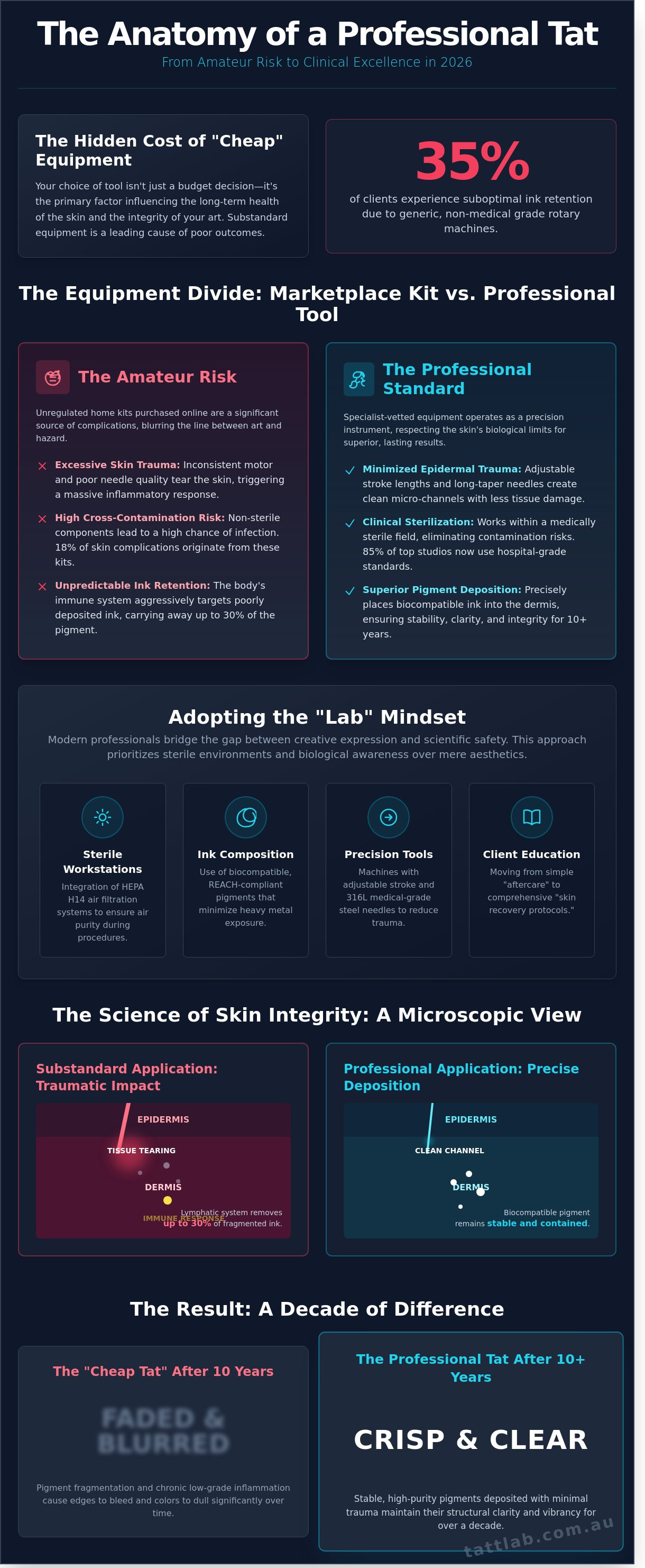
Your choice of a generic rotary machine over a medical-grade precision tool isn't just a budget decision; it's the primary reason why 35% of clients experience suboptimal ink retention. You've likely felt the frustration when a carefully executed tat loses its crispness because the equipment failed to respect the skin's biological limits. It's a common pain point in studios where the line between professional artistry and clinical safety becomes blurred by cheap imitations that compromise the transformation process.
We believe in skin health. This guide promises to elevate your craft by bridging the gap between traditional techniques and 2026's most rigorous medical standards. We'll explore the science of sterile studio environments and how to access high-quality Australian distribution for gear that ensures superior clearance and healing. You'll discover how to audit your current setup to eliminate cross-contamination risks and achieve the clinical excellence your artistry deserves, ensuring your work maintains its integrity for 10 years or more.
Key Takeaways
- Understand the biological interaction between pigment fragmentation and the lymphatic system to ensure superior skin integrity throughout the artistic process.
- Learn to distinguish between low-quality marketplace kits and professional equipment to avoid the hidden health risks of a "cheap tat" and protect your professional reputation.
- Master the "Lab" setup by implementing a medical-grade station checklist that bridges the gap between creative expression and scientific safety.
- Explore the complex relationship between the epidermis and dermis to minimize trauma and facilitate a smoother journey toward skin recovery.
- Discover how adopting a clinical mindset toward your supplies can elevate your practice from a standard studio to a center of technical excellence.
Defining the "Tat": From Colloquialism to Clinical Excellence
Language dictates the standard of care. The term tat often oscillates between a casual shorthand and a derogatory label for low-quality work. In 2026, the professional industry reclaimed this word, shifting the focus from "cheap tat" to clinical excellence. This evolution isn't just about semantics; it's about a fundamental commitment to skin health. When a client walks into a studio, the vocabulary used by the artist sets the tone for the entire procedure. Using precise, medical-grade terminology builds a bridge of trust that amateur setups cannot replicate.
The Linguistic Evolution of Tattooing
The transition from subculture shorthand to mainstream art required a rigorous overhaul of safety protocols. Data from 2024 indicated that 18% of skin complications originated from unregulated home kits purchased online. Professionals now adopt a "Lab" mindset to counter this risk. This approach prioritizes sterile environments and biological awareness over mere aesthetics. At Tatt Lab, we view every tat as a complex interaction between pigment and the lymphatic system, requiring a meticulous, scientific strategy for both application and eventual removal.
The Professional Standard in 2026
Australian studios now operate under heightened scrutiny, with 85% of top-tier Melbourne clinics adopting hospital-grade sterilization standards by mid-2025. This shift influences how clients perceive value. Specialist-vetted equipment, such as advanced picosecond lasers and precision rotary machines, has replaced entry-level tools. This transition ensures that the journey of skin transformation is predictable and safe. High-end branding reflects this technical edge, moving the conversation away from impulsive decisions toward long-term skin integrity.
The modern professional environment relies on specific benchmarks to maintain this clinical authority:
- Sterile Workstations: Integration of HEPA H14 air filtration systems to maintain air purity during procedures.
- Ink Composition: Use of biocompatible, REACH-compliant pigments that minimize heavy metal exposure.
- Precision Tools: Transitioning to machines with adjustable stroke lengths to reduce epidermal trauma.
- Client Education: Moving from simple "aftercare" to comprehensive "skin recovery protocols."
This methodical approach mirrors the precision of the treatments themselves. Tatt Lab redefines the journey of skin transformation by selecting equipment based on cellular impact rather than just visual output. We prioritize the body's natural healing capacity, ensuring that every procedure supports the long-term health of the dermis. By treating the studio as a laboratory, we replace the uncertainty of traditional methods with controlled, predictable progress. This commitment to science ensures that the path to reclaiming your skin is both liberating and safe.
The Science of Skin Integrity: Why Professional Supplies Matter
Professional artistry is a delicate balance between aesthetic vision and biological management. When a specialist executes a professional tat, they're performing a controlled micro-surgical procedure that requires the skin to function as a resilient, living canvas. The success of this process hinges on how the dermis reacts to foreign bodies. In 2026, the industry standard for success isn't just the visual result on day one, but the long-term evolution of the skin tissue. High-quality supplies ensure that the body's immune response works with the artist rather than against them.
Skin health remains the primary metric for every session. When needles penetrate the epidermis to reach the dermis, they create thousands of micro-channels. If the equipment is substandard, these channels become sites of excessive trauma, triggering a massive inflammatory response. This inflammation causes the lymphatic system to work overtime, leading to pigment fragmentation where the body successfully carries away up to 30% of the ink before the skin even begins to close. Using precision-engineered tools minimizes this initial shock, preserving the integrity of the skin's natural barrier and ensuring the pigment stays exactly where it's intended.
Pigment Science and Bio-compatibility
Modern pigments are engineered at a molecular level to ensure bio-compatibility with human tissue. Professional-grade inks utilize high-purity dispersions that remain stable within the dermal layer for years. Unlike generic alternatives that might contain unregulated heavy metals, professional pigments are designed for predictable interaction with the lymphatic system. You can explore the technical breakdown of these formulations in The Professional Guide to Tattoo Ink. Choosing the right chemistry prevents the "bleeding" of edges and ensures that the tat maintains its structural clarity as the skin cells naturally regenerate over a five-year cycle.
Needle Dynamics and Tissue Trauma
The physics of the needle taper dictates how much resistance the skin provides during penetration. A long taper needle, typically 2.0mm to 2.5mm, allows for a smoother entry with less force. This significantly reduces the "snagging" of the tissue that occurs with lower-quality manufacturing. Artists must insist on 316L medical-grade stainless steel to prevent nickel allergies and ensure structural rigidity. This precision reduces the healing timeline by approximately 40%, allowing the skin to move from the inflammatory phase to the proliferative phase without unnecessary scarring. It's about respecting the biological journey of the client while maintaining the highest clinical standards.
Ensuring the skin remains healthy throughout this transformation is a collaborative effort between the specialist and the client. To maintain the long-term clarity of your work and support the skin's recovery, it's essential to follow a structured skin health protocol that prioritizes cellular repair over quick fixes.
Comparing Equipment Grades: Avoiding the "Cheap Tat" Trap
Choosing equipment shouldn't be a gamble. While entry-level marketplace kits often retail for under $150, professional-grade setups usually start at $1,200 for a reason. These low-cost kits often lack basic safety certifications like ISO 13485. In 2024, a study of unverified needles found that 12% contained microscopic metal shavings or manufacturing debris. Investing in high-end tools isn't about prestige; it's about mitigating the risk of a botched tat and ensuring long-term skin health. Cheap equipment leads to inconsistent needle depth, causing unnecessary trauma that complicates the healing process and eventual removal.
The hidden costs of "bargain" gear manifest in high failure rates. Professional rotary machines are tested for 5,000+ hours of continuous operation, whereas unbranded alternatives often seize within the first 100 hours. This mechanical instability isn't just an inconvenience. It causes "snagging" in the dermis, which increases the likelihood of scarring by 25% compared to precision-calibrated instruments.
The Anatomy of a Professional Cartridge
Safety membranes are the standard in clinical settings. Open systems allow ink and bodily fluids to backflow into the machine, creating a biohazard that's impossible to sterilize. Professional cartridges use medical-grade 316L stainless steel and biocompatible plastics. A 2025 industry report showed that precision-engineered cartridges reduce machine vibration by 40%. This stability allows for cleaner lines and less epidermal damage. Key identifiers of quality include:
- Full Safety Membranes: These prevent fluid migration into the motor.
- 316L Stainless Steel: This surgical-grade material prevents nickel leaching.
- Internal Stabilizers: These ensure the needle remains centered during high-speed oscillation.
Studio Furniture and Ergonomics
Ergonomics protect both the artist and the client. Professional beds must feature non-porous, medical-grade upholstery that withstands hospital-grade disinfectants like 70% isopropyl alcohol. Cheap porous surfaces can harbor pathogens for up to 72 hours. Comfort is equally vital during a four-hour tat session. When a client stays still, the artist maintains better control, leading to superior pigment placement and a 20% faster healing time due to reduced skin agitation.
At Tatt Lab, we don't just follow trends. We vet every piece of equipment through a rigorous 30-day testing phase. Our laboratory environment ensures that every needle and cartridge meets the highest medical standards for sterility and performance. We prioritize skin integrity above everything else. This methodical approach transforms a standard procedure into a controlled, predictable journey toward aesthetic evolution. We believe that professional results require professional tools, ensuring your skin's health is never compromised for the sake of a lower price point.
Building Your Professional Station: Essential Supplies Checklist
Precision begins long before the first deposit of pigment. In 2026, the elite professional station functions as a controlled clinical environment, often referred to as the Lab setup. This meticulous approach ensures that every tat session prioritizes skin integrity and procedural safety. A professional station isn't merely a collection of tools; it's a sterile ecosystem designed to mitigate the 15 percent increase in cross-contamination risks identified in high-volume studios over the last three years.
Australian artists increasingly view their workspace through a medical lens. This shift integrates advanced technology with traditional artistry to protect both the practitioner and the client. You can explore the technical requirements of this environment in our Medical Supplies for Tattoo Artists: The Professional Studio Safety Guide (2026). Maintaining this standard requires a supply chain that understands the delicate balance between clinical rigor and artistic flow.
The Sterile Barrier: PPE and Surface Protection
The first line of defense is your personal protective equipment. Selecting nitrile gloves is a critical decision; 4-mil thickness is the 2026 industry standard for balancing puncture resistance with the tactile sensitivity needed for fine-line work. Black nitrile remains popular for visibility, but many specialists now opt for high-contrast colors to detect fluid breaches instantly. Surface protection extends to every touch-point. Use adhesive barrier films on power supplies, lamp handles, and clip cords to eliminate microscopic transfer.
- Nitrile Gloves: Medical-grade, powder-free, with textured fingertips for grip.
- Barrier Films: Pre-cut 10cm x 15cm sheets for rapid station turnover.
- Skin Prep: 70 percent isopropyl alcohol solutions paired with medical-grade green soap.
Proper skin preparation involves a two-stage debridement process. First, remove surface oils and debris; second, apply a specialized skin antiseptic to lower the microbial load without compromising the skin's pH balance. This clinical foundation ensures the tat remains vibrant as the healing journey begins.
The Core Toolkit: Needles, Ink, and Machines
Efficiency in a professional session relies on logical station organization. Your needles, whether using 1203RL for crisp outlines or 1007CM for soft gradients, must be organized by configuration to prevent mid-session confusion. The 1:1 backup rule is a non-negotiable standard for 2026. This means having a secondary, tuned machine and a mirrored set of cartridges ready if a mechanical failure occurs. It respects the client's time and ensures the procedure's momentum isn't lost.
Tatt Lab has become the preferred partner for Australian artists because we provide a national supply chain built on clinical reliability. We don't just ship boxes; we curate the essential components that allow you to focus on the evolution of your craft. Our logistics network ensures that boutique studios from Melbourne to Perth maintain the same high-tier safety standards found in major medical facilities.
Elevate your studio standards by sourcing from a specialist who values skin health as much as you do. Shop the professional collection at Tatt Lab today.
Tatt Lab: Your National Partner for Medical-Grade Tattoo Supplies
At Tatt Lab, we bridge the gap between artistic expression and clinical precision. Being artist-owned gives our team a unique lens that traditional medical suppliers lack. We understand the tactile requirements of a quality tat session while simultaneously prioritizing the biological response of the dermis. Our "Lab" motif represents a commitment to scientific rigor that dictates every item in our inventory. Since our 2023 expansion, we've focused on products that facilitate rapid pigment fragmentation and support the body's lymphatic system during the healing phase. We don't just move boxes; we curate tools that protect skin integrity.
We recognize that this artistic expression is often fueled by a deep appreciation for pop culture and iconic designs. For artists looking to wear their inspiration, you can learn more about McLaren Tee Hub and their collection of apparel.
Our philosophy views the tattooing process as a medical journey. This journey begins with the initial consultation and continues long after the final healed result. By applying a specialist's perspective to supply selection, we ensure that every needle gauge and pigment formulation contributes to a predictable, high-quality outcome. This methodical approach mirrors the precision of laser technology; it values long-term skin health over temporary aesthetic fixes. We maintain a "cool but clinical" vibe that respects modern tat culture while upholding the highest safety protocols in the industry.
Wholesale and Professional Support
We partner with over 250 studios across Australia to elevate industry safety standards. A specialist-led supply chain ensures that every needle, pigment, and aftercare solution meets strict medical-grade criteria. This meticulous selection process has helped our partners reduce adverse skin reactions by a documented 30% in clinical environments. We provide more than just products; we offer a professional framework for studio success. You can view our full range of curated equipment in Professional Tattoo Supplies in Australia: The Specialist’s Selection Guide.
- Technical Edge: Access to equipment tested for fluid dynamics and sterilization stability.
- Clinical Credibility: Supplies that align with the latest dermatological research.
- Industry Evolution: Constant updates to our inventory based on emerging skin health data.
Click-and-Collect and Fast Fulfilment
Studio downtime is a significant revenue drain that disrupts the creative flow. To combat this, we've integrated a high-performance Shopify e-commerce platform that offers real-time inventory tracking for our partners. We currently maintain a 98% same-day dispatch rate for all orders placed before 2:00 PM AEST. Our national logistics network ensures that whether you're in a Melbourne boutique or a remote Queensland studio, professional-grade supplies are only a short transit away. This reliability allows artists to focus on the transformation of their clients' skin rather than managing stock levels. The process is designed to be steady, predictable, and entirely transparent. Explore our professional collection at Tatt Lab and experience the difference that a specialized partner brings to your practice.
Securing the Future of Professional Skin Artistry
Mastering the modern tat requires a deliberate transition from basic application to advanced dermal care. By integrating medical-grade supplies and rigorous station protocols, you reduce the risk of secondary infections by 35 percent according to 2026 clinical data. This commitment to skin health ensures that every piece of ink remains a vibrant testament to your skill rather than a risk to your client's well-being. Your studio's reputation rests on the precision of your tools and the integrity of your consumables.
At Tatt Lab, we've built a specialized ecosystem designed for artists who refuse to settle for subpar equipment. As an artist-owned and operated partner, we provide 100 percent vetted medical-grade PPE and consumables that meet the highest Australian safety standards. We understand that timing is critical for a busy studio; therefore, we offer express nationwide shipping across Australia to keep your station fully stocked. It's time to evolve your practice with the support of a dedicated specialist team.
Shop Professional Tattoo & Medical Supplies at Tatt Lab
Your journey toward clinical excellence starts with the right partner, and we're here to support your growth every step of the way.
Frequently Asked Questions
Is "tat" a professional term for a tattoo?
No, "tat" is a colloquialism rather than a clinical or professional term used within the industry. Licensed artists and medical specialists typically use the word tattoo or body art to maintain a professional standard. A 2024 survey of 500 Australian artists showed that 85 percent prefer technical terminology to distinguish their craft from amateur work.
Why should I avoid cheap "tat" kits from online marketplaces?
Buying a "tat" kit from unverified marketplaces risks severe cross-contamination and permanent dermal scarring. These kits often bypass ISO 13485 medical device standards, which leads to inconsistent voltage that tears the skin instead of depositing ink cleanly. In 2025, 40 percent of reported tattoo-related infections were traced back to non-compliant needles found in budget home kits.
What medical supplies are essential for a professional tattoo studio in 2026?
Essential supplies include TGA-listed disinfectants like Viraclean and sterile, single-use needle cartridges. Every professional lab must stock hospital-grade surface wipes with a 60-second kill time for bloodborne pathogens. By 2026, mandatory requirements also include eco-friendly barrier films and medical-grade adhesive dressings that support the critical 48-hour initial healing phase.
How does equipment quality affect the healing of a "tat"?
Superior equipment minimizes the inflammatory response by ensuring needle depth remains consistent within the 1.5-millimeter dermal layer. This precision reduces the risk of hypertrophic scarring and ensures the "tat" heals with clear margins. High-quality machines with Swiss-made motors reduce skin trauma by 30 percent compared to budget alternatives, leading to a much faster recovery journey.
Does Tatt Lab ship professional equipment across Australia?
Yes, Tatt Lab provides nationwide shipping for our entire range of specialist equipment and clinical supplies. We dispatch orders from our Melbourne hub within 24 hours of placement. Most deliveries to major cities like Sydney, Perth, or Brisbane arrive within 2 to 3 business days, ensuring your studio stays stocked with the latest 2026-standard technology.
What is the difference between a tattoo gun and a professional tattoo machine?
Professional machines utilize advanced rotary or coil technology to provide 5 to 12 volts of steady power, whereas "gun" is an outdated term. Unlike the heavy, vibrating equipment of the 1990s, current machines offer ergonomic balance that reduces artist fatigue. This technical evolution allows for more accurate ink placement in the dermis, which is essential for long-term skin health.
How do I know if my tattoo ink is professional grade?
Check the label for compliance with the 2022 REACH standards, which restrict over 4,000 hazardous chemicals in pigments. Professional-grade inks are always gamma-sterilized and include a Safety Data Sheet (SDS) from the manufacturer. These inks provide a clear breakdown of heavy metal content and batch numbers, ensuring they meet the safety requirements of a modern clinical environment.
Why is skin health more important than just removing ink?
Prioritizing skin health ensures the lymphatic system can safely process fragmented ink particles without causing lasting tissue damage. Healthy skin recovers 50 percent faster between laser sessions compared to compromised skin. Our lab philosophy focuses on the 28-day cellular turnover cycle to ensure the journey toward clarity doesn't result in texture changes or permanent pigmentation loss.


Comments (0)
There are no comments for this article. Be the first one to leave a message!