

Your choice of tattoo cartridges is the single most critical interface between your artistic vision and the biological reality of your client’s skin. In a global market valued at 2.7 billion dollars in 2026, the difference between a crisp line and overworked tissue often comes down to the mechanical stability of a single needle drive. You’ve likely experienced the frustration of inconsistent quality within a single box or the anxiety of potential backflow into your machine. These aren't just technical hiccups; they're direct risks to the skin health and safety standards that define a modern, high-end studio.
We agree that your tools should be as precise as your technique. This guide will help you master the technical nuances of cartridge selection to enhance your ink flow, protect skin integrity, and elevate your artistic output. We'll examine the science behind ISO 13485 medical-grade manufacturing and the performance of leading series like the EZ V-Select and Elite Infini. You'll learn how to select the right configurations for buttery gradients and total peace of mind, ensuring your clinical practice remains as sophisticated as your art.
Key Takeaways
- Learn how medical-grade internal housing reduces friction to protect skin integrity and ensure a smoother healing journey.
- Master the art of mapping specific needle groupings to your style, ensuring the right tool for everything from micro-tattoos to bold traditional work.
- Discover how to select tattoo cartridges based on taper length and gauge to achieve optimal pigment saturation while minimizing tissue trauma.
- Evaluate the technical differences between leading series to find the ideal balance of needle stabilization and ergonomics for your specific machine setup.
- Build a high-performance inventory by identifying the five essential configurations that balance artistic versatility with studio cash flow.
Understanding the Anatomy of a Professional Tattoo Cartridge
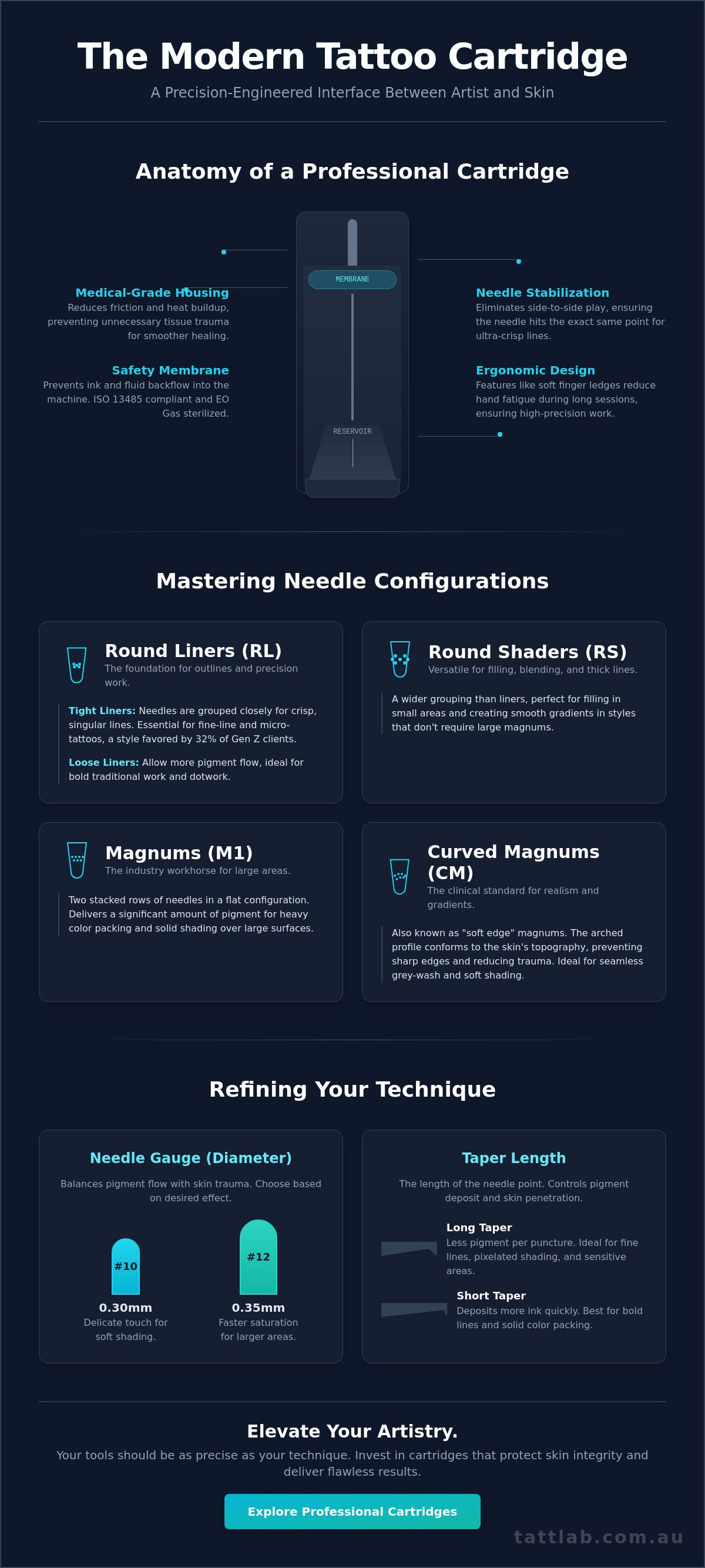
The modern professional tattoo cartridge isn't just a plastic shell; it's a precision-engineered medical device designed to manage the delicate interaction between pigment and the dermis. While the history of tattooing involved rudimentary tools, today’s industry relies on sophisticated delivery systems that prioritize skin integrity. High-quality tattoo cartridges utilize medical-grade plastics for their internal housing. This choice of material is vital because it reduces friction between the needle bar and the casing. When friction is minimized, the needle moves with a consistent, predictable rhythm, preventing the heat buildup that can lead to unnecessary tissue trauma and prolonged healing times for the client.
The Science of Backflow Prevention
Safety in a modern studio is non-negotiable. Traditional setups often relied on rubber bands, but professional tattoo cartridges now feature internal membranes. These serve as a physical barrier against fluid tension, preventing ink and biological fluids from traveling back into the machine. Leading manufacturers adhere to ISO 13485 standards, ensuring membranes are produced in sterile environments. Every unit undergoes Ethylene Oxide (EO) gas sterilization. This clinical rigor ensures the artist's focus remains on the journey of transformation rather than the mechanics of safety, maintaining a Lab-grade standard in every session.
Housing Design and Ink Reservoirs
The geometry of the cartridge tip dictates how pigment is released. An "Inkflow" design uses internal grooves to create a steady reservoir, preventing pigment spitting. Artists choose between clear tips for visibility or tinted versions to reduce glare. Ergonomics also matter; designs with soft finger ledges are essential for maintaining comfort during six-hour sessions. These features allow for the steady hand required for high-precision work without the risk of hand fatigue, ensuring the skin remains the primary focus of the procedure.
Precision is further enhanced by needle stabilization systems. By incorporating an internal bridge or a dedicated guide within the tip, manufacturers eliminate side-to-side play. This ensures that the needle hits the exact same point every time it enters the skin, a standard now expected across the 62,000 licensed tattoo establishments globally. For artists, this means ultra-crisp lines and smooth shading without the micro-vibrations that cause hand fatigue during long days. When you select a cartridge with these anatomical features, you're investing in a tool that respects the biological complexity of the skin and ensures a controlled, predictable evolution of the artwork. This meticulous approach to equipment mirrors the precision of the treatments themselves, where 32% of Gen Z clients now favor ultra-fine-line aesthetics.
Deciphering Configurations: Round Liners, Shaders, and Magnums
Selecting the correct needle configuration is a clinical decision that dictates the success of the skin’s healing journey. Each arrangement of needles within professional tattoo cartridges is engineered to interact with the dermis in a specific way, balancing pigment saturation with the preservation of skin health. When an artist maps their needle groupings to the intended outcome, they reduce the risk of overworking the tissue, which is essential for maintaining the long-term clarity of the piece. This methodical approach ensures that every puncture serves a purpose, moving the artwork from a concept to a permanent biological transformation.
Liners and Shaders: The Foundation of the Piece
The evolution of the Round Liner (RL) has been driven by the rise of fine-line and micro-tattooing, a style now favored by 32% of Gen Z clients. Tight liners feature needles grouped closely together to create high-tension points for crisp, singular lines. Conversely, loose liners allow for more pigment flow, making them ideal for traditional bold work or dotwork. For artists who require a reliable 0.35mm pull, Elite III Round Liners provide the mechanical consistency needed for high-precision outlines. When transitions require more than a single line, Round Shaders (RS) offer a versatile solution for small-area filling and thick-line blending, ensuring the ink is deposited without the harshness of a dedicated liner.
Magnums and Curved Magnums for Large Scale Work
For heavy packing and solid color blocks, standard Magnums remain the industry workhorse. However, the Curved Magnum (CM), or "soft edge" magnum, has become the clinical standard for realism and seamless grey-wash gradients. The slightly arched profile of the needles conforms better to the natural topography of the skin, preventing the "stabbing" effect often seen at the edges of a flat magnum stroke. This design choice is critical for managing tattoo ink safety and skin trauma; it allows for smoother transitions and reduces the inflammatory response during the procedure.
Choosing the right gauge further refines this process. A #10 gauge (0.30mm) provides a more delicate touch for soft shading, while a #12 gauge (0.35mm) allows for faster saturation in larger areas. Understanding these technical nuances allows you to tailor your setup to the specific needs of each client. If you're looking to upgrade your studio setup, explore our curated collection of professional tools to find the perfect match for your technique. By matching the needle gauge and configuration to the biological demands of the skin, you ensure a predictable, high-quality result that respects the integrity of the body’s largest organ.
Key Performance Metrics: Tapers, Gauges, and Skin Trauma
Mastering the mechanics of tattoo cartridges requires a deep understanding of how needle geometry affects the skin’s biological response. While configurations dictate the pattern of the "hit," the taper and gauge determine the depth, precision, and trauma level of every puncture. For the modern artist, these metrics aren't just technical specs; they're the variables that control ink saturation and long-term skin health. By selecting the right combination, you can minimize the inflammatory response and ensure the healing journey is as smooth as the application itself.
The Taper Guide for Professional Artists
The taper refers to the length of the needle’s point before it reaches its full diameter. This length dictates how much resistance the needle meets when entering the dermis. Long Tapers (6mm to 7mm) are the clinical standard for black and grey realism. Because the point is finer, it creates a smaller puncture, allowing for soft, layered shading with minimal trauma. Conversely, Short Tapers (2mm to 3mm) provide a "blunter" hit that carries more pigment into the skin. These are essential for traditional styles where bold, one-pass saturation is the goal. Medium Tapers (3.5mm to 4.5mm) act as the versatile all-rounder, offering a balanced ink flow that suits mixed-style studios. Understanding these nuances helps prevent overworking the tissue, which is a primary cause of adverse reactions to tattoos like scarring or pigment migration.
Understanding Needle Gauges (Diameter)
Needle gauge, or diameter, determines the size of the ink deposit. The industry standard is the #12 (0.35mm), which provides a robust puncture for bold lines and heavy color packing. However, many specialists are shifting toward the #10 (0.30mm) for its versatility in both lining and shading. For ultra-fine detail and micro-realism, "Bugpins" like the #08 (0.25mm) offer a significant advantage. These thinner needles allow for tighter groupings, enabling the artist to achieve photographic levels of detail without excessive skin trauma.
Balancing these gauges with the client's skin type is a hallmark of a professional approach. Thinner, more delicate skin often responds better to a #10 or #08 gauge with a long taper, as this combination reduces the mechanical force required for penetration. In contrast, tougher skin areas may require the stability of a #12 gauge to ensure consistent depth. By tailoring your tattoo cartridges to the specific biological needs of the area, you protect the skin's integrity. This meticulous selection process reduces the risk of blowouts and ensures that the final result remains crisp and vibrant as the skin evolves over time.
Standout Selections: Comparing Elite and EZ Cartridge Series
Selecting the right hardware is a critical step in an artist's professional journey. With the global tattoo supplies market projected to reach 2.6 billion dollars by 2034, the variety of tattoo cartridges available can be overwhelming. However, two brands have emerged as industry benchmarks for clinical reliability and artistic precision: Elite and EZ. These manufacturers prioritize the skin health standards we value, offering specialized series that cater to different studio environments and technical requirements. Choosing between them requires an understanding of how their internal architecture supports your specific tattooing style.
Elite III vs. Elite EVO: Which is Right for You?
The Elite series represents a logical progression in needle engineering. The Elite III remains the reliable workhorse for high-volume studios, favored for its consistent mechanical drive and extensive range of classic #12 (0.35mm) configurations. It's a pragmatic choice for artists who demand predictability in every blister pack. In contrast, the Elite EVO is designed for those seeking a more refined interface with the skin. It features an enhanced tip design that improves ink visibility and incorporates a stabilization system to eliminate micro-vibrations. While a box of 20 Elite liners typically ranges between $23.99 and $32.99 as of 2026, the EVO series offers a justified evolution for artists focusing on intricate, long-session pieces where ergonomic comfort is paramount.
EZ Series: Innovation in Needle Drive
EZ Tattoo Supply has introduced several series that align perfectly with the 29% adoption rate of wireless, pen-style professional tattoo machines. Their V-Select series is particularly noteworthy for its patented V-System, which utilizes a precision-tension membrane to reduce vibration and improve needle accuracy. This system ensures a steady, controlled "hit" that is essential for the 10.2% compound annual growth we see in the industry’s adoption of complex, fine-line styles. For studios managing overheads without sacrificing safety, the EZ Revolution series provides high-performance membranes that meet strict sterilization standards. These cartridges ensure that the clinical integrity of the studio is never compromised, regardless of the volume of work being produced.
Choosing between these series often comes down to the specific rhythm of your artistic practice. Whether you prioritize the ergonomic refinement of the EVO or the mechanical stability of the V-Select, your tools must support the long-term health of your client's skin. To ensure your studio is equipped with the highest standard of hardware, shop our professional cartridge range and find the configuration that elevates your output. By selecting tools that mirror the precision of a medical laboratory, you transform the tattooing process into a predictable, high-quality evolution of the skin.
Strategic Sourcing: Building Your Studio’s Cartridge Inventory
The transition from traditional bar needles to modern tattoo cartridges represents a significant leap in studio efficiency. With the adoption rate of wireless rotary machines reaching 29% in 2026, the cartridge has become the definitive standard for the contemporary artist. This shift isn't merely about convenience. It's about establishing a controlled, sterile environment where every component of the procedure is predictable. Building a strategic inventory ensures that your artistic journey isn't interrupted by equipment failure or supply shortages, allowing you to maintain a steady focus on skin health and professional evolution.
Creating a Versatile Setup
A sophisticated studio inventory doesn't require every possible configuration. Most artists find that an "Essential 5" setup, typically consisting of a 3RL, 7RL, 9RS, 15CM, and a larger 23RM, provides the necessary range for most biological transformations. For those specializing in fine-line work, which 32% of Gen Z clients now request, adding #08 bugpins is a logical evolution. It's vital to integrate these tools with medical supplies for tattoo artists to maintain a truly sterile workflow. We recommend testing any new needle brand or gauge on practice skins before client sessions. This methodical approach allows you to understand the specific "hit" of the cartridge without risking a client's skin integrity.
Why Sourcing Nationally Matters
Reliability of supply is the backbone of a successful studio. Relying on international shipping often leads to the "out of stock" nightmare, which can stall your studio's progress and impact cash flow. Sourcing your tattoo cartridges within Australia ensures access to express shipping and a predictable inventory cycle. This is particularly important as the global market grows toward a projected 6.46 billion dollars by 2035, increasing the demand for high-quality, verified hardware.
Sourcing locally also guarantees that every box meets Australian safety and hygiene standards. At Tatt Lab, our "Lab-Tested" promise means every product has been vetted for mechanical stability and membrane integrity by specialists who value skin health above all else. We prioritize products that provide a steady, educational, and low-pressure experience for the artist. When you're ready to refine your setup and ensure your tools match the sophistication of your art, browse the full range of professional tattoo cartridges at Tatt Lab. This final step in your sourcing strategy ensures your studio remains a high-end laboratory where science meets skin health.
Elevating Your Clinical Practice Through Precision
Your choice of hardware is the final piece in the clinical evolution of your studio. By mastering the relationship between taper length, needle gauge, and membrane tension, you ensure that every procedure respects the biological complexity of the skin. These technical decisions directly influence the clarity and longevity of the artwork as it heals, turning a standard session into a sophisticated journey of transformation. Precision isn't just about the visual result; it's about the long-term health of the dermis.
Selecting professional tattoo cartridges shouldn't be a matter of guesswork; it's a strategic investment in your artistic output. We've examined how refined stabilization systems and medical-grade materials reduce friction and prevent trauma. As an artist-owned and operated specialist, Tatt Lab serves as the official Australian stockist for Elite and EZ brands, ensuring every box in your inventory meets our rigorous "Lab-Tested" standard for safety and performance.
We invite you to Shop Australia’s Leading Range of Professional Tattoo Cartridges to experience the difference that expert-vetted quality makes. Benefit from free shipping on orders over $100 across Australia and the peace of mind that comes from a reliable, national supply chain. We're here to support your creative evolution from the first line to the final result. Your art deserves the highest standard of care.
Frequently Asked Questions
Are tattoo cartridges universal for all machines?
Most modern rotary pens and machines use a standardized twist and lock connection known as the universal cartridge system. This design allows you to switch between brands like Elite and EZ without changing your hardware. However, some proprietary systems require specific adapters or dedicated brand-specific needles. Always verify that your machine supports the universal standard to ensure a secure, stabilized fit during the procedure.
What is the difference between a bugpin and a regular tattoo needle?
The primary difference lies in the diameter of the individual needles within the grouping. Standard needles are typically 0.35mm (#12 gauge), while bugpins are thinner, usually measuring 0.25mm (#08 gauge) or 0.30mm (#10 gauge). These thinner gauges allow for tighter groupings and more delicate punctures. This reduces the mechanical force required for entry, which is essential for achieving the photographic detail found in micro-realism.
How do I know if a tattoo cartridge has a safety membrane?
You can verify the presence of a safety membrane by inspecting the internal housing of the unit. High-quality tattoo cartridges feature a visible silicone or rubber barrier that separates the needle bar from the back of the shell. This membrane acts as a physical seal against fluid backflow into your machine. Professional manufacturers will also clearly state "membrane system" on the blister packaging to distinguish them from cheaper alternatives.
Which cartridge configuration is best for fine-line tattooing?
A Tight Round Liner (RL) using a #08 or #10 gauge is the clinical standard for fine-line work. These configurations group the needles closely at the tip to create a single, high-tension point of entry. This precision is necessary for the ultra-thin aesthetics favored by 32% of Gen Z clients. Using a long taper with these liners further minimizes trauma while ensuring crisp, singular line weights in every pass.
Can I use a 22mm magnum in a standard tattoo pen machine?
Compatibility depends entirely on the diameter of your machine’s opening. While most universal tattoo cartridges fit standard pens, large configurations like a 22mm magnum may be too wide for machines with narrow grips. Always check the physical clearance of your machine's mouth before a session. Forcing a large magnum into a narrow opening can cause friction against the plastic shell, leading to inconsistent needle depth and potential machine damage.
Why is ink spitting from my cartridge tip?
Spitting usually occurs when air is trapped in the reservoir or the needle hang is set incorrectly. If the needle is retracted too far into the tip, it creates a vacuum that disrupts the pigment flow. This can also happen if the tip geometry is poorly designed. Selecting cartridges with "Inkflow" grooves helps manage fluid tension, ensuring the pigment is deposited into the skin rather than pooling on the plastic surface.
How often should I change my cartridge during a long session?
You should change your cartridge if you notice any decline in needle sharpness or a change in the "hit" against the skin. During sessions exceeding four hours, the constant friction can dull the fine points of the needles. Replacing the unit ensures you maintain a clinical level of precision throughout the entire journey. This proactive approach prevents overworking the tissue and protects the long-term integrity of the skin.
What does "EO Gas Sterilized" actually mean for my studio safety?
Ethylene Oxide (EO) gas sterilization is a clinical process that eliminates all viable microorganisms, including spores and viruses. Each cartridge is placed in a breathable blister pack and exposed to the gas, which penetrates the packaging to sterilize the contents. This is the global standard for medical devices. It ensures that every tool you use is 100% sterile until the moment you open the individual package for a procedure.


Comments (0)
There are no comments for this article. Be the first one to leave a message!