

A high-voltage motor won't save a line if the stroke calibration is off. In fact, raw power without specific mechanical torque is exactly what leads to skin trauma and inconsistent ink blowouts. You likely recognize that the difference between a crisp, saturated line and a shaky result often comes down to how your equipment handles the skin's natural resistance. Finding the best rotary tattoo machine for lining in 2026 requires a shift in focus toward precision engineering rather than just raw speed.
This selection guide provides the technical specifications and artist-vetted machines that deliver consistent results while maintaining skin health. We've analyzed the latest hardware to ensure you can achieve single-pass saturation; this efficiency can reduce client healing time by up to 20 percent compared to underpowered alternatives. You'll discover how specific stroke lengths between 3.5mm and 4.2mm provide the necessary punch to overcome hand fatigue during long sessions. We're exploring the intersection of ergonomic comfort and mechanical reliability to help you evolve your craft with clinical precision.
Key Takeaways
- Learn how the transition from traditional coil vibration to rotary motor precision minimizes skin trauma while ensuring consistent needle depth across every pass.
- Identify the specific torque requirements needed in the best rotary tattoo machine for lining to overcome skin resistance and achieve clean, saturated results.
- Evaluate the ergonomic differences between modern tattoo pens and traditional rotary frames to reduce hand fatigue during intensive lining sessions.
- Discover how to match machine stroke length to your artistic specialty, whether you're focusing on delicate fine-line work or bold American Traditional designs.
- Explore the benefits of choosing vetted hardware that prioritizes skin health and long-term mechanical reliability through the Tatt Lab specialist framework.
The Evolution of Lining: Why Professionals are Switching to Rotary
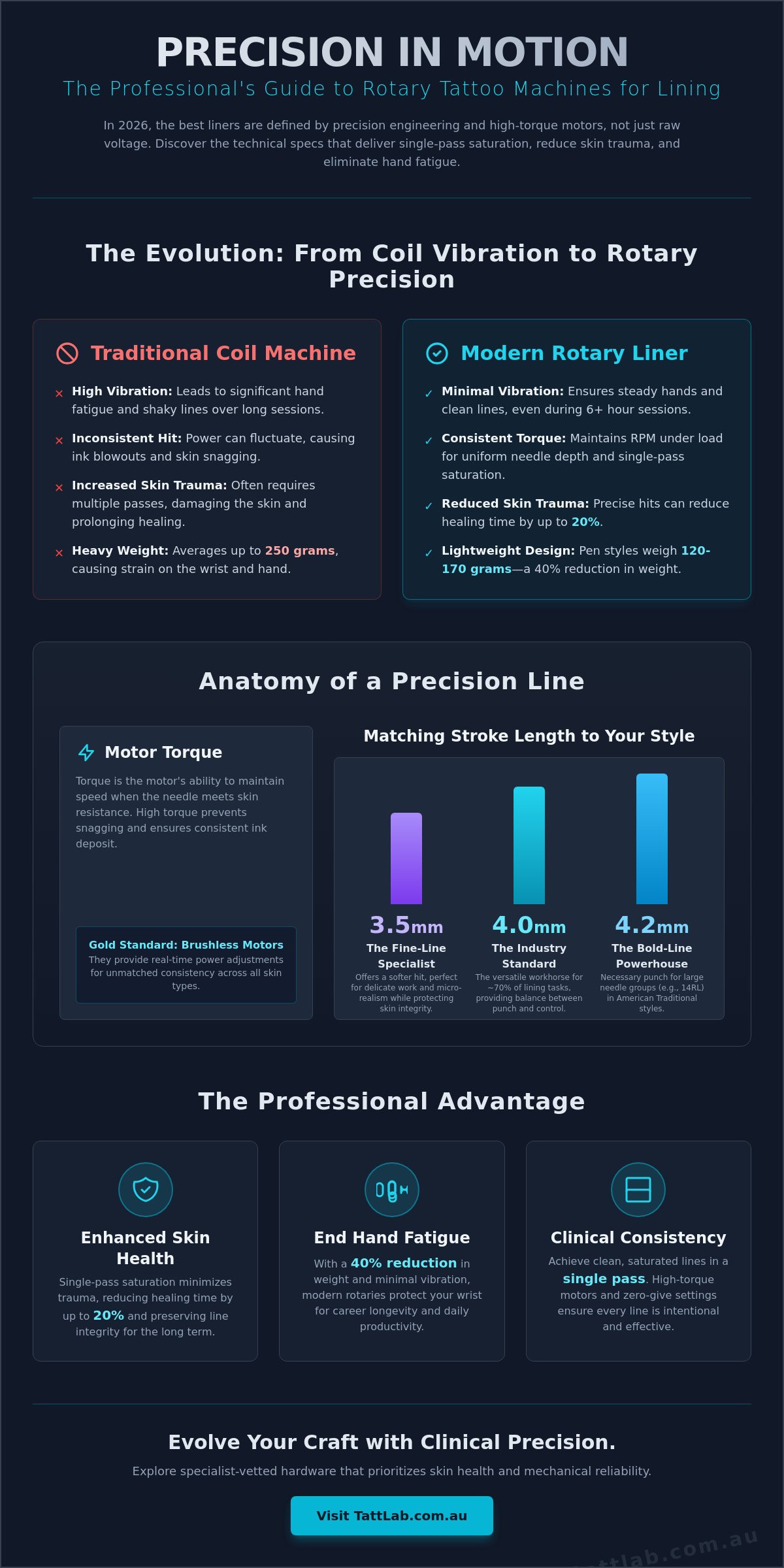
The transition from electromagnetic coils to high-torque rotary motors marks a significant mechanical evolution in how artists approach line work. While the history of the tattoo machine highlights the nostalgic charm of the traditional buzzing coil, modern professionals prioritize the clinical consistency of the rotary hit. In the rotary context, lining isn't simply about needle speed; it's about torque. A motor must maintain its RPM even when meeting the resistance of tough skin. This consistency ensures that the ink is deposited at a uniform depth, preventing the "snagging" often associated with older technology. Selecting the best rotary tattoo machine for lining means choosing a tool that provides a punchy, snappy response rather than a soft, "give-heavy" stroke.
Many artists fall into the trap of using a generic "all-rounder" machine for every task. While versatile, these machines often lack the specific stroke calibration needed for heavy lining. A dedicated liner ensures the needle spends less time in the skin, which is the primary factor in maintaining skin integrity while achieving saturated results. By focusing on mechanical torque rather than just raw voltage, you can pull clean lines in a single pass, which is the gold standard for modern professional work.
Precision Meets Skin Health
When a machine delivers a consistent hit, the skin experiences significantly less trauma. Coils can be temperamental, often requiring multiple passes that can chew up the epidermis and lead to scarring. By contrast, a high-quality rotary allows for single-pass saturation. This evolution is vital for skin health, as reduced trauma leads to a more efficient immune response during the healing process. At Tatt Lab, we view hardware through a specialist lens, where mechanical precision directly correlates to clinical outcomes. Proper equipment choices, combined with strategies found in our guide on Mastering Tattoo Aftercare, ensure that crisp lines remain sharp through the fading process. Using a machine that respects the skin's biological limits can reduce total healing time by up to 20 percent.
The End of Hand Fatigue
Vibration is the silent enemy of the long-term tattoo career. Traditional machines can weigh up to 250 grams, putting immense strain on the wrist and carpal tunnel over years of use. Modern rotaries, especially pen-style models, often weigh between 120 and 170 grams. This 40 percent reduction in weight, coupled with balanced distribution, allows artists to maintain steady hands during 6-hour sessions. By minimizing the micro-vibrations that cause nerve fatigue, you can extend your daily productivity without sacrificing the integrity of your work. It's a shift toward career longevity that respects the artist's body as much as the client's skin.
Technical Specs: Stroke Length and Motor Torque for Lining
The mechanical efficiency of a liner is dictated by two primary factors: stroke length and motor torque. If the stroke is too short, the needle lacks the momentum to penetrate the dermis consistently. If the torque is insufficient, the motor slows down the moment it meets skin resistance, leading to snagged lines and inconsistent ink saturation. Selecting the best rotary tattoo machine for lining requires understanding how these variables interact with different needle groupings. While speed is often discussed in marketing, the stability of the hit is what defines a professional-grade tool in the 2026 landscape.
When searching for the best rotary tattoo machine for lining, artists often prioritize brushless motors for their ability to maintain RPM under load. Unlike traditional brushed motors, brushless systems use electronic controllers to adjust power delivery in real-time. This ensures that whether you're working on soft inner-arm skin or tougher calf tissue, the needle depth remains identical. This clinical approach to power delivery mirrors the precision we value in skin health, ensuring that every pass is intentional and effective.
Stroke Length Comparison for Liners
Stroke length determines how far the needle travels and how hard it hits the skin's surface. A 3.5mm stroke is a nuanced choice for fine-line work and micro-realism. It offers a softer hit that protects the skin's integrity in delicate areas. For approximately 70 percent of daily lining tasks, the 4.0mm stroke is the industry standard. It provides enough punch for standard round liners while maintaining control. When you're moving into American Traditional territory with 14-round liners, a 4.2mm stroke becomes necessary to ensure the needle fully retracts and hammers back in with enough force to deposit heavy pigment in a single pass.
Torque and Needle Tension
A machine's give setting plays a vital role in how it handles needle tension. For lining, most specialists prefer a zero-give or hard setting. This ensures a direct transfer of energy from the motor to the needle. Direct drive systems excel here because they have fewer moving parts between the motor and the cam, resulting in a more stable needle path. While adhering to tattoo safety regulations ensures your pigments meet health standards, your hardware must be equally reliable to prevent micro-scarring.
Ensure your power supply can handle the machine's torque requirements. A drop in voltage can cause the motor to stall mid-line, leading to a loss of saturation. For those looking to upgrade their setup with high-performance professional round liners, matching the needle tension to your machine's torque is the final step in the journey toward perfect saturation. This methodical approach to hardware selection reduces the need for multiple passes, directly supporting the skin's natural healing evolution.
Pen-Style vs. Traditional Rotary: Which is the Superior Liner?
The choice between a pen-style machine and a traditional rotary frame is often the most debated topic in a modern studio. While both utilize a motor to drive the needle, their mechanical delivery systems and weight distributions differ significantly. According to a comprehensive analysis of tattoo technologies, the evolution toward pen-style machines has prioritized artist ergonomics and intuitive handling. However, identifying the best rotary tattoo machine for lining requires looking beyond comfort. You must consider how each form factor manages needle tension, sanitation, and the physical "throw" required for different lining styles.
Sanitation remains a critical differentiator in this comparison. Bagging a traditional rotary can be cumbersome due to its irregular shape and exposed moving parts, while pens slide easily into a slim, sterile sleeve. However, the internal components of a pen require a different level of care. Since the drive system is enclosed, using high-quality Tattoo Cartridges with safety membranes is non-negotiable to prevent pigment backflow into the motor housing. This clinical approach to equipment maintenance ensures the longevity of your hardware and the safety of your client's skin.
The Pen-Style Advantage
Pen machines offer a familiar grip that mimics a standard drawing tool, which reduces the cognitive load during complex illustrative work. This form factor allows for a more natural flow, especially when pulling long, continuous lines. Many 2026 models now feature integrated wireless batteries, removing the drag and snagging resistance often caused by RCA cords. From a clinical perspective, the "Lab" standard for pen machines involves meticulous cleaning of the grip and ensuring the internal plunger remains free of debris. This precision allows for unmatched control in fine-line and micro-realism styles where every millimetre of movement counts.
Traditional Frame Rotaries
Traditional frames, featuring either a vertical or horizontal motor layout, provide a distinct mechanical "throw." Many artists find that these machines deliver a snappier hit that feels remarkably similar to a traditional coil. This "punch" is essential for pushing larger needle groupings where skin resistance is significantly higher. Unlike most pens, traditional rotaries often allow you to swap cams or adjust the stroke on the fly. This level of customization is a major advantage for technical specialists who need to tune their machine for specific skin types. They're also built for professional longevity; you can often replace individual bearings or springs yourself, ensuring the machine stays in peak condition for a decade or more.
Ultimately, the best rotary tattoo machine for lining is the one you can keep 100 percent sterile without compromising its mechanical integrity. Whether you prefer the balanced weight of a pen or the customizable hit of a frame, your choice should always prioritize the long-term health of the skin and the precision of the final result.
Selecting Your Ideal Liner Based on Artistic Style
Every artistic genre demands a unique mechanical response from your hardware. Finding the best rotary tattoo machine for lining isn't a universal search; it's a calibration of your machine's stroke to your specific aesthetic. Fine-line specialists and micro-realists typically seek high-frequency machines with a shorter 3.0mm to 3.5mm stroke. This setup allows for rapid needle movement, ensuring that even at high hand speeds, the line remains a continuous, saturated thread rather than a series of micro-dots. Maintaining skin health here is paramount, as delicate work often involves precision in high-sensitivity areas where over-working the tissue is a constant risk.
In contrast, American Traditional and Irezumi styles require what many call hard hitters. These styles rely on bold, consistent outlines made with 9-round liners or larger. To push these groupings into the dermis without snagging, you need a long-stroke machine (4.0mm to 4.2mm) with high motor torque. This mechanical punch ensures the needle overcomes the resistance of the skin's surface tension on the first pass. Neo-traditional artists often find themselves in the middle, requiring the best rotary tattoo machine for lining that offers versatility to handle both a 3RL for fine detail and a 9RL for heavy framing without switching hardware mid-session.
Matching Needle Groupings to Machine Power
The physics of lining change as needle surface area increases. Small groupings like a 3RL or 5RL require higher speeds but lower impact to avoid chopping the skin. If your voltage is too high for a small grouping, you risk causing unnecessary trauma and subsequent ink migration. Conversely, pushing a 14RL requires substantial torque to prevent the motor from bogging down. This is where the science of pigment comes into play. For a deeper look at how different pigments interact with these mechanics, consult The Professional Guide to Tattoo Ink. Understanding the viscosity of your ink is just as vital as your machine's stroke length for achieving single-pass saturation.
The Artist's Journey: Scaling Your Equipment
Your equipment should evolve alongside your technical skill. Most apprentices begin with a versatile, mid-stroke rotary to learn the foundations of needle depth and hand speed. However, as you specialize, the need for a dedicated liner becomes clear. Transitioning to an artist-vetted, high-torque machine can reduce hand strain by approximately 30 percent during large-scale projects. This move from a generalist tool to a specialized instrument marks a significant milestone in your professional evolution, ensuring your work remains crisp and your client's skin stays healthy as your career progresses.
Ready to refine your technical setup with hardware that prioritizes precision? Explore our range of specialist tattoo supplies to find the precision tools your specific style demands.
The Specialist’s Choice: Why Source from Tatt Lab?
Selecting the best rotary tattoo machine for lining is a commitment to your technical evolution and the long-term health of your client's skin. At Tatt Lab, we apply a clinical rigor to our hardware selection, ensuring every machine meets a standard of mechanical integrity that respects the biological limits of the dermis. We don't believe in the hype of "all-rounder" marketing. Instead, our collection is curated based on objective metrics: torque stability, stroke precision, and motor reliability. By sourcing from a local Australian specialist, you gain a partner dedicated to the science of the craft rather than just a retail outlet.
Every machine in our inventory undergoes a vetting process to ensure it can handle the daily rigors of a high-volume studio. We understand that in 2026, the professional landscape requires tools that offer both ergonomic comfort and uncompromising power. Supporting the Australian industry means providing expert knowledge that's only a phone call or local visit away. This proximity allows us to offer tailored advice that helps you transition from generalist tools to specialized instruments designed for specific artistic outcomes.
The Tatt Lab Professional Advantage
Registered Australian studios can access wholesale accounts, streamlining the procurement process for high-end gear. Our team consists of professionals who understand the nuances of the equipment we sell; we don't just move boxes, we provide technical support grounded in studio experience. This expertise ensures your hardware works in seamless integration with our Medical Supplies for Tattoo Artists. Maintaining a sterile, high-precision environment is a holistic process that starts with your machine and extends to every barrier film and disinfectant used in your workspace.
Final Checklist for Your New Liner
Before you invest in the best rotary tattoo machine for lining, ensure your choice aligns with your technical requirements. A mismatch between your style and your machine's stroke can lead to inconsistent results and increased skin trauma. Use this checklist to verify your setup:
- Verify Stroke Length: Ensure the cam matches your primary style (3.5mm for fine-line, 4.0mm+ for bold traditional).
- Power Compatibility: Confirm your existing power supply or wireless batteries can handle the motor's specific torque requirements.
- Cartridge Quality: Only use professional-grade cartridges with safety membranes to prevent backflow and protect the machine's internal drive.
- Maintenance Plan: Establish a routine for cleaning and lubricating your machine to ensure it operates at peak efficiency for years.
We understand that studio downtime is a significant pain point. That's why we prioritize express shipping across Australia, ensuring most metro orders arrive within 24 to 48 hours. This local presence keeps your studio running without the uncertainty of international delays. When you're ready to upgrade your precision, explore our curated range of professional rotary machines and take the next step in your professional journey.
Elevate Your Lining Standards with Clinical Precision
The journey to perfect saturation is a balance of mechanical torque and biological respect. By understanding that a 4.0mm stroke provides the necessary hit for single-pass lines, you reduce skin trauma and support the client's healing evolution. We've explored how the best rotary tattoo machine for lining isn't just about speed; it's about the consistent delivery of power that prevents hand fatigue during long sessions. It's about precision. It's about lasting results.
Tatt Lab is an artist-owned and operated specialist hub that prioritizes skin health through a curated selection of hardware and specialized medical-grade studio supplies. Our commitment to the Australian industry includes express nationwide shipping, with most metro orders arriving within 24 to 48 hours. This ensures your studio remains at the cutting edge of tattoo technology without the burden of international delays. We invite you to refine your setup with tools that respect your craft and your clients' skin.
Shop Artist-Vetted Rotary Machines at Tatt Lab
Frequently Asked Questions
Can you use a rotary tattoo machine for all lining styles?
Yes, rotary machines are capable of executing every lining style from 3RL micro-realism to 14RL American Traditional. The key is ensuring the motor has the torque to maintain RPM under the specific resistance of the needle grouping. While a single machine might struggle with every extreme, modern hardware with adjustable cams allows for this versatility. Matching the machine's mechanical output to the desired saturation ensures the skin's integrity is preserved during the process.
What is the best stroke length for a dedicated rotary liner?
A 4.0mm stroke length is widely considered the industry standard for versatile lining tasks. This length provides enough momentum to penetrate the dermis in a single pass without over-working the tissue. If you specialize in bold, heavy outlines, a 4.2mm stroke may be more effective. Finding the best rotary tattoo machine for lining often involves selecting a stroke that balances needle retraction with a punchy, decisive hit to ensure ink saturation.
Do rotary machines hurt less than coil machines for lining?
Clients often report less discomfort with rotary machines because they produce significantly fewer micro-vibrations than traditional coils. Coils can vibrate at frequencies that irritate the nervous system more intensely over long sessions. Additionally, the mechanical efficiency of rotaries often allows for single-pass saturation. Reducing the number of passes over the same area minimizes trauma to the epidermis; this leads to a more comfortable experience and a faster healing evolution.
Why is my rotary machine snagging the skin while lining?
Snagging usually occurs when the motor's torque is insufficient to overcome the skin's surface tension. This causes the needle to slow down or "hang" in the tissue rather than retracting cleanly. Ensure your voltage is high enough to maintain the required RPM and check that you aren't using a stroke length shorter than 3.5mm for tough skin. Using high-quality cartridges with sharp, professional-grade needles is also essential to prevent mechanical drag and unnecessary skin trauma.
Should I use a wireless pen or a corded rotary for lining?
Wireless pens offer 100 percent freedom of movement and easier sanitation but can feel top-heavy during long sessions. Corded RCA machines are often lighter and provide a more consistent power flow without the risk of battery depletion. For heavy lining, many specialists still prefer the reliability of a corded setup to ensure the motor never drops in torque. Ultimately, the choice depends on your ergonomic needs and the specific weight balance you require for steady hand control.
How do I maintain my rotary liner for consistent performance?
Routine maintenance involves cleaning the drive bar and lubricating the internal cam every 40 to 50 hours of use. Since rotaries have enclosed motors, preventing ink backflow is the most critical step for longevity. Always use cartridges with safety membranes to keep the internal drive system sterile and free of debris. This clinical approach to hardware care ensures your machine maintains its original torque and stroke precision throughout its professional lifespan.
What voltage should I run my rotary machine at for lines?
Most modern rotary machines perform optimally for lining between 6.5 and 9.0 volts. The exact setting depends on your hand speed and the machine's motor type; brushless motors often require slightly higher voltage to reach their peak torque. Start at a lower setting and increase until the needle penetrates the skin without resistance. Finding the best rotary tattoo machine for lining also means finding the "sweet spot" where the hit is snappy but doesn't cause blowouts.
Are rotary machines suitable for bold traditional lining?
Yes, high-torque rotaries with a 4.2mm stroke are excellent for bold American Traditional outlines. These machines provide the "hard hit" necessary to push 9RL to 14RL groupings into the skin in one pass. While some artists still prefer the feel of a coil for this style, modern rotaries offer better weight distribution and 30 percent less vibration. This mechanical evolution allows for the same bold results while significantly reducing the physical strain on the artist's wrist.


Comments (0)
There are no comments for this article. Be the first one to leave a message!