

Your tattoo machine is only as capable as the mechanical interface connecting it to the skin. If your needle wobble persists or your ink flow stutters, even the most expensive rotary setup becomes a liability rather than an asset. Selecting high-performance tattoo cartridges is not just a matter of artistic preference; it's a critical technical decision that impacts your machine's mechanical longevity and your client's biological safety. In an industry where precision is the standard, the tools you choose must mirror the meticulousness of your craft.
We understand the frustration of a needle that lacks stability during a delicate fine-line session or the anxiety caused by potential backflow into your motor. This guide provides the clinical clarity you need to master cartridge selection, ensuring every pull is crisp and every gradient remains smooth. We'll examine the science of membrane tension, the necessity of medical-grade polycarbonate housings, and how specific tapers influence pigment delivery. By the end of this analysis, you'll have a logical framework for choosing configurations that protect your equipment and deliver the predictable, high-quality outcomes your clients deserve.
Key Takeaways
- Identify how self-contained needle systems provide a superior barrier against cross-contamination while significantly reducing your setup and teardown times.
- Master the technical distinction between needle gauges and taper lengths to ensure consistent ink delivery and precise skin penetration.
- Learn to select the ideal tattoo cartridges for your specific technique, from high-stability Round Liners to versatile Round Shaders.
- Compare the performance profiles of the Elite™ and EZ ranges to find the optimal balance of needle tension and machine protection for your studio.
- Ensure clinical-level safety by verifying EO gas sterilization and sourcing medical-grade equipment from reputable Australian providers.
The Evolution of Tattoo Cartridges: Efficiency and Machine Protection
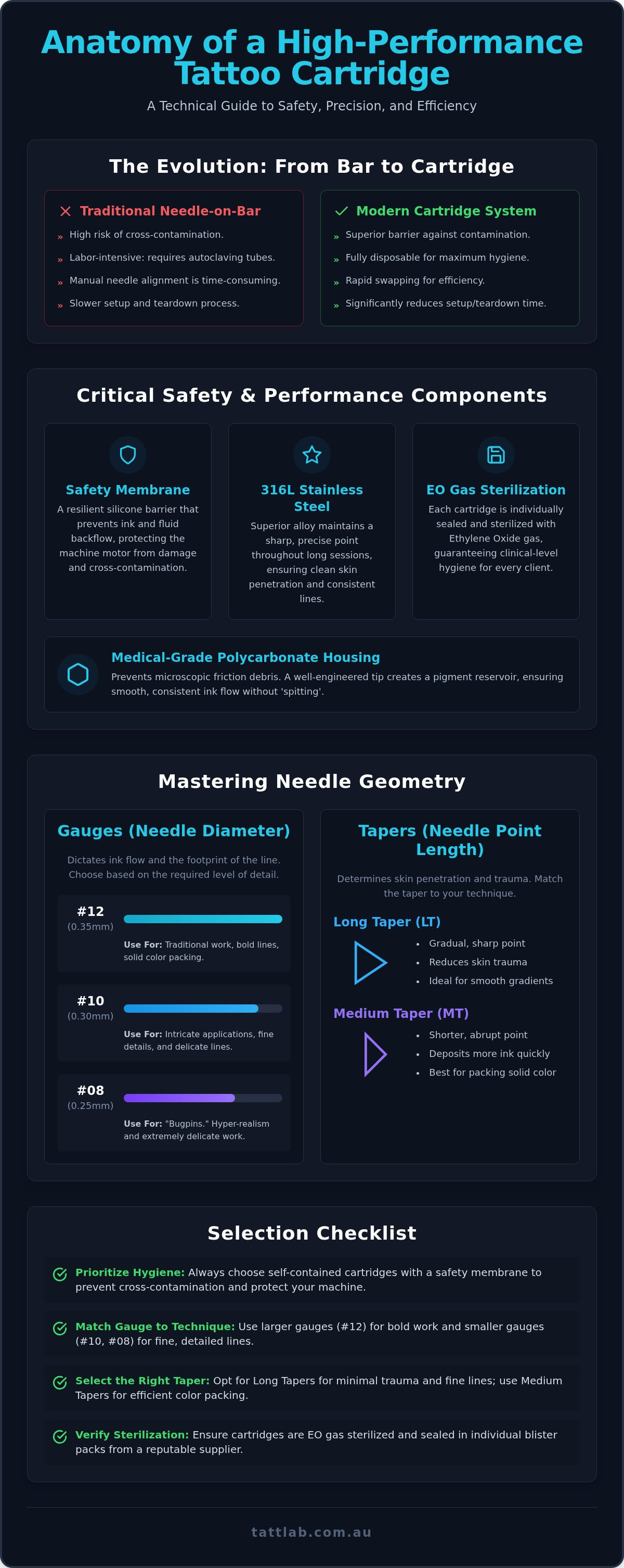
Throughout the history of tattooing, the tools of the trade have evolved from rudimentary hand-tools to the sophisticated mechanical interfaces we rely on today. Modern tattoo cartridges represent the most significant leap in this progression. They are modular, self-contained needle systems designed for rapid swapping and uncompromising hygiene. By integrating the needle and the tip into a single disposable unit, these systems eliminate the need for traditional needle-on-bar setups. This transition has redefined the professional studio. It has moved us away from the labor-intensive process of autoclaving stainless steel tubes and manually aligning needles. Instead, artists can now focus entirely on the artistic narrative of their work.
The transition to these integrated systems is a response to the industry's demand for better workflow and safety. Traditional setups often carried a higher risk of cross-contamination because the entire tube assembly required sterilization between every client. In contrast, the shift in tattoo supplies toward disposable cartridges ensures that every component touching the skin or ink is discarded after a single use. This methodical approach to hygiene protects both the client and the artist's reputation. It's a clinical standard that aligns with modern health regulations and the expectations of a sophisticated clientele.
The Role of the Internal Membrane
The safety membrane is the most critical engineering feature of a professional cartridge. It acts as a resilient physical barrier. This prevents ink, blood, and interstitial fluid from traveling back through the grip and reaching the internal motor of your rotary machine. Without a high-quality membrane, backflow can cause permanent mechanical damage to expensive equipment. It can also lead to cross-contamination inside the machine itself. While some budget options use tension-based rubber bands, professional-grade cartridges utilize high-resilience silicone membranes. Silicone provides a consistent return force. It doesn't lose its elasticity or degrade during long sessions. This ensures your machine motor operates under predictable resistance, preventing overheating and ensuring a steady needle drive.
Medical-Grade Materials and Sterilization
Precision begins with the quality of the raw materials. High-performance needles are crafted from 316L stainless steel. This specific alloy offers the structural integrity needed to maintain a sharp point, even when working on tougher skin areas. The housing itself must be manufactured from medical-grade polycarbonate or similar plastics. Inferior materials can create microscopic friction-based debris that may be driven into the skin along with the pigment. To ensure total safety, every cartridge must undergo Ethylene Oxide (EO) gas sterilization. This process penetrates the packaging to eliminate all microbial life. Each unit should be individually sealed in blister packaging with a visible sterilization indicator, providing a transparent record of safety for every procedure.
Anatomy and Engineering: Understanding Tapers and Gauges
The mechanical efficiency of tattoo cartridges is determined by the specific geometry of the needle points. Understanding the 'Gauge' system is the first step in mastering this technical landscape. A #12 needle, measuring 0.35mm in diameter, is the industry standard for traditional work. It allows for a robust, consistent flow of pigment. Conversely, a #10 needle (0.30mm) offers a smaller footprint, which is essential for more intricate applications. This diameter directly dictates how much tattoo ink is deposited with each stroke. If the gauge is too large for the desired detail, the result can be oversaturation. If it's too small for a large fill, you'll likely struggle with patchy results and inefficient sessions.
The needle count, such as a 3RL versus a 9RL, defines the total physical footprint of the tattoo. A higher count spreads the machine's force over a larger area. This requires a systematic adjustment of your hand speed and voltage to maintain uniform saturation. The housing design of the cartridge also plays a pivotal role. A well-engineered tip creates a reservoir that holds the pigment securely, preventing the 'spitting' or inconsistent flow that can ruin a delicate session. Adhering to FDA tattoo safety guidelines ensures that these technical engineering choices don't compromise the biological safety of your client.
Needle Tapers: Long vs. Medium Taper Applications
Taper length refers to the length of the needle's point. A Long Taper (LT) provides a gradual transition to the point. This design allows for easier skin penetration with minimal resistance, which reduces the force required and lowers skin trauma. Medium Tapers (MT) have a shorter, more abrupt point. This provides more surface area at the tip, making them ideal for packing solid colour or traditional lining where a bolder entry is required. Taper length essentially determines the point of entry and the subsequent level of physical trauma to the dermis.
Bugpins: The #08 and #10 Advantage
Bugpins represent a specialized category of tattoo cartridges. These needles, typically #08 (0.25mm) or #10 (0.30mm), are grouped more tightly than standard needles. This configuration is perfect for hyper-realistic portraits and smooth black and grey shading. Because the individual needles are thinner, they create smaller punctures. This allows for incredibly smooth gradients and layers of pigment that appear seamless to the eye. While #12 needles provide maximum saturation for bold work, bugpins offer the finesse required for photographic levels of detail. For artists seeking to refine their technical setup, exploring a professional range of needle configurations can provide the necessary edge in both performance and safety.
Matching Configurations to Artistic Technique
Selecting the right configuration is where technical knowledge meets artistic intuition. While previous sections detailed the internal mechanics of tattoo cartridges, the specific arrangement of those needles determines the texture, depth, and longevity of the healed work. For instance, Round Liners are soldered into a circular, compressed grouping to provide a single, focused point of contact. This setup is essential for creating the structural framework of a piece. Conversely, Round Shaders feature a looser circular grouping. This allows for more diffused pigment delivery, which is ideal for small area filling or softer lining that doesn't require the aggressive bite of a dedicated liner.
The Precision of Round Liners
Stability is the foundation of a clean line. In high-performance tattoo cartridges, the needle is held firmly within the tip to eliminate lateral wobble or 'play'. This mechanical rigidity is what allows for consistent script or intricate fine-line work. Artists typically choose between 'Tight' and 'Extra Tight' configurations depending on the desired outcome. An 'Extra Tight' liner pulls the needle points closer together, creating a needle that feels stiffer and produces a thinner, more concentrated line. This is the specialist's choice for micro-realism and complex geometry. For bold traditional outlines, a standard Round Liner with a larger gauge provides the necessary volume to deposit a saturated line in a single pass. Maintaining these public health standards for tattooing ensures that while you push for artistic precision, you're also upholding the highest levels of clinical safety.
Magnum Theory: Shading and Packing
Magnums are the workhorses of large-scale saturation and smooth gradients. A standard Magnum (M1) features two rows of needles, providing a wide surface area for efficient colour packing. However, the flat edge of an M1 can sometimes create a 'box' effect or harsh lines at the edges of a gradient. This is where Curved Magnums (CM) offer a distinct advantage. By tapering the needle lengths so the grouping follows a slight arc, the needles mimic the natural contour of the skin. This design allows for softer edges and more seamless transitions in black and grey realism. The housing of a professional magnum must also include an optimized ink reservoir. This reservoir ensures that even at high needle counts, the pigment delivery remains steady, preventing the need for multiple passes that could increase skin trauma and delay the healing process.
Brand Comparison: Elite, EZ, and Professional Ecosystems
Selecting the right manufacturer is as vital as choosing the correct needle configuration. While the engineering principles discussed in previous sections remain constant, the execution of those designs varies significantly between brands. Professional tattoo cartridges must offer more than just a sharp needle; they must provide a stable housing that complements the specific torque and stroke of your equipment. For artists using high-end rotary pens, the synergy between the cartridge's internal membrane tension and the machine's motor is the difference between effortless pigment saturation and mechanical strain.
Why Elite™ Remains an Industry Standard
The Elite™ range has earned its position through a methodical focus on structural integrity. The Elite™ EVO series is specifically engineered for artists who prioritize maximum stability. Its medical-grade housing is precision-moulded to minimize friction, which prevents the microscopic plastic debris mentioned earlier in this guide. Many Elite configurations feature a 'Wide Base' design. This subtle ergonomic shift provides a larger surface area for finger placement, reducing hand fatigue during multi-hour sessions. For high-volume studios, the Elite™ III series offers a balanced performance profile, providing reliable membrane protection and needle sharpness at a scale that suits a busy professional environment. As a dedicated Australian stockist, Tatt Lab ensures that these clinical-grade tools are accessible with the reliability of local expertise.
EZ V-Select: Precision and Aesthetics
EZ has carved a niche with the V-Select series, primarily through its innovative V-System membrane. This design utilizes a unique tension profile that virtually eliminates 'ink spitting' from the tip, a common pain point that can disrupt the visibility of your stencil. The transparent housing of the V-Select is not merely an aesthetic choice. It provides the artist with a clear view of the ink reservoir and needle movement, allowing for real-time monitoring of pigment flow. These cartridges are frequently the preferred choice for artists using modern tattoo machine technology, particularly rotary pens, because their membrane resistance is finely tuned to the sensitive electronics of these devices.
Whether you require the robust stability of the EVO range or the refined flow of the V-Select, your choice should reflect a commitment to both artistic excellence and mechanical safety. You can shop our professional cartridge range to find the exact configuration that aligns with your machine setup and technical style.
Studio Safety: Procurement and Disposal Standards
Maintaining a sterile environment is the final, non-negotiable pillar of professional tattooing. While the technical performance of your tattoo cartridges determines the aesthetic outcome, your procurement standards safeguard the health of every client who enters your studio. Sourcing equipment from reputable Australian suppliers is the only way to ensure that every needle has undergone verified Ethylene Oxide (EO) gas sterilization. This clinical rigor is essential for professional studios that prioritize physical integrity. By integrating high-quality cartridges with specialized medical supplies for tattoo artists, you create a comprehensive safety ecosystem that reflects the sophistication of your craft.
The Danger of Counterfeit Cartridges
The rise of grey market platforms has introduced a significant risk to the industry in the form of unbranded or counterfeit cartridges. These products often lack the high-resilience silicone membranes discussed in earlier sections. A failed seal in a low-quality cartridge can lead to immediate cross-contamination, as fluids may bypass the barrier and enter the grip or machine motor. This doesn't just jeopardize the client's safety; it can cause irreparable mechanical damage to your rotary pens. Always inspect your inventory for clear batch numbers and valid sterilization expiry dates. If a blister pack is compromised or the sterilization indicator has not changed color, the unit must be discarded immediately. Professional transparency starts with the equipment you choose to trust.
Aftercare and Skin Integrity
The biological success of a tattoo is deeply connected to how the skin is treated during the procedure. High-performance cartridges utilize 316L stainless steel needles that maintain their sharpness throughout the session. This sharpness is critical because it reduces the number of passes required to achieve solid saturation. Fewer passes result in less dermal trauma and a more predictable inflammatory response. This minimized trauma directly influences the effectiveness of tattoo aftercare, leading to faster healing times and better pigment retention. When you invest in premium needles, you aren't just buying a tool; you're facilitating a smoother recovery process for the body.
Safe disposal is the final step in the procedural chain. Used cartridges must be treated as biohazardous sharps and placed immediately into a puncture-resistant sharps container. Never attempt to recapsulate or reuse a cartridge, regardless of the session's length. Tatt Lab serves as your dedicated specialist partner, providing both the high-precision tools required for artistic excellence and the clinical supplies necessary for studio safety. By following these methodical procurement and disposal standards, you reinforce a narrative of professional assurance and long-term wellness for your clients.
Advancing Studio Excellence through Technical Precision
Mastering the nuances of needle geometry and membrane tension is a logical progression for any artist dedicated to professional excellence. Selecting the correct configuration for your specific technique ensures consistent pigment delivery while protecting the mechanical integrity of your rotary equipment. Safety isn't just a regulatory requirement; it's a fundamental commitment to the long-term wellness of your clients and the clinical reputation of your studio. High-performance tools are the silent partners in your creative process, providing the stability needed for every crisp line and seamless gradient.
As an artist-owned specialist and official Australian stockist, Tatt Lab provides the clinical support and high-performance equipment your craft demands. You can Shop Australia’s Leading Range of Elite™ and EZ Tattoo Cartridges today to experience the difference that professional-grade tools make in your daily workflow. Our team understands the science behind the art, offering express nationwide shipping to ensure you're never without the sterile supplies required for a safe, efficient studio. Your dedication to safety and precision is what truly sets your work apart. We're here to ensure you have the world-class tools to back it up.
Frequently Asked Questions
Are tattoo cartridges universal for all machines?
Most modern cartridges utilize a standard twist and lock connection often referred to as a Cheyenne style fitment. This design makes them compatible with the vast majority of rotary pen machines and cartridge ready grips currently on the market. If you're using a traditional rotary or coil machine, you'll need a specific cartridge grip and a plunger bar to bridge the mechanical gap. Always verify your machine's connection type before purchasing.
What is the difference between a #10 and #12 needle gauge?
The distinction lies in the physical diameter of each individual needle. A #10 gauge measures 0.30mm, while a #12 gauge is 0.35mm. Thinner #10 needles are grouped more tightly, which makes them the clinical choice for smooth black and grey shading. The larger #12 needles are the industry standard for traditional work. They provide a more robust ink flow which is necessary for bold outlines and packing solid pigment.
How do I know if a tattoo cartridge has a safety membrane?
You can identify a safety membrane by inspecting the rear of the cartridge housing where the drive bar makes contact. A professional seal is a visible, flexible silicone barrier that completely closes the internal chamber. If the unit features a simple rubber band or an open hole, it lacks a true safety seal. High performance tattoo cartridges from brands like Elite and EZ always include these integrated membranes to prevent biological backflow.
Can I reuse tattoo cartridges if I clean them in an autoclave?
No, you must never reuse a cartridge regardless of the cleaning method. These are strictly single use medical devices. The plastic housing and internal silicone components aren't designed to survive the high heat and pressure of an autoclave. Attempting to sterilize them will likely compromise the structural integrity of the unit. Discarding every cartridge after a single session is the only way to ensure total client safety and prevent cross contamination.
What is the best configuration for fine-line tattooing?
The most precise results for fine-line work are achieved using a Round Liner in a #08 or #10 gauge. These smaller bugpin diameters allow for minimal skin trauma and maximum detail. Look for Extra Tight groupings where the needles are soldered closer together at the tip. This mechanical configuration provides the stability needed for crisp script and delicate geometric work without the instability or needle wobble found in lower quality alternatives.
Why is my tattoo cartridge spitting ink?
Ink spitting is typically caused by an air pocket in the reservoir or an accumulation of pigment in the tip. This often happens if your machine voltage is too high or if the needle hang is improperly adjusted. Using tattoo cartridges with a precision moulded tip and an optimized reservoir helps regulate flow. If spitting persists, try cleaning the tip with a sterile wipe or slightly reducing your voltage to stabilize the pigment delivery.
Do I need different cartridges for coil and rotary machines?
The cartridges themselves are generally the same, but the hardware required to drive them differs. Rotary pens are designed specifically for cartridge systems. If you're using a coil machine, you'll need a specialized cartridge grip and a drive bar. Be aware that the aggressive vibration of a coil machine can put more stress on the internal membrane. Most modern specialists prefer the consistent, controlled drive of a rotary motor for these modular needle systems.
How should I dispose of used tattoo cartridges in Australia?
In Australia, all used cartridges must be placed into a yellow, puncture resistant sharps container that complies with AS 4031 or AS/NZS 4261 standards. You should never discard these items in general waste or recycling bins. Once your container reaches the indicated fill line, it must be collected and processed by a licensed medical waste disposal service. This methodical approach to waste management is a vital part of maintaining a professional studio environment.


Comments (0)
There are no comments for this article. Be the first one to leave a message!