

A tattoo cartridge isn't just a plastic consumable; it's a precision-engineered medical instrument that dictates the biological outcome of every puncture. In an industry where the vast majority of professionals have transitioned to tattoo cartridges for their efficiency, the difference between a masterpiece and a compromised heal often rests on the microscopic quality of your gear. You've likely felt the frustration of inconsistent ink flow stalling a soft gradient or the subtle anxiety regarding cross-contamination when a membrane's integrity is unknown. These aren't just technical hurdles; they're risks to your professional reputation and your client's physical wellness.
We'll help you master the technical nuances of these tools to enhance your precision and ensure your studio remains a benchmark for safety. By understanding the relationship between needle gauges, taper lengths, and membrane tension, you'll gain the confidence to choose the perfect configuration for every unique skin type. This guide explores the essential mechanics of professional-grade supplies, the impact of 2026 global safety regulations like MoCRA, and how to optimize your workflow for reduced skin trauma and more predictable results.
Key Takeaways
- Understand the biological necessity of integrated safety membranes and EO gas sterilization to prevent cross-contamination and protect client health.
- Master the technical differences between needle gauges and taper lengths to achieve high-definition saturation while minimizing epidermal trauma.
- Learn how to select the optimal tattoo cartridges for specific techniques, ranging from ultra-fine round liners to versatile round shaders.
- Identify medical-grade plastic housings that eliminate friction and prevent microscopic debris from compromising the integrity of your work.
- Discover why sourcing from artist-vetted specialists ensures your equipment meets the rigorous clinical standards required for modern professional studios.
The Evolution of Precision: Why Modern Artists Prefer Tattoo Cartridges
A tattoo cartridge is a self-contained needle system engineered for rapid deployment and clinical-grade hygiene. Unlike the traditional needle-on-bar method, which requires manual assembly and precise alignment within a stainless steel or disposable tube, these units arrive pre-sterilized and ready for immediate insertion. This shift represents more than just convenience; it's a fundamental change in how artists interact with the skin. By housing the needle within a protective medical-grade plastic casing, the system protects the mechanical integrity of the machine while ensuring the artist can pivot between configurations in seconds. This streamlined approach has redefined the modern studio, replacing cluttered workstations with a more focused, minimalist environment.
Cartridges vs. Traditional Needles: The Professional Verdict
In a traditional environment, performing a piece that requires both fine linework and heavy color packing often meant setting up multiple machines. This increased the footprint of the sterile field and extended the duration of the procedure. Modern tattoo cartridges have eliminated this bottleneck. Artists can now execute complex, multi-technique compositions with a single machine, swapping from a round liner to a magnum with a simple click. This efficiency doesn't just save time; it significantly reduces the risk of cross-contamination. Because the needle is retracted when not in use, the chance of accidental needle sticks is virtually eliminated, creating a safer environment for both the practitioner and the client. The result is a more predictable, controlled procedure that respects the biological vulnerability of the skin.
The Rise of the Rotary Pen Machine
The widespread adoption of the cartridge system served as the catalyst for the development of modern rotary tattoo machines, specifically the ergonomic pen-style models favored by specialists today. These machines rely on a sophisticated synergy between the internal motor's stroke and the tension of the cartridge's safety membrane. This combination results in a significant reduction in machine vibration. Lower vibration levels translate directly to less hand fatigue for the artist, allowing for longer sessions without compromising the steady hand required for intricate realism. For studios across Australia, this transition has become the standard for maintaining a high-end, boutique aesthetic while prioritizing physical longevity. When sourcing professional tattoo supplies, artists look for cartridges that offer consistent needle stabilization to ensure every hit is as precise as the first, fostering a narrative of progress and mastery in every piece.
The Anatomy of a Professional Cartridge: Membranes and Tapers
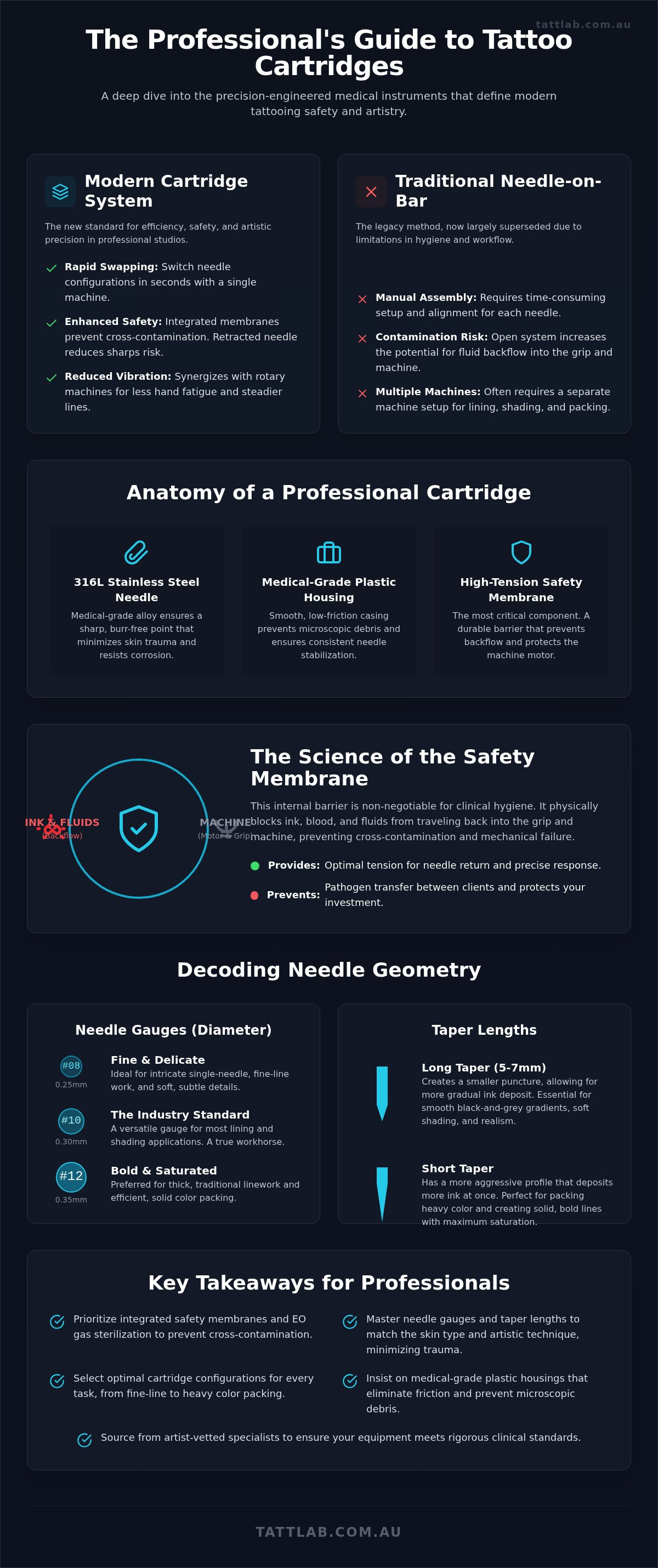
The structural integrity of professional tattoo cartridges is defined by the quality of their internal components. At the core of every reliable unit is the needle itself, typically forged from medical-grade 316L stainless steel. This specific alloy is chosen for its exceptional corrosion resistance and ability to maintain a sharp, burr-free point through hours of contact with the skin. When the needle's physical integrity is compromised, it causes unnecessary trauma, leading to poor healing and distorted pigments. Understanding these microscopic details allows artists to move beyond trial and error toward a more clinical, results-oriented methodology.
The Science of the Safety Membrane
The safety membrane is the most critical feature distinguishing professional-grade equipment from budget alternatives. This internal silicone or rubber barrier provides the necessary tension for the needle's return while simultaneously protecting your equipment. Without a high-performance membrane, ink and interstitial fluids can travel back into the grip, contaminating the machine motor. This backflow doesn't just risk mechanical failure; it poses a severe cross-contamination hazard. A high-quality membrane acts as a resilient physical barrier that prevents pathogens from entering the machine's internal drive system. When you're evaluating supplies, look for membranes with a balance of elasticity and durability. If the tension is too high, it strains the motor. If it's too low, the needle response feels sluggish and imprecise.
Decoding Tapers and Gauges
Precision in tattooing requires matching the needle's geometry to the specific biological task at hand. Needle gauges are standardized by diameter, with #08 (0.25mm), #10 (0.30mm), and #12 (0.35mm) being the industry benchmarks. A #08 needle is ideal for intricate fine-line work because it creates a smaller puncture. Conversely, a #12 is the preferred choice for traditional styles and bold saturation. Matching the gauge to the client's skin density is essential for ensuring the pigment remains stable over time.
Taper lengths further refine this interaction. Long tapers, often measuring between 5mm and 7mm, allow for a more gradual entry into the dermis. This is essential for smooth black-and-grey gradients and realism where soft transitions are required. In contrast, short tapers have a more aggressive profile, making them perfect for packing heavy color with fewer passes. According to FDA tattoo safety regulations, the use of sterile, single-use components is a primary factor in reducing procedural risks. Choosing the right taper geometry reduces the drag on the skin, minimizing inflammation and ensuring a more comfortable experience for the client. To explore a vetted range of configurations designed for various skin types, you can view our selection of tattoo cartridges.
Configuration Mastery: Choosing the Right Configuration for Your Style
Choosing the right needle configuration is a clinical necessity for achieving specific artistic outcomes. While the internal anatomy ensures safety, the arrangement of those needles determines how pigment interacts with the dermal layers. Mastery over these configurations allows an artist to transition from a technical procedure to a liberating narrative of personal transformation. Each grouping is designed to manage the flow of ink and the level of skin displacement, making your choice as critical as the machine's voltage.
Linework and Detail: Round Liners and Shaders
Round Liners (RL) are the foundation of structural integrity in any piece. These needles are soldered into a circular pattern, with "Tight" Round Liners bringing the points even closer together for ultra-fine detail. For single-needle style realism, a specialized 1RL configuration provides the precision required for microscopic textures and sharp focal points. Round Shaders (RS) offer a different utility; because the needles are grouped more loosely, they're ideal for thicker line weights or small area filling where a softer edge is desired. This configuration is particularly effective for elegant script or delicate shading that requires a less aggressive hit than a standard liner. Using the correct liner ensures the ink remains crisp within the dermis, preventing the blurring or "blowout" often associated with incorrect depth or grouping.
Shading and Packing: Magnums and Curved Magnums
Transitioning to larger surface areas requires the use of Magnums. Curved Magnums (CM), often referred to as Soft Edge Magnums, are the gold standard for black and grey realism. Their arched profile mimics the natural movement of the artist's hand, preventing the hard edges or "stencil lines" that can occur with flat configurations. This design facilitates smoother gradients and more predictable healing by distributing the impact across the skin's surface. For heavy color saturation or tribal work, Flat Magnums (M1) provide the necessary efficiency. They deliver pigment across a broader area in a single pass, which reduces the total time the skin is under tension.
Maintaining high standards in configuration selection aligns with broader industry safety protocols. For example, state-level tattoo regulations emphasize the importance of single-use disposables to maintain a sterile environment. Using specialized tattoo cartridges allows you to adhere to these clinical standards without sacrificing the versatility required for modern styles. Matching your configuration to the style is essential:
- Fine Line Realism: 1-3 Round Liners (#08 or #10 gauge).
- Traditional/Bold: 7-14 Round Liners and Flat Magnums for solid packing.
- Black and Grey Realism: Curved Magnums for soft transitions and gradients.
- Lettering/Script: Round Shaders for consistent, medium-weight flow.
Matching the configuration to the artistic intent is a hallmark of a professional who values both physical integrity and aesthetic excellence. By selecting the appropriate tool, you minimize trauma and ensure the healing process reflects the precision of your work.
Clinical Standards: Hygiene, Safety, and Performance
Professional tattooing is a medical procedure performed within an aesthetic environment. The technical quality of tattoo cartridges directly influences the biological inflammatory response and the subsequent healing phase. When a needle enters the dermis, it doesn't just deliver pigment; it initiates a complex wound-healing narrative. High-performance cartridges are defined by their use of Ethylene Oxide (EO) gas sterilization, a clinical process that ensures every disposable unit is free from viable microorganisms. This level of rigor is essential for maintaining physical integrity and building long-term trust with a client base that values safety as much as the final result.
The choice of housing material is equally critical. Low-quality plastics often suffer from high friction coefficients, leading to a phenomenon known as "shaving." This occurs when the needle rubs against the internal housing, creating microscopic plastic debris that is then driven into the skin along with the ink. Medical-grade plastic housings are engineered to prevent this friction, ensuring that only sterile pigment and stainless steel interact with the body. By reducing these foreign body reactions, you simplify the Mastering Tattoo Aftercare process, as the skin is not forced to work overtime to expel non-biological waste.
Sterilisation and Single-Use Integrity
Maintaining a sterile field requires constant vigilance from the artist. Every cartridge should be inspected before use; look for the "EO" sterilization indicator and a valid expiration date on the individual blister pack. If the seal is compromised, the clinical integrity of the tool is lost. This meticulous attention to detail is why we focus on specialized medical supplies for tattoo artists during our vetting process. Swapping cartridges during a session must be done with the same level of care, ensuring the machine remains bagged and the artist's gloves are free from contaminants during the transition. This methodical approach mirrors the precision of the work itself, replacing uncertainty with a sense of controlled, predictable progress.
Performance Factors: Stability and Ink Flow
Precision-engineered tips are the silent partners in achieving consistent ink flow. The geometry of the tip dictates the reservoir capacity and the rate at which pigment is delivered to the needle. A well-designed tip prevents "spitting" and ensures the needle is constantly lubricated with ink, which is vital for smooth gradients. Needle stabilization systems within the cartridge are also paramount; they prevent the "wobble" that can occur during high-speed operation. A stable needle reduces the need for multiple passes on the skin, which significantly lowers procedural trauma. This efficiency allows the artist to focus on the creative execution while the hardware handles the technical burden of stability. To ensure your studio meets these rigorous benchmarks, you can source our vetted range of tattoo cartridges for reliable nationwide delivery.
Sourcing Excellence: Why Tatt Lab is the Professional's Choice
Selecting a supplier is a strategic decision that affects the clinical safety and artistic consistency of your studio. Tatt Lab is artist-owned and operated, which means our perspective is rooted in the daily realities of the procedure room. We don't stock every product on the market; instead, we offer a curated selection of tattoo supplies that we've personally vetted for performance and biological integrity. When you purchase tattoo cartridges from us, you're investing in tools that have been tested for membrane resilience, needle sharpness, and housing stability. This first-hand expertise ensures that the equipment on your tray meets the high standards required for professional-grade results.
The Tatt Lab Quality Guarantee
Our commitment to excellence is grounded in the science of safety. We prioritize sourcing products that utilize EO gas sterilization and medical-grade materials, ensuring that every disposable unit is a benchmark for hygiene. We understand that transitioning to new hardware can feel like a vulnerability, so we provide direct technical support to help artists navigate the nuances of different tapers and configurations. Our professional tattoo supplies in Australia heritage informs a national standard of quality that rejects industry hype in favor of transparent, results-oriented solutions. We believe that professional support should be as precise as the work you perform, replacing technical uncertainty with a sense of controlled progress.
Nationwide Support for the Australian Industry
Reliability is the foundation of an uninterrupted studio workflow. A missing shipment or a backordered configuration shouldn't stall your creative momentum or compromise a client's appointment. We provide express nationwide shipping across Australia, ensuring that high-quality consumables reach your door with clinical efficiency. By serving as a comprehensive one-stop-shop, we simplify the procurement of everything from specialized tattoo ink to essential medical PPE. This methodical approach reduces the administrative burden on studio owners, allowing you to focus on the narrative of personal transformation you provide to your clients.
We also offer wholesale opportunities for established studios looking to stabilize their supply chains with a trusted partner. Our role in the industry is to support the growth and safety of the Australian tattoo community through education and access to superior hardware. Choosing the right tattoo cartridges is a clinical necessity, and Tatt Lab ensures those tools are delivered with the care and professionalism your craft deserves. It's a partnership that values physical integrity above all else, maintaining a modern, boutique-studio persona that respects the specialized nature of your work.
Advancing Your Craft with Clinical Precision
Refining your selection of tattoo cartridges is more than a technical upgrade; it's a commitment to the long-term health of your clients and the physical integrity of your work. By matching specific needle geometries to the unique biological needs of the skin, you reduce unnecessary trauma and foster a more predictable healing narrative. This methodical approach transforms every procedure into a seamless expression of your artistic vision, replacing technical uncertainty with a sense of composed progress.
Tatt Lab stands as a dedicated partner in this journey, operating as an artist-owned specialist that understands the demands of a modern studio environment. Our commitment to medical-grade safety standards means you can focus on the artistry while we handle the technical rigor of quality control. With express nationwide shipping across Australia, the professional tools you need for your next masterpiece are always within reach. We're here to ensure your studio remains a benchmark for safety and excellence.
Shop Professional Tattoo Cartridges at Tatt Lab
Frequently Asked Questions
What is the difference between a safety membrane and a rubber band cartridge?
A safety membrane is a resilient silicone barrier that provides needle tension while preventing ink and blood from entering your machine motor. Rubber band systems use a mechanical return that lacks this protective seal, creating a significant cross-contamination risk. Choosing professional tattoo cartridges with integrated membranes is a clinical necessity for protecting both your equipment and your client's safety. This design ensures that biological fluids remain contained within the disposable housing rather than compromising your machine's internal drive.
How do I choose the right needle gauge for fine-line tattooing?
Fine-line tattooing typically requires #08 (0.25mm) or #10 (0.30mm) needle gauges to achieve the microscopic precision required for delicate work. A smaller gauge creates a narrower puncture, which results in a finer deposited line and reduced dermal displacement. Using these thinner needles allows for intricate detail without the risk of pigment blowout. It's a choice that prioritizes physical integrity, ensuring that sharp focal points remain stable and clear as the skin heals.
Are all tattoo cartridges compatible with every rotary machine?
Most modern professional cartridges utilize a universal twist-to-lock connection that is compatible with the vast majority of rotary pen machines and cartridge grips. While this standardization has simplified the modern studio workflow, you should always verify the specific tension requirements of your machine's motor. Some high-torque rotaries perform better with stiffer membranes; lighter motors require more flexible tension to maintain a consistent stroke and prevent mechanical strain over long sessions.
What does 'EO Gas Sterilised' actually mean for my studio safety?
Ethylene Oxide (EO) gas sterilization is a medical-grade process that eliminates all viable microorganisms, including bacteria, viruses, and fungi, from the product. Unlike heat-based methods, EO gas penetrates the entire cartridge housing and needle grouping without compromising the integrity of the plastic or the solder. This ensures that every component is clinically sterile upon opening. Look for the "EO" indicator on each blister pack to confirm that your supplies meet these rigorous safety benchmarks.
Why is a curved magnum better for realism than a straight magnum?
Curved magnums, or soft-edge magnums, are superior for realism because their arched profile mimics the natural, sweeping motion of an artist's hand. This geometry prevents the harsh "stencil lines" or hard edges that straight magnums can inadvertently create during soft shading. By distributing pigment more gradually at the edges of the grouping, curved magnums allow for the seamless gradients and soft transitions essential for black and grey realism and portraiture.
Can I use tattoo cartridges for permanent makeup (PMU) procedures?
Professional tattoo cartridges can be used for permanent makeup (PMU) procedures provided the artist selects the appropriate needle gauge and configuration for facial tissue. PMU specialists often favor #06 (0.20mm) or #08 (0.25mm) round liners to accommodate the delicate nature of the skin on the brows, eyes, or lips. Using these precision-engineered tools ensures a controlled application that respects the vulnerability of the face while achieving the liberating narrative of personal transformation clients seek.
How often should I change my cartridge during a long tattoo session?
You should change your cartridge immediately if you notice any decrease in needle sharpness or a change in the resistance of the safety membrane. During long sessions, the constant friction can cause microscopic wear on the needle tips, leading to increased skin trauma and slower pigment saturation. Additionally, swapping to a fresh cartridge when transitioning between drastically different ink values prevents muddying your palette and ensures that every hit remains as precise as the first.
What is the difference between a long taper and a short taper needle?
Long tapers feature a gradual point that allows the needle to enter the skin with minimal resistance, making them the preferred choice for smooth shading and soft gradients. Short tapers have a more aggressive, blunt profile that facilitates faster pigment saturation, which is ideal for bold color packing or traditional styles. Choosing the correct taper length is a strategic decision that balances the desired aesthetic outcome with the need to minimize inflammation during the procedure.


Comments (0)
There are no comments for this article. Be the first one to leave a message!