

A tattoo cartridge isn't just a consumable; it's a precision medical instrument that serves as the final gatekeeper between your artistic intent and the client's biological canvas. You've likely felt that spike of adrenaline when a smooth gradient is suddenly interrupted by inconsistent ink flow or the underlying anxiety of a membrane failure. It's frustrating when technical limitations compromise your craftsmanship. We agree that your tools should be as disciplined as your technique.
By mastering the technical nuances of tattoo cartridges, you'll enhance your precision, ensure absolute client safety, and confidently choose the perfect configuration for every style. This guide provides a clinical deep dive into needle gauges, taper lengths, and the mechanics of backflow prevention. We'll demystify the science behind membrane tension and show you how to reduce skin trauma for better healing. From fine-line work to heavy saturation, you're about to transform your technical approach into a predictable, specialized process.
Key Takeaways
- Understand how safety membranes act as a critical barrier against ink backflow, protecting both your machine's longevity and your client's health.
- Discover the technical impact of needle gauges and taper lengths on skin trauma to ensure more predictable healing and better ink retention.
- Learn to optimize your workflow with professional tattoo cartridges by selecting specific configurations like Round Liners or Magnums for every artistic requirement.
- Recognize the importance of EO gas sterilization and medical-grade plastics in maintaining clinical studio standards and preventing friction during long sessions.
- Gain insight into why artist-vetted equipment provides a more reliable foundation for complex techniques like fine-line work or smooth realism.
The Evolution of Precision: Why Modern Artists Prefer Tattoo Cartridges
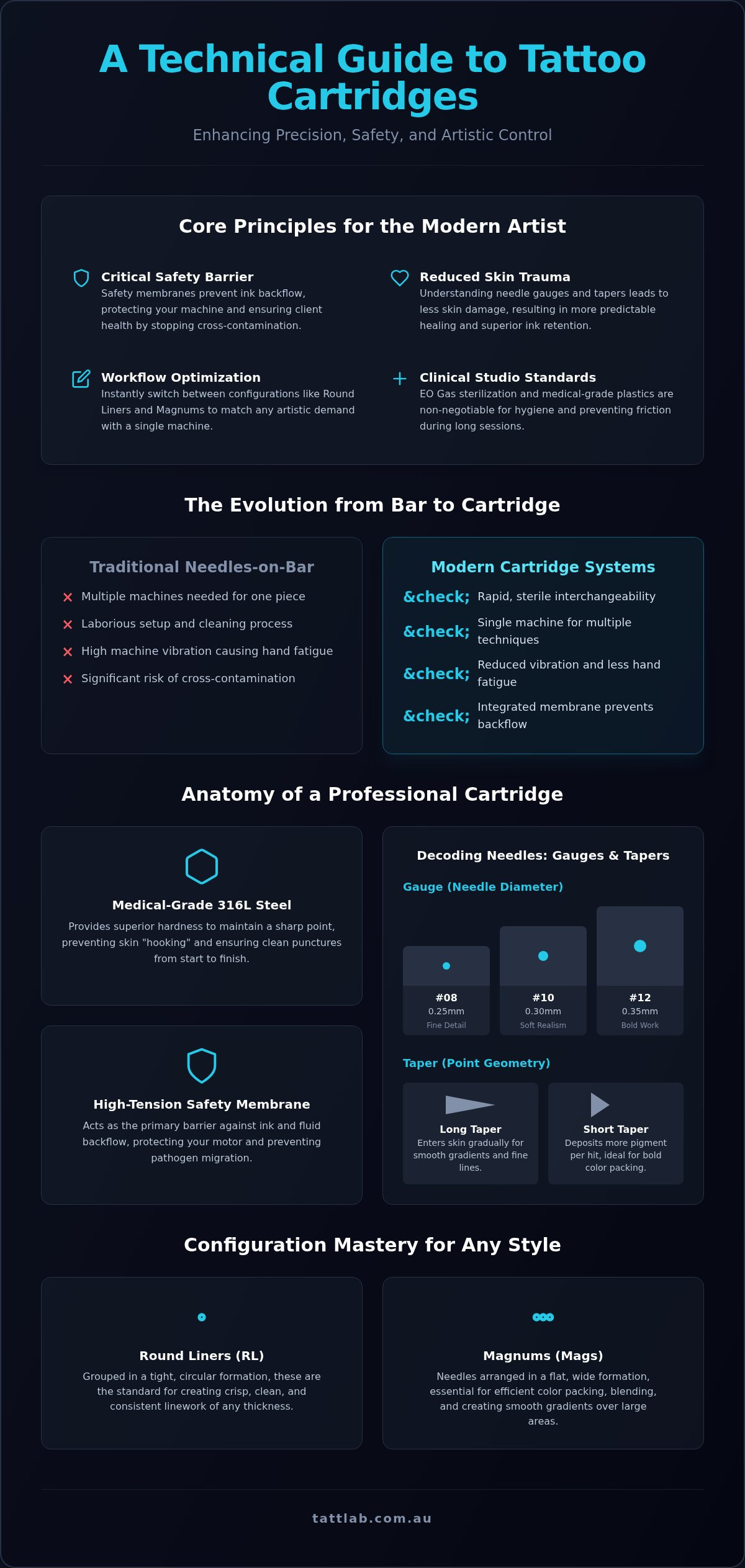
A tattoo cartridge is a self-contained needle system engineered for rapid interchangeability and high-level hygiene. Unlike traditional methods, these units house the needle and the tension mechanism within a single-use, sterile plastic casing. This design allows you to transition between different configurations in seconds. It effectively eliminates the need for manual needle bending or the laborious process of cleaning stainless steel tubes. By centralising the needle's path, these systems facilitate a streamlined, clinical workflow that aligns with the rigorous safety standards required in modern Australian studios.
The shift from traditional needles-on-bar represents a fundamental advancement in studio ergonomics. Traditional setups often resulted in significant machine vibration, which transferred directly to your hand and wrist. High-quality tattoo cartridges utilise internal membranes to dampen this mechanical feedback. This reduction in vibration directly lowers artist hand fatigue, allowing for longer sessions without compromising the stability of your linework or the softness of your shading. It's a technical progression that respects your physical longevity as much as your artistic output.
Cartridges vs. Traditional Needles: The Professional Verdict
In a traditional environment, performing a piece that requires both fine-line work and heavy saturation meant setting up multiple machines. Each machine had to be tuned to a specific needle bar, consuming valuable time and studio space. Modern cartridges consolidate this process. You can now execute a multi-technique piece with a single machine by simply swapping the cartridge. This efficiency significantly reduces setup and teardown times. Beyond speed, the primary advantage is safety. The enclosed nature of the cartridge, combined with an internal safety membrane, drastically reduces the risk of ink backflow. This creates a physical barrier that prevents cross-contamination, ensuring your machine's motor remains sterile and protected from biological fluids.
The Rise of the Rotary Pen Machine
The widespread adoption of cartridge systems was the catalyst for the development of modern rotary tattoo machines. These pen-style devices offer an ergonomic profile similar to a drawing instrument, providing a level of control that traditional coil machines struggle to match. The synergy between the machine's motor stroke and the cartridge's internal tension is critical. When these two components are balanced, the needle enters the skin with consistent force, resulting in less trauma and more efficient pigment deposition. This combination has become the preferred choice for contemporary studios across Australia, where artists prioritise technical precision and the long-term physical health of their hands.
The Anatomy of a Professional Cartridge: Membranes and Tapers
The structural integrity of professional tattoo cartridges begins with the quality of the metal itself. Medical-grade 316L stainless steel is the industry benchmark for a reason. This specific alloy provides the necessary hardness to maintain a needle's point throughout a six-hour session, preventing the tip from curling or dulling. When a needle loses its sharpness, it begins to "hook" the skin, causing unnecessary trauma and poor ink deposition. Choosing high-quality steel ensures that every puncture is clean and every line remains crisp from the first dip to the final pass.
The Science of the Safety Membrane
A high-quality membrane is a non-negotiable feature for any artist using a rotary machine. This component serves as the primary defense for your motor, preventing ink and biological fluids from migrating into the machine's internal housing. A safety membrane acts as a physical barrier against pathogens by sealing the internal needle drive from the machine's motor. When evaluating tattoo cartridges, you should look for membranes with consistent tension and high elasticity. If the tension is too high, your motor works harder and runs hotter; if it's too low, the needle won't retract quickly enough, leading to "snagging" in the skin.
Decoding Tapers and Gauges
Gauges are classified by diameter, ranging from #08 (0.25mm) for fine detail to #12 (0.35mm) for bold work. While #12 is the industry standard, #10 (0.30mm) is often preferred for soft realism. Following FDA tattoo safety guidelines is the baseline; the true mastery lies in taper geometry. Long tapers allow for smooth gradients by entering the skin gradually, whereas short tapers excel at bold color packing by depositing more pigment per hit. Matching the gauge to the skin type and the taper to your specific technique significantly improves healing outcomes. Choosing the right configuration at tattlab.com.au allows you to tailor your approach to the client's specific skin density and the desired level of detail.
Configuration Mastery: Choosing the Right Configuration for Your Style
Selecting the appropriate needle configuration is the point where technical knowledge converges with artistic intuition. The choice dictates how pigment is deposited into the dermis and, ultimately, how the skin responds to the procedure. While your machine provides the power, the configuration of your tattoo cartridges determines the texture, saturation, and trauma level of the work. Mastering these variables allows you to transition from the surgical precision required for fine-line realism to the dense, saturated blocks of colour found in traditional styles.
Linework and Detail: Round Liners and Shaders
Round Liners (RL) are the essential foundation for defining structure. Within this category, Tight Round Liners (TRL) are engineered with needles soldered closer together at the tip to create a singular, focused point. This is the primary tool for single-needle style realism and intricate micro-tattoos. In contrast, standard Round Liners allow for a slightly more generous ink flow, making them more suitable for the bold, consistent linework seen in American Traditional or Neo-Traditional pieces.
Round Shaders (RS) offer a versatile alternative for technical transitions. Because the needles are grouped in a parallel circular pattern rather than being pinched to a point, they create a softer edge. This configuration is ideal for small area filling, thick linework, or delicate script where a hard-edged liner might feel too aggressive. Using a Round Shader for shading small, tight details prevents the "choppy" texture that can occur when attempting to shade with a liner.
Shading and Packing: Magnums and Curved Magnums
For artists specialising in Black and Grey Realism, Curved Magnums (CM) are the gold standard for achieving smooth gradients. The slight arc in the needle grouping mimics the natural contour of the skin, allowing for seamless blending without the risk of "railroading" or leaving harsh lines at the edge of the pass. This design significantly reduces skin trauma by ensuring the outer needles don't dig deeper than the centre of the grouping. Following FDA tattoo safety guidelines regarding adverse events involves more than just sterility; it requires using tools that minimise unnecessary physical injury to the tissue.
Flat Magnums (M1) remain the preferred choice for heavy colour saturation and tribal work. Their straight-edge design allows for maximum pigment delivery in a single pass, which is necessary for packing solid blacks or vibrant colours. When using larger magnum counts, maintaining a consistent angle and hand speed is critical to avoid overworking the area. By matching these configurations to your specific style, you ensure a more predictable healing process and a final result that maintains its integrity over time.
Clinical Standards: Hygiene, Safety, and Performance
The intersection of artistry and clinical safety is most evident in the hardware you choose. Professional tattoo cartridges are not merely plastic consumables; they are medical devices that must adhere to stringent manufacturing standards. High-quality cartridges utilize medical-grade plastic housings specifically designed to withstand the high-frequency friction of the needle. Lower-quality plastics can often "shave" during a session, depositing microscopic plastic debris into the open wound. This irritates the tissue and complicates the Mastering Tattoo Aftercare process before the client even leaves your studio.
Sterilisation and Single-Use Integrity
Every professional cartridge must undergo Ethylene Oxide (EO) gas sterilisation. This process penetrates the packaging and the device itself to eliminate all viable microorganisms. When inspecting your supplies, look for the EO gas indicator on the blister pack; it usually changes colour to confirm successful processing. You should also verify the batch number and expiry date to ensure the integrity of the seal. As an artist, your role is to maintain this sterile field by only opening the blister pack immediately before use and avoiding contact with any non-sterile surfaces during the swap. Tatt Lab prioritises high-standard medical supplies for tattoo artists because we understand that studio hygiene is the foundation of professional reputation and client safety.
Performance Factors: Stability and Ink Flow
Consistency in pigment delivery relies on the precision of the cartridge tip. Professional designs feature a needle stabilisation system that prevents lateral "wobble" during operation. This stability is particularly vital when running machines at high speeds or when performing delicate fine-line work. The internal reservoir and tip geometry are engineered to hold an optimal amount of ink, releasing it with a steady, predictable flow that prevents pooling or dry hits. A stable needle reduces the need for multiple passes on the skin, which directly minimises tissue trauma and promotes faster recovery.
Choosing vetted equipment ensures that your technical skill isn't undermined by hardware failure. You can secure your studio's safety standards by sourcing professional-grade tattoo cartridges at Tatt Lab today.
Sourcing Excellence: Why Tatt Lab is the Professional's Choice
Choosing a supplier is a decision that impacts every aspect of your practice, from the safety of your clients to the fluidity of your creative process. Tatt Lab is an artist-owned and operated facility, which means our inventory isn't determined by profit margins alone, but by clinical performance in a real-world studio environment. We don't just sell equipment; we use it. We only stock tattoo cartridges and consumables that we'd trust on our own skin and within our own professional spaces. This first-hand expertise allows us to provide a curated selection of tattoo supplies that have been rigorously vetted for technical stability and biological safety.
The Tatt Lab Quality Guarantee
Our commitment to your craft starts with the uncompromising standard of our hardware. Every cartridge in our range is EO gas-sterilised and constructed from medical-grade materials to ensure physical integrity throughout the longest sessions. We understand that transitioning to new equipment can be a technical challenge, so we provide dedicated support for artists who are navigating new hardware or exploring different needle tensions. Our Melbourne tattoo supplies heritage serves as the foundation for our national standard, ensuring that every studio receives the same level of specialised attention and scientific rigor.
Nationwide Support for the Australian Industry
Reliability in your supply chain is essential for an uninterrupted studio workflow. We provide express nationwide shipping across Australia, ensuring your station is always prepared for the next procedure without the anxiety of stock shortages. By acting as a one-stop-shop for tattoo ink, cartridges, and medical-grade PPE, we simplify your procurement process. We also offer wholesale opportunities for established studios looking for a dependable, professional partner for their long-term supply needs. Tatt Lab is dedicated to the growth and safety of the Australian industry, positioning ourselves as your partner from the initial interaction to the final, healed result.
Refine Your Technical Precision and Professional Standards
Mastering the technical parameters of your hardware is what separates a standard procedure from a transformative artistic result. By understanding the nuanced interplay between membrane tension, taper geometry, and medical-grade materials, you ensure every session is defined by precision rather than compromise. High-quality tattoo cartridges act as the silent partners in your professional progression. They provide the mechanical stability needed for complex realism while upholding the rigorous safety standards required for optimal skin health and healing.
As an artist-owned and operated supplier, we recognize that your tools must be as disciplined as your technique. We prioritize medical-grade safety standards to protect the physical integrity of your clients and the longevity of your rotary machines. You can secure the future of your craft by choosing hardware vetted by specialists who understand the daily demands of the studio environment. We're dedicated to providing the reliable foundation you need for consistent, high-level results.
Ready to elevate your studio workflow? Shop Professional Tattoo Cartridges at Tatt Lab and benefit from express nationwide shipping. We're here to support your journey from the initial setup to the final, perfectly healed result.
Frequently Asked Questions
What is the difference between a safety membrane and a rubber band cartridge?
Safety membranes use a silicone or plastic seal to prevent backflow into the machine's motor. Rubber band cartridges use a simple tension band that doesn't seal the internal housing. This lack of a barrier allows ink and biological fluids to travel into the machine, increasing cross-contamination risks and causing potential mechanical failure. We exclusively stock membrane-based cartridges to ensure clinical safety and protect your equipment's longevity.
How do I choose the right needle gauge for fine-line tattooing?
Selecting the correct gauge depends on the required detail and the client's skin density. For ultra-fine work, a #08 (0.25mm) gauge provides a smaller puncture and minimal tissue trauma. Many professionals prefer #10 (0.30mm) for its balance of stability and precision. Using high-quality tattoo cartridges in these smaller diameters allows for cleaner ink deposition without the needle flexing during intricate, high-speed passes.
Are all tattoo cartridges compatible with every rotary machine?
Most modern tattoo cartridges use a universal twist-lock connection compatible with the majority of rotary pen machines. However, some specific brands utilize proprietary systems that require dedicated grips or machines. It's essential to verify your machine's drive bar or grip type before purchasing. We focus on universal configurations that offer the broadest compatibility for Australian studios, ensuring a predictable fit across various professional rotary setups.
What does 'EO Gas Sterilised' actually mean for my studio safety?
Ethylene Oxide (EO) gas sterilization is a low-temperature chemical process that kills microorganisms at a cellular level. Unlike steam autoclaving, it penetrates sealed plastic packaging and intricate components without damaging medical-grade materials. This process ensures each unit remains sterile until the moment you open the blister pack. It's the clinical gold standard for single-use disposables, providing peace of mind for both the artist and the client.
Why is a curved magnum better for realism than a straight magnum?
Curved Magnums, often called Soft Edge Magnums, feature a rounded profile that follows the natural curvature of the skin. This design prevents the outer needles from digging too deep, which eliminates the harsh lines often left by straight magnums. This makes them the superior choice for smooth realism gradients and seamless blending. They allow for softer transitions between shades, reducing the risk of railroading during complex sessions.
Can I use tattoo cartridges for permanent makeup (PMU) procedures?
Many professional cartridges are suitable for PMU, provided the needle gauge and configuration match the delicacy required for facial tissue. PMU artists often favor smaller gauges like #06 or #08 for lip blushing and brow work. It's critical to ensure the cartridge features a robust safety membrane to prevent pigment backflow. This is especially important as PMU machines are equally susceptible to internal contamination and require clinical-grade protection.
How often should I change my cartridge during a long tattoo session?
You should replace your cartridge if you notice any hooking at the tip or a decrease in ink flow consistency. While medical-grade 316L stainless steel is durable, constant friction against the skin and plastic housing can eventually dull the needle. For sessions exceeding six hours, some artists proactively swap to a fresh unit. This maintains peak technical precision and minimizes unnecessary skin trauma, which supports a more efficient healing process.
What is the difference between a long taper and a short taper needle?
Taper length refers to the distance from the needle's point to its full diameter. A long taper enters the skin more gradually, making it ideal for soft shading and smooth gradients. A short taper reaches its full width quickly, allowing for more aggressive pigment delivery. This makes short tapers the preferred choice for bold color packing or traditional styles where high saturation is required in fewer passes.


Comments (0)
There are no comments for this article. Be the first one to leave a message!