

Why does a portrait that looked perfect on the chair often heal to a muddy, blue-grey shadow just months later? This shift isn't always a failure of technique, but rather a consequence of pigment instability. You understand that the foundation of any realistic masterpiece is the integrity of your medium. When searching for the best black tattoo ink, the goal is to find a formulation that maintains its deep, neutral tone without the risk of migration or dulling over time.
We recognize the vulnerability inherent in these procedures, especially when transitioning into specialized medical work and areola restoration. You need a predictable, scientific result that respects the body's biological processes. This guide provides a professional framework for selecting high-performing pigments that ensure flawless saturation and smooth gradients. We will examine the importance of EU REACH compliance as a safety benchmark and how specialized dispersions can eliminate the common pains of ink blowout. By the end, you'll have the technical clarity needed to achieve everlasting blacks and the precise depth required for true realism.
Key Takeaways
- Understand how pigment structure influences long-term saturation to prevent your work from shifting toward blue or green tones during the healing process.
- Identify the best black tattoo ink for specific technical applications, distinguishing between high-concentration lining pigments and pre-dispersed shading washes.
- Explore the technical requirements for medical-grade restoration, including the use of specialized areola pigments designed for realistic depth and soft integration.
- Learn why EU REACH compliance serves as a critical safety benchmark for Australian artists navigating a complex regulatory landscape.
- Discover how a curated collection of 26 PMU areola pigments can provide the precise shade range necessary for professional-grade aesthetic outcomes.
Defining the Best Black Tattoo Ink: Viscosity, Saturation, and Healing
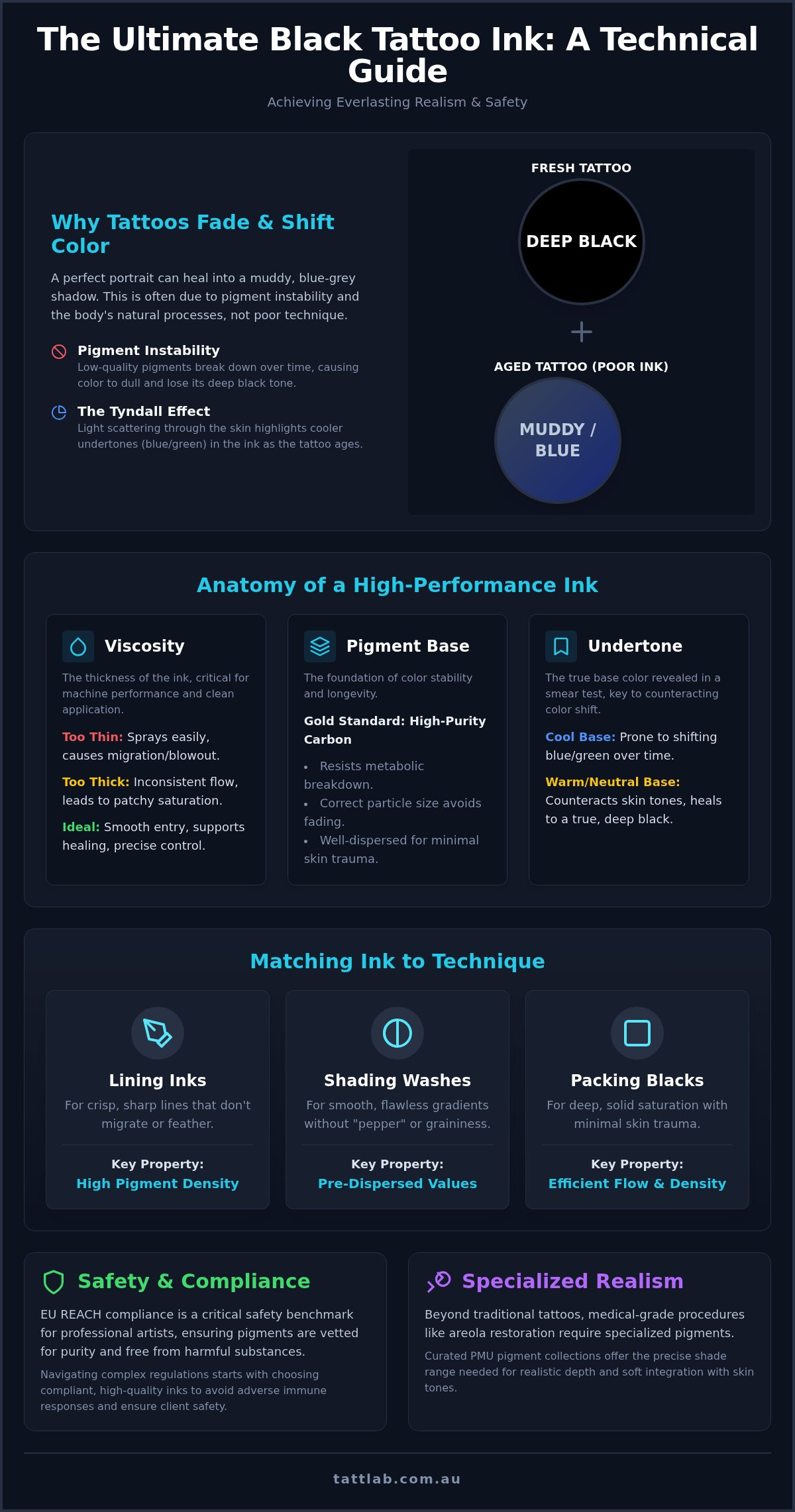
Selecting the best black tattoo ink requires a technical understanding of how pigments interact with human biology. It's not simply a matter of finding the darkest bottle on the shelf. Instead, the focus must be on the chemical stability and physical properties of the formulation. High-quality Tattoo Ink Composition relies on a precise balance between pigments and carriers to ensure that the ink remains where it is placed without migrating or fading into unwanted hues.
Viscosity plays a critical role in how your machine performs. If an ink is too thin, it may spray or cause ink migration as it travels too easily through the tissue. Conversely, an overly thick ink won't flow consistently from the tube, leading to patchy saturation. Achieving a true black involves more than just pigment density; it requires a carrier system that facilitates smooth entry into the dermis while supporting the skin's natural healing trajectory. This synergy between the tool and the medium is what allows for the precision required in modern realism.
The Role of Carbon in Pigment Longevity
Professional artists generally consider high-purity carbon to be the gold standard for permanent saturation. Carbon particles are naturally resistant to the body's metabolic processes, which means they stay trapped in the dermis longer than many organic alternatives. The size of these particles is vital. If they're too small, the immune system's macrophages can eventually transport them away, leading to a faded appearance. Pigment dispersion is the stable suspension of solid pigment particles within a liquid carrier medium to ensure uniform delivery into the dermis. By using a well-dispersed carbon ink, you minimize trauma to the skin while maximizing the concentration of pigment left behind during each pass.
Identifying Undertones and Color Shifting
A common frustration in realism is the blue or green shift that occurs as a tattoo ages. This is often caused by the Tyndall Effect, where light scatters through the skin and highlights the cooler undertones of the pigment. To avoid this, specialists often perform a smear test by swiping a drop of ink across white paper. This reveals the true base of the ink. For realistic depth, you should look for formulations with a neutral or slightly warm base. These tones counteract the natural coolness of the skin's layers, ensuring the black remains deep and honest for years. When you choose the best black tattoo ink for your specific procedure, you're investing in the long-term narrative of your client's transformation and self-assurance.
Selection Criteria: Lining, Shading, and Solid Packing
The performance of a pigment is intrinsically linked to its intended role. In realism, where the transition between a sharp edge and a soft shadow defines the work's quality, using a single "all-purpose" black often leads to technical compromises. Selecting the best black tattoo ink requires categorizing your choices based on technical tasks: lining, shading, and solid packing. Each procedure demands a specific pigment-to-carrier ratio to ensure the ink behaves predictably under the skin.
The Technical Anatomy of a Lining Ink
Precision in fine-line work or structural mapping depends on high surface tension. Lining inks are formulated with a denser pigment concentration to prevent feathering or lateral migration within the dermis. This ensures that the line remains as crisp on day 1,000 as it was on day one. When you pair these inks with specialized insights from The Professional Guide to Tattoo Ink, you achieve a synchronized flow rate that matches your hand speed. Safety remains a priority in this selection process, as high-concentration pigments must be vetted for purity. Referencing international standards for Tattoo Ink Safety helps professionals avoid formulations that might trigger adverse immune responses during the healing phase.
Mastering Gradients with Shading Washes
The hallmark of realism is the absence of visible pepper or graininess in the shadows. To achieve this, many artists transition from custom-mixed caps to pre-dispersed grey wash systems. These sets provide repeatable, laboratory-calibrated values that allow for consistent results across multiple sessions. If you choose to dilute a high-saturation black yourself, use a sterile mixing solution rather than distilled water to maintain the ink's biological integrity. This approach ensures smooth gradients that mimic the natural fall of light on complex anatomical structures.
Achieving a deep, jet black saturation in solid areas requires an ink that packs efficiently without over-working the tissue. Excessive trauma during solid packing often leads to scarring or poor pigment retention. By utilizing curved magnums and a pigment designed for high-volume delivery, you can achieve total saturation in fewer passes. Finding the best black tattoo ink for these heavy-fill areas means prioritizing a formula that flows easily yet stays dense. This methodical approach respects the physical integrity of the skin, fostering a calmer healing process. For artists seeking reliable performance, exploring a curated selection of artist-vetted inks ensures every procedure is backed by technical rigor.
Beyond Traditional Black: Specialized PMU and Areola Realism
Medical tattooing represents a sophisticated shift from aesthetic expression to restorative health. While the best black tattoo ink for a traditional sleeve focuses on achieving maximum "jet black" depth, medical-grade restoration requires a more nuanced approach. Standard decorative blacks are often too harsh or synthetic when placed in the delicate context of an areola or scar camouflage. In these procedures, the goal is not to stand out, but to blend seamlessly with the body's natural anatomy.
Professional restoration demands a palette that includes "soft" blacks and dark umbers. These pigments allow for the creation of 3D realism through subtle layering rather than heavy saturation. By moving away from high-carbon traditional inks, artists can avoid the blue-shift often seen in aged decorative work. This technical precision empowers artists to provide life-changing transformations that help clients reclaim their sense of self-assurance and physical integrity after surgery or trauma.
Pigment Formulation for Sensitive Tissue
Scarred or reconstructed tissue often features a compromised dermal structure. It is typically thinner and less predictable than healthy skin, which changes how it accepts pigment. Using a high-viscosity traditional ink in these areas can lead to blowouts or uneven dispersion. Instead, specialists favor lower-viscosity pigments that allow for gentle, controlled application. This methodical approach respects the vulnerability of the tissue while ensuring long-term stability. Compliance with Australian tattoo ink chemical regulations remains a critical benchmark here. Ensuring that every pigment meets these safety standards for biocompatibility is non-negotiable when working on post-surgical sites where skin health is the primary concern.
Achieving Natural-Looking Results
Realism in areola restoration isn't achieved with a single tone. It requires a complex interplay of dark tones, soft pinks, and warm browns to mimic the texture and depth of natural tissue. By layering these specialized shades, artists create the illusion of projection and anatomical accuracy. This technical process is a liberating narrative of personal transformation. For many clients, the final result represents a return to holistic wellness. To achieve these delicate outcomes, many specialists explore our specialized PMU Areola Pigments. This curated collection of 26 pigments provides the precise shade range and predictable healing required for professional-grade restoration, ensuring that the final result is both beautiful and medically sound.
Standout Pigments for Professional Restoration and PMU
While traditional artistry relies on high-contrast blacks, professional restoration requires a palette that mirrors the complexity of human skin. Tatt Lab provides a specialized collection of 26 PMU areola pigments, each engineered to provide the realistic shade ranges necessary for post-surgical camouflage. These formulations prioritize optimal healing and long-term color retention, ensuring that the liberated narrative of a client's recovery remains intact for years. The precision of these pigments allows for a grounded, honest approach to restoration that builds immediate trust between the artist and the client.
Choosing the best black tattoo ink for restoration often means selecting a "soft black" or a deep, warm umber that acts as a foundational shadow. Using a standard, high-saturation carbon black in these procedures is a common mistake; it often creates a synthetic, "stamped-on" appearance that fails to integrate with the surrounding tissue. By utilizing a curated range of 26 shades, specialists can match the client's natural Fitzpatrick scale with clinical precision, avoiding the harshness of conventional decorative inks.
Choosing the Right Shade for Areola Restoration
Matching pigments to a client's unique undertones is the difference between a technical procedure and a masterpiece of realism. The Fitzpatrick scale serves as your primary diagnostic tool, helping you identify whether a client requires cool, neutral, or warm base tones. Because color retention is the absolute priority in paramedical tattooing, these pigments are designed with a stable molecular structure that resists the fading typically seen in thinner, reconstructed skin. Having access to a diverse range of 26 realistic shades ensures you never have to compromise on the anatomical accuracy of the final result. This variety allows for the gradual improvement and progress necessary for a truly natural look.
Essential Features of High-Performance PMU Pigments
Safety is the cornerstone of any medical-grade environment. High-performance pigments must meet rigorous sterility standards to protect the integrity of compromised tissue. Beyond safety, ease of use is vital. You need a pigment that stays put during the procedure, allowing for precise layering without the risk of the ink "running" or migrating across the skin. This predictable behavior is why many modern studios prioritize artist-vetted Medical Supplies for Tattoo Artists to maintain a sterile, efficient workspace. When you use the best black tattoo ink tailored for PMU, you're investing in a controlled, predictable outcome that respects the body's physical integrity.
A successful outcome relies on the synergy between your technical skill and the quality of your medium. To ensure your studio is equipped for high-level restoration and realism, you can shop our professional-grade tattoo inks and supplies today to find the perfect match for your next procedure.
Professional Application and Safety Standards in Australia
The Australian regulatory landscape for tattoo and PMU supplies is currently in a state of transition. While the Australian Industrial Chemicals Introduction Scheme (AICIS) provides a baseline for chemical safety, there is no mandatory national standard that aligns with the strict EU REACH regulations enforced in 2022. Recent studies in early 2026 have highlighted that many pigments sold locally still contain trace metals that would be prohibited in Europe. For the dedicated artist, finding the best black tattoo ink involves looking beyond local compliance and adopting international safety benchmarks as a personal studio standard. This proactive approach ensures that your work respects the biological integrity of every client.
Professional studios prioritize artist-vetted equipment because technical performance and safety are inseparable. When a supplier understands the science of pigment dispersion and the vulnerability of the dermis, they curate products that minimize the risk of adverse reactions. Sourcing from an artist-owned partner provides a layer of technical support that generic retailers cannot offer. This relationship ensures you have access to pigments that have been tested in real-world clinical environments, backed by express nationwide shipping to maintain your studio's operational rhythm.
Maintaining a Sterile Clinical Environment
A successful procedure is the result of a synergy between high-quality ink and rigorous safety protocols. Even the best black tattoo ink can be compromised by a lack of medical-grade PPE or a failure in cross-contamination control. Your studio should function like a specialized laboratory where science meets health. This requires a commitment to using sterile, single-use cartridges and hospital-grade surface disinfectants. By integrating these elements, you create a reassuring narrative of safety for your clients. For a deeper look at maintaining these standards, consult The Professional Guide to Tattoo Supplies in Australia to ensure your studio remains at the forefront of industry performance.
Final Checklist for Pigment Selection
Before beginning any realism or restoration procedure, perform a final technical audit of your supplies. This methodical habit reduces uncertainty and fosters predictable progress. Your checklist should include the following steps:
- Verify batch numbers and expiry dates to ensure pigment stability.
- Confirm that the ink's viscosity matches the needle taper and machine speed for the specific procedure.
- Assess the client's skin undertones to select a black with the correct neutral or warm base.
- Ensure your pigment choice aligns with the client's long-term healing goals and physical integrity.
Precision is a discipline. When you combine technical mastery with the highest safety standards, you provide more than just a procedure; you offer a path to self-assurance. You can restore confidence with our premium areola restoration pigments, designed to meet the exacting needs of modern medical tattooing.
Elevating Technical Standards in Realism and Restoration
Mastering the art of realism requires a commitment to the technical and biological precision of your medium. You've seen that selecting the best black tattoo ink involves more than comparing darkness; it's about understanding how viscosity and pigment structure ensure long-term stability in the dermis. Precision is a discipline. Whether you're executing a high-contrast traditional sleeve or a delicate medical restoration, the integrity of your results depends on using artist-vetted supplies that prioritize physical health and safety.
As the industry moves toward stricter safety benchmarks, your role as a specialist is to bridge the gap between aesthetic excellence and clinical safety. By choosing pigments engineered for predictable healing and anatomical accuracy, you provide a liberating narrative of transformation for your clients. Tatt Lab supports this journey with an expertly curated range of supplies designed by professionals for professionals. We remain a dedicated partner in your pursuit of holistic wellness and technical mastery.
Browse the Professional PMU Areola Pigment Collection and experience the difference of artist-owned quality with fast, nationwide Australian shipping. Your commitment to excellence ensures every procedure is a step toward predictable, life-changing progress.
Frequently Asked Questions
What is the difference between lining black and shading black ink?
Lining black ink features a higher pigment concentration and specific surface tension to prevent feathering or lateral migration. This ensures lines remain crisp over time. Shading inks are typically pre-dispersed washes or custom-mixed systems designed for soft, pepper-free gradients. When searching for the best black tattoo ink for realism, matching the ink's viscosity to the technical task is essential for achieving professional depth and saturation without over-working the tissue.
Why does some black tattoo ink turn blue or green over time?
This color shift occurs due to the Tyndall Effect, where light scatters through the skin's layers and highlights cooler undertones. If a pigment has a heavy blue or green base, it becomes more visible as the tattoo ages and the skin changes. High-quality black inks often utilize neutral or warm bases to counteract this natural scattering. Choosing stable, high-purity carbon formulations helps maintain a true black tone throughout the healing narrative.
Are the pigments used for areola restoration different from regular tattoo ink?
Specialized areola restoration pigments differ significantly from traditional decorative inks. While standard blacks focus on maximum contrast, restoration pigments prioritize anatomical accuracy through a range of umbers, soft pinks, and warm browns. These formulations are designed for the thinner, reconstructed tissue often found in medical cases. Using a specialized collection of 26 pigments ensures that the final result integrates seamlessly with the client's natural skin tones rather than appearing synthetic.
Is it safe to use carbon-based black inks for medical tattooing?
Carbon-based inks are widely used, but medical tattooing often requires specific pigment structures to ensure safety on compromised skin. High-purity carbon is generally biocompatible, yet specialists must ensure the formulation is free from banned toxic metals. For sensitive procedures like areola restoration, many professionals prefer specialized PMU pigments that offer better stability and a lower risk of migration on post-surgical sites where the dermal structure is thinner and more vulnerable.
How can I ensure the black ink I buy is professional-grade and safe?
You can verify the safety of your supplies by checking for EU REACH compliance and clearly labeled batch numbers. Professional-grade inks should come from artist-vetted suppliers who prioritize technical transparency. It's vital to avoid generic retailers and instead partner with specialists who understand the science of pigment dispersion. This approach ensures that every bottle meets rigorous international safety standards, providing you with the predictability needed for complex realism and medical procedures.
What should I look for in a pigment for areola restoration?
When selecting pigments for areola restoration, prioritize color retention and a realistic shade range. You need a palette that covers the full Fitzpatrick scale to ensure anatomical accuracy for every client. Look for pigments with a stable molecular structure that won't shift as the skin heals. A curated collection of 26 shades allows for the precise layering required to create the 3D illusion of a natural areola while respecting the body's physical integrity.
Does Tatt Lab offer express shipping for tattoo supplies across Australia?
Tatt Lab provides express nationwide shipping across Australia to ensure your studio maintains a consistent operational rhythm. We understand that professional artists require reliable access to high-quality consumables and medical supplies without long wait times. Whether you're restocking the best black tattoo ink or specialized PMU pigments, our logistics are designed to support your studio's needs. This service allows you to focus on delivering transformative results for your clients with minimal interruption.
Can I use PMU pigments for traditional small-scale tattooing?
While PMU pigments can be used for small-scale, delicate details in traditional tattooing, they aren't always suitable for heavy packing. PMU formulations often have a lower viscosity and different pigment-to-carrier ratios compared to traditional inks. They are engineered for the thinner skin of the face or reconstructed areas. For large-scale traditional work, sticking to traditional lining and shading blacks ensures the necessary saturation and durability for long-term aesthetic outcomes on thicker dermal layers.


Comments (0)
There are no comments for this article. Be the first one to leave a message!