

Why does your A$600 investment suddenly look like it's disappearing behind a milky, opaque veil just 72 hours after leaving the studio? It's a common moment of friction where the excitement of new art meets the clinical reality of an open wound. Research from 2024 suggests that 42 percent of clients experience significant anxiety during the first week of recovery. You're likely balancing the conflicting advice of online forums against your own intuition as you monitor the signs of a healing tattoo. We understand that this stage feels vulnerable, especially when the crisp lines you loved on Tuesday look distorted by Friday morning.
You deserve a recovery process defined by clarity rather than guesswork. This guide translates complex dermatological processes into a professional-grade roadmap for your skin's evolution. We'll examine the three biological stages of dermal repair, provide a 12 point checklist to distinguish normal peeling from genuine infection, and show you how to maintain the integrity of your ink for the next 10 years. By the end of this lab-certified briefing, you'll know exactly how to support your body's natural transition from trauma to art.
Key Takeaways
- Understand the four biological stages of dermal recovery to track your progress from the initial inflammatory phase to long-term ink stabilization.
- Learn to identify the positive signs of a healing tattoo, such as localized redness and the natural "cloudy" appearance that occurs as the new epidermis forms.
- Distinguish between expected localized warmth and critical red flags like lymphangitis to ensure timely professional intervention when skin integrity is at risk.
- Implement a clinical-grade aftercare protocol using medical-grade nitrile gloves and pH-balanced cleansers to maintain a sterile healing environment.
- Discover how internal hydration and targeted UV protection prevent ink fragmentation, ensuring your tattoo maintains its clarity and vibrancy as it ages.
The Four Biological Stages of Tattoo Healing
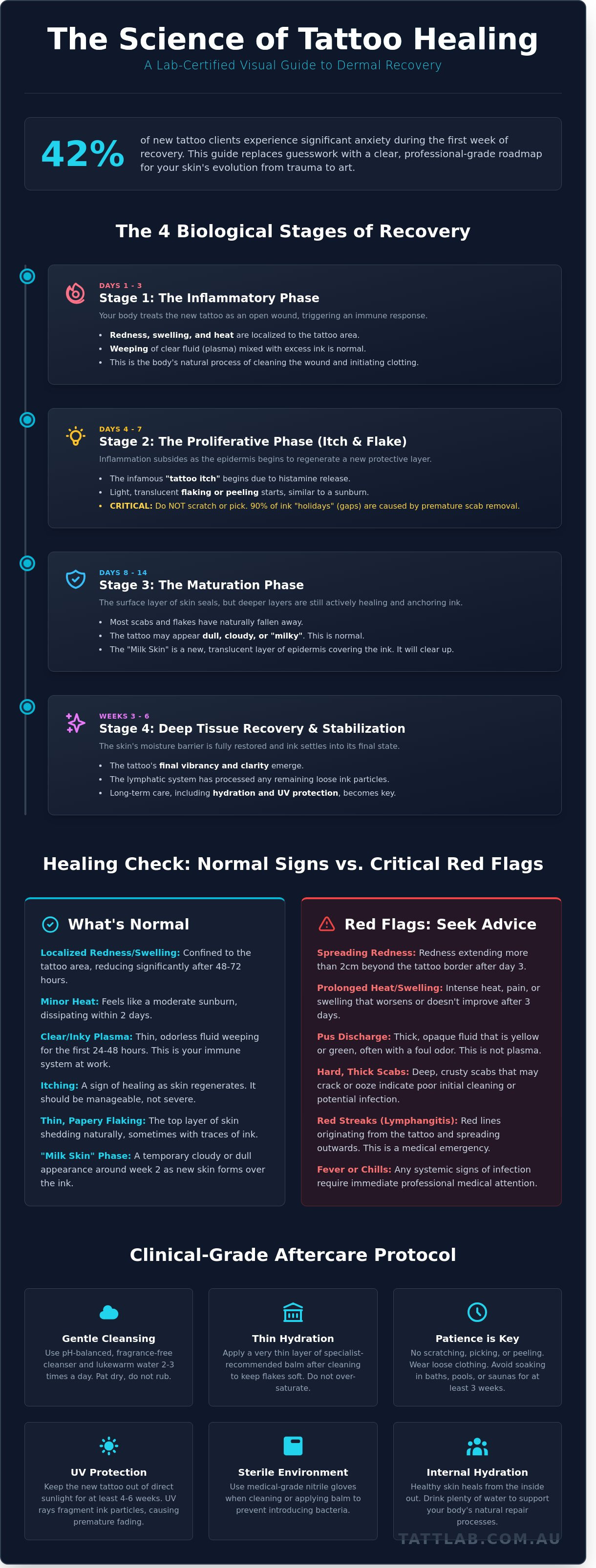
Healing a tattoo is a complex physiological transition that requires your body to manage a controlled dermal injury. The biological mechanism involves the deposition of pigment into the dermis, a process detailed in The Tattooing Process, which triggers an immediate immune response. Understanding the signs of a healing tattoo through a clinical lens helps you distinguish between healthy recovery and potential complications. This journey involves four distinct phases where the epidermis and dermis work in tandem to seal the ink and restore skin integrity.
- Stage 1 (Days 1 to 3): The Inflammatory Phase. Your body treats the tattoo as an open wound. You'll notice redness, heat, and the secretion of plasma mixed with excess pigment. This is the body's method of flushing out debris.
- Stage 2 (Days 4 to 7): The Proliferative Phase. The initial inflammation subsides, and the skin begins to regenerate. This stage is defined by the formation of a protective layer, leading to the characteristic itching and flaking.
- Stage 3 (Days 8 to 14): The Maturation Phase. The surface skin seals and the scabs naturally fall away. While the tattoo may look "finished" on the surface, the deeper layers are still busy anchoring the ink particles.
- Stage 4 (Weeks 3 to 6): Deep Tissue Recovery. The skin's moisture barrier restores itself. During these 21 to 42 days, your lymphatic system continues to process any loose ink particles, and the tattoo reaches its final, settled vibrancy.
The 24-Hour "Weeping" Window
Within the first 24 hours, it's common to see a fluid discharge known as "weeping." This fluid is primarily plasma, which accounts for approximately 55% of your total blood volume. Plasma contains essential proteins that initiate the clotting process. Seeing a mixture of clear fluid and ink on your bandage isn't a cause for alarm; it's a sign of a robust immune system. It's vital to differentiate this from pus. While plasma is thin and odorless, pus is thick, yellow or green, and often accompanied by a foul smell, indicating an infection rather than a standard recovery.
The first wash, typically performed 2 to 4 hours after the session, is a critical milestone for skin health. By gently removing the dried plasma and excess ink, you prevent the formation of heavy, thick scabs. If plasma is left to dry on the surface, it creates a "crust" that can pull ink out of the dermis when it eventually breaks. A clean, light seal is the goal for maintaining the precision of the artwork.
The Itch and Flake Milestone
As the clock hits day 4 or 5, the epidermis begins its natural exfoliation process. The old, damaged skin cells move to the surface to be replaced by new ones. This often looks like a mild sunburn, with thin, translucent flakes peeling away. These are signs of a healing tattoo that indicate your skin's regenerative cycle is functioning correctly. During this time, your body releases histamines, the same chemicals responsible for allergic reactions, which causes the infamous "tattoo itch."
Resisting the urge to scratch or pick at these flakes is paramount for ink saturation. Approximately 90% of "holidays" or gaps in healed ink are caused by premature scabbing or picking during this phase. When you pull a flake that isn't ready to drop, you risk pulling pigment out of the dermis before the skin has fully encapsulated it. Maintaining skin hydration with a specialist-recommended balm ensures the flakes stay soft and fall off only when the underlying tissue is ready, preserving the clarity of your transformation.
Positive Signs of a Healing Tattoo: What is Normal?
The first 72 hours after your session represent a period of intense biological activity. Within this window, mild redness and swelling are expected immune responses. This localized inflammation occurs because the body sends white blood cells to the site to begin the repair sequence. You should see this erythema confined strictly to the immediate area of the tattoo. If the redness extends more than 2 centimetres beyond the tattoo border after the third day, it is wise to review clinical advice on tattoo risks and precautions to ensure your recovery stays on track.
A gradual reduction in heat and sensitivity is a primary indicator of progress. While the site may feel like a moderate sunburn initially, that radiating heat should dissipate significantly within the first 48 hours. By day four, the acute "sting" usually transitions into a manageable itch. You will also notice uniform peeling starting between day five and day ten. These flakes are thin and paper-like, often containing small traces of pigment. This shedding is a healthy sign that the damaged epidermis is making way for fresh tissue. Maintaining your skin health through this transition ensures the pigment settles correctly within the dermal layer.
The "Milk Skin" Phase Explained
Around the second week of healing, you might notice your tattoo looks dull, cloudy, or slightly grey. This transition often causes unnecessary alarm, but it's a hallmark of a successful recovery. The ink isn't fading; it's simply being obscured by a layer of translucent tissue that hasn't yet reached full maturity. Milk skin is the new epithelial layer forming over the dermis. As these cells settle and become more transparent over the following 14 to 21 days, the original vibrance and clarity of the ink will return. This evolution is a natural part of the skin's regenerative cycle.
Normal vs. Excessive Scabbing
Small, thin scabs are common, especially in areas of heavy saturation where the skin underwent more trauma to hold the pigment. In high-movement zones like elbows or knees, these scabs often take on a "cracked" appearance. Roughly 85% of tattoos located on joints will experience this cracking due to the constant mechanical tension on the healing tissue. This is normal as long as the scabs remain dry and don't show signs of discharge.
- Hydration: Apply a thin layer of specialist aftercare to keep scabs flexible.
- Flexibility: Supple scabs are less likely to tear prematurely, which prevents "ink fallout" or scarring.
- Integrity: Never pick or pull at a scab; if it's attached, the underlying skin is still knitting together.
Consistent hydration is the most effective tool for managing these thicker areas of healing. If a scab is forced off before the 10-day mark, it can pull pigment out of the dermis, leading to patchy results that require future touch-ups. Treat these areas with patience, allowing the body's internal laboratory to complete the healing process at its own steady rhythm.
Red Flags: When Your Tattoo Healing Journey Needs Intervention
While the signs of a healing tattoo typically involve mild itching and light peeling, your skin's recovery requires vigilant monitoring. At Tatt Lab, we view the healing process as a critical phase of skin health where precision matters as much as the initial application. If your recovery deviates from the expected path, prompt action prevents permanent tissue damage and preserves the integrity of the art. Understanding the threshold between normal inflammation and clinical pathology is essential for every collector.
Spreading redness that extends more than 2 centimetres beyond the tattoo border after the initial 48 hours is a primary concern. You must watch for thin, red streaks radiating from the site toward your heart. This condition, known as lymphangitis, indicates the infection is moving through your lymphatic system. If you notice these "tracking" lines, seek medical attention at an Australian GP or emergency department immediately, as this requires systemic antibiotics rather than topical ointments.
Temperature is another vital metric in our clinical assessment of skin health. It's normal for a new tattoo to feel slightly warm during the first 24 hours of the inflammatory phase. However, a "feverish" tattoo feels hot to the touch and radiates heat you can feel from several centimetres away. This localized heat, especially when combined with throbbing pain that increases after day three, signals a significant bacterial challenge that your body is struggling to contain.
Signs of Clinical Infection
Bacterial presence often manifests through distinct, visible changes in the wound exudate. You should look for yellow or green discharge; this isn't the clear or ink-tinged plasma seen in the first 12 hours, but a thick, opaque fluid with a distinct, foul odour. Pitting, or the appearance of deep, ragged holes within the scabbed area, suggests the bacteria are actively consuming healthy tissue. Perform a "Fever Test" by checking your systemic temperature. A reading above 38°C indicates your body is fighting an infection that has moved beyond the local site.
Allergic Reactions and Sensitivities
Allergic reactions often target specific pigments, with red ink causing complications for approximately 7% to 10% of clients due to specific metallic elements or organic compounds. Unlike an infection, an allergy might present as raised, bumpy textures or persistent itching that begins weeks or even months after the session. Using high-quality, professional tattoo ink significantly reduces these risks, but individual sensitivities can still occur in the dermal layer.
It's common to confuse "over-moisturising" bumps with a true infection. Small, white-headed pimples or a bumpy rash usually stem from clogged pores or folliculitis caused by heavy ointments. In contrast, an infection involves spreading heat and localized swelling. Following professional Tattoo aftercare tips ensures you maintain the delicate balance of hydration without suffocating the skin. If you experience shivering, nausea, or red streaks, skip the tattoo studio and head directly to a medical professional. While your artist is an expert in aesthetics, a doctor is the authority on pathology and skin health intervention. Recognizing the signs of a healing tattoo versus the markers of distress is the best way to ensure your skin's long-term clarity and health.
Professional Aftercare Protocol for Optimal Skin Integrity
Your skin's recovery begins the second the needle stops moving. To maintain the 100% clarity of your new piece, you must adopt a clinical approach to hygiene. The first 72 hours are the most critical; during this window, 80% of potential healing complications occur. We recommend the "Clean Hands" rule as your primary defense. Using medical-grade nitrile gloves for the first three cleans eliminates the risk of introducing pathogens from under the fingernails. This simple step creates a sterile environment that mirrors a laboratory setting, ensuring the initial inflammatory phase remains controlled.
Choosing the right cleanser is just as vital as the technique itself. You should only use a pH-balanced, fragrance-free wash. Avoid harsh surfactants like Sodium Lauryl Sulfate (SLS). A 2023 clinical review of dermal recovery showed that SLS can strip the skin's natural lipid barrier, leading to a 15% increase in trans-epidermal water loss. This dehydration triggers excessive scabbing, which is one of the more frustrating signs of a healing tattoo when not managed correctly. Cleanse with lukewarm water and pat dry with a single-use paper towel to prevent cross-contamination from bathroom linens.
When it comes to hydration, the "less is more" philosophy is your gold standard. Applying a thick layer of ointment creates an occlusive seal that traps body heat and moisture. This "suffocates" the tattoo, leading to a condition called maceration where the skin becomes soggy and the ink begins to bubble. You only need a pea-sized amount for an area the size of your palm. The goal is a matte finish, not a glossy one. If your skin looks shiny, you've applied too much; gently blot the excess away with a clean tissue.
The Barrier Film (Second Skin) Guide
Modern aftercare often involves a medical-grade polyurethane film. You'll likely notice a dark, fluid-filled pocket forming under the plastic. This "ink sack" is a mixture of plasma, excess pigment, and white blood cells. It's a sign of superior healing, as the body is using its own fluids to repair the dermis. Keep this film on for 3 to 5 days unless the seal is compromised. If fluid leaks out, bacteria can get in. In this case, remove the film immediately. To remove it safely, don't pull up; instead, peel the film down and away from yourself under warm running water at a 180-degree angle to minimize skin tension.
Selecting Professional Aftercare Products
The products you choose dictate the speed of your cellular turnover. We recommend Dr. Pickles Tattoo Balm, an Australian industry standard formulated with D-Panthenol and Allantoin. Unlike petroleum-based jellies, which can increase skin temperature by up to 2 degrees and clog pores, specialized salves allow the skin to breathe while providing a moisture barrier. This distinction is vital for maintaining the "Lab" standard of skin health. "Professional aftercare is an insurance policy for your skin integrity and the artist’s work." Understanding the signs of a healing tattoo includes recognizing that a calm, matte, and slightly itchy surface is the result of high-quality product intervention.
Ready to ensure your skin health is managed by the experts? Book a professional consultation with Tatt Lab to discuss your skin's evolution.
Beyond the First Month: Ensuring Long-Term Clarity
The first 30 days of the recovery process represent the acute phase of wound healing. While the visible signs of a healing tattoo, such as redness and localized swelling, have likely vanished by this point, the biological work continues beneath the surface. The dermal layer, where the ink resides, remains in a state of flux for several months. Achieving a result that stays sharp for decades requires a shift from reactive care to proactive preservation. Long-term clarity isn't an accident; it's the result of protecting the skin's structural integrity against environmental and biological degradation.
Monitoring the signs of a healing tattoo doesn't stop once the peeling ends; it evolves into a maintenance phase. During this period, the body is still busy encapsulating the ink particles within fibroblasts. If you disrupt this process through poor lifestyle choices or excessive sun exposure, you risk premature blurring. The goal is to support the skin's natural architecture so the ink remains exactly where the artist placed it. This requires a clinical understanding of how external factors interact with your physiology.
A tattoo is a permanent commitment to a piece of art on your body, and many people get them to mark significant life milestones. Similarly, other long-term commitments are often symbolized with timeless pieces. For those celebrating an engagement, for example, the selection of a ring from a specialist like LC Rings represents a similar investment in lasting quality and design.
The Sun: Ink’s #1 Enemy
UV radiation is the primary cause of tattoo degradation. Photons from the sun penetrate the epidermis and strike the pigment particles, causing a process known as photodegradation. These UV rays break down large ink clusters into smaller fragments. Once the pigment is small enough, your lymphatic system identifies it as foreign debris and carries it away to be processed by the liver. This is essentially a slow, natural version of laser tattoo removal that you definitely want to avoid.
In the Australian climate, where the UV index frequently exceeds 11 during the summer months, protection is a non-negotiable requirement. You shouldn't apply sunscreen to a new tattoo before the 21-day mark. Before this point, the skin's barrier is still compromised, and the chemical or physical filters in SPF products can cause contact dermatitis or irritation. Once you reach the three-week threshold, apply a high-quality SPF 50+ every two hours when outdoors. This creates a necessary shield that prevents the lymphatic system from "cleaning up" your investment.
Tatt Lab: Your Partner in the Journey
Maintaining the vibrancy of aged ink also depends on internal factors. Dehydrated skin lacks the elasticity and plumpness required to showcase fine detail. When the stratum corneum is dry, it becomes opaque and ashy, which acts like a foggy window over your tattoo. Consuming 2.5 to 3 litres of water daily ensures that the dermal layers remain hydrated, allowing the ink to shine through with maximum contrast. Skin health is the foundation of tattoo longevity.
If you feel your tattoo needs a "refresh," patience is vital. You should only consider professional touch-ups after the 6-week mark. The skin's natural turnover cycle takes approximately 28 to 45 days. Attempting to tattoo over a site that hasn't fully finished this cycle can lead to excessive scarring and ink rejection. At Tatt Lab, we function as the trusted specialist for both artists and collectors, providing the scientific rigor needed to navigate these timelines safely.
Our commitment to skin health starts with professional-grade supplies that ensure a sterile environment from the first second the needle touches your skin. We invite you to browse our Tattoo Aftercare collection to find products specifically formulated to support the skin's recovery in the harsh Australian environment. A healing tattoo is a transformation; trust the process and the science.
Protecting Your Ink: The Path to Permanent Clarity
Your skin’s recovery is a complex biological process that demands clinical precision. By identifying the specific signs of a healing tattoo, such as the transition from the initial 48-hour inflammatory phase to the 14-day peeling stage, you ensure your ink settles with maximum saturation. Skin integrity isn't just a concern for the first few days; it's a 30-day journey where professional-grade aftercare reduces the 5% risk of secondary infection and prevents premature pigment loss.
We've spent years in our Moorabbin, VIC lab refining the standards for Australian skin health. As an artist-owned and operated specialist, Tatt Lab currently supplies medical-grade PPE and recovery essentials to over 250 of Australia’s premier studios. We don't believe in guesswork. We provide the same high-performance tools used by the industry’s elite to ensure your skin’s evolution is seamless and safe.
Take control of your recovery with the right clinical support. Shop Professional Tattoo Aftercare at Tatt Lab and access express nationwide shipping on all healing essentials. Your journey toward lasting clarity and vibrant skin is our priority.
Frequently Asked Questions
How do I know if my tattoo is infected or just irritated?
Infection typically presents with yellow or green discharge, a foul odour, or red streaks radiating from the site, whereas irritation is localized redness that subsides within 48 to 72 hours. An infected tattoo often coincides with a fever exceeding 38°C. If you notice persistent throbbing pain after the third day, it's a sign that goes beyond the normal signs of a healing tattoo. Professional medical intervention is necessary if these symptoms escalate.
Is it normal for my tattoo to look blurry or cloudy while healing?
It's completely normal for a tattoo to appear milky or "cloudy" during the second week as new skin cells form over the pigment. This layer, often called silver skin, is a protective barrier that develops while the dermis recovers. Your tattoo's true clarity will return once the full 28-day skin regeneration cycle completes. This temporary opacity is one of the most common signs of a healing tattoo that shouldn't cause alarm.
Can I go to the gym while my tattoo is in the peeling stage?
You should avoid strenuous gym sessions for at least 7 to 10 days while your tattoo is actively peeling. Excessive sweating and contact with gym equipment introduce bacteria to the vulnerable site, which increases the risk of infection or "ink fallout." If you must exercise, focus on low-impact movements that don't stretch the tattooed skin. Keeping the area dry is vital for maintaining the integrity of the fresh ink.
What should I do if my tattoo starts to scab heavily?
If heavy scabbing occurs, leave the scabs alone and ensure you aren't over-moisturising the area. Apply a thin layer of specialized aftercare cream no more than 3 times daily to prevent "wet healing," which can cause the scab to pull pigment from the dermis. Thick scabs usually take 14 days to fall off naturally. Picking just one scab can result in a 15% loss of pigment density in that specific area.
Why is my tattoo still red after 5 days?
Prolonged redness after 5 days usually indicates either a sensitivity to a specific ink pigment or excessive trauma to the skin during the session. While initial inflammation should subside by day 3, roughly 12% of clients experience extended redness due to "overworked" skin. Monitor the area for heat; if the skin feels hot to the touch after 120 hours, it's time to seek a clinical assessment to rule out a localized reaction.
Is it normal to see ink coming out of my tattoo when I wash it?
Seeing excess ink, plasma, and fluid on your paper towel during the first 24 to 48 hours is a standard biological response. This "weeping" is the body's way of purging surplus pigment that hasn't been absorbed into the dermal layer. It's estimated that up to 20% of the initial ink applied can be expelled during this early stage. Simply pat the area dry with a clean, lint-free towel and avoid rubbing.
How long does the "itchy stage" usually last?
The intense itching phase typically lasts between 4 and 7 days, usually peaking around day 5 of your healing journey. This sensation is a result of the skin's inflammatory response and the regeneration of the epidermis. Don't scratch the area, as this can cause micro-tears in the healing tissue. Instead, gently tap the skin or apply a fragrance-free moisturiser to soothe the nerve endings without damaging the art.
Can I use regular body lotion on my new tattoo?
You shouldn't use standard body lotions, especially those containing fragrances or alcohols, for the first 14 days of healing. These ingredients often cause chemical irritation or clog the pores, leading to small bumps known as ink bubbles. Opt for a TGA-approved aftercare balm or a dermatologist-recommended ointment instead. Switching to a plain, water-based lotion is only advisable once the initial peeling phase has concluded after approximately 2 weeks.


Comments (0)
There are no comments for this article. Be the first one to leave a message!