
A rotary tattoo gun turns a motor’s rotation into the needle’s repeated up-and-down movement. That motion is the key to understanding how the machine works, but the feel during tattooing also depends on how the artist controls the machine and needle.
It’s easy to assume that a machine’s movement is a technical detail only the artist needs to understand. In reality, knowing what drives the needle can make the process feel less mysterious and help you follow why rotary machines can feel different from other types.
This article explains how a tattoo gun’s rotary mechanism works, from the motor and drive system to the needle’s stroke. You’ll learn what that movement means during tattooing and how artists choose equipment for different tasks.
Key Takeaways
- Understand how a rotary mechanism turns motor movement into repeated needle action, and what that means as tattooing progresses.
- Learn how coil, rotary and pen machines differ so you can follow why artists may choose one type over another.
- See which factors shape machine costs in Australia, without relying on a single price as a guide.
- Identify the supporting equipment used alongside a machine, including needles, power supplies, ink and aftercare.
Rotary tattoo machines
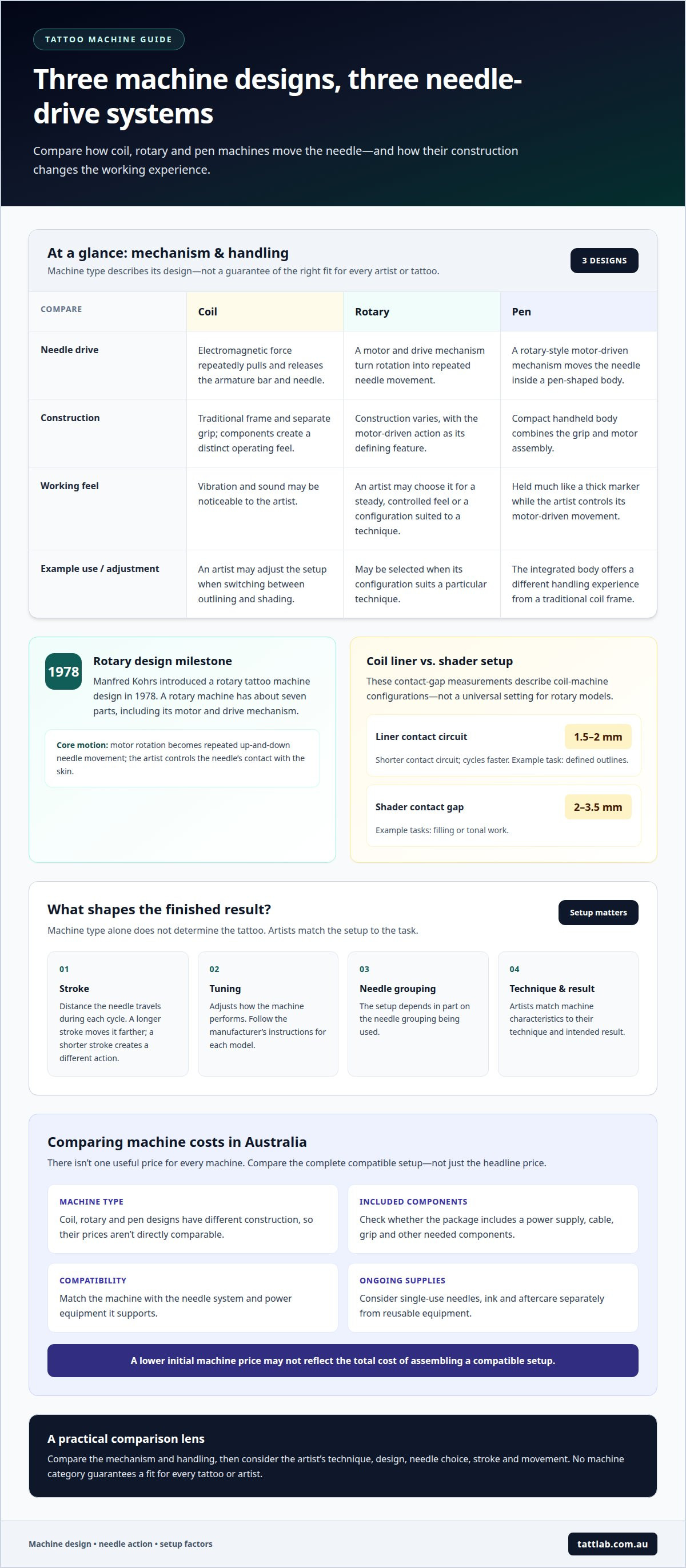
A rotary machine converts motor rotation into repeated needle movement. Manfred Kohrs introduced a rotary tattoo machine design in 1978.
A rotary machine has about seven parts, including its motor and drive mechanism. Together, they move the needle in and out, while the artist controls its contact with the skin.
Coil machines use electromagnetic action instead. Their coils generally have 8 to 10 wraps, and their components create a different operating feel. Cosmetic and permanent make-up machines also move needles mechanically, but are designed for procedures such as eyebrow or lip pigmentation.
Liner and Shader Machines
Liner and shader machines are configured for different needle actions and tattooing tasks. A liner uses a short contact circuit of about 1.5-2 mm to cycle faster, while a shader uses a contact gap of about 2-3.5 mm. These measurements describe coil-machine configurations, not a universal setting for every rotary model. For example, an artist may select a liner setup for defined outlines and a shader setup for filling or tonal work. The distinction helps explain why one machine configuration may not suit every part of a design.
Machine Tuning and Stroke
Stroke is the distance the needle travels during each cycle, while tuning adjusts how the machine performs. The right setup depends on the machine, needle grouping, technique and intended result. A longer stroke moves the needle farther; a shorter stroke creates a different action. Artists match these characteristics to the task rather than assuming one setting suits every design. Follow the manufacturer’s instructions when adjusting each model.
In Australia, applicable health requirements can vary by location; the machine itself doesn’t establish compliance. Tattoo equipment must be used in line with the requirements that apply to the procedure and setting.
For safer use, follow the machine manufacturer’s instructions and use sterile, single-use needles. Keep the work area organised, and don’t use equipment that is damaged or contaminated.
Cleaning and sterilising are separate stages: reusable equipment needs appropriate cleaning before sterilisation. Use a validated process suited to the equipment, rather than relying on surface wiping alone.
Home tattooing can expose people to infection, skin injury and poor-quality results. Without appropriate training, sterile equipment and controlled working conditions, it can be difficult to manage a machine’s movement safely.
What are the main types of tattoo machines: coil, rotary, and pen?
Coil, rotary and pen machines are three common designs, each moving a needle differently. A coil model uses electromagnetic force to move its armature bar and needle. A rotary model uses a motor and drive mechanism. A pen machine houses its motor and needle assembly in a pen-shaped body. These differences affect how the artist handles and controls the machine.
In a coil machine, electromagnetic action repeatedly pulls and releases the armature bar. This creates a distinct operating feel, with vibration and sound that artists may notice while working. The separate frame and grip also give it a different balance from a pen model. For example, an artist may adjust a coil machine’s setup when switching from outlining to shading.
Rotary machines use a motor to convert rotation into repeated needle movement. Construction varies, but the motor-driven action is their defining feature. An artist may choose a rotary machine for its steady, controlled feel or because its configuration suits a particular technique. Machine type alone doesn’t determine the finished tattoo; needle choice, stroke and the artist’s movement matter too.
A pen machine is a rotary-style design shaped for a pen-like grip. Its compact form combines the grip and motor in one handheld body, rather than using a coil machine’s traditional frame. For example, an artist can hold a pen machine much like a thick marker while controlling needle movement through its motor-driven mechanism.
Compare the mechanism and handling, not just the machine’s label. A coil’s electromagnetic cycle, a rotary’s motor-driven movement and a pen’s integrated body each create a different working experience. The right fit depends on the artist’s technique, design and handling preferences. These categories describe how machines are built, not a guarantee that one type suits every tattoo or artist.
How much does a tattoo machine cost in Australia?
There isn’t one useful price for every tattoo machine in Australia. Cost depends on the design, components, intended use and package contents. Coil, rotary and pen-style machines have different construction, so their prices aren’t directly comparable. A machine sold on its own is also a different purchase from a bundle with a power supply and accessories.
Build quality and compatibility matter as much as machine type. For example, a setup designed for a particular cartridge system may not suit an artist’s existing needle arrangement. A pen-style body may combine the motor and grip, while another setup may require separate components. These differences affect what the listed price includes, not just the machine’s appearance.
Before choosing, compare the complete setup, not just the headline price. Check whether the package includes the power supply, cable, grip and other components you need. Then consider recurring consumables, such as needles and ink, separately from reusable equipment. A lower initial machine price may not reflect the total cost of assembling a compatible setup.
- Machine type: Compare coil, rotary and pen designs by construction and intended use.
- Included components: Identify what comes in the box and what must be purchased separately.
- Compatibility: Match the machine with the needle system and power equipment it supports.
- Ongoing supplies: Account for single-use needles, ink and aftercare as separate requirements.
For a professional studio, suitability and consistent operation may matter more than the lowest price. If you’re building a setup, prioritise compatibility with the equipment and technique you already use. Compare specifications and included components in Australian dollars, then assess the complete setup before deciding. This makes it easier to compare machines without treating different configurations as equivalent.
Design history offers another way to distinguish machine types. Thomas Edison's electric pen, a predecessor to the tattoo machine, was patented in the United States in 1876. Thomas Riley patented the first tattoo machine based on electromagnetic technology twenty days after Samuel O'Reilly filed the patent for his rotary machine. Carson Hill invented the first pneumatic tattoo machine in 2000. A coil tattoo machine consists of about fifteen different parts, which helps explain why construction and included components vary.
What needles, power supply, and other equipment are needed with a tattoo machine?
A machine is one part of a setup. Essential components include compatible needles, a power source and connection, ink, and tools for preparing the design. For example, a rotary machine using cartridges needs cartridges suited to its grip and connection. A traditional needle setup instead uses compatible tubes and needles.
Needle choice shapes the mark. Round liners can create defined lines, while round shaders and magnums cover broader areas or support shading. Artists match the needle grouping to the design, machine and technique. A stencil transfers the planned image onto the skin, providing a guide before tattooing begins.
Power equipment supplies and controls the machine’s motor. Depending on its design, a machine may connect to a power supply by cable, with a foot pedal controlling operation. Compatibility matters: connectors and power supplies must suit the machine. Follow the manufacturer’s instructions for connecting and operating each component.
- Needles and cartridges: Choose a compatible configuration for the machine and intended line or shading work.
- Power equipment: Use a suitable power supply, connection cable and pedal where the machine requires them.
- Ink and stencil: Ink supplies the colour, while a stencil helps position the design.
- Workstation supplies: Barriers, gloves and ink cups help organise the work area and keep supplies separated.
Artists also need a stable work surface, good lighting and a well-organised supply area. For example, keeping ink cups within reach reduces unnecessary movement during a session. Aftercare products support care for freshly tattooed skin, while cleaning and sterilisation equipment is part of a professional studio’s wider workflow.
Build a compatible setup by matching the machine, needle system and power connection first, then selecting the design and workstation supplies. Shop tattoo needles, inks and stencils for the consumables used alongside tattoo equipment.
Before ordering tattoo-specific supplies, make sure the order is licensed. Checking its licensing status before checkout can help avoid cancellation and charges, so confirm this before selecting supplies for a compatible setup.
Tatt Lab
Tatt Lab helps Australian tattoo artists build a practical, considered setup around their equipment. Once you’ve chosen a machine type, compatible needles, ink and aftercare products support the wider process, from preparing to tattoo to caring for finished work.
Tatt Lab’s range includes traditional needles, tattoo cartridges, tattoo inks and tattoo aftercare. These supplies are useful when matching consumables to your machine, replenishing studio essentials or organising care products alongside your equipment. Choose according to your setup and working approach, not the machine label alone.
For tattoo equipment supplies that support your workflow, contact Tatt Lab.
Make your next equipment choice with clarity
Your next step is to connect what you’ve learned about machine movement with how you want your setup to work. A tattoo gun is one part of a considered workflow, so compatible supplies and ongoing care deserve as much attention as the machine itself. For working artists, keeping these choices aligned can make equipment decisions more purposeful as techniques and projects develop.
Tatt Lab offers traditional needles, tattoo cartridges and tattoo aftercare for different stages of that workflow. These supplies support planning for tattooing and care beyond the session, alongside equipment choices suited to your practice.
If you’re ready to discuss supplies for your setup, contact Tatt Lab. Take the next step at a pace that feels right, with a clearer understanding of the choices ahead.
Frequently Asked Questions
What is a tattoo gun and how does a tattoo machine work?
A tattoo gun is the informal name for an electric tattoo machine. Its motor or electromagnetic coil drives a needle assembly, while the artist guides the handpiece and controls where it meets the skin. The machine doesn’t create the design by itself. The artist follows a stencil or visual plan, coordinating hand movement with the needle to form lines or shading.


Comments (0)
There are no comments for this article. Be the first one to leave a message!