
A colour chart can't prove an ink is safe. Knowing what to tell clients about ink safety means explaining how you assess the product’s compliance, packaging, ingredients and batch details, while being honest that reactions can still arise later. EU REACH restrictions introduced in 2022 affected certain tattoo ink pigments, so compliance claims need to be supported by clear product information, not appearance alone.
Clients may reasonably want reassurance before a permanent procedure. Explain what the label and safety documentation can show, what they cannot guarantee, and why sealed packaging, expiry information and traceable batch details matter. This guide covers practical checks before a session and ways to discuss possible risks, including irritation, allergic reactions and infection. The aim is to help clients make an informed decision without creating unnecessary worry.
Key Takeaways
- Assess REACH claims through product documentation, not colour charts alone, and understand that EU compliance relates to specific chemical restrictions.
- Review the seal, label, ingredient information and product instructions together to build a clearer picture of an ink’s suitability.
- Explain that contamination and reactions can still be concerns, and discuss what clients should do if healing problems or symptoms arise.
- Record each ink’s product name, colour and batch details for the session so the information remains traceable if questions emerge later.
How can I tell if my tattoo ink is REACH compliant?
EU REACH compliance addresses restrictions on chemicals in tattoo inks, including certain pigments. For sessions in Australia, distinguish this from the domestic chemical requirements that apply here.
REACH Restrictions on Tattoo Ink Pigments
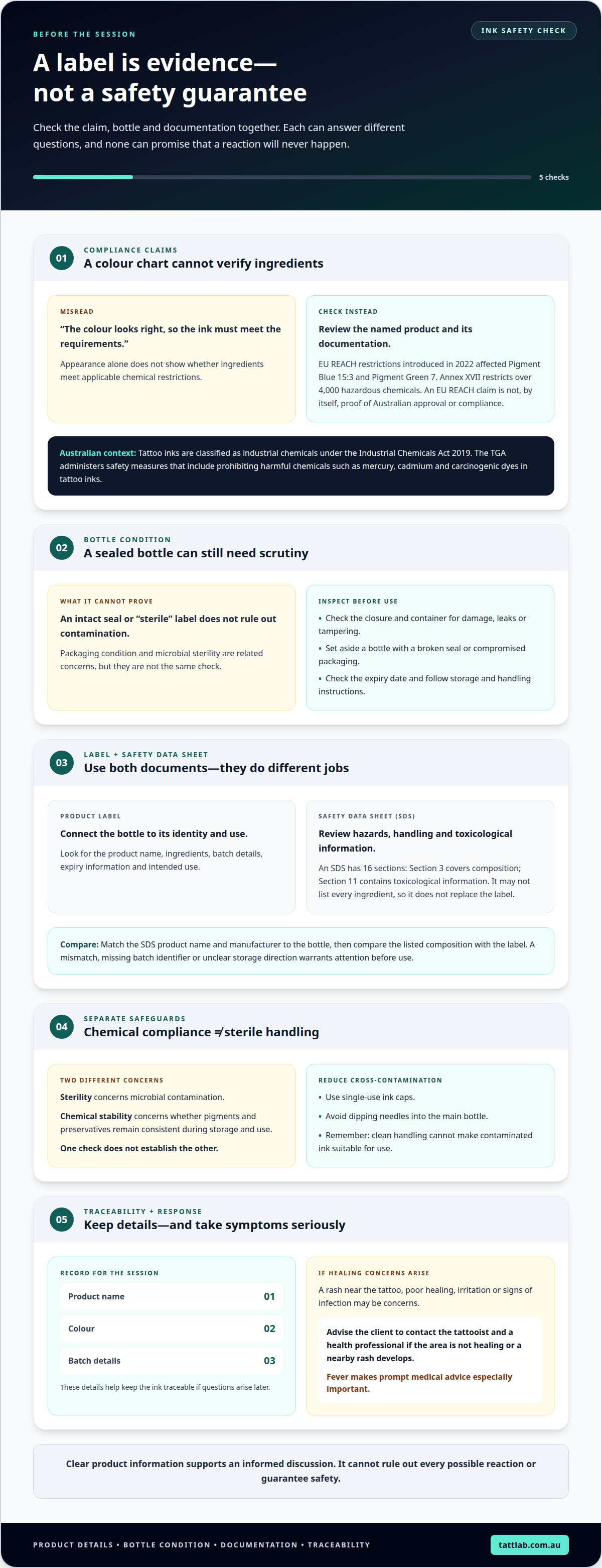
REACH is the European Union framework restricting hazardous chemicals in tattoo inks. Restrictions introduced in 2022 affected pigments including Pigment Blue 15:3 and Pigment Green 7. Annex XVII restricts over 4,000 hazardous chemicals, including certain pigments and preservatives. Regulation (EU) 2020/2081 sets out relevant EU criteria. These restrictions matter because an ink’s colour chart alone can’t show whether its ingredients meet the applicable requirements.
Australia has its own context: tattoo inks are classified as industrial chemicals and governed by the Industrial Chemicals Act 2019. The Therapeutic Goods Administration administers safety measures that include prohibiting harmful chemicals such as mercury, cadmium and carcinogenic dyes in tattoo inks. Clients can ask which ink is being used and review its label and supplier documentation. An EU REACH claim describes compliance with EU restrictions; it isn’t, by itself, proof of Australian approval or compliance.
Pigment Sterility and Chemical Stability
Sterility concerns microbial contamination; chemical stability concerns whether pigments and preservatives remain consistent during storage and use. Both matter: contamination or degradation can undermine confidence in an ink even when its packaging looks intact. A sealed container or a label claiming sterility does not rule out contamination. Check the expiry date and handling instructions, and do not use expired ink. Explain that these checks address different issues: sterile handling does not establish chemical compliance, and compliant ingredients do not establish sterility.
Colour and Ingredient Risk Differences
Risk can vary with an ink’s pigments and other ingredients, so colour alone doesn’t establish suitability. Pigment Blue 15:3 and Pigment Green 7 faced EU restrictions, making their presence relevant when assessing EU REACH claims. Clear ingredient information helps identify what a product contains, while a colour chart only shows its appearance. Some ingredients can also be associated with allergic reactions; clients should understand that reactions remain a possible health concern. Discuss the named product and its documentation, rather than making broad promises about every ink of one colour.
Tamper-proof packaging, labelling and ingredient transparency
Packaging, product labels and Safety Data Sheets each provide different information. Compare them to identify inconsistencies before using an ink.
Tamper-Proof Packaging and Ink Sterility
An intact seal helps indicate whether a bottle may have been opened or interfered with, but it does not prove the ink is sterile. Contamination can occur despite sealed packaging or a sterility claim on the label. Before use, check the closure and container for visible damage, leaks or signs of tampering. If the seal is broken or the packaging is compromised, set the bottle aside; do not treat the label as proof of safety.
Check that the ink label identifies the product and states that it is sterile. Note the expiry date and follow the manufacturer’s storage and handling instructions to help maintain the product’s condition. Certification or claims about manufacturing practices can provide context, but they do not replace checking the individual bottle and its documentation. This distinction addresses client concerns without implying that packaging alone can prevent every serious risk.
Labels and Ingredient Transparency
A product label should identify ingredients, batch details, expiry information and intended use. These details let a studio connect the bottle in use with its supporting documentation. A Safety Data Sheet (SDS) adds information about chemical hazards, handling and toxicological data. It has 16 sections: Section 3 covers composition, while Section 11 contains toxicological information. An SDS may not list every ingredient, so it doesn’t replace the product label.
Match the Safety Data Sheet (SDS) product name and manufacturer to the bottle, then compare its listed composition with the label. A mismatch, missing batch identifier or unclear storage direction warrants attention before use. The Globally Harmonized System (GHS) standardises hazard symbols and language, but each jurisdiction applies it through its own regulations. Clear documentation supports an informed discussion; it cannot rule out every possible reaction.
When reviewing professional tattoo inks, use the label and product documentation together to understand ingredients and handling information.
Health risks of contaminated or low-quality tattoo ink
In Australia, tattoo inks are classified as industrial chemicals and governed by the Industrial Chemicals Act 2019. The Therapeutic Goods Administration administers safety measures that include prohibiting harmful chemicals such as mercury, cadmium and carcinogenic dyes in tattoo inks.
Contamination and Infection Risks
Microbial contamination occurs when harmful microorganisms are present in ink or introduced during handling. It can cause infection after tattooing, so a sealed bottle or sterile label claim does not eliminate every risk. Control ink handling, use single-use ink caps and avoid dipping needles into the main bottle. These practices help reduce cross-contamination between a client and the ink supply.
Contamination can occur even when a container is sealed or labelled sterile. The US Food and Drug Administration has recalled tattoo inks found to contain bacteria. This highlights why ink quality and hygienic handling are related but separate safeguards. A clean setup cannot make contaminated ink suitable for use.
Responding to Tattoo Reactions
Possible reactions include a rash near the tattoo, poor healing, irritation or signs of infection. Advise clients to contact the tattooist and a health professional if the area is not healing or a nearby rash develops. Fever makes prompt medical advice especially important. If a client reports an infection or another reaction, they should notify the artist and seek healthcare support rather than relying on studio advice alone.
Ask the client when symptoms began and which tattooed area is affected. These details can help a health professional assess the problem. FDA reports describe some adverse reactions emerging years after tattooing, so clients should also raise later changes with a health professional.
Long-Term Effects and Tattoo Removal
Tattoos are designed to be permanent, and removal can be difficult. Some removal procedures may leave permanent scarring or fail to remove the tattoo completely. Explain this before the session so clients understand that removal is not a simple reversal if their preferences change.
Ink pigments may be organic or inorganic, but that description alone does not establish whether a particular product is suitable. The ingredients, product information and handling all matter. Low-quality or contaminated inks can raise concerns beyond appearance, including infection or other reactions. A clear, measured conversation helps clients understand immediate and possible longer-term concerns without promising a reaction-free outcome.
Identifying ink brands, colours and batch numbers
A traceable record links the ink used in a session to its product, supplier and batch. For an artist, deciding what to tell clients about ink safety starts with identifying the exact bottle used, not relying on a colour name alone.
Product, Supplier, and Batch Identification
Record the product name, manufacturer or supplier, colour and batch number together. Include the lot code if the bottle has one, and match each detail to the bottle used. Similar shade names can refer to different products, so colour alone will not identify the ink. Complete records help distinguish products and batches if questions arise later.
Keep these details with the client’s session record instead of relying on memory or an old bottle image. If you change products or batches, record the replacement. This creates a useful history even when a colour is refreshed or a supplier changes.
Questions About Ink Brands and Ingredients
Clients can ask which brand and colour the artist plans to use, whether they can see the bottle label, and how the ingredients are described. They can also ask how the studio records the batch number for their session. A practical way to explain what to tell clients about ink safety is to answer with product information and session records, rather than broad claims about a brand.
Store the ink details alongside the session date and tattooed area, and retain batch records for 3 years. Update the record whenever a product or batch changes. Accurate tracking can help identify which batch was used if an adverse concern is raised later. It also gives the artist a reliable reference when discussing the session with the client.
For your studio’s ink supply, shop tattoo inks and keep product and batch details organised for session records.
Tatt Lab
Tatt Lab supplies tattoo studios with professional equipment and products for day-to-day practice. Once you have established how you assess ink labels, ingredients and batch records, Tatt Lab can help equip your studio with tattoo inks, needles, cartridges and aftercare.
Apply the same care when selecting supplies: keep product information accessible, organise stock records and follow each product’s handling instructions. Clear records connect the materials used in a session with the information you may need to discuss with a client later. Tatt Lab’s range includes equipment and aftercare supplies to support your studio’s ink-safety practices.
Contact Tatt Lab to discuss supplies for your studio.
Make informed conversations part of every session
Knowing what to tell clients about ink safety is not a one-time conversation. Make openness part of the studio experience so clients feel comfortable raising concerns before a session and sharing changes afterwards. A calm, clear discussion supports informed choices without suggesting that any tattoo is entirely free from risk.
Build that approach into the way you prepare, communicate and care for clients. Tatt Lab offers Tattoo Aftercare, Traditional Needles and Tattoo Cartridges to support studios’ professional supply needs. For a considered next step, contact Tatt Lab about ink safety and discuss supplies for your studio.
Every thoughtful conversation helps clients move forward with greater clarity and confidence.
Frequently Asked Questions
Could other problems occur later?
Yes. Tattoo-related reactions can emerge long after the appointment, not only during healing. If a client later notices a change around the tattoo, they should tell a health professional when it began and which area is affected. The studio’s session record can help identify the ink used, giving the clinician useful context without assuming the ink caused the symptom.
Does Having an SDS Mean a Product Is Safe?
No. A Safety Data Sheet explains chemical hazards and safe handling, but it does not test the particular bottle or guarantee that every client will tolerate the ink. Treat it as one part of product assessment. For example, an SDS can inform safe handling, while the bottle’s identity and condition need separate attention.
Does MoCRA affect individual tattoo artists or just manufacturers?
MoCRA is a United States cosmetics law, not an Australian tattoo-studio regulation. For Australian artists, it doesn’t replace the domestic framework: tattoo inks are classified as industrial chemicals under the Industrial Chemicals Act 2019, with safety measures administered by the Therapeutic Goods Administration. In the United States, an artist’s obligations depend on their role in the product’s manufacture or marketing, not simply on applying ink.
Is vegan tattoo ink safer than traditional ink?
Not by itself. “Vegan” describes whether animal-derived ingredients are used; it does not establish an ink’s chemical profile, sterility or suitability for a particular person. A client with sensitivities should discuss the specific product and its ingredients with the artist before the session. A vegan claim answers an ethical question, not every question about health risk.
What should tattoo artists tell clients about tattoo ink safety?
Explain which ink you will use and invite clients to raise ingredient sensitivities or other concerns before the session. Be clear that careful product selection and studio hygiene reduce avoidable risks but cannot promise a reaction-free result. Agree on what the client should do if symptoms appear, including seeking advice from a health professional and notifying the artist.
What ingredients and contaminants in tattoo ink can pose health risks?
Potential concerns include certain pigments, preservatives, harmful chemicals and microorganisms. Australian safety measures administered by the Therapeutic Goods Administration include prohibitions on mercury, cadmium and carcinogenic dyes in tattoo inks. Bacterial contamination can also create infection concerns. If a client asks about a specific colour, show them the relevant product information rather than relying on reassurance based on colour or marketing claims alone.


Comments (0)
There are no comments for this article. Be the first one to leave a message!