

What if a strong apprentice portfolio didn’t need to be full of tattoos? If you’re still building experience, it’s understandable to worry that drawings and practice pieces won’t look professional enough. But studios want to see the foundations you bring to tattooing: confident drawing, thoughtful composition and a willingness to develop. These tattoo portfolio tips for apprentices will help you show that potential without overstating your experience.
A portfolio isn’t a record of everything you’ve made. It’s a considered selection that makes your current ability easy to assess. Choose finished drawings and relevant practice work, show range across styles and subjects, and organise each piece so it’s easy to view and discuss. Brief, consistent captions and clear images give useful context, whether you’re sharing a digital portfolio or bringing a printed one to a studio conversation.
With a simple routine for reviewing and updating your work, your portfolio can grow alongside your skills. The aim isn’t to appear fully formed. It’s to present your progress honestly and give a mentor a clear view of what you can do now and what you’re ready to develop next.
Key Takeaways
- Use tattoo portfolio tips for apprentices to build a curated record of your visual thinking, technique and development, not a pile of everything you’ve made.
- Choose original designs that show control and range. Pair cohesive flash sheets with a few distinctive standalone pieces.
- Label design work, practice work and completed tattoos clearly so your portfolio reflects your experience honestly.
- Select, sequence and review your work with a repeatable process. Keep a clear digital version and a tidy printed portfolio when useful.
- Be ready to discuss your influences, design choices and developing skills so studio conversations can lead to focused, constructive feedback.
Why a Tattoo Portfolio Matters for Apprentices Starting Out
A tattoo portfolio is a curated record of an artist’s visual thinking, technique and development. For an apprentice, it gives a studio something concrete to discuss before there’s an extensive record of tattooing experience. A thoughtful selection can show how you observe, make design decisions and respond to feedback, helping a mentor understand your current skills and potential fit with the studio.
Think of it as a conversation tool, not a sales pitch. A clear portfolio helps you explain what you were aiming for and gives a mentor specific work to respond to. They might ask why you chose a particular composition or how you’d adjust a design for a different placement. That exchange can reveal your thought process as clearly as the finished artwork.
Page count isn’t a measure of readiness. Clarity, consistency and honest labelling matter more. A small selection of resolved work is easier to assess than a crowded collection of unfinished or near-identical pieces. Keep the subject, medium and completion status visible so the viewer can focus on the work instead of guessing how it was made. For general background on the apprenticeship context and studio practices, see Tattoo Artist Apprenticeships and Practices.
What a tattoo apprenticeship portfolio needs to communicate
Make your observation, drawing fundamentals and composition easy to see. Include pieces that show how you handle shape, spacing, contrast and detail, alongside an emerging direction in your subject matter or style. Add a short label when it helps, such as “botanical design, pencil, finished study.” A portfolio is a working document, not a claim of mastery. It should make your current level and development clear.
Can you build a portfolio before tattooing clients?
Yes. Original drawings, cohesive flash sheets and clearly labelled practice work can demonstrate design ability before you have tattooed clients. Keep the distinction explicit: a design shows what you can draw, while a completed tattoo documents work on skin. Don’t present one as the other. Develop practical skills under appropriate studio supervision and follow the requirements that apply locally.
These tattoo portfolio tips for apprentices start with a simple principle: show what you can do now, label it accurately and leave room for growth. That honesty gives studio conversations a useful foundation and makes it easier to identify which skills to strengthen next.
What to Include in a Tattoo Portfolio for Apprentices
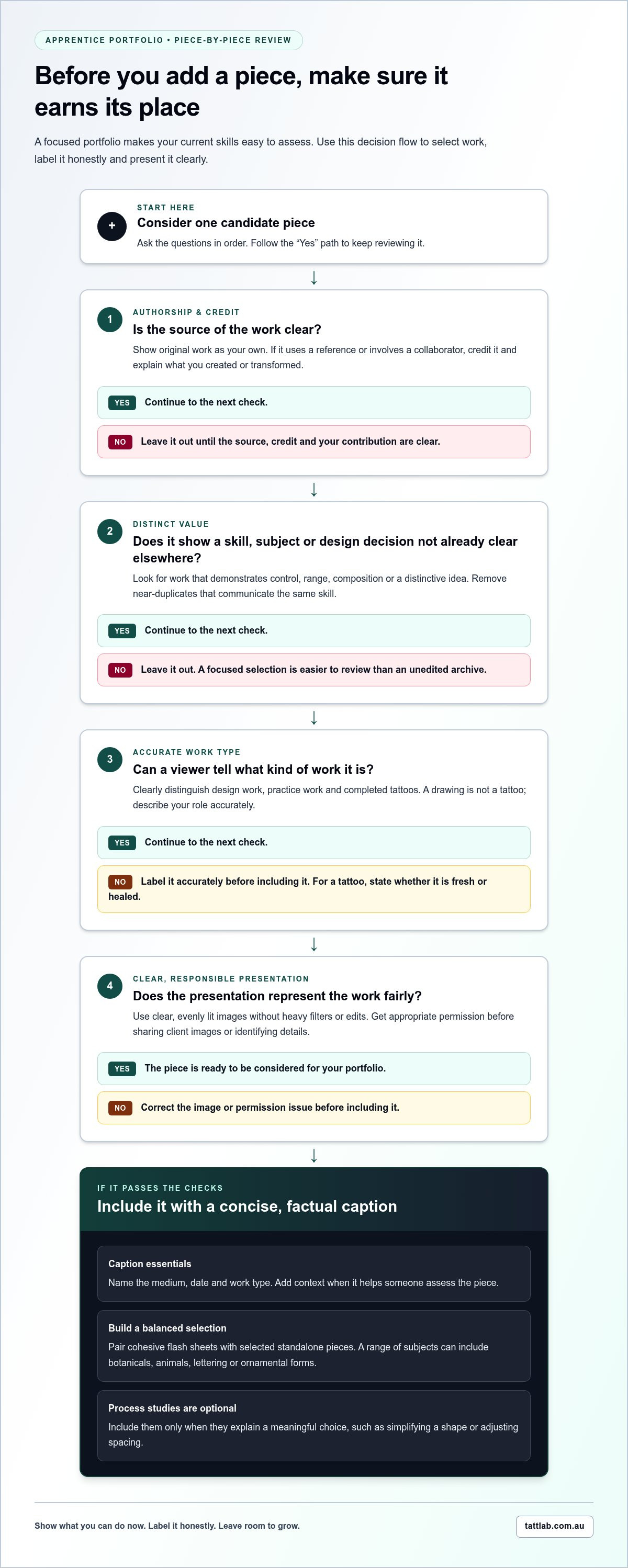
Build your selection around finished, original drawings and designs that make your control and decision-making visible. A portfolio doesn’t need to prove you can tattoo clients. It should show the visual skills you’re developing. Choose work with clear composition, considered use of space and subjects that demonstrate range. Remove near-duplicates that communicate the same skill.
Choose designs that show range and a developing point of view
Include a mix of subjects, such as botanicals, animals, lettering or ornamental forms, while keeping the overall standard consistent. Look for confident lines, a readable silhouette and a clear value structure, especially when a design will be viewed at a small scale. Where relevant, show how the artwork might sit on a body area, but don’t imply that a drawing has been tattooed.
A cohesive flash sheet can demonstrate how several designs work together; selected standalone pieces can show a more detailed or distinctive idea. Add process studies only when they explain a meaningful choice, such as how you simplified a shape or adjusted spacing before arriving at the final design. These tattoo portfolio tips for apprentices are about making each piece earn its place, not filling pages.
Document tattoo work and references responsibly
If you include tattooed work, label whether it is fresh or healed, and distinguish it from practice, digital and design-only pieces. Add dates when they help show progression. Use clear, evenly lit photographs that represent the work accurately. Heavy filters or edits can distort line quality, colour and contrast. Professional practice also involves care around presentation and standards, as reflected in the Professional Standards in Tattooing.
Get appropriate permission before sharing client images or identifying details. Credit references and collaborators clearly, and never present another artist’s design or a copied reference as your original work. If a piece was based on a reference, explain what you created yourself and how you transformed the idea.
Before adding a piece, ask yourself whether it shows a skill, subject or design decision that isn’t already clear elsewhere. If not, leave it out. A focused portfolio is easier to review and update than an unedited archive. As you prepare for a professional studio environment, you can also explore professional tattoo supplies for needles, cartridges, inks and other studio essentials.
How to Present Apprentice Work Without Overstating Experience
You don’t need to imply that you’ve tattooed clients to make your portfolio credible. A studio can assess your drawing and design skills without mistaking them for experience working on skin. Clear distinctions help a mentor understand what you’ve practised, what you’ve completed and what you’re ready to develop next.
Use concise, factual captions throughout. Name the medium, date and work type, then add context only when it helps someone assess the piece. For example, “Botanical design, digital drawing, 2026” describes a design, while “Linework practice on synthetic skin, supervised session, 2026” identifies a practice piece without suggesting a client result. If you include a completed tattoo, state whether it is fresh or healed and describe your role accurately.
What each work type can show
Design work: Demonstrates drawing, composition and design decisions. It doesn’t demonstrate how the design performs as a tattoo or your experience working on skin.
Practice work: Shows a specific exercise or developing technique under the conditions you state. It isn’t a client result, and the caption shouldn’t imply independent professional work.
Completed tattoo work: Documents work applied to skin. Identify your role and whether the image shows fresh or healed work. Don’t use a drawing or practice piece as a substitute.
This distinction is part of a professional mindset, not a weakness. Educational resources such as Tattoo Industry Education and Growth can offer broader context on learning and development in tattooing, while your portfolio should remain a precise account of your own work.
How to handle gaps honestly
If you notice that your portfolio lacks a clear example of a skill, turn that gap into a practice plan. For instance, if your shading feels inconsistent, create focused tonal studies and review them before deciding whether they’re ready to include. Ask a mentor for feedback on the gap itself rather than trying to hide it with dramatic effects or vague captions.
Keep captions consistent, with a format such as title or subject, medium, work type, date. Avoid including work you can’t explain, attribute or represent accurately. These tattoo portfolio tips for apprentices help a studio assess the work on its real merits and make feedback more specific. A mentor can identify what’s already strong and suggest a practical next step.
How to Build and Update Your Tattoo Portfolio Step by Step
A repeatable process makes portfolio updates manageable. Rather than reworking the whole collection every time you finish a drawing, use these tattoo portfolio tips for apprentices to make deliberate selections and keep each version clear.
- Step 1: Gather possible pieces. Collect finished drawings, flash sheets and relevant practice work in one folder. Keep original files or scans separately so you can return to them later.
- Step 2: Review each piece. Remove duplicates, unfinished experiments and work that no longer reflects your current ability. Keep a piece only if it shows a distinct skill, subject or design decision.
- Step 3: Check the documentation. Give each file a consistent name, such as “Botanical study, pencil, 2026.” Add a concise caption with the medium, date and work type. Check that images are clear and true to the original.
- Step 4: Sequence the selection. Group related designs by subject or visual approach so the portfolio feels coherent. Open with work you can discuss confidently, then finish with pieces that show a direction or area of development.
- Step 5: Review the whole portfolio. Look at it as a studio might. Is it easy to follow, and does each piece have a clear purpose? Make changes when your skills progress or you receive meaningful feedback, rather than replacing work constantly.
Prepare a digital and in-person version
Use a digital format with simple navigation, readable captions and minimal decoration. The artwork should remain the focus. View it on different screens to check that images and text are legible, and keep a backup of your original files in a separate location. A tidy printed selection can also be useful for in-person studio conversations. Make sure its order and captions match your digital version.
Prepare a short introduction that explains what the viewer is looking at without overselling your experience. Be ready to discuss a design decision, what you learned from a piece and what you’re working to improve. This helps turn the portfolio into a practical conversation rather than a silent display.
Keep file names, dates and captions consistent so updates don’t become a separate project. If preparing for studio work also means organising your supplies, explore professional tattoo supplies as part of planning a considered workspace.
Using Your Portfolio for the Next Apprenticeship Step
A portfolio conversation is a chance to explain how you think about your work, not to defend every page or prove you’re already an experienced tattooer. Bring a focused selection that suits the discussion and introduce it briefly: “These pieces show my current drawing work and the areas I’m developing.” This gives the studio a clear starting point and leaves room for questions.
Prepare for a portfolio conversation with a studio
Choose examples you can talk about in detail. For each one, be ready to explain your influences, a key design decision and what you learned while making it. You might describe how you adjusted a silhouette to make the subject read more clearly, or identify a skill you’re still practising. Speak honestly about your strengths and gaps. A thoughtful answer is more useful than claiming confidence in every technique.
Invite specific feedback with a focused question, such as, “Which piece best shows my line control?” or “What should I practise to make these compositions clearer?” Feedback is guidance for your next iteration, not a final judgement of your potential. Listen, note the points you can act on, and clarify anything you’re unsure how to apply.
Keep improving after the first portfolio review
Turn useful feedback into clear goals for your next drawings or portfolio update. If a mentor points out that your values are difficult to read, make a study focused on contrast, then review whether it addresses the issue before adding it. Replace or reorganise older work when a new piece represents your current ability more accurately. You don’t need to rebuild the portfolio after every conversation. Let meaningful progress guide changes.
As you move towards studio work, follow the studio’s expectations and the health requirements that apply locally. Your portfolio shows your artistic development, while your approach to learning should also reflect care, responsibility and respect for safe practice.
Before the conversation, check that you can:
- Introduce the selection and accurately describe each work type.
- Discuss your influences, design decisions and current learning goals.
- Ask for feedback you can turn into a practical next step.
- Keep your work aligned with studio expectations and relevant local health requirements.
These tattoo portfolio tips for apprentices are most useful when they support steady, honest progress. As you prepare your workspace for the next stage, professional tattoo supplies can help you organise the equipment and consumables you need, while your portfolio stays focused on the work and skills you’re developing.
Take the Next Step with a Portfolio That Grows
A strong apprentice portfolio doesn’t need to suggest you’ve already mastered tattooing. It should make your current skills easy to understand, with a considered selection of original work, accurate labels and a clear sense of how you’re developing. Keep it organised, invite focused feedback and use each conversation to set practical goals for your next round of work.
These tattoo portfolio tips for apprentices can help you present your ability with confidence while staying honest about your experience. Your portfolio and studio preparation develop alongside one another, one thoughtful step at a time.
Keep making, keep learning and let your work show the progress you’re building.
Preparing a professional workspace? Shop tattoo aftercare, needles, cartridges, inks and other professional tattoo supplies online from Tatt Lab.
Frequently Asked Questions
What should an apprentice tattoo artist include in a portfolio?
Include a curated selection of original drawings and designs that demonstrates drawing fundamentals, composition and range. Cohesive flash sheets can sit alongside distinct standalone pieces, as long as each adds something new. Label the medium, date and work type, and include practice or tattooed work only when you can describe it accurately. Clear captions help a studio understand what you made and which skills each piece shows.
Can I get a tattoo apprenticeship without tattooing experience?
Yes, you can approach studios with a portfolio before you have tattooed clients. Your drawings and designs can show artistic potential, while honest labelling makes clear that they aren’t evidence of tattooing experience. Apprenticeship expectations vary between studios, so prepare to discuss your current skills and willingness to learn. Any practical development should take place under appropriate studio supervision and follow relevant local health requirements.
How many pieces should an apprentice tattoo portfolio have?
There’s no universal required number. A curated selection of around 20 to 40 finished pieces can provide enough variety to show your strengths without turning the portfolio into an archive. Treat that range as a guide, not a target to fill at any cost. If you have fewer strong pieces, prioritise clarity and quality; remove repetitive work that doesn’t add a new subject, skill or design approach.
Should tattoo apprentices include drawings or only tattooed work?
Include drawings and original designs, not only tattooed work. Design pieces let a studio assess your linework, composition and visual thinking even if you’re new to tattooing. If you have practice pieces or completed tattoos, label them separately and explain their context accurately. Never present a drawing or practice exercise as a client tattoo. A balanced, clearly identified selection gives a more truthful picture of your experience and potential.
How do I make a tattoo portfolio stand out to a studio?
Make it easy to assess. Choose work that reflects your current ability, sequence it thoughtfully and use consistent, factual captions. Show range without sacrificing quality, and be ready to explain your influences, design decisions and areas you’re developing. These tattoo portfolio tips for apprentices help your work stand out through intention and clarity, rather than visual effects or inflated claims. A focused portfolio also gives the studio specific pieces to discuss with you.
Can I include digital art in a tattoo portfolio?
Yes. Digital designs can show your composition, editing and ability to develop an idea using modern tools. Include them alongside traditional drawings if you want to show both digital and hand-drawn skills. Label the medium clearly, such as “digital illustration” or “graphite on paper,” and make sure the artwork is your own or that references and collaborators are credited. Digital presentation should support the work, not obscure it with unnecessary effects.
How often should I update my tattoo portfolio?
Review it after meaningful progress, new finished work or useful mentor feedback, rather than changing it constantly. Add a piece when it represents your current ability or fills a clear gap; remove or reorganise older work if it no longer helps tell that story. Keep dated files and captions consistent so updates are straightforward. Regular, considered revisions let your portfolio develop with your skills while preserving a clear record of progress.


Comments (0)
There are no comments for this article. Be the first one to leave a message!