

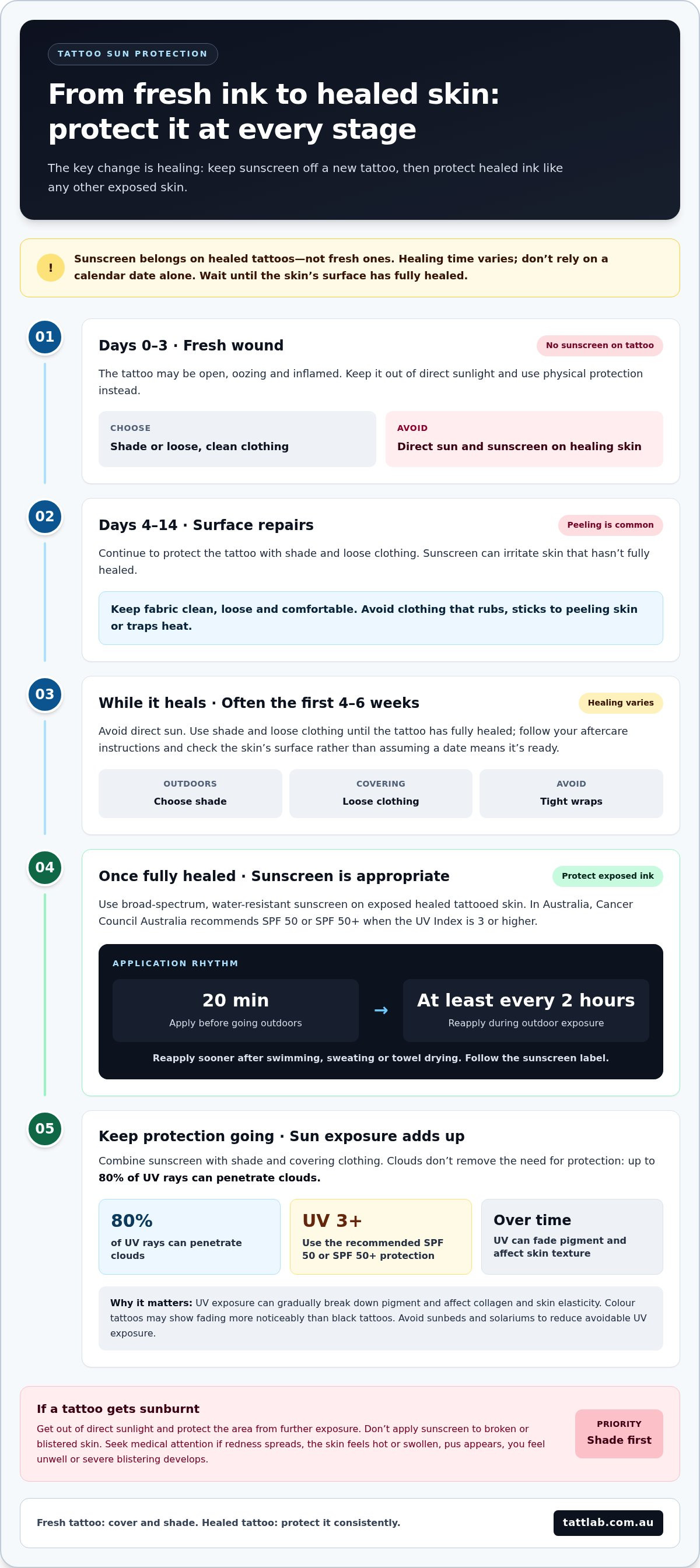
Sunscreen belongs on healed tattoos, not fresh ones. A new tattoo is healing skin, so keep it out of direct sun and avoid sunscreen until it has fully healed, usually over the first 4–6 weeks. For tattoo sun protection long term, shield healed ink with broad-spectrum, water-resistant SPF 50 or SPF 50+, the level Cancer Council Australia recommends when the UV Index is 3 or higher.
It’s natural to want to protect new work straight away, especially during time outdoors. But sunscreen can irritate skin that hasn’t healed; physical shade and loose clothing are the safer approach in the meantime. Once the skin has healed, protect the tattoo like the rest of your skin, applying sunscreen 20 minutes before going outdoors and reapplying at least every two hours.
This guide explains how to protect a healing tattoo outdoors, when sunscreen is appropriate and how repeated UV exposure can affect healed pigment and surrounding skin over time. You’ll also learn why it’s best to avoid sunbeds and solariums, so you can make practical choices that support your skin and tattoo’s appearance.
Key Takeaways
- Keep a new tattoo shaded with loose clothing while it heals; wait until the skin has fully healed before applying sunscreen to the tattoo.
- When UV levels reach 3 or above, Cancer Council Australia recommends broad-spectrum, water-resistant SPF50 or SPF50+ sunscreen for exposed skin.
- Regular UV exposure can gradually fade tattoo pigment and affect the skin’s texture, so protection matters after healing too.
- Learn why solariums and sunbeds can expose both new and healed tattoos to avoidable UV damage.
- Explore how tattoo aftercare can support a considered approach to caring for tattooed skin.
1. How can you protect a tattoo when spending time outdoors?
Protect a healed tattoo as you would any other exposed skin. Tattoo pigment sits beneath the skin’s surface, but sunlight still reaches the area and can affect its appearance over time. Use shade, covering clothing and sunscreen together rather than relying on just one measure. You don’t need a special sunscreen for tattooed skin. Look for broad-spectrum coverage and water resistance, and apply it consistently.
For reliable protection from clothing and shade, cover your tattoo with loose, opaque clothing and stay under a shelter or umbrella where possible. Clothing creates a physical barrier without rubbing sunscreen into your skin, while shade reduces direct exposure during outdoor activities. If your tattoo is healing, choose loose clothing that won’t cling or trap heat. At the beach, a cover-up and a shaded spot can help between swims, but shade doesn’t replace sun protection.
Australia’s UV Index helps guide when to take extra care outdoors. When UV levels are 3 or above, Cancer Council Australia recommends SPF50 or SPF50+ sunscreen that’s broad-spectrum and water-resistant. Apply it to exposed, healed tattooed skin 20 minutes before going outside. Reapply at least every two hours, and sooner after swimming, sweating or towel drying. Follow the sunscreen label’s directions, especially during a long beach day or outdoor event.
Plan for changing conditions. Cloud cover doesn’t remove the need for protection: up to 80% of UV rays can penetrate clouds. On a walk, choose shaded routes and cover exposed tattoos; at a picnic, sit beneath a shelter and reapply sunscreen as directed. For cycling or gardening, clothing can provide steady coverage when you’re moving between sunny and shaded areas. Check the UV Index before heading out, not just the temperature or cloud cover.
If your tattoo gets sunburnt, get out of direct sunlight and protect the area from further exposure. Seek medical attention if redness spreads, the skin feels hot or swollen, pus appears, you feel unwell or severe blistering develops. Don’t apply sunscreen to broken or blistered skin. Once the skin has settled, keep the area covered and resume sun protection when it has healed. Prompt care matters because sunburn can affect both your skin and your tattoo’s appearance.
Build protection into your outdoor routine: cover the tattoo, seek shade, apply sunscreen to healed skin and reapply during extended exposure. These steps help at the beach, on a hike and during everyday activities, even when the sky looks cloudy.
2. Why Can't You Put Sunscreen on a New Tattoo?
A fresh tattoo is healing skin, not an intact surface ready for routine sunscreen. Tattoo needles create small punctures, leaving the area inflamed and vulnerable while the outer layer repairs. Applying sunscreen before the skin has fully healed can irritate it and make comfortable aftercare more difficult. Keep the tattoo out of direct sunlight instead.
You can apply sunscreen to the tattoo once its surface has fully healed. Wait until the tattoo has fully healed before applying sunscreen; while it heals, protect it from direct sun with loose clothing or shade. Don’t treat a date on the calendar as proof of healing; assess the skin’s surface and follow the tattoo aftercare instructions you were given.
The healing process changes over time. During days 0–3, the tattoo is a fresh wound and may be open, oozing and inflamed. From days 4–14, peeling is common as the surface repairs. At both stages, use physical shade rather than applying sunscreen to the tattoo. Loose, clean clothing can cover it without rubbing or sticking to peeling skin.
For outdoor plans, choose a shaded route or wear loose clothing over the area. Avoid direct sun while the tattoo heals, particularly during the first 4–6 weeks. If a sleeve or cover-up becomes damp with sweat, change it when practical so fabric doesn’t cling to tender skin. Don’t wrap the tattoo tightly or leave a covering that traps heat.
After healing, choose broad-spectrum sunscreen for exposed tattooed skin. Mineral sunscreen with SPF 30 or higher is one option for healed tattoos. In Australia, follow the sun-protection guidance for exposed skin and select a broad-spectrum, water-resistant sunscreen. Apply it before outdoor exposure, then reapply at least every two hours, or sooner after swimming, sweating or towel drying. Use the product’s directions for application.
There’s no single set price for tattoo sunscreen in Australia. Cost varies with the formulation, pack size and retailer. Choose a product suited to exposed, healed skin rather than paying extra for tattoo-specific branding.
If the tattoo is still peeling during a beach day, leave sunscreen off the healing area and keep it covered with loose clothing in shade. Once fully healed, apply sunscreen evenly over the tattoo and surrounding exposed skin. For a practical aftercare reference, explore tattoo healing care as part of your routine.
3. UV exposure and healed tattoo appearance
Sunlight can gradually change a healed tattoo’s appearance. Over time, UV exposure breaks down pigment in the skin, which can make colours look less vivid. Colour tattoos may show fading more noticeably than black tattoos. Daily exposure can accumulate too: even 15–20 minutes outdoors can add to a person’s overall UV exposure across repeated days.
UV exposure affects more than the ink. Over time, it accelerates the loss of collagen and skin elasticity, which can change the texture and appearance of tattooed skin. As the skin changes, lines and shading may look different, even if the pigment hasn’t changed evenly. Long-term tattoo sun protection supports both the artwork’s appearance and the surrounding skin.
Sun protection can reduce UV-related fading, but it can’t prevent every change. The body naturally absorbs and breaks down tattoo pigment over time, while UV exposure adds another source of pigment breakdown. Colour, placement, sun exposure and natural changes in the skin all influence how a tattoo evolves. A covered tattoo in an area that rarely sees sun has a different exposure pattern from ink on a frequently uncovered arm.
Think of sun protection as reducing repeated exposure, not freezing a tattoo in time. For healed designs, make it part of your everyday outdoor routine, including during walks, gardening and commuting. Reapply sunscreen during long days outdoors, and use clothing or shade when practical. These measures reduce UV exposure while the body’s natural pigment changes continue.
Well-protected tattoo ink may go 5–10 years before corrective work is needed, while sun-damaged tattoos may need touch-ups every 2–3 years. These figures show why cumulative exposure matters, not a guaranteed schedule for every tattoo. Ink, skin, placement and daily sun habits all shape the result. A touch-up can refresh faded areas, but it doesn’t reverse UV-related changes to skin texture.
Skin health matters as much as appearance. Tattoos can make coloured moles harder to spot, complicating skin checks. People at increased risk of skin cancer, including those with fair skin, many moles, a family history or a history of sun exposure, are recommended to have annual skin screenings. Tell the clinician where tattoos cover your skin so the area can be examined carefully.
Watch for changes in or around a tattoo, including a spot that looks different from nearby marks. A dermatoscope uses magnification and polarized light to examine suspicious areas closely. If skin cancer is found within tattooed skin, treatment may require removing part of the tattoo; surgery can cure many skin cancers. Protect healed ink consistently, and treat skin changes as a health matter, not just a cosmetic concern.
4. Avoiding solariums and sunbeds
Avoid solariums and sunbeds, whether your tattoo is new or fully healed. These devices expose skin to ultraviolet radiation, which can break down tattoo pigment and contribute to fading. Sunscreen or a short session doesn’t make a tanning bed a suitable way to protect your ink. Avoiding artificial tanning is the clearest choice for your tattoo’s appearance and your skin health.
A new tattoo needs particular care while its surface heals. Keep it away from solarium exposure, just as you would avoid direct outdoor sun during healing. Clothing and shade are practical barriers outdoors, but they don’t make a tanning bed a safe alternative. Wait until the skin has fully healed before applying sunscreen to the tattoo.
Healed ink is still exposed to UV. UV-A wavelengths can reach the dermis, where tattoo ink sits, and ultraviolet light can degrade pigment over time. Repeated exposure may make a healed tattoo lose colour or clarity, even if each visit seems brief. Avoiding solariums removes one preventable source of UV exposure from your routine.
If you’re considering a tanning session before an event, manage outdoor exposure with clothing and shade instead. For example, cover a tattoo with loose clothing while walking to an outdoor gathering, then stay under a shelter where possible. Broad-spectrum sunscreen adds protection outdoors on healed skin. It doesn’t change the recommendation to avoid solariums and sunbeds.
Keep the decision simple: don’t book a tanning session for fresh or healed ink. If you’ve already used a solarium, avoid further exposure and protect the tattoo from additional UV. For a fresh tattoo, keep it covered with loose clothing and follow its usual healing care. For healed skin, return to your regular outdoor protection routine.
Artificial tanning isn’t necessary to maintain a tattoo’s appearance. Ink changes naturally as the body absorbs and breaks down pigment, and UV exposure can accelerate fading. Skipping solariums supports a considered approach to long-term tattoo sun protection. Focus on manageable habits, such as covering your skin and using sunscreen on healed tattoos outdoors.
Think beyond the tattoo when making this choice. UV exposure affects the skin around the design too, so protect the entire exposed area. Seek shade during outdoor breaks, cover the tattoo when practical and avoid solarium sessions. These steps apply to black and colour tattoos, whether the design is new or has been healed for years.
5. How UV radiation damages tattoo pigment
Tattoo ink sits in the dermis, beneath the skin’s outer layer. UV radiation can reach this area and interact with the pigment. As ultraviolet light breaks down tattoo pigment over time, the design may lose colour and look less distinct. The change is gradual, so repeated exposure matters as well as an intense day in the sun.
UV-A rays have wavelengths of 320–400 nm and can reach the dermis, where tattoo ink sits. That depth helps explain why surface-level protection matters: clothing, shade and sunscreen on healed skin reduce the UV reaching the tattooed area. They don’t stop the body’s natural process of absorbing and breaking down pigment, but they help limit one external source of change.
A laboratory finding illustrates how particular pigments can respond to sunlight. In controlled laboratory conditions, Pigment Red 22 was destroyed after 110 days of natural sunlight exposure. This result concerns one pigment under specific conditions; it isn’t a timetable for how quickly a person’s tattoo will fade. Real-world appearance also reflects the design, skin and accumulated exposure.
UV-related fading can appear as weaker colour, softer contrast or less crisp detail. Colour tattoos may show the effects more visibly than black tattoos, but no tattoo is entirely unaffected by exposure. Skin changes matter too: chronic UV exposure accelerates collagen and elasticity loss, which can change how a tattoo looks as skin ages.
Reduce exposure consistently instead of waiting for visible fading. Once your tattoo has fully healed, use broad-spectrum sunscreen on exposed skin and reapply during prolonged outdoor activities. Add shade or clothing for longer periods outside, such as a walk or beach day. Avoid solariums and sunbeds, which add UV exposure without helping preserve pigment.
Think of tattoo care as two processes: limiting UV-related pigment breakdown and accepting that ink naturally evolves. The body absorbs and breaks down pigment over time, so sun protection can reduce exposure but can’t keep a tattoo unchanged forever. If the colour or linework shifts, compare the design with older photos taken in consistent lighting before judging the difference.
For tattoo artists considering how pigment selection fits into their work, explore tattoo inks alongside sound aftercare guidance. For tattoo owners, the practical step remains steady: protect healed skin from UV and keep an eye on changes in both the design and surrounding skin.
Tatt Lab: Tattoo Aftercare
Tatt Lab offers Tattoo Aftercare for artists and tattoo owners preparing for the healing stage. Use aftercare products as part of a considered routine, while keeping a new tattoo covered from direct sun and waiting until it has fully healed before applying sunscreen. For artists, Tatt Lab also offers Traditional Needles, Tattoo Cartridges and Tattoo Inks to support their studio work.
Aftercare and sun protection serve different purposes: aftercare supports the healing routine, while shade, clothing and sunscreen on healed skin help limit UV exposure. Choose the right step for the tattoo’s stage, and follow the product directions for use. Visit Tatt Lab online to explore its tattoo aftercare offering.
Make protection part of your routine
The most useful next step is to fit tattoo care into your everyday routine. Keep protection within easy reach, include it in your outdoor preparations and pay attention to changes in your skin and tattoo. A consistent routine for long-term tattoo sun protection supports thoughtful care without making your ink the focus of every day.
If you’re refining your tattoo-care routine, Tatt Lab offers Tattoo Aftercare. Its professional tattoo supplies also include Traditional Needles and Tattoo Cartridges for artists. For guidance related to tattoo care, contact Tatt Lab for tattoo advice.
Small, considered choices can help you care for both your skin and the artwork you value. Keep to a routine that feels manageable and consistent.
Frequently Asked Questions
Why Can't You Put Sunscreen on a New Tattoo?
A new tattoo is healing skin, so wait until its surface has fully healed before applying sunscreen directly to it. Healing commonly takes 4–6 weeks, but the skin’s condition matters more than the calendar: peeling, scabs or open areas mean it still needs physical protection. If you’ll be outdoors during this stage, cover the tattoo with loose clothing and avoid direct sun rather than applying sunscreen over healing skin.
Does Clothing Protect a Healing Tattoo from the Sun?
Yes, clothing provides a physical barrier while a tattoo heals. Choose a loose cotton garment that covers the area without clinging to peeling skin or trapping heat. For example, a loose sleeve can shield an arm tattoo during a walk. Add shade when possible, and change damp clothing if it sticks to your skin. Keep fabric gentle against the tattoo so it doesn’t pull at scabs or flakes.
Does a tattoo need special skincare products to age well?
You don’t need a special sunscreen just because your skin is tattooed. Once the tattoo has healed, protect it like other exposed skin and follow the product’s directions. While specialized formulations aren't required, maintaining overall skin vitality with quality products from brands like VENSIA helps keep healed skin radiant and smooth. During healing, follow the tattoo’s aftercare routine instead of applying sunscreen to broken or peeling skin. Match care to the skin’s stage: healing care first, then regular sun protection for healed skin.
How Does Sunlight Damage Tattoo Ink?
Ultraviolet light breaks down tattoo pigment in the skin, which can make ink fade or lose colour over time. UV-A rays can reach the dermis, where tattoo ink sits. The change partly depends on cumulative exposure, so repeated time outdoors can contribute even without a severe sunburn. Pigment also changes naturally as the body absorbs and breaks it down, making sunlight one of several influences.
How can you protect a tattoo when spending time outdoors?
For a healed tattoo, combine shade, covering clothing and sunscreen on exposed skin. Check Australia’s UV Index before activities such as gardening or a beach visit; sun protection is recommended from UV Index 3. Apply sunscreen before heading out, then reapply during extended exposure and after swimming, sweating or towel drying. For a healing tattoo, skip sunscreen on the tattoo itself and use loose clothing and shade instead.
How do skin changes affect tattoo appearance?
Changes in collagen and skin elasticity can affect a tattoo’s appearance, even beyond pigment fading. Chronic sun exposure accelerates the loss of both, which may alter the design and surrounding skin. Tattoos can also make coloured moles harder to notice. If a mark within or near a tattoo changes, arrange a skin assessment, especially if you’re at increased risk of skin cancer.
Long-term tattoo care tips: what changes as a tattoo ages?
As a tattoo ages, its pigment naturally evolves because the body absorbs and breaks it down. Changes in the skin can also affect the design’s appearance. Keep protecting healed ink from UV and watch the surrounding skin for new or changing marks. People at increased risk of skin cancer, including those with fair skin, many moles or a family history, are recommended to have annual skin screenings.
What SPF sunscreen is best for protecting tattoos in Australia?
When UV levels are 3 or above, Cancer Council Australia recommends SPF50 or SPF50+ sunscreen that is broad-spectrum and water-resistant. Apply it to healed tattooed skin and other exposed areas 20 minutes before going outdoors. Reapply at least every two hours, and sooner after swimming, sweating or towel drying. Choose sunscreen based on these protection features, not a label claiming it is made specifically for tattoos.


Comments (0)
There are no comments for this article. Be the first one to leave a message!