

A nearby tattoo supply store is most useful when it stocks the categories you need for each part of your setup, from needles and cartridges to inks, stencil supplies, cleaning products and aftercare. When searching for a tattoo supply store near me, compare products against your workflow instead of choosing on proximity alone.
It can be hard to tell whether you need an essential supply, a useful studio extra or an item that must match your equipment. A clear checklist helps you focus on compatibility, intended use and the supplies that support a careful workflow.
This guide explains what to consider when choosing needles, machines, kits, studio supplies, cleaning products and aftercare from an Australian supplier. It also shows how these categories fit together, so you can plan your next purchase with less guesswork.
Key Takeaways
- Match needle and cartridge choices to the equipment and technique you use, rather than relying on a broad label alone.
- Separate core consumables from optional studio upgrades when planning a kit, grips, tubes and furniture.
- Choose cleaning, barrier and aftercare supplies by their role in your studio workflow and the care instructions they support.
- Before buying, understand whether a nearby supplier serves the public, professional artists or both, and what its purchasing process involves.
- Use the guide’s category-by-category checklist to build a focused supply list for your next studio restock.
Aftercare products
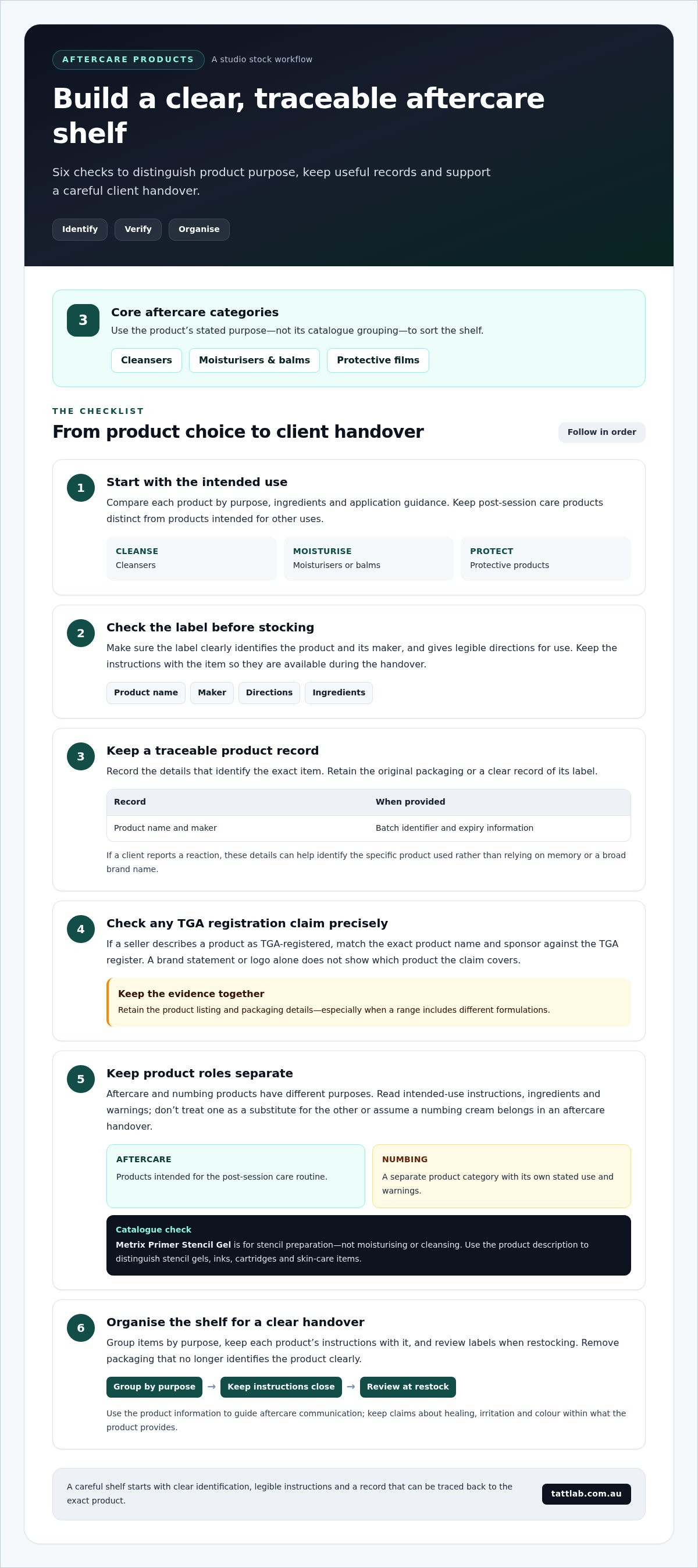
Aftercare supports the tattoo’s care routine once the appointment ends, so choose products with clear directions and identifiable makers. Compare balms, moisturisers, cleansers and protective films by intended use, ingredients and application guidance. The label should make it easy to identify the product, its maker and how to use it. These details help artists explain the handover without making unsupported claims about healing or colour retention.
Traceability matters when you need to identify a product later. Before adding a balm or cleanser to studio stock, record its product name, maker, batch identifier and expiry information where provided. Keep the original packaging or a clear record of the label. If a client reports a reaction, these details help identify the exact item used instead of relying on memory or a broad brand name.
Handle claims of TGA registration carefully. If a seller describes an item as TGA-registered, match the exact product name and sponsor against the TGA register. A brand statement or logo alone does not show which product the claim covers. Keep the product listing and packaging details together, especially when a range includes different formulations. This gives you a more precise record than assuming every product under one brand has the same status.
Keep aftercare and numbing creams separate when planning your product list. A balm intended for post-session use and a topical product marketed for numbing have different purposes. Read the intended-use instructions, ingredients and warnings before deciding whether a product fits your studio procedures. Don’t treat aftercare as a substitute for a numbing product or assume a numbing cream belongs in an aftercare handover.
Brand names can help identify products, but they don’t replace checking the category and instructions. For example, Metrix Primer Stencil Gel is for stencil preparation, not moisturising or cleansing. Catalogues may show equipment and supplies alongside aftercare, so use the product description to distinguish stencil gels, inks, cartridges and skin-care items. This prevents catalogue grouping from being mistaken for a usage guide.
Organise an aftercare shelf around the work your studio performs. Group cleansers, moisturisers or balms, and protective products by purpose, and keep each item’s instructions with it. When working with different tattoo styles, this makes it easier to explain which product fits a client’s care plan. Review labels when restocking, and remove packaging that no longer identifies the product clearly.
For Australian tattoo artists, product choice is part of a careful client handover. Prioritise clear identification, legible instructions and a traceable product record. This supports consistent aftercare communication while keeping claims about healing, irritation and colour within the information the product provides.
Tattoo needles and cartridges
Needle choice shapes how you approach outlines, shading and colour work. Start with the configuration, then compare its size and intended use with your technique. Round liners are designed for line-focused work, while round shaders and magnums suit different shading approaches. These are distinct needle groupings, not interchangeable tools. Record the exact configuration used for each setup so restocking doesn’t depend on memory.
Traditional needles and cartridges involve different setup workflows. Traditional needles are handled separately from cartridge systems, while cartridges combine a needle grouping with a compatible cartridge body. Before ordering, match the cartridge connection to your machine and grip, then confirm the grouping and size on the packaging. Similar labels can cover different configurations, so check the full product description rather than relying on “liner” or “shader” alone.
For a concrete example, Lotus Cartridge Needles Ultra Small Liner are specified as 0.20mm - 06 Gauge. That combination gives an artist a precise identifier for comparing listings and organising stock. It doesn’t establish suitability for every machine or technique. Check the product details against your existing setup, including the connection type and the work planned. Keep the packaging information with your stock records to make repeat ordering clearer.
Treat needles and inks as separate choices within one workflow. A cartridge description identifies its needle configuration; an ink listing identifies the colour product. Don’t assume a needle label indicates ink compatibility or colour performance. For example, if you’re planning a black outline and colour fill, list the required needle groupings separately from the ink colours. This keeps the order specific and reduces confusion during preparation.
- For line work: compare round liner configurations and their stated sizes.
- For shading: distinguish round shaders, magnums and curved magnums by their grouping.
- For repeat orders: record the full name, configuration and compatible setup.
Useful customer service helps resolve product-description questions before ordering. Share the exact machine or connection details and the cartridge name you’re comparing. A clear product page should identify the configuration, size and intended category. Those details support a more considered choice than broad claims about smooth performance. For Australian artists comparing traditional needles and tattoo cartridges, use the product categories and listed specifications to narrow the options.
Keep a simple stock record by category: traditional needles, cartridges, liners, shaders and magnums. Add the product identifier from each package and note which setup it belongs with. This makes reordering more consistent and helps you distinguish similar configurations without relying on colour-coded packaging alone.
Tattoo kits, grips, tubes and furniture
A tattoo kit can simplify setup, but its contents matter more than its label. Compare the machine, power supply, cables and accessories with the equipment you already use. A wireless machine, for example, relies on its battery setup, while a corded machine needs a compatible connection and power supply. Check the itemised contents before ordering to see whether the kit fills a genuine gap or duplicates studio stock.
Grips and tubes affect how a machine feels in your hand and how its components fit together. Match the grip connection to your machine, then compare the tube or cartridge system used in your workflow. Disposable components may reduce the need to manage reusable parts, but check the product description to confirm their intended use. Don’t assume similar-looking grips or tubes are interchangeable. Record the exact model and connection details for repeat purchases.
Assess a battery-powered setup by its compatibility, not the word “wireless” alone. Check how the battery attaches, how you control the machine and which charging components the kit includes. For a corded machine, identify the required cable and power supply connection. These checks help prevent equipment mismatches. If a listing calls a setup “amazing,” treat that as promotion, not a technical specification. Compare the listed components instead.
Studio furniture should support a stable, workable layout. Consider an adjustable client bed or chair, an artist stool and a trolley for supplies. Check the adjustment controls, accessible surfaces and fit within your working area. A trolley beside the chair can keep frequently used items within reach, while a clear route around the setup makes repositioning easier. Choose furniture to suit your procedures and space.
Include lighting in your equipment plan. An adjustable task light can direct illumination toward the work area, while general room lighting helps with visibility around the studio. Check the lamp’s positioning options and whether it can move without obstructing the artist. Keeping the light separate from the supply trolley and chair adjustments reduces unnecessary rearranging during a session.
- Kits: compare the included machine, power components and accessories with your existing setup.
- Grips and tubes: match connections and distinguish reusable components from disposable products.
- Furniture: assess adjustability, work-surface access and fit within the studio layout.
- Lighting: check positioning and coverage around the client chair and work area.
Use this checklist before buying, then record the selected machine, grip, tube and furniture details in your studio inventory. That record makes future comparisons more precise and separates essential setup requirements from upgrades that may improve workflow, such as a wireless machine or movable task light.
Cleaning, barrier and aftercare supplies
A well-organised station separates cleaning products, barriers and client aftercare. Compare each item by its intended role, label and place in your workflow.
Cleaning and Barrier Supplies
Cleaning products, protective film and gloves serve different studio functions. Check labels for intended use, application directions and storage needs. These examples help you compare formats and plan stock, not substitute one category for another.
Build a restocking routine around the station’s separate tasks. Keep cleaning products distinct from barrier items, and store each in its original packaging. Before ordering, review the product name, size and pack format. A roll of film and a box of gloves create different stock needs. Recording these details also helps you plan deliveries around the studio’s supply schedule.
Barrier products need clear identification in a busy studio. Store protective film with barrier supplies, not among cleansers or aftercare products. Check its dimensions and packaging description before purchase, then add it to your stock record. This makes like-for-like comparisons easier at the next order and helps prevent confusion between products with different functions.
Studio Essentials and Aftercare
Studio essentials include supplies used around a session, as well as aftercare intended for the client’s later routine. Separate these categories on shelves and in stock lists. For example, group gloves and protective film, and keep aftercare products in a distinct area. Clear labels help artists find the right item quickly and explain which products belong in the post-session handover.
Choose aftercare using its own criteria. Review the product’s instructions, ingredients and intended use, then consider how clearly you can pass that information to a client. A balm, cleanser or protective product should be identifiable from its packaging and directions. Don’t treat every item marketed for tattoo care as interchangeable. A precise product description supports a more consistent conversation about the client’s care routine.
For an Australian tattoo studio, organise supplies by stage: station preparation, session barriers and client aftercare. Record each item’s product name, format and storage location. Review stock before ordering, especially when products have similar packaging. This practical routine helps you plan deliveries and clearly separate studio-use supplies from take-home aftercare.
When comparing supplies, focus on clarity and function rather than broad promotional language. A 10-metre film roll, packaged gloves and a labelled aftercare product each answer different needs. A written stock list helps the tattoo artist identify those needs before ordering, while reducing last-minute substitutions that may disrupt the studio’s established workflow.
Do nearby stores sell to the public or only to licensed tattoo artists?
Access depends on the store’s sales policy and the product category. Some retailers sell through public-facing online shops, while others use trade accounts or restrict selected professional supplies. A storefront’s location alone doesn’t tell you who can purchase there. Review stated account requirements and product descriptions before planning a collection visit or online order.
Separate who can buy a product from who should use it. Someone may be able to purchase equipment without having the training to use it safely. Needles, tattoo machines and inks belong in a professional workflow, not an at-home experiment. Aftercare is a different category: clients may need products for their post-session routine.
Retailers may set different terms across their catalogues. For example, a shop might sell aftercare to the general public but require trade registration for certain equipment. Check the product page and checkout requirements for the item you need. A general statement about public sales doesn’t necessarily cover every category, so compare the terms for inks, cartridges, stencils and aftercare individually.
For a studio purchase, prepare the details that make ordering precise. Identify the product category, exact item description and professional setup it is intended for. If a retailer requires a trade account, follow its registration process and provide the requested business information. Keep the order confirmation with your product packaging in your stock records. This makes repeat purchasing clearer and helps distinguish professional supplies from client aftercare.
- Public purchase: review the shop’s stated sales terms for the category.
- Trade purchase: follow the account process and requirements shown by the retailer.
- Product use: distinguish professional equipment from take-home aftercare.
- Order records: retain product descriptions and confirmations for restocking.
Treat “open to the public” as a description of purchasing access, not proof that a product suits every user. A cartridge for sale still needs to match the machine and workflow, and buying ink doesn’t replace the skill required to apply it. Purchasing professional tools does not provide training or make tattooing at home an appropriate substitute for studio work.
In Australia, avoid assuming one nationwide rule governs every retailer’s customer access. Store terms, product categories and account arrangements shape the practical answer. Read the relevant sales conditions and keep your purchase aligned with your role. If you’re building a professional stock order, browse tattoo aftercare and inks alongside the other supplies that fit your workflow.
Tattoo artist Tim Tavaria says he has been tattooing for over 16 years. His experience underscores the distinction between being able to buy a product and having the expertise to use it, so shoppers should consider the item’s intended setting as well as the retailer’s access policy.
Tatt Lab: Tattoo Aftercare
Tatt Lab is a practical option when you’re restocking professional tattoo supplies or choosing aftercare for a client handover. Its range includes Tattoo Aftercare, Traditional Needles, Tattoo Catridges and Tattoo Inks, bringing core consumable categories together for Australian artists.
Choose from Tatt Lab’s Tattoo Aftercare range for post-session care. For studio restocking, Traditional Needles, Tattoo Catridges and Tattoo Inks address distinct parts of your workflow. Review product descriptions to match each category to your needs, then build your order around the supplies you use.
Explore the range or visit tattlab.com.au to contact Tatt Lab.
Make your next restock more intentional
Make your next purchase a deliberate part of your studio’s workflow. Before searching for a tattoo supply store near me, note the supplies you rely on, what needs replenishing and which product details matter for your setup. A focused list helps you compare relevant options without letting a broad catalogue distract from the work ahead.
Tatt Lab offers Tattoo Aftercare, Traditional Needles and Tattoo Catridges for Australian artists. These categories can support your restocking plan, whether you’re preparing client aftercare or replenishing core consumables. Align product choices with your techniques and established studio practices, then place each order with a clear purpose.
Ready to take the next step? Contact Tatt Lab about tattoo supplies and explore options for your studio. A considered restock can help you move into upcoming work with greater clarity and confidence.
Frequently Asked Questions
What tattoo supply stores are near me in Australia?
Tatt Lab provides Australian shoppers with online access to professional tattoo supplies nationwide. If you’re searching for a tattoo supply store near me, consider whether a nearby storefront matters more than ordering from a national retailer. Your location affects which physical shops are convenient, while online shopping lets you browse categories such as needles, cartridges, inks and aftercare. Choose the option that suits your purchasing needs.
Which nearby tattoo supply stores offer online ordering, delivery, or in-store pickup?
Tatt Lab offers online shopping, express nationwide shipping and local click-and-collect. These options serve different needs: delivery suits artists ordering from elsewhere in Australia, while pickup is a local collection option. Before placing an order with any retailer, review its checkout information for the available fulfilment methods and delivery details. For a studio restock, grouping required items into one planned order can also make receiving and recording supplies more straightforward.
How can I check that tattoo supplies are sterile, safe, and compliant with Australian standards?
Inspect each package for intact seals, clear product identification, batch details and expiry information where provided. Follow the manufacturer’s handling instructions, and don’t use packaging that appears damaged or altered. For a product described as TGA-registered, search its exact name in the TGA register; a brand name alone may not identify the registered item. These checks help you assess product information without treating a broad compliance claim as proof of every requirement.
How much do tattoo machines, ink, and needle cartridges cost at nearby stores?
Prices for tattoo machines, professional inks, and sterile needle cartridges vary depending on the specific brand, quality, and type of equipment you choose. Entry-level machines and basic supplies generally cost less, while professional-grade rotary machines, premium pigment sets, and bulk cartridge boxes represent a higher investment. Because costs fluctuate based on current stock and manufacturer pricing, it is best to check the online product catalogs of reliable suppliers like Tatt Lab to compare current rates before making a purchase.


Comments (0)
There are no comments for this article. Be the first one to leave a message!