
The difference between a muddy, overworked heal and a seamless, airbrushed gradient isn't just in your hand speed; it's a matter of precise needle geometry meeting biological resistance. You've likely felt the frustration of inconsistent saturation or the anxiety of seeing skin become unnecessarily traumatized while trying to pack a smooth transition. Choosing the best tattoo needles for shading is about more than just brand preference. It's a technical decision that directly impacts how pigment interacts with the dermis and how the body responds to the procedure.
We understand that your reputation rests on the long-term health and aesthetic of your client's skin. By selecting the optimal configuration for your specific style, you can achieve "invisible" gradients and faster tattooing times without compromising physical integrity. This guide provides a professional analysis of modern needle tapers and configurations, helping you transition from guesswork to clinical precision. We'll examine how specific geometries like curved magnums and long tapers facilitate smooth transitions and ensure your work heals with the clarity your artistry deserves.
Key Takeaways
- Learn to differentiate between ink dispersion and line definition to minimize epidermal trauma while maximizing pigment saturation.
- Understand the physical footprint of magnums versus round shaders to determine the optimal mechanical motion for your desired texture.
- Discover why selecting the best tattoo needles for shading involves balancing needle gauge and taper length to achieve seamless, "invisible" gradients.
- Identify the specific needle configurations required to transition effectively between soft black-and-grey realism and the bold packing of traditional styles.
- Evaluate the technical advantages of membrane cartridge systems in eliminating needle wobble and maintaining a sterile, professional environment.
Defining the Best Tattoo Needles for Shading and Gradients
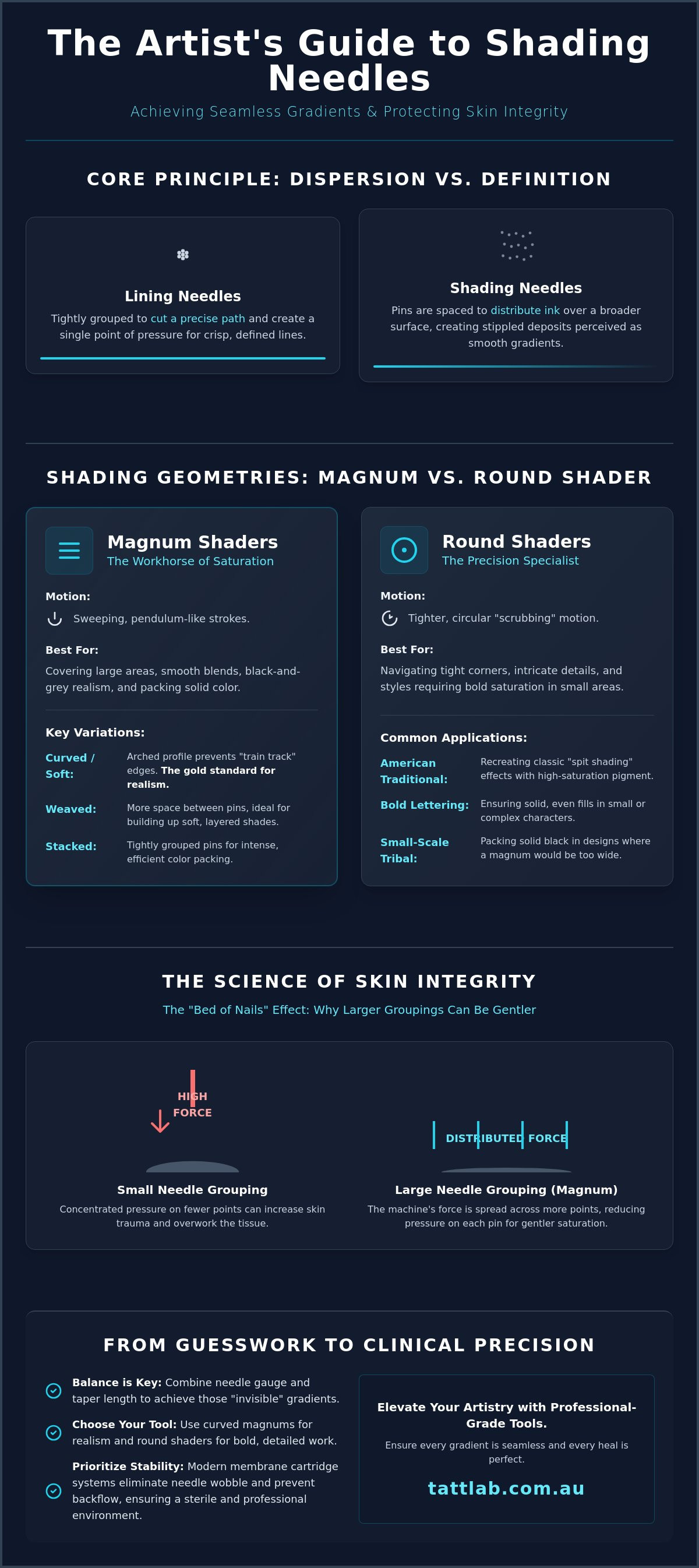
The shift from defining a silhouette to breathing life into a form requires a fundamental change in how we deliver pigment. While lining needles are grouped tightly to create a singular point of pressure, shading needles are engineered to distribute ink across a broader landscape. Identifying the best tattoo needles for shading starts with understanding that we're no longer cutting a path; we're saturating a surface. This process relies on a delicate equilibrium between needle configuration, gauge, and taper length to ensure the pigment settles into the dermis without causing unnecessary inflammation.
In a professional studio environment, the standard has moved toward advanced cartridge systems. These modern tools incorporate safety membranes that prevent backflow, protecting the internal components of modern tattoo machines while providing a stable housing for the needle pins. This stability is vital for shading, as any lateral movement or "wobble" can result in uneven saturation or traumatic snagging of the skin. Choosing the right tool is a commitment to both the artist's efficiency and the client's long term skin health.
The Mechanics of Ink Dispersion
The spacing between individual pins is the primary architect of a shade's softness. When pins are spaced further apart, the ink is deposited in a stippled pattern that the human eye perceives as a smooth, airbrushed gradient. Surface tension also plays a critical role; the way ink clings to the metal determines how much pigment is released upon contact. We distinguish packing from shading by the density of these deposits. Packing involves high density saturation for solid color, whereas shading focuses on lower density to create the illusion of depth and shadow. The best tattoo needles for shading allow for this nuance, giving the artist control over the volume of ink delivered per pass.
Why Configuration Matters for Skin Integrity
Skin integrity is the foundation of a successful heal. Every time a needle enters the skin, it meets biological resistance. The "bed of nails" effect explains why a larger grouping, like a 15-magnum, can often be gentler than a small round shader. By spreading the machine's force across more points, we reduce the pressure on each individual pin. This allows for efficient pigment delivery without overworking the tissue or causing excessive trauma. Shading needles are designed to deposit pigment into the upper dermis with minimal disruption to the basement membrane, ensuring that the ink remains stable and vibrant as the skin undergoes its natural regenerative cycle.
Magnum vs. Round Shader: Choosing Your Shading Geometry
Geometry dictates the visual texture of your work. While we've established that shading is about dispersing ink, the physical footprint of your configuration determines how that dispersion feels to the eye. Magnums, with their flat or stacked horizontal alignment, act much like a wide paintbrush. They're designed for sweeping, pendulum-like strokes that cover ground efficiently. Round Shaders, conversely, arrange pins in a circular cluster. This configuration requires a tighter, circular scrubbing motion to achieve even saturation. It's a common misconception that magnums are reserved solely for large-scale projects. In reality, a small magnum is often among the best tattoo needles for shading delicate transitions in restricted spaces, offering more control than a large round shader might.
The reliability of your work depends on using tattoo supplies that guarantee consistent pin alignment. If the pins flare or sit unevenly, your gradients will appear pixelated rather than smooth. Adhering to FDA Tattoo Safety Guidelines is essential when selecting any geometry. Precision in manufacturing prevents micro-burrs that cause excessive trauma and lead to poor pigment retention. By choosing configurations with clinical rigor, you ensure the skin's physical integrity remains the priority throughout the procedure.
Magnum Shaders: The Workhorse of Saturation
Magnums come in two primary variations: weaved and stacked. Weaved magnums have more space between the pins, making them ideal for soft, layered shading. Stacked magnums are grouped more tightly for intense color packing. For artists specializing in realism, Curved Magnums (often called Soft Edge Magnums) are the gold standard. The slight arc of the needle pins matches the natural dip of the skin, preventing the harsh "train track" lines that straight magnums can leave at the edge of a gradient. They're indispensable for achieving smooth black and grey transitions or large-scale color saturation.
Round Shaders: Precision and Detail
Round Shaders excel where magnums struggle: tight corners and intricate details. Because of their circular footprint, they can reach into narrow junctions without the risk of over-shading adjacent areas. They play a vital role in traditional American styles, often used to recreate the look of "spit shading" with high-saturation pigment. Beyond traditional work, Round Shaders are the preferred choice for bold, saturated lettering and small-scale tribal designs where a magnum's width would be cumbersome. If you're looking to refine your kit, exploring our selection of professional-grade Round Shaders can provide the technical edge needed for complex geometries.
The Role of Taper and Gauge in Smooth Ink Saturation
Precision in shading is as much about the diameter of the needle as it is about the configuration. The gauge, or the diameter of each individual pin, dictates the size of the puncture wound and the volume of pigment delivered. While #12 (0.35mm) pins are a common industry standard for bold work, many specialists consider #10 (0.30mm) pins to be the best tattoo needles for shading smooth, photographic gradients. The smaller footprint of a #10 needle allows for more frequent punctures in a smaller area without causing excessive trauma, resulting in a more refined pixel density. This technical choice is often influenced by the viscosity of your tattoo ink; thinner pigments flow more readily through smaller gauges, whereas thicker, high-pigment loads may require a larger diameter for consistent delivery.
Taper refers to the length of the needle's point before it reaches its full diameter. This geometry is a critical variable in how the needle interacts with the dermis. A long taper (LT) provides a sharper, more gradual entry, which is essential for "pepper shading" and soft realism. This microscopic precision is supported by Scientific Research on Tattoo Ink Deposition, which highlights how needle geometry dictates the depth and distribution of pigment particles. By understanding these mechanical nuances, you can tailor your setup to the specific biological needs of your client's skin.
Bugpins and Soft Shading
Bugpins, typically #8 (0.25mm) gauge, represent the pinnacle of fine-line realism and ultra-soft shading. These needles are exceptionally thin, allowing for a level of detail that standard gauges cannot replicate. However, this precision comes with a trade-off: because each pin carries less pigment, it takes significantly longer to pack solid color. A longer taper reduces the force required for skin penetration. This allows the artist to build up layers of transparent grey wash slowly, creating the "invisible" transitions required for professional-grade portraits and soft textures.
Matching Taper to Technique
Selecting the right taper is a matter of matching the tool to the intended aesthetic outcome. Short Taper (ST) needles have a blunt, abrupt point that is ideal for bold, traditional packing where immediate, heavy saturation is the goal. Medium Taper (MT) serves as a versatile middle ground, often favored for neo-traditional styles that require both solid fills and some soft blending. Long Taper remains the primary "safety" choice for modern artists. Its gradual slope minimizes the risk of overworking delicate skin, making it the best tattoo needles for shading when the priority is a calm, predictable healing process with minimal inflammation.
Needle Selection by Style: From Soft Realism to Bold Traditional
Shading isn't a monolithic technique; it's a specialized response to the intended visual texture of the piece. A portrait requires a fundamentally different mechanical approach than a traditional Japanese backpiece. The best tattoo needles for shading are those that align with the specific physics of your style. For instance, whip shading relies on a "dot" effect rather than a smooth wash. This is achieved by utilizing a lower needle count and a long taper. As the needle moves across the skin in a flicking motion, the long taper creates a distinct, stippled entry point that doesn't fully saturate the tissue, leaving behind the intentional, visible pixels that define the technique.
Colour realism demands a sophisticated layering strategy. Success in this style often involves using multiple gauges within a single session. You might begin with a #12 gauge for the base saturation of deep tones, then transition to #10 bugpins for the translucent, fine layers that create the illusion of depth. This methodical progression ensures that the skin remains receptive to pigment without becoming overworked or prone to scarring. Precision in these choices distinguishes a professional application from a generic one.
The Realism Toolkit
In the world of black and grey realism, 10-gauge Curved Magnums are considered the industry standard for portraits. Their slight arc allows the artist to follow the natural contours of the body, preventing the harsh edges that often plague flat configurations. For micro-details like the iris of an eye or the fine texture of a pore, a 3 Round Shader provides the necessary control. Because realism sessions often extend for several hours, managing skin trauma is vital. Utilizing professional medical supplies for tattoo artists alongside your needle selection helps maintain the skin's physical integrity, ensuring the client remains comfortable and the heal is predictable.
Traditional and Neo-Traditional Power
Traditional styles require the punchy, high-volume saturation of a standard 12-gauge needle. This gauge provides the "classic" saturated look that defines American Traditional and Japanese motifs. Large weaved magnums are particularly effective for solid black backgrounds, as the wider spacing between the pins allows for heavy pigment loads without the skin resistance of a tighter grouping. To achieve clean transitions in bold colour blends, artists often rely on the consistent, firm hit of a standard magnum. If you're ready to upgrade your setup, you can explore our professional range of Traditional Needles and Curved Magnums to find the perfect fit for your signature style.
Professional Cartridge Systems for Superior Shading Performance
Modern shading requires more than just the right pin configuration; it necessitates a delivery system that maintains absolute stability and hygiene. Professional cartridge systems have revolutionized the studio workflow, allowing artists to switch between specialized configurations in seconds. This flexibility is essential when your project requires a rapid transition from a wide curved magnum for background saturation to a small round shader for intricate detailing. Using the best tattoo needles for shading within a high-quality cartridge ensures the needle maintains a consistent path, eliminating the "needle swing" or lateral wobble that often plagues lower-tier equipment.
Stability in the cartridge housing directly correlates to the smoothness of your gradients. If a needle vibrates within its casing, the resulting ink deposit will be uneven, leading to a pixelated appearance that's difficult to correct. High-end cartridges incorporate internal stabilizers and precision-molded tips to keep the needle centered. This mechanical accuracy is complemented by the safety membrane, a non-negotiable feature for professional studio hygiene. These membranes act as a physical barrier, preventing pigment and biological fluids from migrating into the machine's grip and motor; this upholds the highest standards of clinical safety.
The success of a shading project doesn't end when the machine stops. Because shading often involves treating larger surface areas of the dermis, the skin's inflammatory response can be more pronounced. Integrating a dedicated tattoo aftercare regimen is the final, critical step in preserving the soft transitions you've worked to create. Proper healing ensures the pigment remains exactly where it was deposited, preventing the blurring that can occur if the skin becomes excessively dry or irritated during the regenerative phase.
Quality Control in Manufacturing
The integrity of a cartridge is defined by its materials. We prioritize medical-grade plastic housings that are resistant to the friction of the needle's movement. Low-quality plastics can degrade during long sessions, potentially introducing microscopic shrapnel or debris into the skin. Similarly, poor quality control in needle manufacturing can leave metal burrs on the tips, causing unnecessary trauma. Tatt Lab vets every brand in our inventory for these specific markers of consistency, ensuring your tools never compromise the safety or aesthetic outcome of your work.
Optimising Your Workflow
Efficiency in the studio is a byproduct of preparation. When setting up your palette, match your needle sizes to your ink cups to prevent cross-contamination and ensure optimal ink flow. Utilizing pre-sterilized, single-use cartridges is a clinical necessity that streamlines your setup and teardown process while protecting your clients. If you're looking to refine your technical setup, we invite you to consult with the Tatt Lab team for curated studio supply kits tailored to your specific shading style. Our focus is on providing the scientific precision you need to elevate your artistry and ensure long-term results.
Advancing Your Shading Practice with Technical Precision
At Tatt Lab, we're an artist-owned and operated facility dedicated to providing tools that meet medical-grade safety standards. We understand the importance of reliable equipment in a high-pressure studio environment. Our curated selection of cartridges and traditional needles is designed to support your professional growth and technical excellence. Explore our range of professional shading cartridges at Tatt Lab and benefit from express nationwide shipping across Australia. We're here to support your journey toward superior healed results and a more sophisticated practice.
Frequently Asked Questions
What is the best needle for smooth black and grey shading?
Curved Magnums with a long taper are generally the superior choice for achieving smooth black and grey results. The arc of the pins allows for a softer edge, which prevents harsh lines and lets the artist build layers of grey wash gradually. This configuration mimics the natural contours of the skin, facilitating the seamless transitions that are essential for high-end realism and professional portraiture.
Should I use a Round Shader or a Magnum for colour packing?
Magnums are the preferred geometry for large-scale colour packing due to their wider surface area and efficient ink delivery. While Round Shaders excel at detail and tight corners, Magnums allow for more consistent saturation across broad fields. Using a stacked magnum can provide the high-density pigment load required for vibrant, solid colour work without overworking the tissue or causing excessive inflammation during the process.
What gauge needle is best for soft shading?
A #10 (0.30mm) gauge is widely considered the best tattoo needles for shading soft, airbrushed textures. The slightly smaller diameter compared to a standard #12 allows for higher pixel density with less trauma. This results in a smoother visual gradient and a more predictable healing process. Because the skin's basement membrane remains more intact during the procedure, the pigment settles with greater clarity.
Why are Curved Magnums better than Flat Magnums for gradients?
Curved Magnums feature a slight arc in the needle grouping that prevents the outer pins from digging too deeply into the dermis. This design eliminates the "train track" effect often caused by the sharp corners of Flat Magnums. By distributing pressure more evenly, Curved Magnums allow for a softer dispersion of ink at the edges of your strokes, which is vital for achieving professional gradients.
How does needle taper affect the way a tattoo heals?
Long tapers create a smaller, cleaner puncture wound, which significantly reduces inflammation and promotes faster regeneration of the epidermis. A shorter taper is more aggressive and blunt; this can lead to increased swelling and potential scarring if not managed carefully. Selecting a taper that matches the skin's biological resistance ensures long-term pigment stability and a calm, predictable healing narrative for your client throughout their recovery.
Can I use the same needle for lining and shading?
While technically possible with Round Shaders, it's not a recommended professional practice for high-quality results. Lining requires tightly grouped pins to create a crisp, singular point of pressure, while shading requires dispersed pins to distribute ink across a surface. Using the wrong configuration can lead to inconsistent saturation and unnecessary skin trauma. This ultimately compromises the physical integrity of the artwork and the long-term healing process.
What is a bugpin needle and when should I use it for shading?
Bugpins are ultra-thin needles, typically #08 (0.25mm) gauge, used for extreme detail and microscopic gradients. They're the best tattoo needles for shading when working on fine-line realism or portraits where "invisible" transitions are required. Because they deliver less ink per pass, they offer the artist maximum control over the gradual buildup of shadow. This precision is essential for maintaining skin health during complex, multi-layered sessions.
How many needles should be in a shading configuration?
The needle count depends entirely on the surface area you're treating and the level of detail required. Smaller groupings, like a 7 or 9 magnum, are ideal for restricted spaces and tight transitions. Larger groupings, such as 15 to 27 magnums, are designed for broad saturation and large-scale backgrounds. Matching the configuration size to the anatomical site ensures a more efficient, professional, and comfortable procedure for the client.


Comments (0)
There are no comments for this article. Be the first one to leave a message!