

What if the most significant barrier to your artistic evolution isn't your technique, but the mechanical vibration traveling through your hand for six hours a day? For many Australian artists, the traditional coil machine has become a relic of the past, replaced by the streamlined efficiency of a professional tattoo pen tattoo instrument. You likely already feel the strain of heavy hardware, which contributes to the 22% of industry professionals reporting chronic wrist fatigue in recent 2025 surveys. We understand that your career depends on the delicate balance between high-end power and your own physical longevity.
We'll help you discover the precision, ergonomics, and technical specs of the industry's leading pens to find the perfect instrument for your specific style. This guide provides a detailed look at the top five wireless models for 2026, focusing on consistent power delivery and local A$ warranty support. Our meticulous analysis ensures your next move toward a wireless workflow prioritizes both your creative output and your long-term skin health standards. You can expect a breakdown of motor torque, battery life, and the specific ergonomic features that define this year's elite lineup.
Key Takeaways
- Understand the technical evolution from coil to rotary, focusing on how vertical motor alignment enhances precision and reduces physical fatigue for the modern artist.
- Decode the science of stroke length to determine whether an industry-standard 3.5mm or a high-impact 4.0mm+ punch is required for your specific tattooing style.
- Explore our curated selection of the best tattoo pen tattoo machines for 2026, featuring high-performance Elite and EZ models rigorously vetted for reliability.
- Gain essential insights into advanced barrier protection and hygiene protocols to safeguard your machine's internal mechanics and maintain strict clinical standards.
- Discover the benefits of sourcing equipment through local Australian support, ensuring your practice is backed by professional warranty repairs and artist-vetted inventory.
The Evolution of the Tattoo Pen: Why Professionals are Making the Switch
Modern tattooing has undergone a radical transformation. The tattoo pen tattoo machine is a specialized rotary device where the motor aligns vertically with the needle, mimicking the ergonomics of a standard drawing tool. This shift marks a departure from the traditional History of the tattoo machine, which was dominated by heavy, unbalanced coil units for over a century. Professionals are moving toward pens because they offer a level of precision that mirrors a surgical instrument, allowing for more intricate detail and smoother gradients during complex procedures.
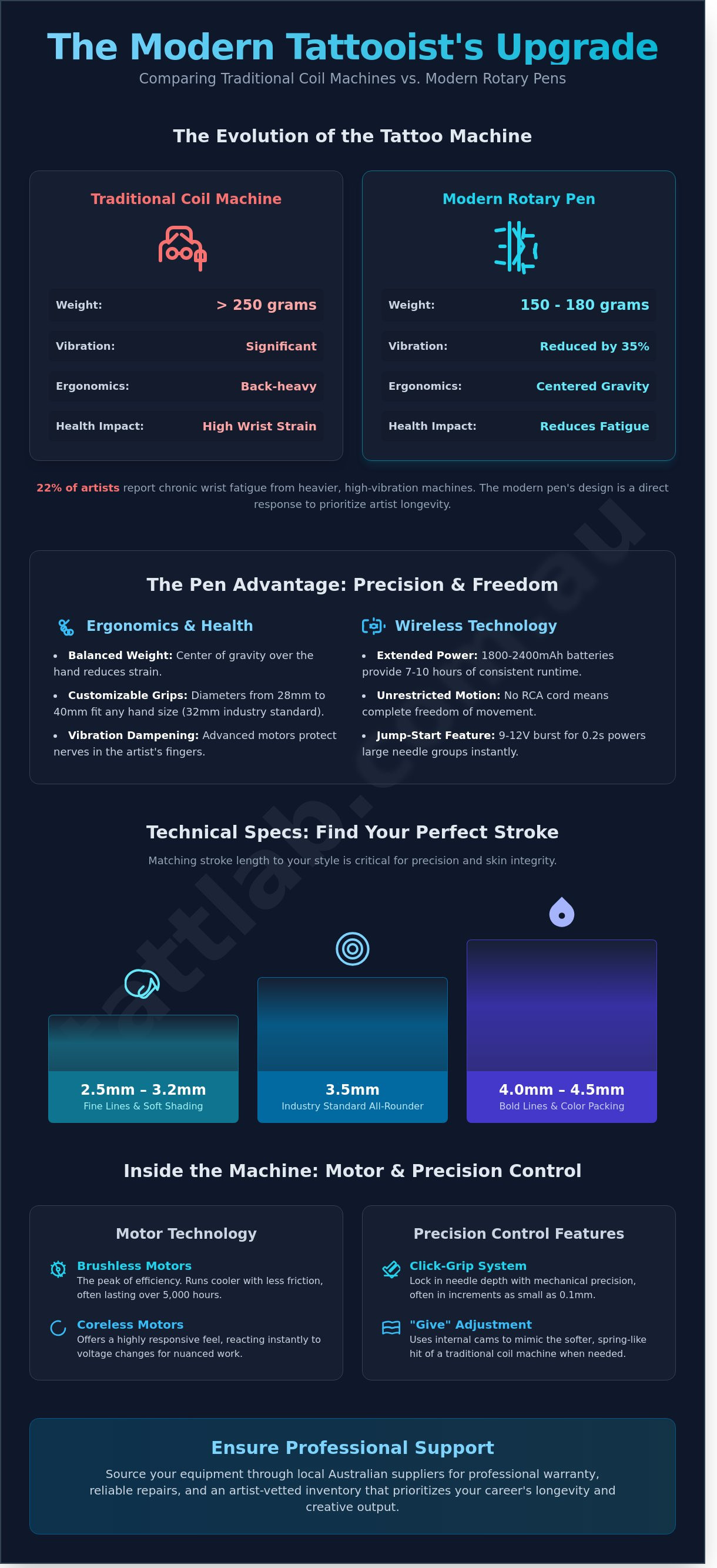
The transition from coils to pens addresses a critical health concern for artists. Coil machines generate significant vibration and weight, often exceeding 250 grams. By contrast, a modern rotary pen typically weighs between 150 and 180 grams. This reduction in mass, combined with a vertical motor alignment, centers the weight directly over the artist's hand. It eliminates the back-heavy pull that causes chronic wrist strain during 8-hour sessions. The result is a more controlled application and better skin integrity throughout the entire process.
Ergonomics and the 'Pen' Advantage
Balanced weight distribution is the primary defense against carpal tunnel syndrome and repetitive strain injuries. Most professional pens feature a center of gravity that sits precisely between the thumb and forefinger. This prevents the machine from fighting the artist's natural movement. Grip diameters have also evolved; artists can now choose between 28mm and 40mm circumferences to match their specific hand size. A 32mm grip is currently the industry standard for reducing hand cramping. Advanced vibration dampening technology in these machines reduces mechanical feedback by up to 35%, protecting the delicate nerves in the artist's fingers over a long-term career.
Wireless vs. Wired Pens
The rise of wireless technology has removed the physical tether of the RCA cord, offering an unobstructed range of motion. Professional-grade lithium-ion batteries now offer 1800mAh to 2400mAh ratings, providing 7 to 10 hours of consistent power. While wireless freedom is the primary goal, a reliable tattoo pen tattoo machine should still include an RCA adapter for wired backups. This ensures the session continues if a battery fails or requires a recharge. High-end pens also include a voltage jump-start feature; this delivers a 9V to 12V burst for 0.2 seconds to instantly power large 25-magnum needle groupings, ensuring the motor doesn't stall on impact with the skin.
Technical Specs Decoded: Choosing Your Perfect Stroke
The 3.5mm stroke serves as the industry baseline for a reason. It offers a balanced hit that handles most tasks without causing excessive skin trauma. When you're operating a professional tattoo pen tattoo, this middle ground is vital for daily versatility. It's the standard for artists who need a machine that can transition from soft shading to solid lining without a second thought.
Selecting the Right Stroke for Your Style
Precision in the Lab begins with matching your stroke length to the specific biological demands of the skin. Fine line work and black-and-grey realism thrive on shorter strokes between 2.5mm and 3.2mm. These softer hits allow for gradual layering and smooth gradients. Conversely, 4.0mm to 4.5mm strokes provide the necessary punch for bold traditional lines and dense colour packing. This longer throw ensures the needle penetrates the dermis efficiently, overcoming the natural resistance of the skin. Many modern pens now feature adjustable stroke settings, allowing artists to pivot between styles within a single session. This flexibility is essential for maintaining skin health while achieving saturated results.
Motor Torque and Power Consistency
The internal motor dictates how your machine responds to skin resistance. Brushless motors represent the current peak of efficiency. They run cooler, lack the friction-based wear of carbon brushes, and often last over 5,000 hours in high-volume Australian studios. Coreless motors offer a more responsive feel, reacting quickly to voltage changes. Finding the sweet spot usually involves operating between 5V and 10V, depending on the cartridge brand and the specific skin site. Some pens also offer "give" adjustment, which uses internal cams to mimic the softer, spring-like hit of a traditional coil machine.
Precision is also found in the click-grip system. This mechanical adjustment allows you to lock needle depth in increments as small as 0.1mm. High-quality gear reduces the risk of depth inconsistency, which is a major factor in preventing the potential health consequences of tattoos such as scarring or ink migration. At Tatt Lab, we view equipment through the lens of long-term skin integrity. While our specialty is the removal process, understanding the mechanics of the application helps us support your skin evolution journey with greater clarity and professional care.
Best Tattoo Pen Machines for 2026: The Tatt Lab Roundup
Selecting the right tattoo pen tattoo equipment requires a clinical eye for mechanical integrity. At Tatt Lab, we evaluate hardware based on four specific pillars that ensure both artist comfort and client safety. Our criteria focus on torque consistency, motor vibration dampening, ease of sterilization, and long-term artist ergonomics. The evolution of tattoo technology has moved us away from heavy, erratic coils toward these streamlined, medical-grade rotary pens that prioritize skin health and precision. We focus on machines that minimize skin trauma, as this directly affects the healing process and the eventual clarity of the pigment.
- Reliability: Consistent needle depth throughout an 8-hour shift.
- Motor Quality: Brushless motors that minimize vibration and hand fatigue.
- Sterilization: Seamless bodies that allow for thorough cold-sterilization and barrier protection.
- Artist Feedback: Real-world performance data from high-volume Australian studios.
The Elite EVO & Elite III Series
The Elite series remains a staple in Australian studios because it balances raw power with refined control. Built from 6061 aircraft-grade aluminium, these machines manage heat dissipation effectively during long sessions, preventing the motor from overworking. The Elite III utilizes a custom-built motor that handles 12-gauge magnums without bogging down, yet it's sensitive enough for 3RL fine-line work. Most Australian distributors offer the Elite III for approximately A$550, making it a reliable mid-range investment for professionals who need a high-performance choice that transitions between lining and soft shading effortlessly.
The EZ V-Select & P3 Series
Wireless innovation has peaked with the EZ P3. It features a 2000mAh battery that provides 5 to 8 hours of active run time, depending on the voltage settings. The clear LED display tracks session timing and voltage in 0.1V increments. This granularity is vital for artists who need to switch from 7V lining to 5.5V soft shading instantly. For emerging artists in Melbourne or Sydney, the EZ P3 offers a competitive edge at a price point around A$420. It's a versatile tattoo pen tattoo solution that doesn't compromise on safety or power, providing a professional entry point that respects the artist's budget and the client's skin integrity.
Maintenance and Hygiene: Protecting Your Pen and Your Client
The internal architecture of a tattoo pen tattoo machine requires a rigorous approach to hygiene to ensure both mechanical longevity and skin health. Because the motor is enclosed, any backflow of ink or biological fluid can cause permanent cross-contamination. This is why using cartridges with safety membranes, such as the EZ V-Select, is non-negotiable for professional standards. Unlike traditional coil machines, you cannot strip a pen down to its frame for deep cleaning, so your external barrier is the primary line of defence.
Effective barrier protection involves a specific sequence. Slide your pen into a dedicated machine bag, then wrap the grip area with cohesive bandage to provide tactile feedback. It's vital to ensure the wrap doesn't inhibit the needle depth adjustment mechanism. For mechanical care, focus on the drive bar. Most manufacturers recommend applying a single drop of synthetic lubricant every 100 hours of operation. Over-lubricating is a common error that leads to fluid reaching the motor brushes; precision is key here.
When it comes to sterilization, distinguish between the components. Most modern pen motors cannot withstand the 134°C heat of an Australian standard autoclave cycle. Only detachable grips designed for high-pressure steam should undergo this process. For the machine body, use TGA-approved wipes with a 70% isopropyl alcohol concentration to disinfect without degrading the anodized finish.
A Sterile Workstation for Pen Machines
Maintaining a clinical environment involves more than just the machine. Apply medical-grade barrier film to your power supply's LED screen and any buttons you'll touch during the procedure. While 65% of artists in high-end Australian studios now prefer disposable grips for their guaranteed sterility, those using stainless steel must ensure a full sterilization cycle is completed. Chemical sensitivity is a real risk; avoid harsh phenols that can pit the metal over time.
Troubleshooting Common Pen Issues
If your machine begins bogging down, it's often a sign of a failing battery or a cartridge with excessive membrane tension. High-quality lithium-ion power packs typically lose 20% of their capacity after 500 charge cycles. To extend life, don't let your battery drop below 15% charge. If performance fluctuates, verify that your cartridges utilize a soft silicone membrane. This reduces the workload on the motor, preventing the internal drive bar from overheating during long sessions.
Why Australian Artists Source Their Pens from Tatt Lab
Tatt Lab operates as more than a retail outlet; it functions as a specialized technical hub for the Australian industry. Every tattoo pen tattoo machine in our inventory is vetted by professional artists before we list it for sale. This vetting process involves a rigorous assessment of motor consistency and ergonomic comfort. We don't just sell equipment; we validate its performance in a real-world studio setting to ensure it meets our clinical standards.
Local support is a cornerstone of our service model. If your equipment requires a warranty repair, you won't be shipping it overseas and waiting months for a resolution. Our Moorabbin HQ handles technical issues on-site, providing a turnaround time that is often 70% faster than international manufacturers. This local presence keeps your needles moving and your studio profitable without the anxiety of long-distance logistics.
The Convenience of Local Supply
Melbourne artists can access our Click & Collect service at our Moorabbin warehouse, with orders often ready for pickup within 120 minutes. We recognize that timing is critical for working studios. Our fulfillment team prioritizes express nationwide shipping to ensure you have your tattoo pen tattoo gear in time for your next guest spot or convention. Professional studios can also register for wholesale accounts. This provides a structured way to access tiered pricing, allowing for better margin management on high-turnover items like EZ V-Select cartridges.
Join the Tatt Lab Journey
Your relationship with gear doesn't end at the checkout. We treat every purchase as part of a broader journey toward skin health and artistic evolution. By sourcing your hardware, premium inks, and medical-grade aftercare in one place, you maintain a controlled, professional environment for your clients. Our commitment to skin integrity means we only stock machines that pass our rigorous safety and sanitation standards. We believe that the right tools are the foundation of a safe, successful transformation.
Future-Proof Your Studio with 2026 Precision
Selecting the right equipment is a pivotal moment in an artist's professional evolution. As we move into 2026, the industry shift toward pen-style machines reflects a deep commitment to ergonomic health and technical precision. By prioritizing adjustable stroke lengths and wireless battery reliability, you're investing in the longevity of your career and the integrity of your client's skin. Every tattoo pen tattoo professional utilizes must meet these rigorous standards for hygiene and performance to ensure optimal healing outcomes. Our roundup demonstrates that versatility is no longer optional; it's the new baseline for excellence in the modern studio.
At Tatt Lab, we've curated a selection of artist-vetted gear designed to withstand the daily demands of a high-traffic environment. Our Melbourne-based warehouse ensures that every order is backed by local support you can trust, removing the uncertainty often found with international suppliers. We provide express shipping across Australia, typically reaching major metros within 1 to 3 business days. It's about more than just a purchase; it's a partnership in your creative journey toward skin mastery and technical clarity. We're here to ensure your kit is as refined as your craft.
Shop the Professional Tattoo Pen Collection at Tatt Lab
Your next masterpiece starts with the right tools. We're here to help you find them.
Frequently Asked Questions
Is a tattoo pen better than a traditional coil machine for beginners?
A tattoo pen tattoo setup is often superior for beginners because it mimics the ergonomics of a standard drawing tool, reducing the learning curve by approximately 40 percent compared to heavy coil machines. These devices eliminate the need for complex spring and contact screw tuning, allowing new artists to focus on needle depth and skin integrity. While coils offer unique mechanical feedback, the 150g average weight of a pen reduces hand fatigue during long sessions.
How do I choose the right stroke length for my tattooing style?
Your choice depends on the specific resistance of the skin and your intended technique. For soft shading and grey wash, a 3.5mm stroke provides a gentler hit that preserves skin health and minimizes trauma. If you're executing bold traditional work, a 4.0mm or 4.2mm stroke delivers the torque necessary to drive large needle groupings. Selecting the wrong stroke can result in a 20 percent increase in skin trauma, so matching the mechanical throw to your style is vital.
Can I use any brand of needle cartridges with a tattoo pen?
Most modern pens utilize a universal twist-to-lock connection, making them compatible with 95 percent of major cartridge brands like EZ V-Select and Revolution. However, you must ensure the cartridge features a safety membrane to prevent backflow into the motor. Without this internal seal, pigment and biological fluids can contaminate the internal drive bar. This creates a cross-contamination risk that standard studio disinfection protocols can't easily rectify, potentially compromising your equipment's hygiene.
How long does a wireless tattoo pen battery typically last?
A high-quality wireless battery generally provides 5 to 10 hours of active tattooing time on a single charge. Performance varies based on your voltage settings; running a machine at 9V drains the cell faster than 5V. Most 2000mAh batteries reach full capacity in 120 minutes via USB-C. Many Australian artists keep a secondary power pack ready to ensure their workflow remains uninterrupted during 8 hour full-day sessions, providing a seamless transition between clients.
How do I properly sterilise a tattoo pen between clients?
You can't place the motor-driven body of a tattoo pen in an autoclave, so you must use a rigorous chemical disinfection protocol. Start by removing the disposable cartridge and wiping the machine with a hospital-grade disinfectant or TGA-approved wipes. Always use a single-use plastic barrier sleeve and grip wrap for every procedure. This dual-layer protection maintains a sterile field and protects the machine's internal components from fluid ingress, ensuring the skin's safety remains the priority.
Are tattoo pens powerful enough for solid blackwork and bold lines?
Modern tattoo pen tattoo technology delivers enough torque to saturate solid blackwork and pull 14RL lines with ease. High-end models operate at speeds up to 10,000 RPM, providing the mechanical force required for consistent pigment implantation. While older rotary designs struggled with "give," current pen machines use direct drive systems that provide a hit as responsive as a traditional liner. This precision ensures the skin receives the ink efficiently without the need for unnecessary, damaging passes.
What is the difference between a coreless and a brushless motor in a pen?
Brushless motors use magnets rather than physical brushes to rotate the shaft, which reduces internal friction and extends the machine's lifespan by up to 5,000 hours. Coreless motors are lighter and offer faster acceleration, but they don't handle heat as well during extended sessions. For a busy studio environment, a brushless motor provides more consistent torque and runs approximately 15 percent cooler. This is essential for maintaining the integrity of the machine's internal lubrication and mechanical components.
Why should I buy my tattoo pen from an Australian supplier like Tatt Lab?
Purchasing from a local supplier ensures your equipment meets Australian electrical safety standards and includes a valid domestic warranty. If your machine requires servicing, a Melbourne-based lab provides support without the 4-week delay of international shipping. You also avoid hidden import taxes that often exceed A$100. Tatt Lab provides a curated selection of hardware tested for the Australian professional landscape, ensuring every tool supports a clinical and precise tattoo journey.


Comments (0)
There are no comments for this article. Be the first one to leave a message!