

Your stencil isn't just a purple guide on the skin; it's a critical chemical bridge between dermal integrity and hectograph ink. If that bond fails, the precision of your entire session is at risk. You likely know the frustration of watching a complex design wipe away mid-session or seeing crisp lines turn into a blurry mess that loses every fine detail. It's an anxiety-inducing hurdle that disrupts your professional flow and compromises the final aesthetic outcome you've promised your client.
Finding the best tattoo stencil transfer gel is about more than just stickiness. It's about selecting a non-toxic, professional-grade medium that respects skin health while ensuring maximum wipe-resistance. In this specialist's guide, we'll explore the top-performing solutions for 2026, including the market-leading Hustle Butter Deluxe and the industry-standard Stencil Stuff. You'll learn how to achieve high-definition transfers that stay locked in for eight-hour sessions, regardless of the skin type. We'll break down the science of adhesion and the latest hygiene regulations to ensure your setup is both efficient and clinically sound, turning the stenciling process into a predictable, high-performance journey.
Key Takeaways
- Understand the science of chemical adhesion and how surfactants lower skin surface tension to lock in hectograph ink for flawless transfers.
- Discover how to select the best tattoo stencil transfer gel by evaluating the four pillars of performance, which include clarity, longevity, viscosity, and safety.
- Compare leading professional solutions like Stencil Stuff and Electrum Premium to find the ideal viscosity for your specific session length and level of detail.
- Adopt a clinical protocol for skin preparation to ensure your designs remain crisp and wipe-resistant during even the longest tattooing sessions.
- Streamline your studio workflow by choosing artist-vetted transfer mediums that prioritize both skin health and technical precision.
The Science of Stencil Longevity: How Transfer Gels Work
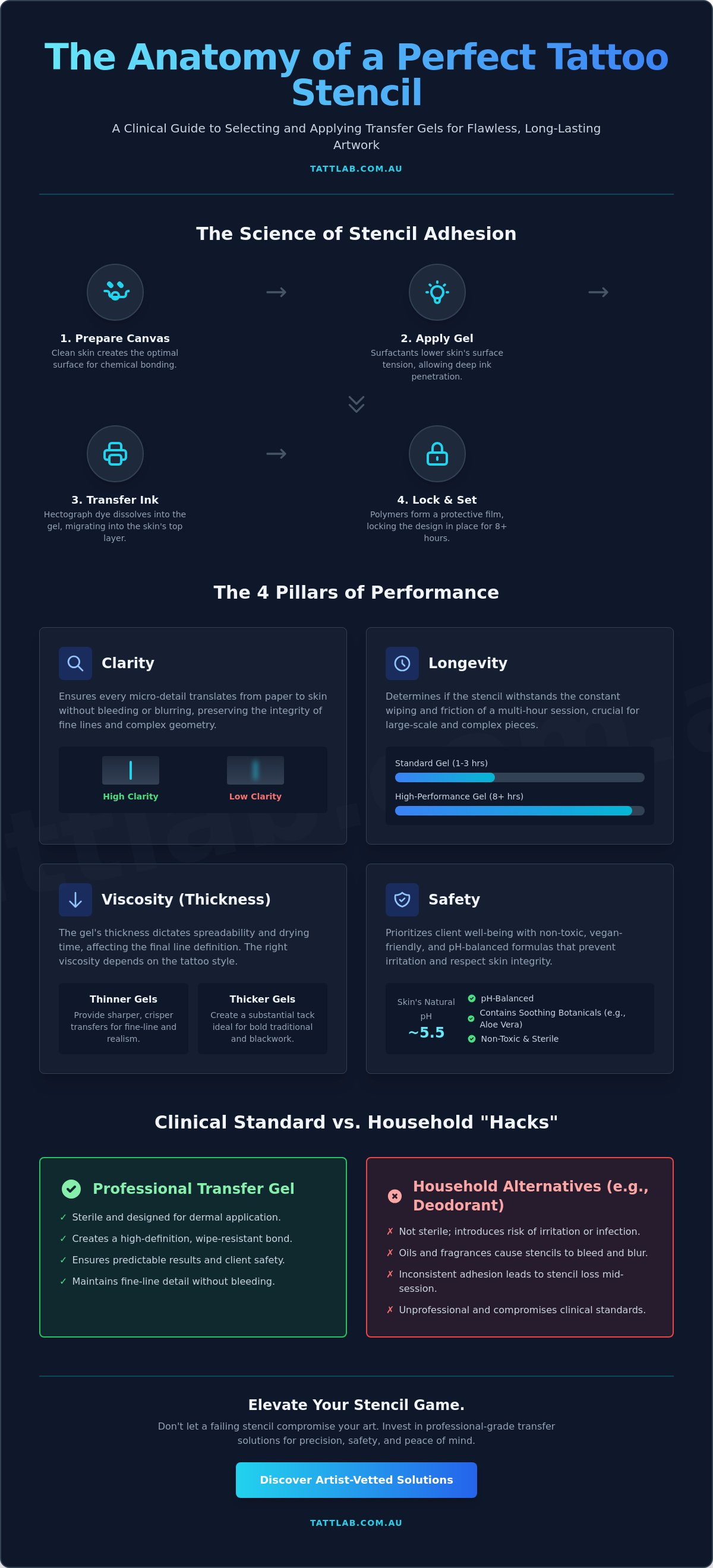
A tattoo stencil transfer gel is far more than a simple adhesive; it's a precision-engineered medium designed to facilitate the molecular bond between hectograph ink and the human epidermis. At its core, the best tattoo stencil transfer gel acts as a chemical conduit. It transforms the volatile dyes found on transfer paper into a stable, long-wear marking that can withstand the rigors of a multi-hour session. This process is foundational to The Tattooing Process, ensuring that the artist's roadmap remains intact from the first line to the final shade.
The efficacy of these gels relies heavily on surfactants. These surface-active agents lower the skin's natural surface tension, allowing the gel to spread evenly and penetrate the microscopic ridges of the skin. By temporarily modifying the skin's lipid barrier, surfactants create a receptive environment where the ink can anchor itself deeply. Once applied, specialized polymers within the formula begin to cross-link, forming a breathable, protective film. This microscopic shield is what provides the "lock" that resists moisture, sweat, and the constant friction of wiping during the tattoo's evolution.
Maintaining dermal integrity is a priority in any clinical environment. High-quality transfer solutions are meticulously pH-balanced to match the skin's natural acidity, typically around 5.5. This balance is vital because it prevents unnecessary irritation before the needle even touches the skin. When the pH is off, the skin can become reactive or inflamed, which complicates the ink's entry and slows down the overall healing journey. By respecting the skin's biological chemistry, professional gels ensure a calm, predictable canvas for the artist.
Molecular Bonding: Ink Meets Skin
When the hectograph ink, usually containing methyl violet dye, touches the gel, a specific chemical interaction occurs. The dye dissolves into the gel's base, allowing it to migrate into the upper layers of the stratum corneum. This is why "setting time" isn't just a suggestion; it's a chemical necessity. It takes approximately 10 to 15 minutes for the moisture to evaporate and the polymers to stabilize the bond. Skipping this step often results in the design lifting away during the first few wipes. While water-based formulas offer a gentler experience for sensitive skin, alcohol-based variants provide a faster dry time and more aggressive adhesion, though they can be more drying over long durations.
Why Household Alternatives Fail the Professional Test
In some corners of the industry, artists still rely on "hacks" like deodorant sticks or antiseptic liquids. From a clinical perspective, these methods introduce significant risks. Household products aren't sterile and often contain harsh fragrances or oils that can cause the stencil to bleed, losing all fine-line detail. More importantly, these chemicals aren't designed for broken skin. Using them can lead to localized dermatitis or inconsistent ink saturation. For a predictable, high-definition result, the use of a purpose-built, sterile transfer medium is a non-negotiable standard for modern skin health.
Evaluating Performance: What Defines the Best Transfer Gel?
Selecting the best tattoo stencil transfer gel isn't a matter of brand loyalty; it's a clinical calculation based on four critical pillars of performance: clarity, longevity, viscosity, and safety. Each variable influences how the skin responds and how long your design remains visible. Clarity ensures that every micro-detail from your transfer paper translates to the skin without bleeding. Longevity determines if that design survives the first hour or the eighth. Viscosity, or the thickness of the fluid, dictates how easily the gel spreads and how quickly it dries. Finally, safety addresses the biological impact on the client's skin health.
Viscosity plays a decisive role in line definition. Thinner, more fluid gels often provide a sharper, crisper transfer for fine-line realism because they don't pool in the skin's natural pores. Conversely, thicker gels create a more substantial tack, which is often preferred for heavy blackwork or traditional styles where a bolder stencil is required. Beyond the physical application, the chemical profile must be considered. Modern formulations prioritize botanical extracts like Aloe Vera to soothe the skin on contact. This aligns with broader standards for Tattoo Ink Safety, ensuring that every substance applied to the dermal layer is non-toxic and respects the body's natural defenses.
Session Length and Wipe Resistance
The endurance of a transfer medium is tested by friction. For a short flash session, a standard gel is sufficient. However, a six-hour back piece requires a formula with superior wipe-resistance. Every time you wipe away excess ink with soap and water, you're physically eroding the stencil. High-performance gels use specific polymers to resist this mechanical wear. If you're working on a complex design with intricate shading, you need a bond that won't degrade under the constant pressure of a paper towel. Choosing a gel with a primer effect can provide that extra layer of security for long-haul sessions.
Skin Type Compatibility
Skin isn't a uniform surface. Oily skin, characterized by high sebum production, can repel water-based gels, leading to a stencil that slides or blurs. Dry skin might absorb the gel too quickly, preventing an even transfer. Understanding these dermal variations helps you adjust your prep. Hypoallergenic formulas are essential for clients prone to stencil shock, a localized reaction where the skin becomes red or raised immediately after application. To ensure your studio is equipped for every client, you can browse professional-grade tattoo stencils and transfer solutions that prioritize skin integrity. This methodical approach reduces the risk of irritation and ensures a smooth, predictable journey for every piece you create.
Top Professional Stencil Transfer Solutions for 2026
While the previous sections explored the clinical chemistry of adhesion, selecting the best tattoo stencil transfer gel often comes down to the specific technical demands of your tattooing style. The market in 2026 has matured beyond generic adhesives, offering specialized formulas that cater to different viscosities and session lengths. Whether you're executing a high-contrast realism piece or a bold traditional sleeve, the medium you choose acts as the foundation for your technical precision. Understanding the nuances between these top-tier solutions ensures that your "Lab" environment remains consistent and predictable.
A significant evolution in recent years is the development of high-contrast gels specifically formulated for darker skin tones. These products use specialized pigments and reflective agents to ensure the stencil remains visible against deeper melanin levels. This focus on inclusivity and visibility allows artists to maintain the same level of detail across all skin types, ensuring every client receives a result that reflects the highest standards of clarity. Adhering to FDA tattoo safety guidelines remains a priority when evaluating these new formulations, as maintaining skin health is just as important as the visual outcome.
Stencil Stuff: The Gold Standard
Stencil Stuff remains the industry benchmark for a reason. Its reputation is built on a non-toxic, laboratory-tested formulation that provides a predictable, crisp result every time. The consistency is a creamy, mid-viscosity fluid that spreads easily without pooling, making it accessible for both apprentices and seasoned specialists. It's particularly favored for its ease of use across various styles, from fine-line scripts to heavy saturated blocks. When sourcing your tattoo supplies, Stencil Stuff is often the first recommendation for its reliable molecular bond that resists the early-session "wipe-away" that plagues inferior products.
Electrum and Anchored: The Artist-Driven Alternatives
Electrum Premium offers a distinct chemical profile often referred to as a "primer" approach. It's known for its significant "tackiness," which serves a dual purpose. It provides an aggressive bond for hectograph paper and acts as a superior base for freehand drawing with skin markers. If your journey involves a mix of stenciling and hand-drawn elements, Electrum prevents the marker ink from spreading or fading during the process; artists looking for high-quality tools for their broader creative projects can find a specialized range at PoscART. Its thicker viscosity creates a robust barrier that stands up to heavy friction.
In contrast, Anchored, developed by world-class realism artists, focuses on a thinner viscosity that utilizes "lock-in" technology. This formula is designed specifically for ultra-fine details and long-wear durability. It provides a high-definition transfer that won't blur, which is essential when you're aiming for maximum professional tattoo ink saturation in complex realism. By choosing between the tacky grip of Electrum and the high-definition lock of Anchored, you can tailor your setup to the specific complexity of the design, ensuring a seamless transition from the initial transfer to the final healed result.
The Clinical Protocol: Mastering the Transfer
Even the most advanced formulas require a methodical approach to achieve their full potential. At Tatt Lab, we view the stencil transfer as a clinical bridge; a moment where technical precision meets skin biology. This isn't just about sticking paper to skin. It's about creating a sterile, high-adhesion environment that respects the dermal layer. By following a rigorous "Lab" approach, you ensure that the bond between the ink and the epidermis is unbreakable, providing the clarity you need for a successful journey from the first line to the final clearance. Even the best tattoo stencil transfer gel will underperform if the underlying skin preparation is flawed.
Step 1: Skin Preparation and Sanitisation
Successful adhesion starts with a blank canvas. You must shave the target area, even if hair isn't visible to the naked eye. Microscopic follicles trap air and moisture, creating tiny pockets where the gel cannot bond effectively. Following the shave, use a high-percentage isopropyl alcohol or a specialized skin cleanser to strip away sebum. These natural oils are the primary enemy of stencil longevity, as they create a slippery barrier that prevents the gel from anchoring. It is crucial to ensure the skin is perfectly dry before the gel touches the surface. During this phase, utilizing high-quality medical supplies for tattoo artists ensures that your preparation remains sterile and aligns with professional safety standards.
Step 2: Application and Transfer Technique
When applying the best tattoo stencil transfer gel, less is consistently more. A pea-sized amount is usually sufficient for a standard forearm piece. Over-saturation is a common error that leads to "stencil bleed," where the design loses its crisp edges and becomes a purple blur. Spread the gel in a thin, even layer until you achieve the "tackiness test" threshold. Tap the skin with a gloved finger; if the skin lifts slightly without feeling wet, it is ready for the paper. For contoured body parts, use steady, rolling pressure rather than a flat press. This technique prevents the paper from shifting and avoids design distortion across the muscle's natural curves.
The final, and perhaps most critical, step is the dwell time. You must allow the stencil to set for at least 10 minutes before the machine starts. This period allows the polymers in the gel to cross-link and the moisture to evaporate, effectively locking the design into the upper layers of the skin. During this wait, adjust your lighting and ensure the client's position maintains natural skin tension. If the skin is too loose during the transfer, the design will warp once the client moves. If you're ready to elevate your studio's technical standards, you can shop our professional tattoo stencils and supplies to ensure every session begins with total clarity and clinical precision.
Optimising Your Workflow with Tatt Lab
Efficiency in a modern studio is built on the reliability of your consumables. At Tatt Lab, we act as a specialized curator, selecting only artist-vetted solutions that meet our rigorous standards for dermal safety and technical performance. We understand that your reputation is tied to the longevity of your work, and that begins with the bond created by the best tattoo stencil transfer gel. By consolidating your sourcing, you create a controlled environment where every variable, from the nitrile gloves you wear to the transfer medium you apply, works in clinical harmony.
Managing a busy studio requires more than just high-quality tools; it requires a partnership that respects your time and professional standards. Sourcing medical-grade PPE alongside your transfer gels allows for a streamlined workflow that prioritizes hygiene without sacrificing speed. This holistic approach ensures that the skin remains a healthy, receptive canvas throughout the entire session. Once the needle work is complete, the journey continues into the recovery phase. Implementing a professional tattoo aftercare protocol is essential to preserve the precision started by your stencil, protecting the skin's integrity during the vital healing evolution.
The Tatt Lab Difference: Quality Control
Our "Lab" motif isn't just an aesthetic choice; it's a commitment to scientific rigor. Every product in our collection undergoes a vetting process to ensure it doesn't cause adverse dermal reactions or compromise ink fragmentation. For Australian studios, our express national shipping ensures you stay stocked with the latest 2026 innovations without the stress of long lead times. We invite professional artists to explore our wholesale benefits, providing a dedicated supply partner that values skin health as much as you do.
Conclusion: From Stencil to Skin Integrity
The journey of a masterpiece begins long before the first drop of ink is deposited. It starts with a crisp, high-definition roadmap that stays locked to the skin through hours of friction and wiping. By understanding the chemistry of surfactants and polymers, you can choose the best tattoo stencil transfer gel for your unique style. Whether you're a realism specialist or a traditionalist, your transfer protocol is the foundation of your technical success. Upgrade your studio's precision and ensure every design ends as a healed masterpiece. Explore the Stencil Collection at Tatt Lab and refine your clinical process today.
Secure Your Technical Foundation
Precision tattooing is a journey that begins with a stable, high-definition roadmap. You've seen how the chemistry of surfactants and polymers keeps your design anchored through the most demanding sessions. By mastering the clinical protocol of skin preparation and choosing the right viscosity for your specific style, you eliminate the anxiety of fading stencils. This methodical approach ensures your focus remains entirely on the artistic evolution of the piece rather than the loss of your guide.
Selecting the best tattoo stencil transfer gel is a commitment to both technical excellence and long-term skin health. Tatt Lab supports this professional standard by providing artist-vetted solutions that meet medical-grade safety standards. As an artist-owned and operated specialist, we prioritize your studio's efficiency with express nationwide shipping across Australia. It's time to refine your workflow and protect the integrity of every design you create.
Shop the Best Stencil Transfer Gels at Tatt Lab
We're here to ensure your transition from stencil to skin is seamless, predictable, and remarkably clear. Your artistic legacy deserves a foundation that won't wipe away.
Frequently Asked Questions
How long should I let the tattoo stencil gel dry before tattooing?
You should allow the stencil to set for at least 10 to 15 minutes before starting your machine. This dwell time is a clinical necessity that allows the gel's polymers to cross-link and the moisture to evaporate. This process effectively locks the hectograph ink into the upper layers of the epidermis, ensuring the design doesn't lift during the initial stages of your session.
Why does my tattoo stencil keep wiping off during the session?
Stencils usually fail due to improper skin preparation or over-application of the transfer medium. If residual sebum or natural skin oils aren't removed with isopropyl alcohol, the gel cannot anchor to the skin. Additionally, using too much product creates a slippery barrier rather than an adhesive bond. Ensure the skin is chemically clean and the gel is applied in a thin, tacky layer.
Can I use Dettol instead of a professional stencil transfer gel?
You shouldn't use household antiseptics like Dettol for stencil transfers. While it was a common practice in the past, these liquids aren't formulated for dermal adhesion and can cause significant skin irritation or "stencil shock." Professional gels are pH-balanced and sterile, prioritizing skin health and providing a much more predictable, high-definition result that won't blur or bleed.
Is tattoo stencil gel safe for all skin types?
Most professional formulations are hypoallergenic and designed to be safe for a wide range of skin types. The best tattoo stencil transfer gel will typically feature botanical extracts like Aloe Vera to soothe the area on contact. If a client has a history of extreme sensitivity, it's a professional standard to perform a small patch test before proceeding with the full design.
What is the difference between stencil gel and stencil primer?
A stencil gel acts as the primary transfer medium, while a primer provides an aggressive, tacky base specifically designed for long-wear durability. Primers, such as Electrum, are often preferred for complex realism or sessions lasting over six hours. They create a more robust chemical bridge that is also highly effective at locking in freehand marker drawings compared to standard, thinner gels.
How much stencil gel should I apply for the best result?
A pea-sized amount is usually sufficient for a standard forearm-sized piece. It's a common mistake to over-saturate the skin, which leads to a blurry transfer and "stencil bleed." The goal is to achieve a surface that feels tacky to the touch rather than wet. When you've applied the correct amount, the skin should lift slightly when tapped with a gloved finger.
Does the brand of transfer paper matter when using high-quality gels?
Yes, the quality of your transfer paper is critical to the performance of even the best tattoo stencil transfer gel. High-grade hectograph paper ensures a consistent and dense release of dye onto the skin. If the paper lacks sufficient pigment, the gel won't have enough ink to bond with, resulting in a faint or inconsistent stencil that is difficult to follow.
Can I use transfer gel for freehand drawing with markers?
You can use specialized transfer gels to lock in freehand designs and prevent them from wiping away. By applying a very thin layer of gel over your completed marker drawing and letting it dry, you create a protective film. This is a core part of the "Lab" approach to custom work, ensuring your hand-drawn guide remains visible throughout the entire tattooing journey.


Comments (0)
There are no comments for this article. Be the first one to leave a message!